SAP - M1L1
 Call Kai
 Learn
Learn Practice Test
 Spaced Repetition
 Match
Match Flashcards
 Knowt Play
1/123

There's no tags or description
Looks like no tags are added yet.
Name | Mastery | Learn | Test | Matching | Spaced | Call with Kai | Chat |
|---|
No analytics yet
Send a link to your students to track their progress
124 Terms
What is Social and Administrative Pharmacy (SAP)?
SAP is an integral perspective that connects medicines, people, organizations, and healthcare systems.
What are the three major paradigms in pharmacy practice?
Product-oriented, patient-centered, and population- and systems-oriented.

How has the role of pharmacists evolved?
From a product-focused profession to a patient-centered and population- and systems-oriented practice.
What is the focus of the product-oriented paradigm?
The development, formulation, and manufacturing of pharmaceutical products.
What does the patient-centered paradigm emphasize?
Individualized medication therapy and appropriate use of medicines to achieve desired health outcomes.
What is the focus of the population- and systems-oriented paradigm?
Broader healthcare systems and factors influencing the delivery and use of pharmaceutical services.
What does Social Pharmacy study?
The social aspects of pharmacy practice, including how society interacts with medicines.

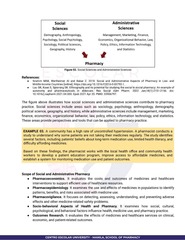
Which social sciences contribute to Social Pharmacy?
Demography, anthropology, psychology, social psychology, sociology, political science, geography, and history.
What are the key domains of Social and Administrative Pharmacy?
Addressing medicine use, pharmacy services, and healthcare systems.
What is the application of Social Pharmacy?
To understand how social factors influence medicine use and pharmacy practice.
What is the historical context of Social and Administrative Pharmacy?
It has evolved to meet the changing needs of healthcare systems and pharmacy practice globally and in the Philippines.

What is the role of pharmacists in the population- and systems-oriented paradigm?
To improve access to medicines and promote efficient use of healthcare resources.
What is the significance of the Philippine Practice Standards for Pharmacists 2.0 (PhilPSP 2.0)?
It outlines the competencies and standards for pharmacists in the Philippines.
How do social and psychosocial factors affect medicine use?
They influence people's experiences with medicines and their usage patterns.
What is the focus of Administrative Pharmacy?
The management and organization of pharmacy services and resources.
What is the relationship between sociology and Social Pharmacy?
Sociology helps understand societal influences, while Social Pharmacy applies this understanding to pharmacy practice.
What are the functions of Social and Administrative Pharmacy?
To address issues related to medicine use, optimize pharmacy services, and enhance healthcare systems.

How has technological innovation impacted pharmacy practice?
It has expanded the role of pharmacy beyond medicine development to include patient care and healthcare management.
What is the importance of understanding beliefs and behaviors in Social Pharmacy?
They can significantly influence how individuals use and adhere to medication regimens.

What does the term 'pharmaceutical care' refer to?
The process of optimizing medication therapy through collaboration with patients and healthcare professionals.
What are some challenges faced by Social Pharmacy in global education?
Addressing the needs for integration of social sciences into pharmacy curricula.
What is the role of healthcare policies in Social and Administrative Pharmacy?
To inform and guide the delivery of pharmaceutical services and improve access to medicines.
What is the significance of understanding economic and organizational factors in pharmacy?
They affect the availability and accessibility of medicines within healthcare systems.
What is the goal of improving equitable access to drugs?
To ensure that all populations can obtain necessary medications regardless of socioeconomic status.
How does Social Pharmacy contribute to sustainability in health systems?
By promoting efficient resource use and informing healthcare policies.
What is the impact of population needs on pharmacy practice?
Pharmacy practice must adapt to meet the diverse health needs of different populations.
What are the expected outcomes of applying Social and Administrative Pharmacy principles?
Improved healthcare delivery, better patient outcomes, and enhanced pharmacy services.
What factors influence the availability and use of medicines?
Economic conditions and organizational factors.
How do policies and ethics affect pharmacy practice?
They influence medicine use and the delivery of pharmacy services.
What role does communication play in pharmacy?
It influences medicine use and the delivery of pharmacy services between patients, pharmacists, and healthcare professionals.
What is the broader scope of social pharmacy?
It examines pharmacy practice within the healthcare system, including patient movement between different care settings.

How can social pharmacy strengthen its connection with clinical pharmacy?
Through broader research, continuity of care, multidisciplinary collaboration, professional collaboration, policy advocacy, and an expanded patient-care role.
What does pharmacy management involve?
Overseeing pharmacy operations in various settings to support safe and efficient service delivery.
What is the role of health policy and regulation in pharmacy?
Developing and implementing policies that govern medication use and pharmacy practice.
What does pharmacoeconomics evaluate?
The cost-effectiveness and impact of pharmaceutical services.
What is the importance of quality assurance in pharmacy?
Ensuring compliance with standards and improving the quality of pharmacy services.
How can technology support pharmacy practice?
By using information systems for inventory control, patient records, and decision-making.
What is the significance of advocacy and leadership in pharmacy?
Representing pharmacy interests in professional societies and healthcare organizations.
What does Social and Administrative Pharmacy (SAP) examine?
How people, organizations, healthcare systems, policies, and resources influence medicine use and pharmacy services.
What social sciences contribute to pharmacy practice?
Demography, anthropology, psychology, sociology, political science, geography, and history.
What administrative sciences are relevant to pharmacy?
Management, marketing, finance, economics, organizational behavior, law, policy, ethics, information technology, and statistics.
What is an example of a pharmacist addressing cultural beliefs in medicine use?
A pharmacist studying why patients prefer herbal remedies due to cultural beliefs and family advice.
What is a common issue faced by hospital pharmacies?
Medicine stockouts due to manual inventory tracking.
How can pharmacists contribute to patient care beyond dispensing medications?
By taking on greater responsibility for medication-related and health-related needs.
What is the goal of studying patients' medication experiences across healthcare settings?
To gain a broader understanding of medicine use and pharmacy practice.
What is the role of multidisciplinary collaboration in pharmacy?
Working with various fields to address complex healthcare issues.
What does the term 'continuity of care' refer to in pharmacy practice?
Considering patients' medication needs as they transition through different healthcare settings.
What is the purpose of a patient education program developed by pharmacists?
To improve health literacy and access to affordable medicines.
What is a key aspect of the pharmacist's role in managing chronic conditions?
Monitoring medication use and patient outcomes.
What is the significance of understanding patients' beliefs about medication?
It helps pharmacists tailor interventions to improve adherence.
What does the integration of social sciences and administrative sciences in pharmacy practice aim to achieve?
To address issues related to medicine use and enhance pharmacy services.
What is the focus of pharmacoepidemiology?
It examines the use and effects of medicines in populations to identify patterns, benefits, and risks associated with medicine use.
What does pharmacovigilance aim to prevent?
Adverse effects and other medicine-related safety problems.
What factors does the socio-behavioral aspects of health and pharmacy examine?
Social, cultural, psychological, and behavioral factors that influence health, medicine use, and pharmacy practice.
What does outcomes research evaluate?
The effects of medicines and healthcare services on clinical, economic, and patient-related outcomes.
What is the purpose of quality of life assessment in pharmacy?
To examine how diseases, medicines, and healthcare interventions affect patients' physical, psychological, and social well-being.
What does pharmaceutical management focus on?
The planning, organization, leadership, and management of pharmaceutical services and resources.
What does marketing in pharmacy examine?
How medicines and pharmacy services are promoted, communicated, and positioned within the healthcare and pharmaceutical sectors.
How did social and administrative pharmacy develop?
As pharmacy practice expanded beyond the preparation and dispensing of medicines to include patient care and public health.
What was a significant change in pharmacy education from the 1950s to 1970s?
Incorporation of social and behavioral sciences to better understand patients and factors affecting medicine use.
What emerged as a field of study in the 1970s?
Social Pharmacy, which examines medicines and pharmacy practice from social and humanistic perspectives.
What characterized the expansion of the field in the 1980s and 1990s?
Growth in research and education, broader areas of study, and interdisciplinary development.
What is a focus of Social and Administrative Pharmacy in the 2000s to present?
Addressing issues involving medicine access, health policy, health economics, and population health.
What are the four main roles of pharmacists according to Good Pharmacy Practice?
1. Prepare, obtain, store, secure, distribute, administer, dispense, and dispose of medical products. 2. Provide effective medication therapy management. 3. Maintain and improve professional performance. 4. Contribute to improving the effectiveness of the healthcare system and public health.
What is the role of the International Pharmaceutical Federation (FIP) in Social and Administrative Pharmacy?
It brings together pharmacists and professionals from diverse practice settings to focus on the organization of pharmacy practice and evidence for decision-making.
What does the Social and Administrative Pharmacy Section (SAPS) aim to achieve?
To unite FIP members from diverse practice settings and backgrounds to improve pharmacy practice and policy.
What is the significance of interdisciplinary development in Social and Administrative Pharmacy?
It draws from sociology, psychology, economics, public health, and management to address issues affecting medicines and pharmacy practice.
What does the term 'evidence-based decision-making' refer to in the context of SAP?
Research contributes to decisions concerning medicines, pharmacy services, healthcare resources, and public health.
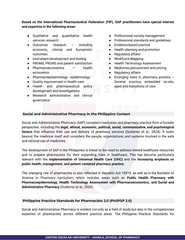
What areas of expertise do SAP practitioners focus on?
Qualitative and quantitative health services research, outcomes research, pharmacoeconomics, evidence-based practice, and regulatory affairs.
What is the significance of Social and Administrative Pharmacy (SAP) in the Philippines?
SAP addresses limited healthcare resources and prepares pharmacists for expanding roles in healthcare, especially with Universal Health Care (UHC).
What does SAP consider beyond the medicine itself?
It considers legal, ethical, economic, political, social, communicative, and psychological factors influencing the use and delivery of pharmacy services.
What are the Philippine Practice Standards for Pharmacists 2.0 (PhilPSP 2.0)?
Standards that integrate common competencies and practice area-specific competencies for pharmacists.
What is the role of pharmacists in Academic Pharmacy (AP)?
To prepare students to become professional pharmacists, contribute to scientific research, and share technical expertise.
What is the focus of Industrial Pharmacy (IP)?
Contributing to pharmaceutical product lifecycle management and participating in quality management systems.
What is the primary responsibility of Community & Institutional Pharmacy (CIP)?
To ensure the safe, effective, and appropriate provision of medicines and health services tailored to client needs.
What are the key functions of Hospital Pharmacy (HP)?
Collaborating with healthcare providers, managing the hospital formulary, and providing client-centered clinical pharmacy services.
What does Public Health Pharmacy (PHP) focus on?
Identifying health and pharmaceutical needs of the population and contributing to policy development and implementation.
What is the importance of health product vigilance in pharmacy practice?
It ensures compliance with health vigilance requirements and promotes the safe use of medicines.
What does the competency 'CC 1' emphasize?
Placing the client's and patient's welfare at the center of practice.
What is the focus of the competency 'CC 2'?
Practicing in an ethical, legal, and professional manner.
What does 'CC 3' entail for pharmacists?
Displaying leadership, management, and entrepreneurial skills.
What is the significance of 'CC 4' in pharmacy practice?
Demonstrating cultural competence and effective communication.
What does 'CC 5' focus on?
Exhibiting effective collaboration in healthcare settings.
What is the goal of 'CC 6'?
Committing to continuing professional development.
What does 'CC 7' involve?
Engaging actively in health product vigilance activities.
What is the role of pharmacists as educators according to 'CC 8'?
Supporting the professional development of colleagues and future pharmacists.
What does 'CC 9' emphasize in the context of digital health?
Optimizing digital health to deliver pharmaceutical services and advance pharmacy research.
What is the focus of 'CC 10'?
Enabling individuals and communities to build capacity for health-promoting actions.
What is the relevance of Health Technology Assessment in SAP?
It evaluates the effectiveness and efficiency of health technologies and interventions.
What is the role of pharmacists in regulatory affairs?
Participating in the development and implementation of regulatory guidelines.
How does SAP contribute to quality improvement in healthcare?
By implementing structured interventions and programs for health promotion and patient safety.
What is the relationship between SAP and Universal Health Care (UHC)?
SAP supports the implementation of UHC by preparing pharmacists for expanded roles in public health.
What are PROMS and PREMS in the context of SAP?
Patient-reported outcome measures (PROMS) and patient-reported experience measures (PREMS) used for assessing health services.
What does the term 'pharmacoepidemiology' refer to?
The study of the use and effects of drugs in large numbers of people.
What is the significance of workforce mapping in pharmacy practice?
It helps in planning and optimizing the workforce to meet healthcare needs.
What does SAP stand for?
Social and Administrative Pharmacy
What is the primary focus of Social and Administrative Pharmacy?
To integrate social sciences, management, policy, and communication skills into pharmacy practice.
What is one key function of SAP?
Optimizing medicine use and improving patient outcomes.
What does CC 9 emphasize in SAP?
Optimizing digital health to deliver pharmaceutical services and advance pharmacy research.
What is the role of SAP in public health?
Empowering individuals and communities to address health inequities.