ESS Standard Topic 6.1
 Call Kai
 Learn
Learn Practice Test
 Spaced Repetition
 Match
Match Flashcards
 Knowt Play
1/24

Earn XP
Description and Tags
Our Changing Atmosphere
Name | Mastery | Learn | Test | Matching | Spaced | Call with Kai | Chat |
|---|
No analytics yet
Send a link to your students to track their progress
25 Terms
Dynamic System
Has the Ability to Change
The Atmosphere as a Significant Idea
A dynamic system with inputs, outputs, flows and storage that has undergone changes throughout geological time
The Atmosphere
A thin envelope of gas and suspended particles that surrounds the Earth
Becomes increasingly thinner with distance away from Earth’s surface
Held in place by the Earth’s gravitational pull
It is the outer limit of the biosphere and its composition and processes support life on Earth.
The 4 main gases in the atmosphere
Nitogen 78%
Oxygen 21%
Argon 1%
CO2 0.04%
Input and Output Wavelengths
Input - Shortwave Radiation
Output - Longwave Radiation
System
An assemblage of parts and the relationships between them that enable them to work together to form a functioning whole
Troposphere
The lowest and thinnest layer (10-15km) of atmosphere in constant motion, where all weather occurs. Gets colder as you go up and stops at the Tropopause.
Stratosphere
(40km thick) Composed of mostly dry stable air, So pollutants do not disperse and remain in the layer for long periods of time.
The Ozone Layer is found in the lower section of the Stratosphere and temperature gets warmer as you go up. Stops at the stratopause.
The other 3 layers of the atmosphere
Mesosphere (Temperature decreases)
Thermosphere (Temperature Increases)
Exosphere (Where satellites are found)
—pause (Between Atmospheric layers)
Separates the different —sphere layers and here temperatures are constant.
Change in pressure between Atmospheric layers
Decreases at an exponential rate, therefore less weight pushing down the higher you go.
Climate
How the atmosphere behaves over relatively long periods of time.
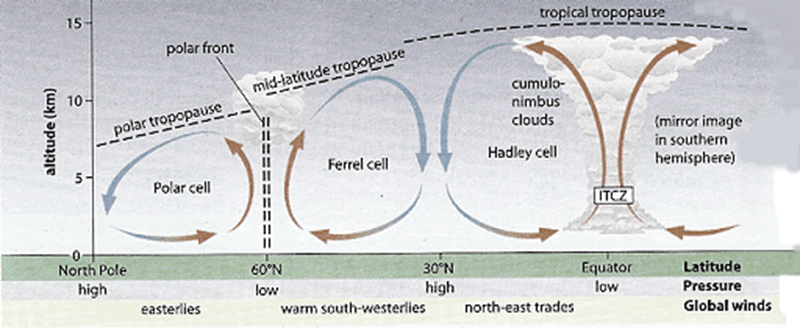
The Tricellular Model of atmospheric circulation
Differential heating of the atmosphere creating a tricellular atmospheric circulation that redistributes heat from the equator to the pole, creating distinct climate regions.
How does the Tricellular model of atmospheric circulation work?
Warm air rises at the equator, moves towards the poles, cools, and descends, forming three cells, and areas of high and low pressure.
This making the equator cooler and northern latitudes warmer.
3 cells of the tricellular model of atmospheric circulation
Polar Cell - Descends at 90, Ascends at 60
Ferrel Cell - Ascends at 60, Descends at 30
Hadley Cell - Descends at 30, Ascends at 0
High pressure at 90 and 30 degrees (Less Clouds)
Low pressure at 30 (Clouds) and 0 degrees (Inter tropical Conversion Zone)
Enhanced greenhouse effect
The accumulation of GHGs (Greenhouse gases) by human activity leading to global warming - increasing mean global temperature
Climate Change
Encompasses global warming but refers to the broader range of changes that are happening to the planet as a result.
What causes the greenhouse effect?
Greenhouse gases (GHGs) absorbing and re-emitting infrared radiation, which is given out by the Earth’s surface after being warmed by the Sun.
Greenhouse effect
A natural phenomenon responsible for creating a habitable temperature on the Earth. (Increase by 30*C).
The Earth’s temperature depends on the concentration of GHGs in the atmosphere.
Source of Carbon dioxide
Released as a result of respiration and combustion and mitigated by plants through photosynthesis.
Source of Methane
Produced by livestock, agriculture and wetland microbial activity.
Source of Nitrous oxide
Produced by industrial activities, and fertilisers.
Source of CFCs and HFCs
From refrigeration and aerosols.
Source of Black carbon
from incomplete fossil fuel burning - contribute more to climate change than previously thought.
Water Vapour
the most common GHG
creates a positive feedback loop by increasing warming and evaporation
Excluded from climate models as its abundance changes as a result of global warming
Dynamic within the atmosphere and essential for life
Cannot be mitigated against