Civil Procedure Practice Flashcards
 Call Kai
 Learn
Learn Practice Test
 Spaced Repetition
 Match
Match Flashcards
 Knowt Play
1/232

Earn XP
Description and Tags
Vocabulary flashcards covering Subject Matter Jurisdiction, Personal Jurisdiction, Venue, Pleadings, Joinder, Discovery, Motions, and more.
Name | Mastery | Learn | Test | Matching | Spaced | Call with Kai | Chat |
|---|
No analytics yet
Send a link to your students to track their progress
233 Terms
Subject Matter Jurisdiction (SMJ)
The power of a court over the subject matter, kind, or nature of the lawsuit; parties can never consent to or waive objection to a court's lack of SMJ
Can ever raise this shit for the first time ever on appeal
Either party or court itself can raise
Courts of General Jurisdiction
State courts possess this, meaning they can hear any kind of case unless specifically excluded.
Courts of Limited Jurisdiction
Federal courts possess this, requiring a specific jurisdictional basis for every claim filed
Need to show 1 of the following for every claim you’re trying to get heard in federal court:
Federal Question JX
Diversity JX
Supplemental JX
Federal Question Jurisdiction
Jurisdiction derived from a claim that "arises under federal law," such as a right of action created by federal law (gives private right of action) or a state-law claim dependent on a substantial federal question (dispute relating to either the U.S Constitution or federal tax law)
Requirements for Federal Issue on Federal Question JX
Federal issue must appear on face of plaintiff’s well-pleaded complaint (within 4 corners) AND be part of plaintiff’s own claim (not a defense)
Substantial Federal Question (State Law Claim)
A state law claim that depends on a dispute relating to the U.S. Constitution or federal tax law.
Well-Pleaded Complaint Rule
The requirement that a federal issue must appear on the face of the plaintiff's own claim within the complaint, not via a defense or counterclaim.
Diversity Jurisdiction Requirements
Requires complete diversity between the parties and an amount in controversy exceeding 75,000.01.
AND issue can’t be about domestic law — alimony, divorce, child custody — or probate/interpretation of will = areas of state law that aren’t going to be infringed upon by federal courts
Complete Diversity
The rule that no plaintiff is a citizen of the same state as any defendant.
TLDR Roadmap: Citizenship for Individuals, Corporations, Unincorporated Associations, international guys, dead/minors/incompetent
Types of Citizens for Diversity Purposes
Individuals: domicile
Corporations: state of incorporation AND state with HQ (need to clear both for diversity)
Unincorporated Associations: where every single owner (limited or general) is domiciled
Doesn’t matter where org is HQ/incorporated
International guys
Noncitizen, not permanent resident: can sue/be sued by any US citizen on diversity
Noncitizen, but permanent resident: domiciled in their state of permanent residence
US citizen living permanently outside US: can never sue/be sued on diversity
Dead/minors/incompetent: based in real party in interest’s domicile
Domicile (define, when is it finalized)
Person’s true home and where they intend to remain OR return if they’re not there; cemented when complaint is filed (can’t scurry around trying to make yourself seem fully established somewhere else to get out of federal court)
Citizenship of Individuals
Determined by the state of domicile, defined as a person's true home where they intend to remain or return.
Domicile Placement Timing
A person's domicile is cemented at the moment the complaint is filed.
Citizenship of Corporations
A corporation is a citizen of both the state of incorporation and the state of its principal place of business (HQ).
Citizenship of Unincorporated Associations (what counts as an unincorporated association and rule)
Unincorporated association: any association other than corporation, LLC, LP general partnership
Determined by the domicile of every owner (limited or general) attributed to the association.
Diversity Status: Noncitizen (Permanent Resident)
Considered domiciled in the U.S. state of their permanent residence.
Diversity Status: Noncitizen (Non-Permanent Resident)
Considered not domiciled in the US and thus, diverse — can sue or be sued by any U.S. citizen based on diversity.
Diversity Status: U.S. Citizen Living Abroad Permanently
Cannot sue or be sued on diversity because they are not a citizen of any specific state.
Citizenship of Estates, Minors, and Incompetents
Determined by the domicile of the real party in interest, not the executor or guardian.
How to Determine Amount in Controversy
From plaintiff’s viewpoint — can be in either actual value of damages sought, value of injunctive relief OR both combined
What does plaintiff’s proposed value of relief NOT INCLUDE?
COSTS (no filing fees, expert witness fees, attorney’s fees) OR interests on debts (unless the interest itself is the primary claim)
Debt as primary claim: i.e. trying to recover on bond. Principal amount on bond is $100k, plus 10% annual interest. Guy paid back the principal after 8 years, but now has $80k interest he still hasn’t paid off — THAT INTEREST is the primary claim for the lawsuit, so can actually be considered when talking about amount in controversy)
Injunction Quantification
The value of an injunction is measured by either the value to the plaintiff or the cost of compliance to the defendant.
Legal Certainty Exception (Amount)
A plaintiff's good-faith allegation that the amount in controversy exceeds $75,000 controls unless it appears to be a legal certainty that the plaintiff cannot recover more than $75,000.
Aggregation for Amount in Controversy: Single Plaintiff and Single Defendant
A single plaintiff can combine the value of all claims against a single defendant, even if the claims are unrelated.
Aggregation for Amount in Controversy: Single Plaintiff and Multiple Defendants
CANNOT aggregate unless the claims allege joint liability
Aggregation for Amount in Controversy: Multiple Plaintiffs and One Defendant
Generally prohibited (even if arising from same incident!!) unless the plaintiffs are enforcing a single title or common interest (e.g., real property).
Supplemental Jurisdiction
Discretionary power of a federal court with SMJ over one claim to hear another claim if both arise from a "common nucleus of operative fact."
“A federal court with subject matter jx over a claim has discretion to hear another claim if both claims arise from common nucleus of operative fact”
Supplemental JX Plaintiff Restriction (for πs who got in on Diversity)
In diversity cases, a plaintiff cannot use supplemental jurisdiction to add claims against non-diverse parties or join parties who destroy diversity.
If you’re a plaintiff who got in federal court on diversity, your supplemental claim needs to hit common nucleus AND ALSO preserve diversity to be let in
Rule Statement: When the original basis of federal jurisdiction is diversity, § 1367(b) prohibits plaintiffs from using supplemental jurisdiction for certain claims against parties joined under Rules 14, 19, 20, or 24, if doing so would be inconsistent with diversity jurisdiction.
Supp Jx (got into court on diversity): Defendant wanting to bring in someone who messes up diversity — and what are the accompanying restrictions on plaintiff?
In federal court, a defendant can bring in (via impleader, compulsory/permissive joinder, intervention) another defendant if the claim arises from a common nucleus of operative fact, regardless of diversity or amount.
BUT, π can’t then try to take advantage of that and also add in a claim against THAT GUY under suppjx → suppjx barred for plaintiff’s claim against non-diverse guy brought in by defendant barred
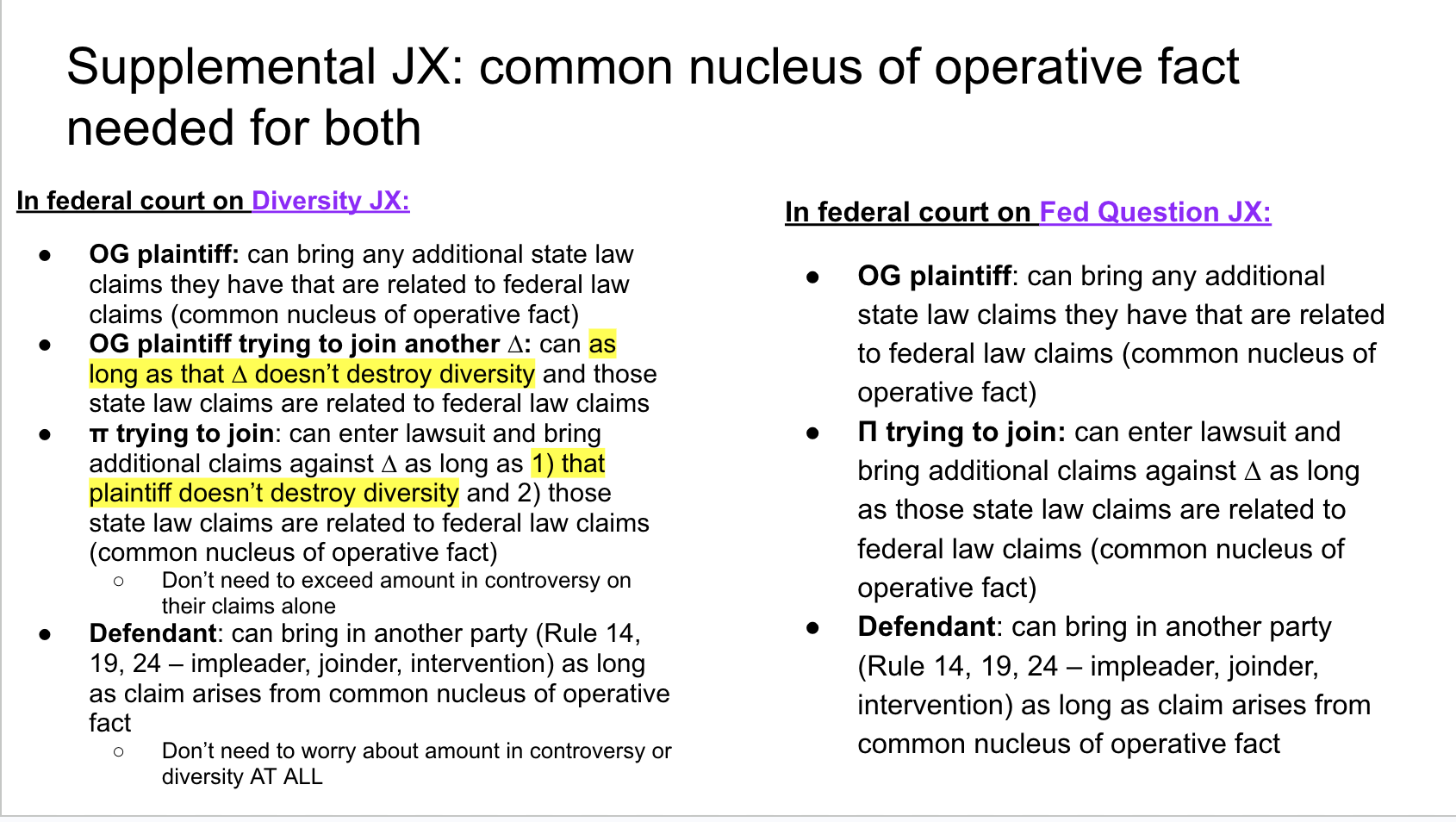
SuppJx (got into court on diversity): π wanting to join a π whose claim arises from nucleus of common fact — allowed?
Allowed only if the other π is a diverse party — other π doesn’t need to also satisfy amount in controversy requirement
If the other π is not a diverse party, not allowed to bring in even if claim arises from nucleus of operate fact
TLDR: Supplemental JX Restrictions when claim in federal court under diversity
If you’re a π in federal court under diversity you can’t use suppjx to add non diverse parties
But can if that claim’s primary jx basis is fed question jx
If you’re trying to intervene on π side — need to preserve diversity and arise from common nucleus of operative fact
If you’re a ∆ you probably can (but π can’t use that as their opportunity to now also sue that party in federal court under suppjx)
If you’re trying to intervene on ∆ side — don’t need to preserve diversity, just need to arise from common nucleus of operative fact
Supplemental jx is generous to defendants, restrictive towards plaintiffs
Supplemental JX: in federal court on Federal Question JX, but some additional state law claims — can plaintiff bring them?
What about defendant?
What if there’s another plaintiff that wants to join?
OG Plaintiff: yes — plaintiff can bring additional state law claim if they arise from same nucleus of operative fact as the federal law claims
Diversity or amount in controversy doesn’t matter
Defendant: yes — defendant can bring in another party (Rule 14, 19, 24 — impleader, joinder, intervention) as long as claim arises from common nucleus of operative fact
Diversity/amount in controversy doesn’t matter
Another π: yes — can enter lawsuit and bring additional claims against defendant as long as those additional state law claims they’re bringing arise from the same nucleus of operative fact as the federal claims we’re in federal court to talk about
Diversity/amount in controversy doesn’t matter
TLDR: if you’re in federal court on Federal Question JX and og π, ∆, or new party wants to bring in a state law claim that’s fine — just needs to arise from same common nucleus of operative fact
No diversity/amount in controversy requirements
So if you meet diversity/common nucleus requirements does that mean your/new ∆/new π additional state law claims will be added via supplemental jx?
NOT NECESSARILY — court still has discretion to not take them in
Factors: claim raises novel/complex state law issues, predominates over the federal claim, or if federal claims were dismissed
Discretionary Decline of Supplemental JX: when will federal court refuse to take in common nucleus state law claim even if it meets standards?
Even if you meet the diversity/common nucleus requirements, courts may decline if the claim raises novel/complex state law issues, predominates over the federal claim, or if federal claims were dismissed.
Removal (define + is it final once it happens? Any different rules for diversity vs. Fed Question)
The process by which a defendant moves a lawsuit filed in state court to the federal court that sits in the same location.
Not necessarily final once it happens (remand means a plaintiff can file a motion to send it right back to state court on grounds of no SMJX)
YES different rules for diversity: can’t remove if home-state defendant OR notice of removal filed more than one year after state court action was filed
Requirements for Removal
For a defendant to remove a case from state court to the federal court (that sits in the same state as the state court originally filed), defendant/all ∆s must consent to removal AND file notice of removal in federal court within 30 days of service of state court complaint
Removal Deadline
A defendant must file a notice of removal in federal court within 30 days of service of the state court complaint.
Removal Consent Rule
All defendants must consent to the removal.
Remand (define, who initiates/can initiate)
The process by which a plaintiff moves to send a case back to state court — plaintiff just needs to file a motion to remand within 30 days of ∆’s filing of the notice of removal telling the federal court that the case lacks SMJx
If plaintiff doesn’t file motion to remand, federal court must remand it on its own if they find that they actually do lack SMJx over claim
Plaintiff Motion to Remand Deadline
A plaintiff may file a motion to remand within 30 days of the notice of removal filing.
Limitations on Removal when in Federal Court Via Diversity
Can’t remove if home-state defendant OR notice of removal filed more than one year after original state court action was filed
Home-State Defendant Rule
A ∆ cannot remove a case to federal court on the basis that diversity jx exists, if any defendant is a citizen of the state where the action was filed/forum state.
Home state defendant: π is a citizen of New York — she files suit in Arkansas against ∆1 (citizen of Georgia), ∆2 (citizen of Florida), ∆3 (citizen of Kansas), ∆4 (citizen of Georgia), ∆5 (a corporation who is headquarted in Arizona, incorporated in Arkansas and whose president lives in Washington). There are no federal questions here. Can any ∆ remove?
No.
First, there is actually complete diversity (satisfying requirement for diversity jx): there are no matches in citizenship “across the v.” (It’s fine that two defendants are from Arkansas, diversity for the purposes of establishing diversity jx is assessed by making sure there are no similarities in citizenship between plaintiff and any of the defendants — the any similarities in the citizenship of the defendants between each other is fine.)
BUT, assuming that we meet amount in controversy requirement (which would be necessary to get this removed under diversity jx), we still have one problem: the home-state defendant rule. The home state defendant rule is a limit on a defendant’s ability to remove an action filed in state court — it requires that none of the defendants be citizens of the state in which the action was filed. Here, the corporation is a citizen of Arkansas (in addition to Arizona). Defendant fails home-state defendant limit — action cannot be removed to federal court.
Home state defendant: π is a citizen of New York — she files suit in Arkansas against ∆1 (citizen of Georgia), ∆2 (citizen of Florida), ∆3 (citizen of Arkansas), ∆4 (citizen of Georgia), ∆5 (citizen of New York). Can any ∆ remove?
NO — but because there’s no diversity jx (we don’t even get to home state defendant rule). ∆ can only successfully remove if he can show basis for federal question jx (at which point, home state defendant rule is no longer applicable — it’s only for cases getting removed to federal court on diversity!)
What cases does home state defendant rule NOT apply to?
Cases where ∆ is removing on the basis of federal question jurisdiction
One-Year Removal Limit (Diversity)
Removal based on diversity cannot occur more than 1 year after the original state action was filed, unless the plaintiff acted in bad faith
Bad faith: just adding a non-diverse party — keeping them around for 13 months and then immediately dropping suit against non-diverse party, just to keep actual ∆ from being able to remove it
Confusing bc of 30 day limit on ∆s to file notice of removal after service of state court complaint, but what this is saying is OG case wasn’t removable but then something changed (settled with/suit dismissed against non-diverse party opening up diversity jx, etc)… so if something changes after 1 year after OG state court action was filed… ∆ is shit outta luck, no removal
Erie Doctrine (define, analysis, tldr of analysis)
Under the Erie doctrine, a federal court sitting in diversity jurisdiction applies federal procedural law and the substantive law of the state in which it sits, including that state's choice-of-law rules.
Step 1: Is there a federal rule/statue (FRCP, FRE, 7th Amendment trial by jury, normal federal statute) DIRECTLY ON POINT answering the same procedural question as the state law?
YES —> federal law controls
I.e. pleading requirements, service, discovery, SJ, jury size, timing, evidence
I.e. "FRCP says serve within 90 days,” State says “serve within 30 days” — federal wins
NO —> Step 2
Step 2: would applying federal law instead of state law encourage forum shopping (would plaintiffs file in federal court because it would give them an advantage/disadvantage/more time to file/more money/etc) or would federal law merely tell the court the details of how the litigation should proceed? (TLDR: is this conflict about a procedural or substantive issue)
YES —> state law governs
I.e. statute of limitations, elements of claims, burdens of proof, damages, tolling, claim preclusion, state specific privileges
NO —> federal law governs (just means ignore the state law rule)
State law requires that signatures on complaints are done with black ink. Federal law doesn’t have this requirement — federal law will govern (case not being thrown out because complaints signed in blue ink)
TLDR analysis:
Step Zero: Make sure you’re in diversity (if you’re here on federal question, federal law controls)
1. Federal rule/statute on point? (if yes — federal)
2. If not, would applying the federal law here encourage forum shopping/encourage plaintiffs to file in federal court > state court bc it would give them some type of advantage/disadvantage?
If yes — state law
If no — federal law
Super shorthand: stupid rules will be procedural — federal law will govern and just X it out
Outcome Determinative Test (Erie)
If following state law would change the case's outcome (e.g., statute of limitations), the state law is substantive and must be used.
Substantive Law Examples (Erie)
Damages calculations, statutes of limitations, and state-specific privileges (e.g., physician-patient privilege).
Paula (NY) sues David (PA) in the U.S. District Court for the Southern District of New York for negligence arising from a car accident. Paula seeks $500,000 in damages.
New York law requires complaints to be filed on green paper.
The Federal Rules contain no rule regarding paper color.
Should the federal court apply the New York rule?
Step Zero: we are here on diversity (complete diversity and over $75,000 in controversy)
1) Is there a federal law directly on point?
NO — no federal law requiring green paper.. federal law will govern
Paula (NY) sues David (PA) in federal court for negligence seeking $500,000. New York law requires service within 30 days. FRCP 4 permits service within 90 days. Which rule applies?
Step Zero: we are here in diversity (PA vs. NY)
1) YES there is a federal law directly on point
Federal law governs
Paula (NY) sues David (PA) in federal court for negligence seeking $500,000.
New York law provides a 2-year statute of limitations.
The Federal Rules contain no statute of limitations.
Which law governs?
Step Zero: we are here on diversity
1) Is there a federal rule directly on point?
No
2) Could this encourage forum shopping? (Substantive)
Yes, statute of limitations are substantive because they affect substantive rights and would encourage forum shopping if ignored — state law governs
Anna sues Equifax in federal court alleging violations of the Fair Credit Reporting Act (FCRA). New York law requires all complaints to be filed on green paper. The Federal Rules contain no paper-color requirement. Should the federal court apply the New York rule?
Step Zero: we’re not here on diversity!!! This is federal question jx!!
Erie does not apply, federal law governs
A Florida citizen sues a Georgia citizen in federal court after a car accident seeking $500,000.
Georgia law adopts comparative negligence.
The Federal Rules contain no comparative negligence rule.
Which law governs?
Step Zero: this is a diversity case.
1) There is no Federal Rule directly on point.
2) Comparative negligence affects liability and damages — substantive right likely to induce forum shopping
State law governs.
Full Faith and Credit Clause
A valid judgment entered in state court must be recognized and enforced in every other federal and state court.
But for a federal court to enforce a state court judgment they need to have SMJX (so you can’t go to a federal court and ask them to enforce a state tort judgment of $50k… but you can go to the state court and ask them to do it!!)
When does a state NOT have to enforce/recognize another state court’s judgment
If the original judgment didn’t have valid SMJx or PJX — it’s not entitled to full faith and credit, can be collaterally attacked
Amanda, a citizen of New York, and Brian, a citizen of Connecticut, entered into a written contract under which Brian agreed to sell Amanda a rare painting for $50,000. Brian later refused to deliver the painting.
Amanda filed suit against Brian in the United States District Court for the District of Connecticut, alleging only breach of contract under Connecticut law and seeking $50,000 in damages.
Brian was personally served in Connecticut and filed an answer. The case proceeded to trial, and the federal district court entered judgment in Amanda's favor for $50,000.
Brian owns no assets in Connecticut, but he owns a lake house in Vermont.
Amanda then filed an action in Vermont state court asking the court to recognize and enforce the Connecticut federal judgment against Brian's Vermont property.
Diversity: complete diversity, but amount in controversy under 75k
No need to enforce — no smjx
Anti-Injunction Act
Prohibits federal courts from enjoining pending state court actions, state tax proceedings, or state criminal prosecutions.
Abstention
When a federal court with jurisdiction chooses not to hear (or stays) a case because an unresolved issue of state law or interpretation of a state statute could eliminate the need to decide a federal constitutional question.
Federal court may stay the action pending the state court's interpretation of its own law.
Purpose: avoid unnecessary constitutional rulings and give state courts the first opportunity to interpret ambiguous state laws through this case
Temporary Restraining Order (TRO)
An emergency order entered for up to 14 days to prevent irreparable harm and preserve the status quo prior to an injunction hearing — requires notice to adversary (unless excused) and movant to post security bond
Good cause/adversary consent can push this past 14 days
When will notice for TRO be excused?
Notice excused if movant can show that immediate and irreparable injury/loss/damage will happen before adverse party can be heard in opposition
I.e. ∆ about to destroy evidence, transfer assets offshore, disclose trade secrets
Security Bond (in TRO context)
Amount proper to pay costs and damages if court ultimately finds other party was wrongfully enjoined
Movant has to post this in order to get a TRO
Preliminary Injunction
An order granted only after notice and hearing to maintain the status quo before a trial occurs — courts consider likelihood of success on merits, irreparable harm, balance of hardships/public interest
Over 14 days — lasts until litigation is over/court reaches final decision on merits
Personal Jurisdiction (PJX)
The power of a federal court over a defendant's person or property.
Does Federal Court Have PJX: 2 steps (name them and general elements)
Federal court has pjx if
1) Law grants pjx/statutory authorization AND
a) Via federal statute OR
b) Borrowing (if this were filed in state court, would this state court have PJX)
Consent (Gen PJX)
Presence/tag jx (Gen PJX)
Long-arm (Specific PJX — tied to specific thing they did in that state)
2) Must be constitutional/satisfy DP
Consent, presence: automatically satisfy
Long-arm: needs to go through minimum contacts + fairness balancing
Via federal statute: needs to go through minimum contacts in application to ∆’s contacts with united states as a whole (5th Amendment due process) + fairness balancing
Is PJX Constitutional/Satisfy DP Analysis (who needs to go through this analysis and what are the steps)
Who needs to go through this analysis: long-arm, federal statute (but via nationwide)
Who does not: consent, presence
Don’t need to go through minimum contacts or fair play substantial justice
1) Is there minimum contacts?
Did ∆ purposefully avail itself of the benefits and protections of the forum state’s laws or targeted consumers there AND
2) Is there a connection between the availment/targeting and the lawsuit filed?
2) Would trying the case in this forum/court violate fair play and substantial justice? Balance…
a) State interest: citizens injured; dangerous product sold there; desire to regulate business/physician/whatever operating in state
b) ∆ interest: burden on the ∆ of appearing in the case
3) Convenience: which forum would make this easiest to resolve (witnesses, evidence, accident scene, documents, etc.)
4) Other states’ interests: does another state have a much stronger governmental interest?
Step 1 of PJX Constitutionality/DP Analysis: Minimum Contacts
Personal jx is constitutional if the ∆ engaged in such minimum contacts that it would not be unfair to make the ∆ come to the forum state to defend against a lawsuit
1) Is there minimum contacts?
Did ∆ purposefully avail itself of the benefits and protections of the forum state’s laws or targeted consumers there AND
2) Is there a connection between the availment/targeting and the lawsuit filed?
Step 2 of PJX Constitutionality/DP Analysis: Fair Play and Substantial Justice
Balancing state interest, defendant's burden, judicial efficiency, and the shared interests of other states.
2) Would trying the case in this forum/court violate fair play and substantial justice? Balance…
a) State interest: citizens injured; dangerous product sold there; desire to regulate business/physician/whatever operating in state
b) ∆ interest: burden on the ∆ of appearing in the case
3) Convenience: which forum would make this easiest to resolve (witnesses, evidence, accident scene, documents, etc.)
4) Other states’ interests: does another state have a much stronger governmental interest?
PJX: Consent (name the 2 forms, general or specific?)
Consent permits PJX regardless of where claim arose
Express consent
Implied consent
PJX by Express Consent
A verbal or written expression of consent, such as a forum selection clause in a contract.
PJX by Implied Consent (+ waiving formal process)
Occurs if a ∆ fails to object to PJX in proper and timely manner (21 days of service) → waiver of your right to object
BUT if ∆ waives formal process → 60 days to be considered waiver
If ∆ outside US → 90 days after waiving formal process
Either way ∆ needs to raise objection in their first response (if they don’t → waived)
PJX by Presence
Form of general PJX based in whether ∆ is actually and voluntarily present OR domiciled in the forum OR essentially at home in the forum
PJX by Presence: ∆ actually and voluntarily present (define, exceptions)
Service of process while ∆ is physically and voluntarily present in state
Exception: if you’re only in the state bc summoned for proceedings → not voluntary
Exception: π can’t use force/fraud to lure ∆ to the state
This does not apply to corporations — only natural persons
PJX by Presence: Domicile
∆’s true home is in that state and ∆ intends to remain/return — establishes basis for pjx via presence by their domicile
PJX by Presence: Corporate "At Home" Status
A corporation is essentially at home where it is incorporated or principal place of business
Principal place of business: where its officers direct, control, and coordinate the company’s activities
PJX by Long-arm statute
Form of specific pjx — federal court may secure jurisdiction via forum state's long-arm statute. These generally provide a state with specific personal jx over defendants who perform a specific act in the state from which the lawsuit derives
Service of Process (what is it, who can serve it)
Formally delivering notice of a lawsuit (summons and complaint) to a defendant via an authorized process serve (nonparty who is 18+ years old)
If either requirement is not met, service is invalid and the defendant may object based on insufficient service of process.
Service of Process Deadline
The authorized process server (non-party 18+) has 90 days from the date the lawsuit was filed to serve the defendant.
Ways to Serve Process on Individual ∆
Lots of options: personal service, leave it at their house, authorized agent, whatever else state law allows
Personal delivery to the defendant.
Leaving the summons and complaint at the defendant's dwelling or usual abode with a resident of suitable age and discretion.
Delivering them to an authorized agent.
Using any method authorized by the law of the forum state or the state where service is made.
Ways to Serve Process on Organizational Defendants (list them and how this is different from serving individual ∆s)
Distinguish from serving individual ∆s: more scrutiny on who/what agent is allowed to accept — can’t just leave it with any random employee/receptionist
Must deliver to…
Agent who is authorized by law to receive process (officer, managing agent, general partner, authorized attorneys)
Agent who has been appointed to receive process (like in the articles of incorporation)
Any process allowed in state where court is located
TLDR: agent authorized by law, agent appointed by company, any state rule of serving process
How do you determine whether service is valid in federal court?
The method of service is authorized by AND
Federal Rule 4 OR
The law of the state where the federal court sits OR
The law of the state where service is made
The method satisfies due process.
What is required to have validly served process? (2 elements)
1) Method of service authorized by… AND
Federal rules
Law of state where federal court sits OR
Law of state where service is made
2) Method must be constitutional under due process clause — reasonably calculated to inform interested parties of the litigation
All proper methods of service listed meet this requirement
Note: no requirement that person actually receives notice… service just needs to be reasonably designed to notify
What methods of service are authorized under FRCP?
1) Personal service: in-hand, direct delivery to ∆ by authorized process server
2) Abode service
3) Service on authorized agent: personal service on an agent who is authorized to accept OR a managing agent of the ∆
4) Waiver of service
5) Any method permitted by state law of state where lawsuit filed OR law of state where service occurs
Abode service
Leave summons and complaint at ∆’s (NOT AGENT’S) dwelling/usual abode with someone who lives there and is of suitable age and discretion (can’t leave it with 5 year old)
Usual abode: hotel room is not going to work
Waiver (service of process context)
When π mails summons and complaint to ∆ (or ∆’s agent) with request that ∆ waive formal methods of process
∆ has duty to avoid cost of formal service: if a U.S. defendant refuses to waive without good cause, the court must impose the expenses later incurred in making service.
Upside for if you’re a ∆ and you waive formal process → you get more time to respond to complaint
Normally you get 21 days to respond, but if you waive you get 60 days (if in US) and 90 days (if not in US) — run from the date the request for waiver was sent
Can you satisfy service of process by following a state rule of the state where the court sits?
YES, if suing in federal court — can check-off service of process by following federal rules OR state rule of state where court sits OR state rule of state where you’re serving process
BUT if suing in state court — can only check-off process by state rules of state where court sits (but if state rules allow federal rules of process to also be valid, then yay!)
Don’t get law of state where service is made either (unless state statute says so)
Plaintiff files a lawsuit in federal court in Illinois. Defendant is a citizen of Michigan. Defendant is attending a week-long business conference in Nevada. Plaintiff hires a Nevada process server. Nevada law allows service by leaving the summons and complaint with a responsible adult at the defendant's hotel room (assume this is valid under Nevada law). The process server leaves the papers with Defendant's adult daughter, who is staying in the hotel room. Illinois law would not permit this method.
Is service valid?
YES — service is valid. Process server served process in a way permitted by the state where he was serving process (Nevada). For process to be valid in federal court, plaintiffs may serve process (and have it be valid) according to the FRCP, the state laws regarding process of the state where the court where the lawsuit was filed sits, and the state laws regarding process of the state where process is ultimately able to be served (as is the case here).
Due Process Standard for Service/Constitutionality
The method of service must be reasonably calculated to inform interested parties of the litigation.
Waiver of Service Benefit (Time)
A defendant who waives formal process receives 60 days (U.S.) or 90 days (Abroad) to respond, rather than the standard 21 days.
Proper Venue
The federal district that is the most convenient and appropriate location for this lawsuit
Proper Venue Bases
Venue is proper in the federal district court of where any defendant resides (if all in one state) or where a substantial part of the events occurred
Or if neither of these work — fallback: any district where any ∆ is subject to PJX (rarely tested)
Note for location of events: more than one district can be proper — the standard is “substantial” not “most substantial”
Individual Residence (Venue)
The district where the individual is domiciled.
Organizational Residence (Venue)
Any district that would have PJX over the organization if the district were its own state
I.e. place of incorporation, principal place of business, continuously conducts business in SDNY → can be considered to reside in SDNY
Foreign Defendant Venue Rule
A foreign defendant can be sued in any federal district
What if venue is improper?
∆ files motion to dismiss or transfer (but needs to be in first response to the complaint – either FRCP 12 motion OR answer) → court can then dismiss or transfer
If not mentioned in first response — improper waiver objection waived
What if venue is proper but ∆/π/court wants case to go somewhere else? What are the options and when does the motion to transfer need to be filed by?
Even when venue is proper, the court may transfer the case to another proper federal district for convenience of parties, convenience of witnesses, location of evidence interest of justice (plaintiff’s choice of forum given some deference)
Court may also transfer the case to venue agreed upon by all parties: forum-selection clause strongly favors transfer to the chosen forum
Transfer to other proper venue may generally be requested at any time. Delay may weigh against transfer if it causes prejudice.
What if proper venue is a state or foreign court (rather than a federal court)
Federal court can’t transfer to state court or foreign court… federal court has no authority to do that
BUT if the TRULY appropriate form is a state/foreign court… federal court may grant ∆ MTD under forum non conveniens (current forum is excessively inconvenient). Then π refiles in a convenient forum
Forum Non Conveniens
A motion to dismiss granted when the truly appropriate forum is a state or foreign court that the federal court cannot transfer to and the current forum is excessively inconvenient.
Pleading Requirements
Requires a jurisdictional statement, a short/plain statement showing a plausible claim, a demand for relief and needs to be Rule 11 certified
Short and plain statement of claim: now needs to be sufficient to show substantive plausibility (if not, can get dismissed at MTD stage for failure to state a claim)
Claims involving fraud must be pled with particularity (higher standard – more facts)
Must serve pleading/complaint on a party within 90 days of filing (∆ then has 21 days to respond)
Fraud Pleading Standard
Claims involving fraud must be pled with particularity, which is a higher standard requiring more specific facts.