NMJ Disorders
 Call Kai
 Learn
Learn Practice Test
 Spaced Repetition
 Match
Match Flashcards
 Knowt Play
1/29

There's no tags or description
Looks like no tags are added yet.
Name | Mastery | Learn | Test | Matching | Spaced | Call with Kai | Chat |
|---|
No analytics yet
Send a link to your students to track their progress
30 Terms
Describe Myasthenia Gravis:
STATs
Associated w/ what other diseases?
Clinical Presentation?
Pathogenesis?
STATs:
most common disorder of neuromuscular transmission
200 cases per million people
Bi-modal distribution: women < 40 or men > 65
Etiology Stats
Generalized MG-85% have AchRAb and 8-10% have muscle specific tyrosine kinase receptor antibodies (MuSK)
Associated w/ other autoimmune disorders:
Autoimmune thyroid disease
60-70%: have thymic hyperplasia
10-12% have thymoma
SLE
rheumatoid arthritis
neuromyelitis optica spectrum disorder (NMO-SD)
Clinical Presentation:
Fluctuating, intermittent symptoms sometimes w/ periods of spontaneous improvement
Appearing with repetitive activity; worsening as day progresses
Muscle fatigue and weakness
Characteristically affects extra-ocular, bulbar or proximal limb muscles
Pathogenesis:
Autoantibodies against the AChR (post synaptic)-> receptor destruction (complement)
Decreases # of active Ach binding
Destruction of post-synaptic folds
List the types of presentation in MG

Describe Ocular Onset MG
STATs
Symptoms
Ocular Onset MG
STATs
Most common
Eventually 90% of MG patients have ocular symptoms
15% continue to have isolated ocular symptoms
Symptoms:
Ptosis
Extraocular weakness
Begins asymmetrically
Mimics 3rd 4th and 6th nerve palsies and, rarely INO-(InterNuclear Ophthalmoplegia)
NOTE: Unlike true 3rd nerve palsies MG never affects pupillary function
Describe the normal measurements for eyelids and palpebral fissure
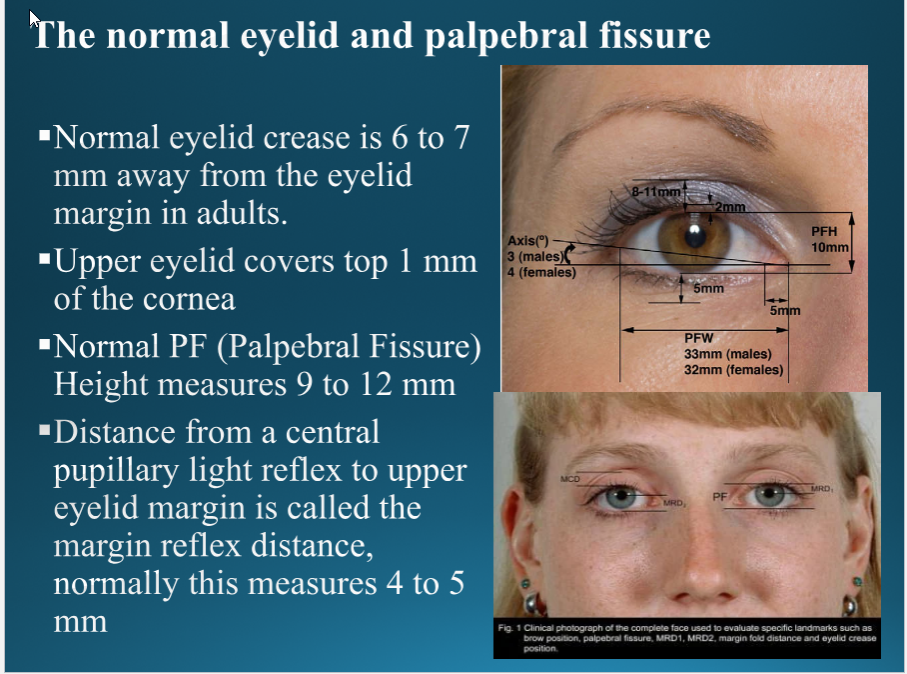
What does the Ptosis-primary gaze look like?

What does the upward gaze w/ ptosis look like in pts w/ mg?
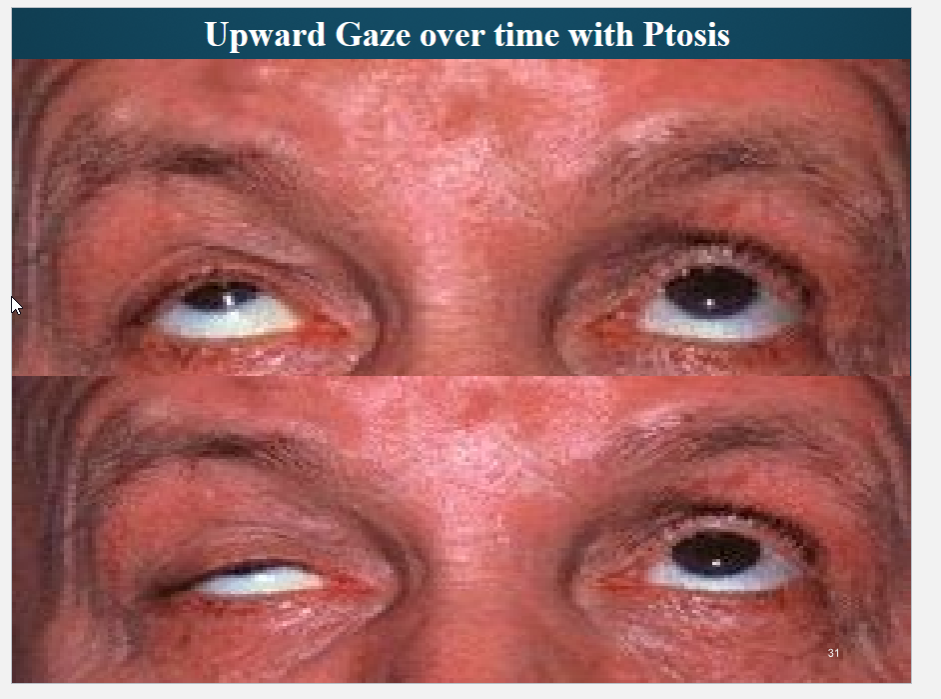
Describe Bulbar-onset MG
STATs
Symptoms
STATs
next most common type of MG
Symptoms:
Dysphagia
Dysarthria
nasal speech, slurred and hypophonic
Mastication Fatigability/weakness
inability to keep the jaw closed after chewing.
Nasal regurgitation
Describe the Facial muscles involvement in MG
Describe limb involvement in MG\
Describe Resp. Involvement in MG
Facial muscles involvement in MG
Characteristics:
Freq. involved
Pts appear expressionless
"myasthenic sneer
attempting to smile where the mid- lip rises but the outer corners of the mouth fail to move
Limb involvement in MG
Characteristics:
Limb weakness
Symmetric + prox.
Affects Wrist and finger extensors and foot dorsiflexors
RARELY:
Isolated + no eye/bulbar weakness
Respiratory Involvement in MG
Characteristics:
Difficulty breathing, SOB
Obstructive sleep apnea
Difficulty sleeping on flat bed
What does the Myasthenic sneer look like?

Describe the Diagnostic Tests for MG
Bed Side Tests
Serologic testing
Other Tests
Bed side tests:
Tensilon test:
Inject edrophonium (AcHE inhibitor) -> improvement in ptosis/ ophthalmoparesis
Ice pack test
Cooling -> reduce AcHE act. By making more Ach available @ NMJ
Serologic testing:
Acetylcholine receptor antibodies (AChR-Ab)
80-90% of generalized MG have AChR-Ab
50% of ocular MG have AChR-Ab
Lrp4-Low density lipoprotein-related protein 4
3-50% of AchR-Ab NEG patients
Anti Muscle-specific kinase antibodies (MuSK-Ab)
38-50% of generalized MG who are AChR-Ab —NEG
Much lower frequency of thymic pathology
More common in females
Usually present with severe oculobulbar weakness along or neck, shoulder, and respiratory weakness
Other Tests
Repetitive nerve stimulation studies
Single-fiber electromyography (EMG) = most sensitive test
Ct Scan of Chest
Describe the Treatment of MG
In Crisis
Ongoing Treatment
Crisis
Plasma Exchange (1.5 total blood volume)
IVIG
Efficacy equal but fewer side effects
IV Rituxan for refractory cases
More efficacious in Musk positive patients
Ongoing Treatment
Pyridostigmine
Oral steroids
Oral immunosuppressants
Azathioprine
Cellcept-Avoid in pregnancy
Describe Soliris
AKA?
Uses besides MG
MOA?
Req. to Prescribe?
Costs?
Soliris
AKA:
(Eculizumab)
Uses besides MG
Paroxysmal Nocturnal Hemoglobinuria
Typical Hemolytic Uremic Syndrome
MOA
binds + inhibits cleavage of C5
Req. to Prescribe:
generalized MG
AChR-Ab POSITIVE
Failed other immunosuppressants
Costs:
$500,000 annually
Describe Ultomiris
AKA?
MOA?
Req. to Prescribe
Cost
Dose
Ultomiris
AKA: ravulizumab-cwvz
MOA:
Long acting C5 complement inhibitor
Req. to prescribe:
AChR-Ab positive
Cost:
$458,000 annually
Dose:
Loading dose based on weight then Infusion every 8 weeks
Describe Vyvgart
AKA?
MOA?
Req. to Prescribe
Cost
Vyvgart
AKA: (efgartigimod-alpha)
MOA:
IgG Abs to Fc of IgG auto Abs -> degradation
Req. to Prescribe:
general MG patients who are AChR-Ab positive
Cost: $225,000 annually
Describe the prognosis of MG
Phases?
MG Prognosis
Early: Symptoms transient -> worsens/more persistent months later -> max. Weakness w/in 2 yrs
Phases:
First phase
Active phase w/ fluctuations + more severe symptoms
First 5-7 years
Most myasthenic crises occur in this early period.
Second Phase
Symptoms stable but persists
Can get worst:
infection, medication taper, or other perturbations
Third Phase
Remission can occur
Describe Myasthenic Crisis
Definition
Cause
Myasthenic Crisis
Definition:
Weakness from acquired MG that is life threatening and severe enough to necessitate intubation
Cause:
weakness of respiratory muscles
Severe oropharyngeal muscle weakness often accompanies or predom. Feature
Triggered by infections or certain medications.
List the common medicines to avoid w/ MG pts


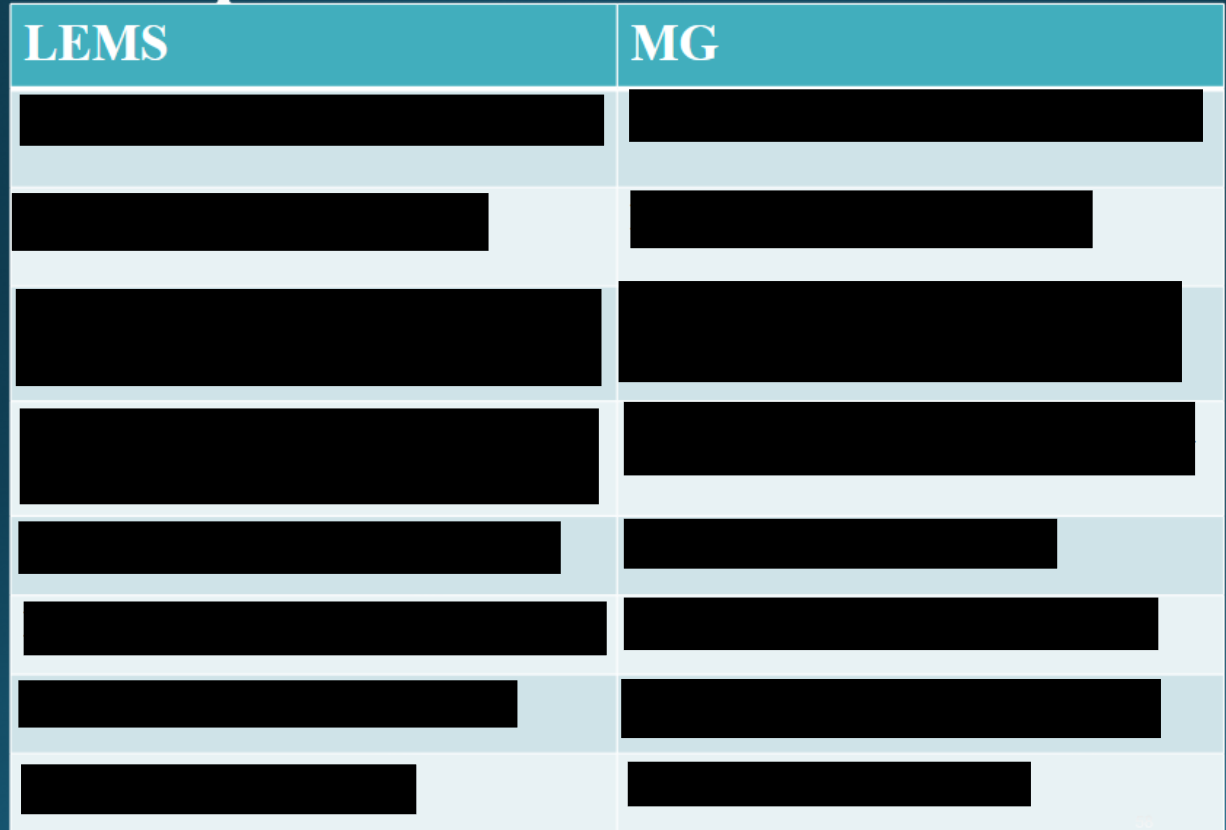
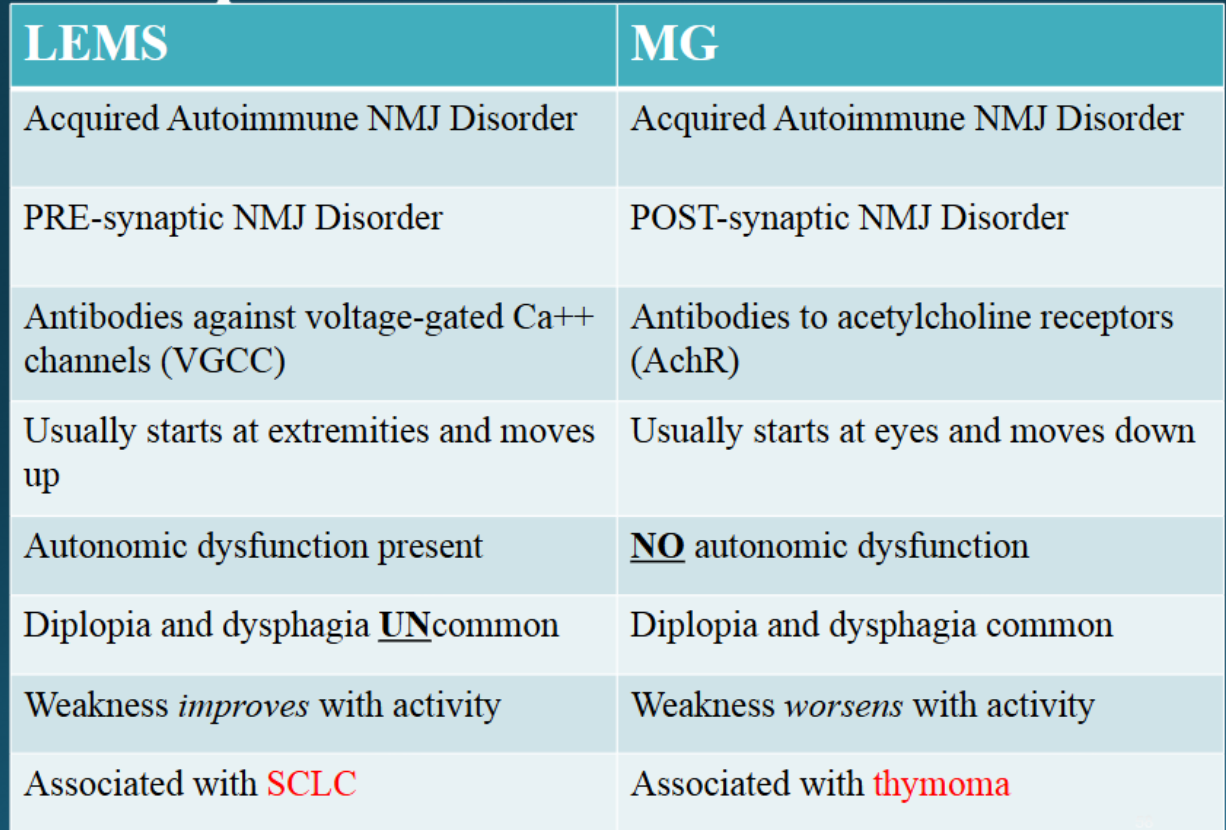
Describe Lambert Eaton Myasthenic Syndrome
STATs
Pathogensis
Associated w/
STATs:
Middle age to older people
Annual incidence = 0.48 per million population
Pathogenesis:
PRE-synaptic NMJ disorder
P/Q type VGCC (Voltage Gated Calcium Channel) antibodies
Associated w/
malignancy (especially small cell lung cancer)
70%
Describe the symptoms and clinical signs for Lambert Eaton Myasthenic Syndrome
Symptoms
Signs
Symptoms
Proximal limb weakness Legs > arms
Fatigue or fluctuating symptoms
Difficulty rising from sitting; climbing stairs
Metallic taste in mouth
Autonomic dysfunction
Dry mouth
Constipation
Blurred vision
Impaired sweating
Clinical Signs
Weakness on exam is less demonstrable than patients level of disability
Hypoactive or absent muscle stretch reflexes
Lambert’s sign
Grip becomes more powerful over several seconds
b/c increased influx of calcium in pre-synaptic membrane
Sluggish pupillary reflexes
List the Laboratory Work-up for LEMS
Find Neoplasm (Serum tumor markers, CT, PET)
EMG/NCS
Serum markers for inflammatory/autoimmune diseases
Antibodies to voltage-gated calcium channels (VGCCs)
75-100% of LEMS patients who have small cell lung cancer (SCLC)
50-90% of LEMS patients who do not have underlying cancer.
List the LEMS treatments
LEMS Treatments
Treat underlying malignancy
Pyridostigmine
3,4-DAP (Di-Amino Pyridine) Trade name=Ampyra
NOTE:
Other possible treatments (plasma exchange, steroids and immunosuppressive agents) have not been tested in randomized controlled trials
Describe Botulism
What is it?
Pathogenesis
STATs
Key Symptom
Botulism
What is it?
PRE-synaptic NMJ disorder
Toxins produced by Clostridium Botulinum
Pathogenesis:
Inhibits release of Ach from the NMJ, sympathetic and parasympathetic ganglia
STATs
100 cases/year in the US-25% food born/3% wound/ 72% infantile
Key symptom:
Symmetric Descending Flaccid Paralysis
Autonomic disturbance always beginning with the cranial nerves
Describe the transmission and types of botulism and Symptoms
Botulism Transmission/Type
Transmission
Skin Break
Toxin can’t pass through intact skin
Direct absorption through mucous membranes
Lung
GI Tract
Types
Food born
Wound
Inhalation
Infantile-infestation through GI tract
Symptoms
Diplopia or Blurred Vision ptosis
Dysphagia
Dry mouth
Symmetric Descending Flaccid Paralysis
Describe the MOA of Botulism

List the Diagnosis/Treatment of Botulism
Diagnosis
Identification of Botox Toxin in serum or stool
EMG/NCS
MRI Brain
CSF
Tensilon test
Treatment
Anti-toxin
Surgical removal of wound
Describe Neuromyotonia (Isaac's Syndrome)
STATs
Variants
What is it?
MOA
Symptoms
Cause
STATs
100-200 cases in the US
Varients:
Acquired-80% of all cases/Auto-immune related
Paraneoplastic-Small Cell Lung CA, Thymoma or Lymphoma
Hereditary
What is it?
Small Cell Lung Cancer or Thymoma involving voltage gated potassium channels (VGKC) @ PRE-synaptic membrane
MOA:
Inhibition of VGKC -> prolongs depolarization -> increases Ach release -> hyperexcites post-synaptic membrane -> twitching or myokymia
Symptoms:
muscle stiffness
Cause:
Exposure to toxins + autoantibodies
gold or mercury or radiation
List the Diagnosis/Treatments for Neuromyotonia (Isaac's Syndrome)
Diagnosis:
EMG/NCS-High,
irregular single unit discharges
fibrillation potentials and fasciculations
Chest CT
Serum for VGKC
Serum for AChR-Ab, immunofixation, TSH, ANA, ESR
Treatment:
Immunosuppressive therapy
Plasma exchange
Anticonvulsants