Chapter 8: Joints
 Call Kai
 Learn
Learn Practice Test
 Spaced Repetition
 Match
Match Flashcards
 Knowt Play
1/109

There's no tags or description
Looks like no tags are added yet.
Name | Mastery | Learn | Test | Matching | Spaced | Call with Kai | Chat |
|---|
No analytics yet
Send a link to your students to track their progress
110 Terms
1) An immovable joint is a(n) A) synarthrosis.
B) diarthrosis.C) amphiarthrosis. D) syndesmosis.
E) symphysis.
A) synarthrosis.
2) A slightly movable joint is a(n) A) synarthrosis.
B) diarthrosis.C) amphiarthrosis. D) gomphosis.
E) synostosis.
C) amphiarthrosis.
3) A freely movable joint is a(n) A) synarthrosis.
B) diarthrosis.C) amphiarthrosis. D) syndesmosis.
E) symphysis.
B) diarthrosis.
4) A suture is an example of a(n) A) synarthrosis.
B) syndesmosis. C) symphysis. D) diarthrosis.
E) amphiarthrosis.
A) synarthrosis.
5) An epiphyseal line is an example of a A) gomphosis.
B) synchondrosis. C) synostosis.D) symphysis.
E) syndesmosis.
C) synostosis.
6) Dense connective tissue is to a suture as a periodontal ligament is to a(n) A) amphiarthrosis.
B) syndesmosis. C) synostosis.D) synchondrosis.
E) gomphosis.
E) gomphosis.
7) A synovial joint is an example of a(n) A) synarthrosis.
B) amphiarthrosis. C) diarthrosis.D) symphysis.
E) syndesmosis.
C) diarthrosis.
8) A ligamentous connection such as an interosseous ligament is termed a A) syndesmosis.
B) symphysis.C) synchondrosis. D) synostosis.
E) gomphosis.
A) syndesmosis.
9) Which of the following is not one of the four major types of synarthrotic joints? A) suture
B) gomphosisC) synchondrosis D) synostosis
E) syndesmosis
E) syndesmosis
10) Joints are classified by the A) range of motion.
B) structure.C) type of movement.D) amount of cartilage present.
E) All of the answers are correct.
E) All of the answers are correct.
11) The synarthrosis that binds the teeth to the bony sockets is a A) suture.
B) gomphosis.C) synchondrosis. D) synostosis.
E) None of the answers is correct.
B) gomphosis.
12) Syndesmosis is to ligament as symphysis is to A) fibrocartilage.
B) dense regular connective tissue. C) periodontal ligament.D) rigid cartilaginous bridge.
E) completely fused.
A) fibrocartilage.
13) The location where two bones meet is called a joint, or an A) adduction.
B) appendix.C) amphiarthrosis. D) articulation.
E) insertion.
D) articulation.
14) Functionally, the public symphysis is classified as a(n) ________ articulation. A) synarthrotic
B) amphiarthrotic C) diarthrotic
B) amphiarthrotic
15) Which of the following is not a function of synovial fluid? A) shock absorption
B) increasing osmotic pressure within joint C) lubricationD) providing nutrients
E) protecting articular cartilages
B) increasing osmotic pressure within joint
16) Which of the following is not a characteristic of articular cartilage? A) There is no perichondrium.
B) The matrix contains more water than other cartilages. C) Surfaces are normally slick and smooth.D) It is composed of hyaline cartilage.
E) It increases friction during movement.
E) It increases friction during movement.
17) Bursae can be found in all of the following areas except A) tendons.
B) ligaments.C) within connective tissue exposed to friction or pressure. D) around blood vessels.
E) around many synovial joints.
D) around blood vessels.
18) The surface of articular cartilage is A) slick.
B) flat.C) smooth. D) rough.
E) both slick and smooth.
E) both slick and smooth.
19) Which of the following is not considered to be an accessory synovial structure? A) fat pads
B) menisci C) ligaments D) bursae
E) synovial membrane
E) synovial membrane
20) Identify the structure at label 1. A) meniscus
B) bursaC) articular cartilage D) synovial membrane
E) joint cavity
B) bursa
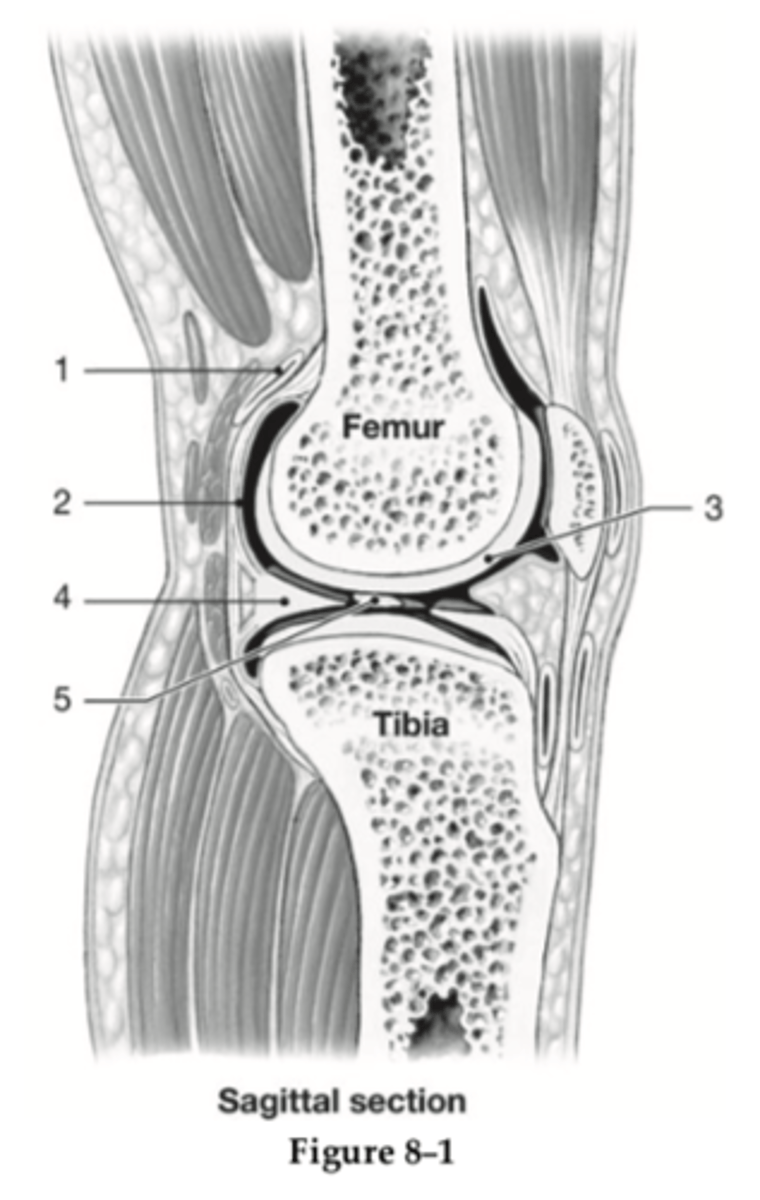
21) Identify the structure labeled 4. A) serous membrane
B) synovial membrane C) meniscusD) periosteum
E) intracapsular ligament
C) meniscus
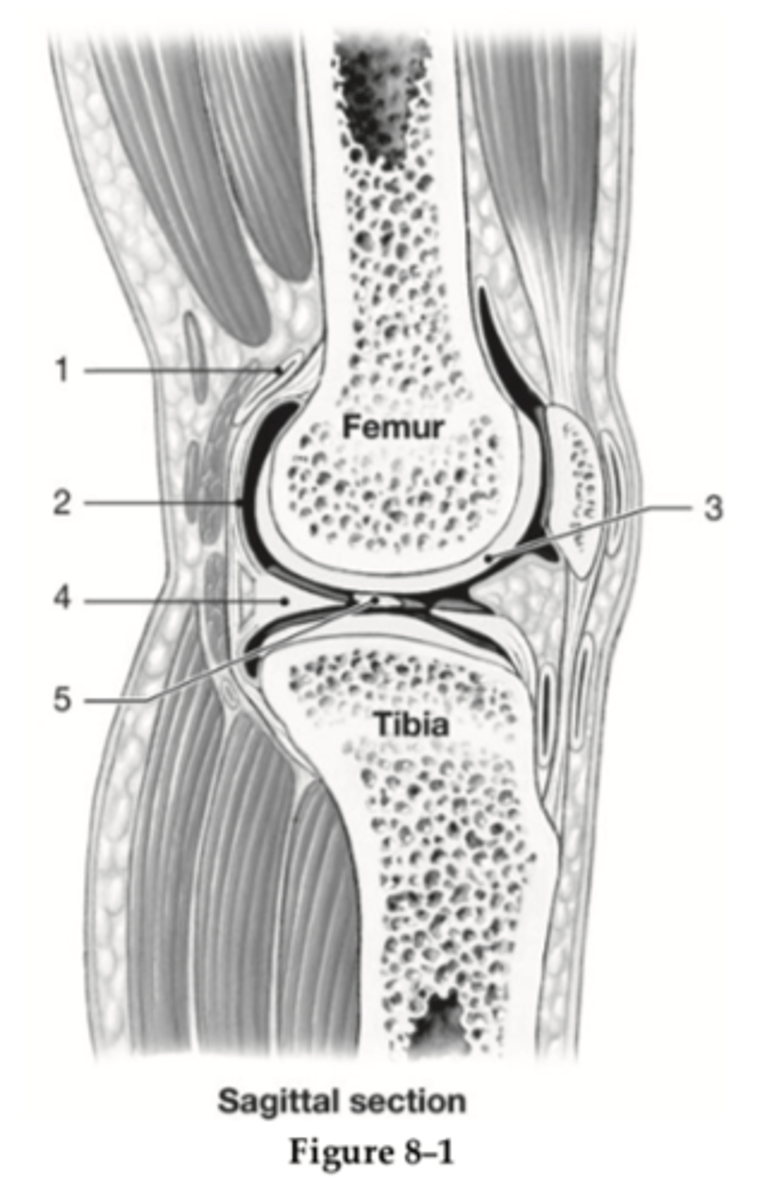
22) Identify the structure labeled 5. A) serous membrane
B) synovial membrane C) joint capsuleD) periosteum
E) intracapsular ligament
E) intracapsular ligament
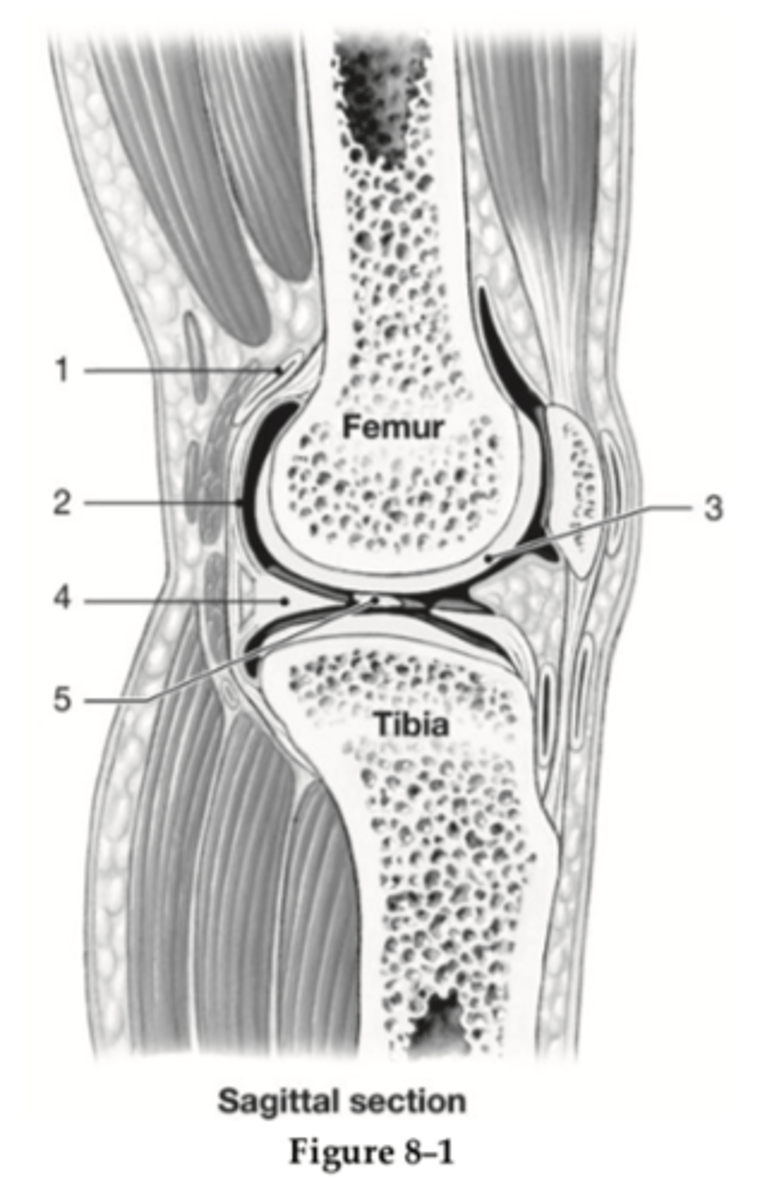
23) Which structure acts as a cushion and consists of fibrocartilage?A) 1
B) 2 C) 3 D) 4 E) 5
D) 4
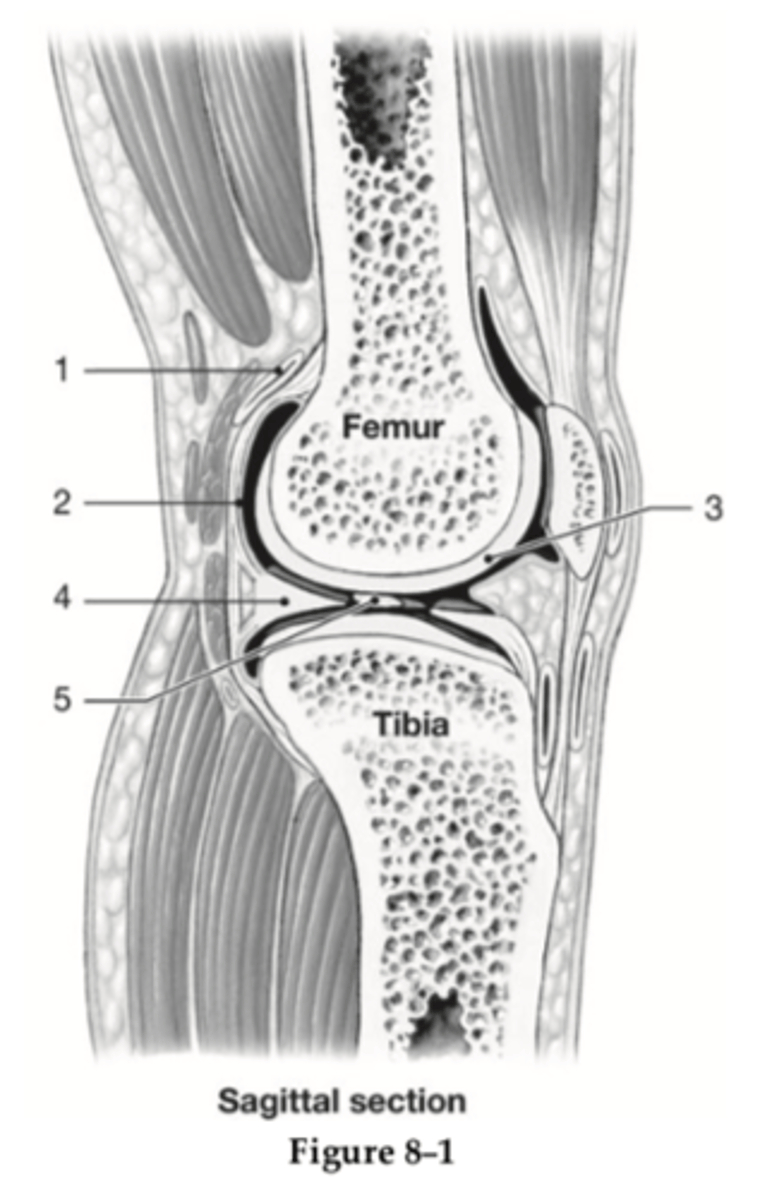
24) What type of tissue occurs at the structure labeled 3? A) fibrocartilage
B) synovial membrane C) hyaline cartilageD) bone tissue
E) dense connective tissue
C) hyaline cartilage
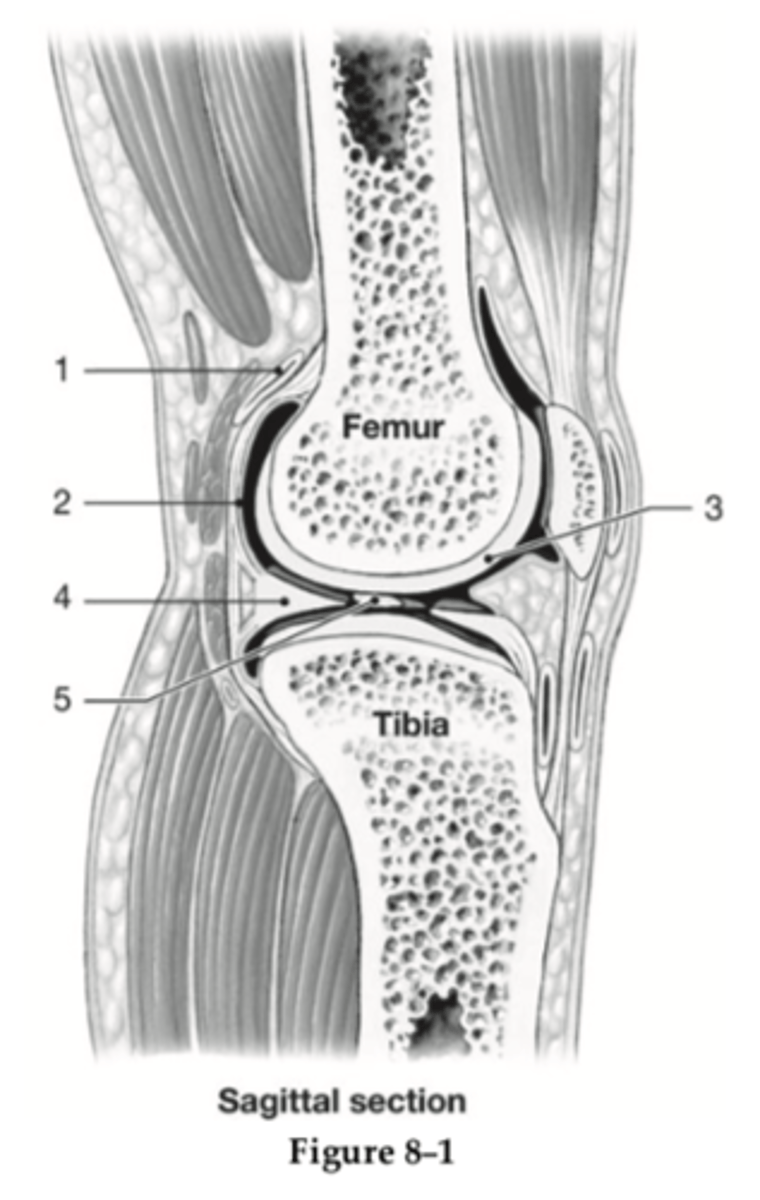
25) Which of the following is not a property of synovial joints? A) freely movable
B) reinforced by accessory structures C) covered by a serous membrane D) contain synovial fluid
E) covered by a capsule
C) covered by a serous membrane
26) ________ subdivide synovial cavities, channel the flow of synovial fluid, and allow for variations in the shapes of the articular surfaces.
A) Cruciate ligaments B) Synovia
C) BursaeD) Capsular ligaments
E) Menisci
E) Menisci
27) Usually found outside the capsule, ________ protect the articular cartilages and act as packing material for the joint.
A) menisci B) fat pads
C) patellar ligaments D) capsular ligaments
E) tendons
B) fat pads
28) Small pockets of synovial fluid that reduce friction and act as a shock absorber where ligaments and tendons rub against other tissues are called
A) bursae. B) fat pads.
C) articular cartilages. D) menisci.
E) scapulae.
A) bursae.
29) The elbow joint is an example of a ________ joint. A) saddle
B) planeC) condylar D) hinge
E) pivot
D) hinge
30) The joint between the trapezium and metacarpal bone of the thumb is an example of a ________ joint.
A) saddle B) plane
C) condylar D) hinge
E) pivot
A) saddle
31) Which type of joint is found between the carpal bones? A) saddle
B) planeC) hingeD) ball-and-socket
E) pivot
B) plane
32) The joint that permits the greatest range of mobility of any joint in the body is the ________ joint.
A) hip
B) shoulder
C) elbow
D) knee
E) wrist
B) shoulder
33) The radiocarpal joint is a(n) ________ joint. A) saddle
B) immovable C) hingeD) plane
E) condylar
E) condylar
34) The intercarpal articulations are ________ joints. A) saddle
B) condylar C) hingeD) plane
E) ball-and-socket
D) plane
35) The ankle joint is an example of a ________ joint. A) condylar
B) saddleC) hingeD) ball-and-socket
E) plane
C) hinge
36) The joints that connect the four fingers with the metacarpal bones are ________ joints. A) condylar
B) saddle C) pivot D) hinge
E) ball-and-socket
A) condylar
37) All of the following are structural classifications of synovial joints except A) hinge.
B) plane. C) rolling. D) saddle.
E) pivot.
C) rolling
38) Which of the following is an example of a ball-and-socket joint? A) elbow
B) knee C) ankle D) wrist
E) hip
E) hip
39) A joint that permits only flexion and extension is a ________ joint. A) saddle
B) hinge C) pivot D) plane
E) ball-and-socket
B) hinge
40) A movement away from the midline of the body is termed A) inversion.
B) abduction. C) adduction. D) flexion.
E) extension.
B) abduction.
41) Bending at the neck to look up at the starts would ________ the neck. A) hyperextend
B) hyperflex C) flexD) extend
E) laterally flex
A) hyperextend
42) An extension past the anatomical position is known as A) double jointed.
B) extension. C) flexion. D) rotation.
E) hyperextension.
E) hyperextension.
43) Which of the following movements is a good example of abduction? A) opening the mouth
B) turning the hand palm upwardC) extreme backward bending of the head D) moving the hand toward the shoulder
E) spreading the fingers
E) spreading the fingers
44) Which of the following movements is a good example of flexion? A) opening the mouth
B) turning the hand palm upwardC) extreme backward bending of the head D) moving the hand toward the shoulder
E) spreading the fingers
D) moving the hand toward the shoulder
45) Nodding your head yes is an example of A) lateral and medial rotation.
B) circumduction.C) flexion and extension.D) pronation and supination.
E) protraction and retraction.
C) flexion and extension.
46) Lifting a stone with the tip of the foot is A) circumduction.
B) eversion.C) inversion.D) plantar flexion.
E) dorsiflexion.
E) dorsiflexion.
47) Which foot movement enables a ballerina to stand on her toes? A) dorsiflexion
B) plantar flexion C) inversionD) rotation
E) eversion
B) plantar flexion
48) The movements known as dorsiflexion and plantar flexion are limited to the A) radiocarpal joint.
B) hip joint.C) glenohumeral. D) talocrural.
E) sacroliliac.
D) talocrural.
49) The two little girls who hold and move the rope in jump-rope are performing what action? A) dorsiflexion
B) extensionC) rotationD) plantar flexion
E) circumduction
E) circumduction
50) Many gyms feature weightlifting machines called adductor machines that are used to strengthen the thighs. If you were to work out on one of these, what would you be doing?
A) twisting both thighs to the left, then to the right B) lifting both thighs upward
C) pushing both thighs outward, separating your knees as far as you canD) pulling both thighs inward toward a center point, bringing your knees together
E) None of the answers is correct.
D) pulling both thighs inward toward a center point, bringing your knees together
51) To pinch with a thumb and finger involves a movement called A) rotation.
B) opposition.C) circumduction. D) eversion.
E) retraction.
B) opposition.
52) A common injury to the ankle occurs by excessive turning of the sole inward, termed A) eversion.
B) protraction.C) dorsiflexion. D) plantar flexion.
E) inversion.
E) inversion.
53) All of the following are associated with the joints of the vertebral column except A) syndesmoses.
B) synchondroses. C) synovial.D) saddle joint.
E) pivot joint.
D) saddle joint.
54) A twisting motion of the foot that turns the sole of the foot outward is known as A) inversion.
B) plantar flexion. C) eversion.D) dorsiflexion.
E) None of the answers is correct.
C) eversion.
55) Which of the following movements is a good example of depression? A) opening the mouth
B) turning the hand palm upwardC) extreme backward bending of the head D) moving the hand toward the shoulder
E) spreading the fingers
A) opening the mouth
56) Which of the following movements is a good example of supination? A) opening the mouth
B) turning the hand palm upwardC) extreme backward bending of the head D) moving the hand toward the shoulder
E) spreading the fingers
B) turning the hand palm upward
57) Which of the following movements would you associate with chewing food? A) elevation
B) abduction C) flexionD) pronation
E) circumduction
A) elevation
58) The movement of rotating a limb toward the anterior surface of the body is called A) inversion.
B) medial (internal) rotation. C) lateral (external) rotation. D) eversion.
E) protraction.
B) medial (internal) rotation.
59) The movement of rotating a limb outward is called A) inversion.
B) medial (internal) rotation. C) lateral (external) rotation. D) eversion.
E) protraction.
C) lateral (external) rotation.
60) You ________ your jaw when you grasp your upper lip with your lower teeth. A) invert
B) evert C) adduct D) protract
E) hyperextend
D) protract
61) The movement of a body part upward is called A) eversion.
B) elevation. C) depression. D) inversion.
E) retraction.
B) elevation.
62) The movement of a body part downward is called A) eversion.
B) elevation. C) depression. D) inversion.
E) retraction.
C) depression.
63) Which of the following is not a joint of the appendicular skeleton? A) atlanto-occipital
B) talocruralC) kneeD) humero-ulnar
E) acromioclavicular
A) atlanto-occipital
64) The joints between vertebrae are examples of ________ joints. A) saddle
B) pivotC) condylar D) hinge
E) plane
E) plane
65) A herniated intervertebral disc is caused by A) loss of annulus fibrosis elasticity.
B) slippage of the fibrocartilage disc. C) ossification of the vertebral disc.D) protrusion of the nucleus pulposus.
E) transformation of fibrocartilage to hyaline cartilage.
D) protrusion of the nucleus pulposus.
66) Which ligament connects the clavicle and the acromion? A) coracohumeral
B) coraco-acromial C) coracoclavicular D) glenohumeral
E) acromioclavicular
E) acromioclavicular
67) Which of the following statements is false?
A) Five major ligaments help stabilize the shoulder joint.
B) The shapes of the articulating surfaces within the joint help prevent movement in a particular direction and strengthen and stabilize the joint.
C) The tighter two bones are held together within a joint, the stronger the joint.
D) The more movement a joint allows, the stronger the joint.
E) The tension produced by muscle tendons surrounding a joint help stabilize the joint.
D) The more movement a joint allows, the stronger the joint.
68) Which of the following ligaments is not associated with the hip joint? A) iliofemoral ligament
B) pubofemoral ligament C) ischiofemoral ligament D) ligamentum teres
E) anterior cruciate ligament
E) anterior cruciate ligament
69) Which of the following ligaments assists in stabilizing the shoulder joint? A) coraco-acromial
B) subscapularisC) coracoclavicularD) All of the answers are correct.
E) both coraco-acromial and coracoclavicular
E) both coraco-acromial and coracoclavicular
70) A factor that does not increase the stability of the hip joint include A) strong muscular padding.
B) tough capsule.C) almost complete bony socket. D) supporting ligaments.
E) shallow socket.
E) shallow socket.
71) Which of the following athletes are at greatest risk of developing a shoulder injury? A) tennis players
B) basketball players C) runnersD) baseball pitchers
E) golfers
D) baseball pitchers
72) The glenoid fossa is rimmed by the fibrocartilaginous A) ligamentum flavum.
B) glenoid labrum. C) nucleus pulposus. D) ligamentum teres.
E) coracoid proces
B) glenoid labrum.
73) The shoulder joint, or ________ joint, permits the greatest range of motion of any joint. A) acromioclavicular
B) sacroiliacC) humero-ulnar D) glenohumeral
E) vertebrocostal
D) glenohumeral
74) A rim of fibrocartilage in the joint cavity of the hip is called the A) greater trochanter.
B) glenoid labrum. C) nucleus pulposus. D) acetabular labrum.
E) ischial tuberosity.
D) acetabular labrum.
75) The elbow joint is extremely stable because A) the ulna and humerus interlock.
B) the articular capsule is thin.C) the capsule lacks ligaments.D) several muscles support the joint capsule.
E) the joint lacks bursae.
A) the ulna and humerus interlock.
76) Which of the following is improperly matched? A) nursemaids elbow — iliofemoral ligament
B) hyperextension of the knee — anterior cruciate ligament C) hyperflexion of the knee — posterior cruciate ligament D) shoulder separation — acromioclavicular ligament
E) bulging disc — nucleus pulposus
A) nursemaids elbow — iliofemoral ligament
77) The ligament that provides support to the front of the knee joint is the ________ ligament. A) anterior cruciate
B) posterior cruciate C) patellarD) popliteal
E) tibial collateral
C) patellar
78) The back of the knee joint is reinforced by ________ ligaments. A) tibial collateral
B) anterior cruciate C) posterior cruciate D) patellar
E) popliteal
E) popliteal
79) The medial surface of the knee joint is reinforced by the ________ ligament. A) cruciate
B) fibular collateral C) patellarD) popliteal
E) tibial collateral
E) tibial collateral
80) The largest and strongest articulation at the elbow is the A) humero-ulnar joint.
B) ulnar joint.C) ulnoradial joint. D) radial joint.
E) humeroradial joint.
A) humero-ulnar joint.
81) The ligaments that limit the anterior-posterior movement of the femur and maintain the alignment of the femoral and tibial condyles are the ________ ligaments.
A) cruciateB) fibular collateral
C) patellar D) popliteal
E) tibial collateral
A) cruciate
82) Muscles that extend the elbow attach to the A) coronoid process.
B) radial tuberosity. C) olecranon process. D) medial epicondyle.
E) lateral epicondyle.
C) olecranon process.
83) Contraction of the muscle that is attached to the radial tuberosity results in A) flexion of the forearm.
B) extension of the forearm. C) abduction of the forearm. D) adduction of the forearm.
E) rotation of the shoulder.
A) flexion of the forearm.
84) Which of the following does not help stabilize the knee joint? A) anterior cruciate ligament
B) medial collateral ligament C) posterior cruciate ligament D) iliofemoral ligament
E) popliteal ligament
D) iliofemoral ligament
85) Which of the following does not occur when the articular cartilage is damaged? A) The matrix begins to break down.
B) The exposed surface changes to a rougher feltwork. C) Friction in the joint decreases.D) Increase in pain.
E) Normal synovial joint function is compromised.
C) Friction in the joint decreases.
86) ________ is a general term for pain and stiffness that affects the skeletal or muscular system. A) Articulitis
B) RheumatismC) OsteoporosisD) Rheumatic fever
E) Rheumatitis
B) Rheumatism
87) ________ is also known as degenerative joint disease. A) Atherosclerosis
B) Rheumatism C) Osteoporosis D) Osteoarthritis
E) Osteopenia
D) Osteoarthritis
88) Arthritis always involves damage to A) synovial membranes.
B) diarthroses. C) menisci.D) bursae.
E) articular cartilage.
E) articular cartilage.
89) Define range of motion (ROM). (Module 8.1A)A) Range of motion is the amount of movement at a joint.
B) Range of motion refers to joints that are biaxial and triaxial compared to monoaxial. C) Range of motion is the degree of circumduction in ball and socket joints.D) Range of motion refers to the degree of muscle contraction.
E) Range of motion is the extent a muscle can contract without pain.
A) Range of motion is the amount of movement at a joint.
90) Which structural category of joints allows for the greatest range of motion? (Module 8.1B) A) fibrous
B) cartilaginous C) synovialD) gomphosis
E) suture
C) synovial
91) Describe the types of motion possible at a synovial joint. (Module 8.3A) A) swinging, opening, closing, and spinning
B) opening, closing, sliding, and breakingC) spinning, bending, extending, and planarD) gliding, angular, circumduction, and rotation
E) monoaxial and biaxial
D) gliding, angular, circumduction, and rotation
92) Identify the types of synovial joints. (Module 8.3B)A) finger, elbow, knee, saddle and ball-and-socket joint
B) plane, hinge, pivot, condylar, saddle, and ball-and-socket joint C) dovetail, finger, tongue-in-grove, and extension jointD) bridle, stifle, girdle, and pivot joint
E) pivot, hinge, finger, saddle, stifle, and extension joint
B) plane, hinge, pivot, condylar, saddle, and ball-and-socket joint
93) Which type of synovial joint permits the greatest range of motion? (Module 8.3C) A) pivot
B) condylar C) saddle D) plane
E) ball-and-socket
E) ball-and-socket
94) Name the type of synovial joint for each of the following: shoulder, elbow, ankle, and thumb. (Module 8.3D)
A) shoulder: ball-and-socket; elbow: hinge; ankle: plane; thumb: saddle. B) shoulder: ball-and-socket; elbow: plane; ankle: condylar; thumb: plane
C) shoulder: saddle; elbow: hinge; ankle: pivot; thumb: plane D) shoulder: condylar; elbow: plane; ankle: hinge; thumb; hinge
E) shoulder: ball-and-socket; elbow: hinge; ankle: condylar; thumb: hinge
A) shoulder: ball-and-socket; elbow: hinge; ankle: plane; thumb: saddle.
95) Which movements are possible at hinge joints? (Module 8.4A) A) rotation and circumduction
B) adduction and abduction C) pronation and supination D) flexion and extension
E) rotation and adduction
D) flexion and extension
96) Compare dorsiflexion and plantar flexion. (Module 8.4B)
A) Dorsiflexion is movement toward the longitudinal axis of the body in the frontal plane.
Plantar flexion is movement away from the longitudinal axis of the body in the frontal
plane.
B) Dorsiflexion is movement away from the longitudinal axis of the body in the frontal
plane. Plantar flexion is movement toward the longitudinal axis of the body in the frontal
plane.
C) Dorsiflexion is upward movement of the foot or toes. Plantar flexion extends the ankle
joint and bends the foot or toes down, as in standing on tiptoes.
D) Dorsiflexion extends the ankle joint and bends the foot or toes down, as in standing on
tiptoes. Plantar flexion is upward movement of the foot or toes.
E) Dorsiflexion is moving the digits away from midline. Plantar flexion is moving the digits
toward midline.
C) Dorsiflexion is upward movement of the foot or toes. Plantar flexion extends the ankle
joint and bends the foot or toes down, as in standing on tiptoes.
97) When a person does jumping jacks, which limb movements are necessary? (Module 8.4C) A) rotation and circumduction
B) adduction and abduction C) pronation and supination D) flexion and extension
E) rotation and adduction
B) adduction and abduction
98) What movements are made possible by the rotation of the head of the radius? (Module 8.5A) A) rotation and circumduction
B) adduction and abduction C) pronation and supination D) flexion and extension
E) rotation and adduction
C) pronation and supination
99) Snapping your fingers involves what movement of the thumb? (Module 8.5B)
A) Snapping involves retraction at the thumb and protraction at the third
metacarpophalangeal joint.
B) Snapping involves protraction at the thumb and retraction at the third
metacarpophalangeal joint.
C) Snapping involves opposition at the thumb and extension at the third
metacarpophalangeal joint.
D) Snapping involves opposition at the thumb and flexion at the third metacarpophalangeal
joint.
E) Snapping involves opposition at the thumb and inversion at the third
metacarpophalangeal joint.
D) Snapping involves opposition at the thumb and flexion at the third metacarpophalangeal
joint.
100) What hand movements occur when a person wriggles into tight-fitting gloves? (Module 8.5C) A) protraction, supination, and pronation
B) retraction, pronation, and inversion C) protraction, retraction, and eversion D) depression, protraction, and eversion
E) opposition, elevation, and supination
A) protraction, supination, and pronation