Chapter 1: Introduction to Organic Chemistry
 Call Kai
 Learn
Learn Practice Test
 Spaced Repetition
 Match
Match Flashcards
 Knowt Play
1/389

There's no tags or description
Looks like no tags are added yet.
Name | Mastery | Learn | Test | Matching | Spaced | Call with Kai | Chat |
|---|
No analytics yet
Send a link to your students to track their progress
390 Terms
What key element do organic compounds contain?
Carbon
Does every carbon-containing compound have to be organic?
No. Some carbon-containing compounds are classified as inorganic
Why are organic compounds important?
They make up everyday substances including, food, clothes, pharmaceuticals, and plastics
What are pharmaceuticals?
Medicines or drugs
What happens when ammonium cyanate is heated?
It forms urea
Is ammonium cyanate organic or inorganic?
Inorganic
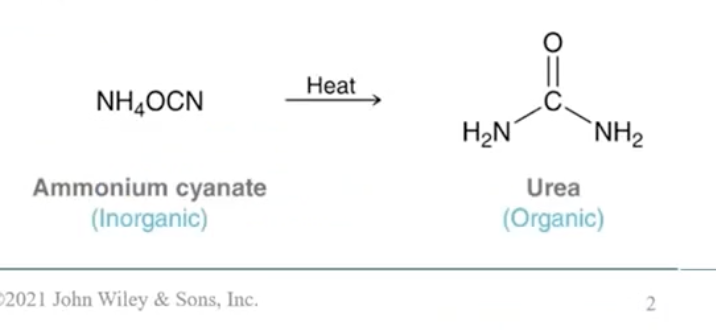
Is urea organic or inorganic?
Organic
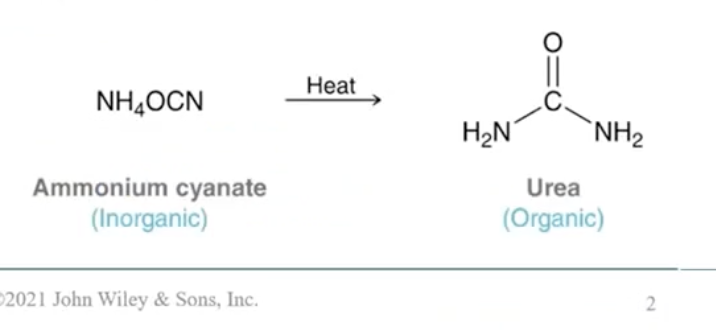
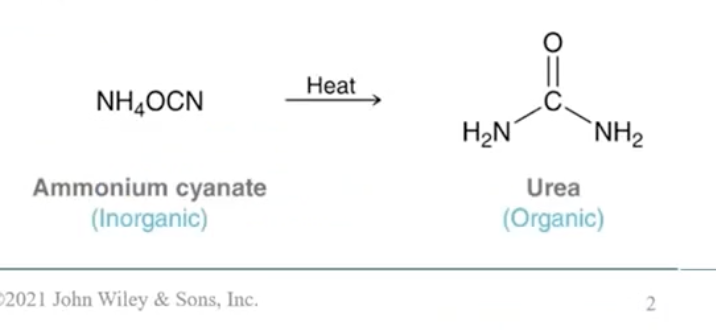
What does the ammonium cyanate → urea example demonstrate?
An inorganic compound can be converted into an organic compound
What is organic chemistry?
The study of carbon-containing molecules and their reaction
What happens when molecules react?
Molecules collide
Bonds Break
New Bonds Form
What happens to bonds during a chemical reaction?
Old bonds are broken and new bonds are made
What do curved arrows show in an organic reaction?
The movement of electrons
(In other words: The arrow shows where electrons start and where they go)


In the reaction shown, what new bond is formed?
A C-O bond


In the reaction shown, what bond is broken?
The C-I

What should you focus on to understand why organic reactions occur?
The electrons
How are electron movement, bonds, and reactions connected?
Electrons move → bonds break/form → molecules change
Why did structural theory suggest about substances in the mid-1800s?
Substances are defined by a specific arrangement of atoms
Why is molecular formula not always enough to define a compound?
Because atoms can be bonded together in different ways
What are constitutional isomers?
Compounds with the same molecular formula but different structures
In other words: Same atoms and amounts, but different connections
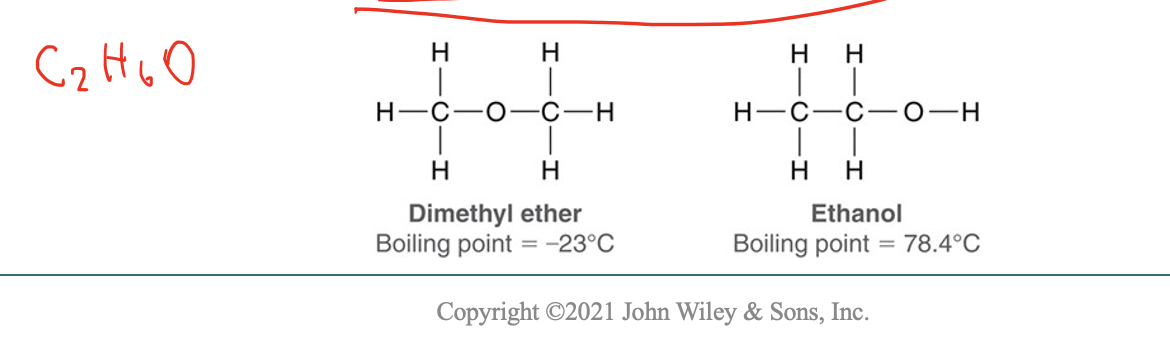
What molecular formula do dimethyl ether and ethanol share?
C2H6O
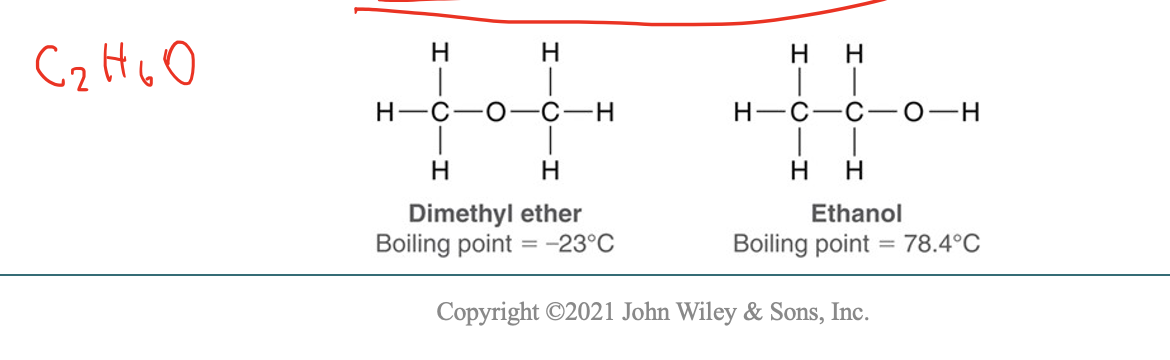
Why are dimethyl ether and ethanol constitutional isomers?
They have the same molecular formula but their atoms are connected differently
How are the atoms connected in dimethyl ether vs. ethanol?
Dimethyl ether → C-O-C
Ethanol → C-C-O
What can happen when compounds have the same molecular formula but different structures?
They can have different properties
Example: Dimethyl ether and ethanol have very different boiling points
What atoms are most commonly bonded to carbon?
N
O
H
Halogens (X)
What does X represent in organic chemistry?
A halogen: F, Cl, Br, I
How many bonds does carbon generally form?
4 bonds
What does tetravalent mean?
Generally forms 4 bonds

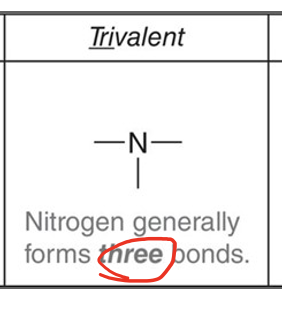
How many bonds does nitrogen generally form?
3 bonds
What does trivalent mean?
Generally forms 3 bonds
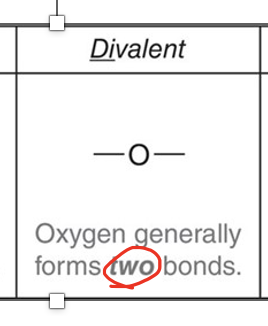
How many bonds does oxygen generally form?
2 bonds
What does divalent mean?
Generally forms 2 bonds
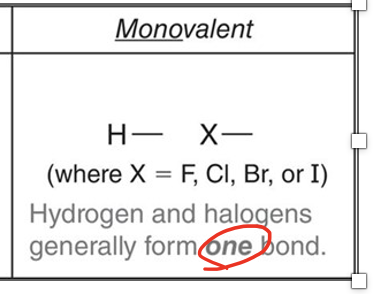
How many bonds do hydrogen and halogens generally form?
Generally form 1 bond
What does monovalent mean?
Generally forms 1 bond
What are the typical bonding patterns for C, N, O, H, and X?
C=4
N=3
O=2
H=1
X=1
What is a covalent bond?
A pair of electrons shared between two atoms
How many electrons are shared in one covalent bond?
2 electrons
What does the line H-H represent?
A shared pair of electrons, or one covalent bond
What molecule forms when two H atoms form a covalent bond?
H2
What is the relationship between energy and stability?
Lower energy = Greater stability
Connection Card: Why do two H atoms form a stable covalent bond?
Bonding allows the H atom to reach a lower-energy, more stable state
In other words: H atoms bond because the bonded arrangement is more stable
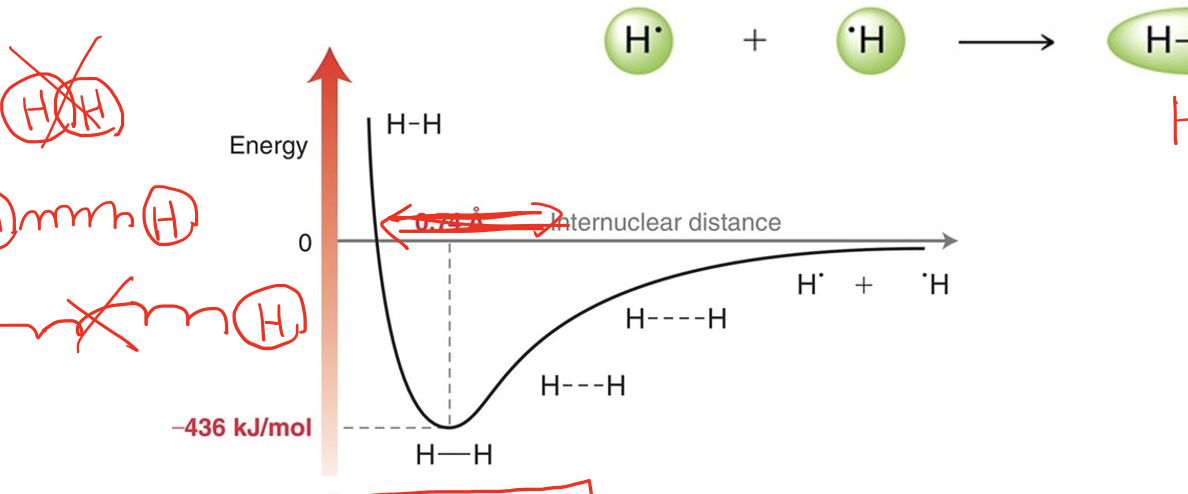
What does the Y axis of the H-H graph represent?
Energy

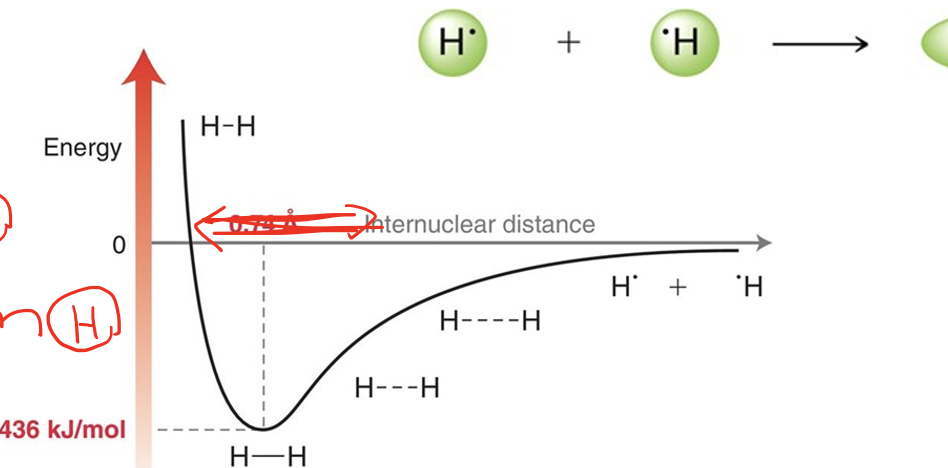
What does the X-axis of the H-H graph represent?
Internuclear distance: the distance between the nuclei of the two H atoms
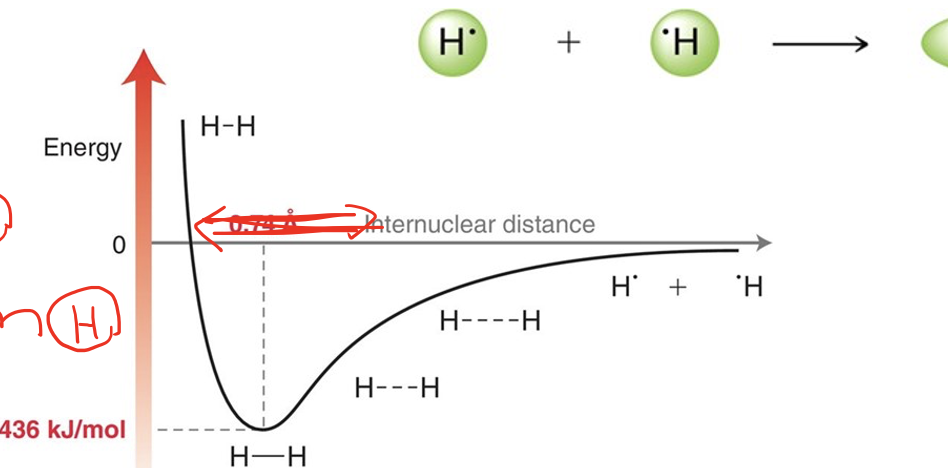

What does the far right side of the H-H energy graph represent?
Two atoms far apart and not bonded
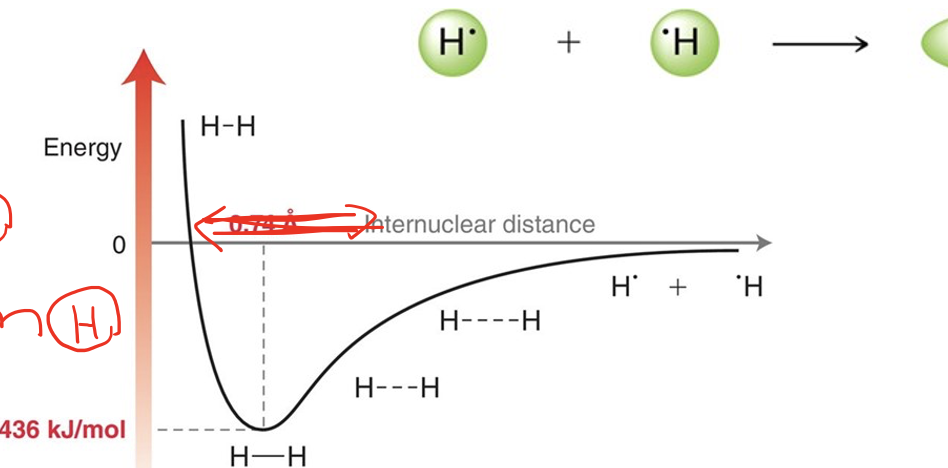
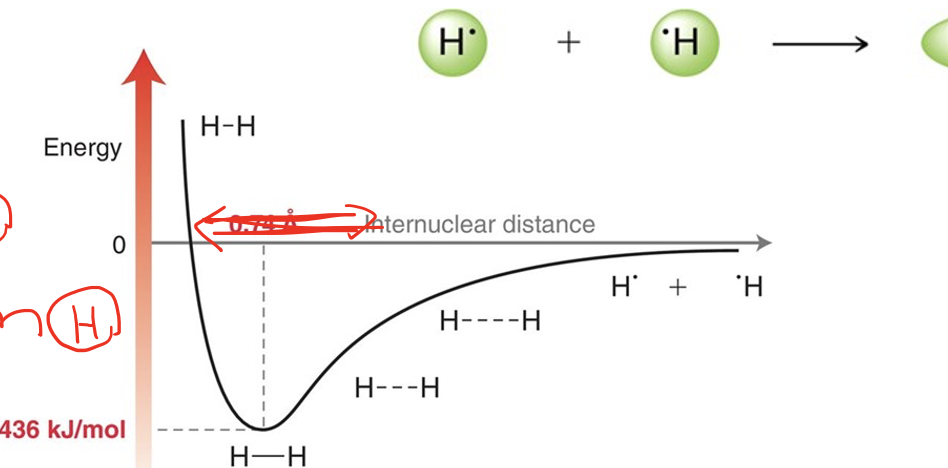
What happens to energy as two H atoms approach the proper bonding distance?
Energy decreases
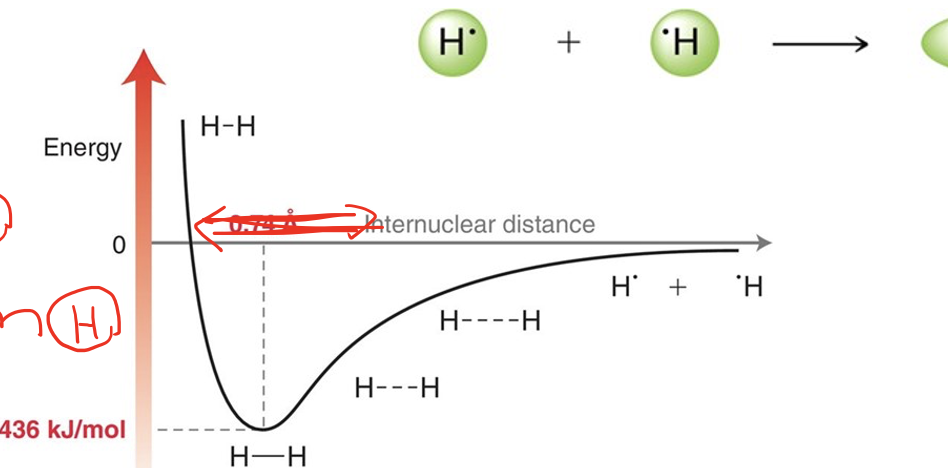
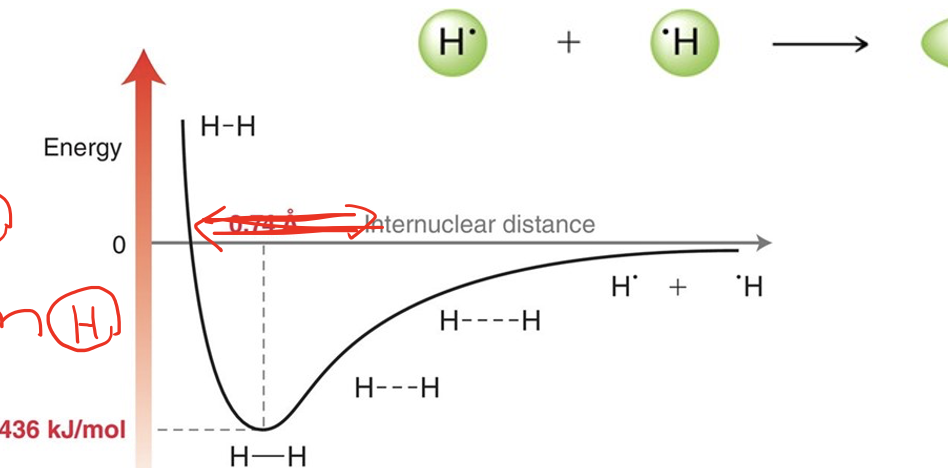
How can you identify the most stable arrangement on the H-H energy graph?
Find the lowest point on the energy curve


What does the bottom of the H-H energy curve represent?
The lowest energy, most stable arrangement, where a stable H-H covalent bond exists

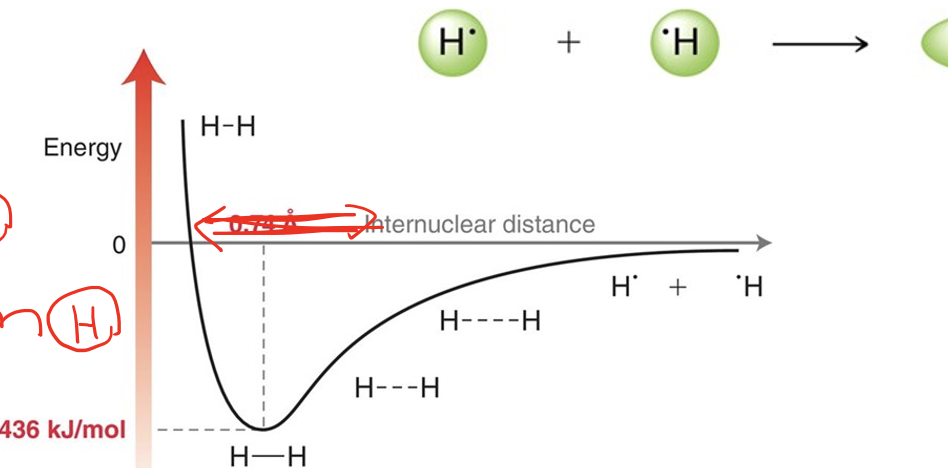
What happens if the two H atoms become to close together?
Their energy increases sharply, making the arrangement less stable
Connection card: How are covalent bond formation, energy, and stability connected?
H atoms approach→ energy decreases → stability increases → stable H-H bond forms at the energy minimum
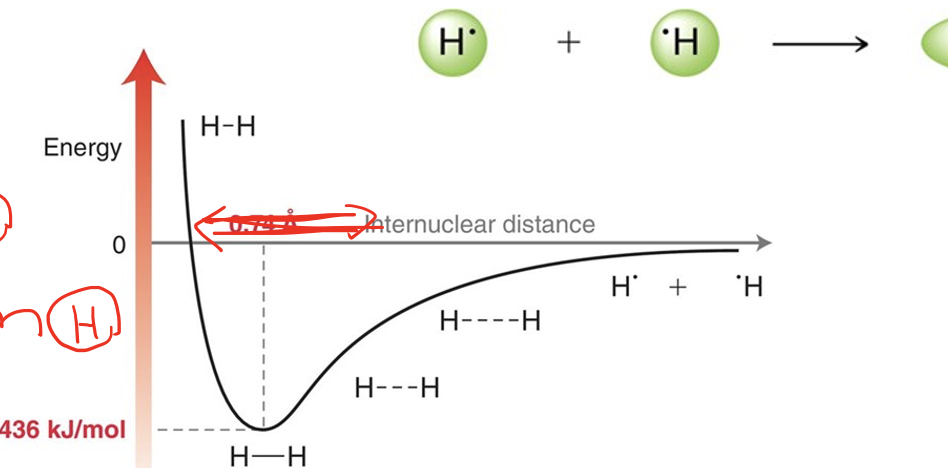
How are potential energy and and stability related?
Lower potential energy= greater stability
What happens to stability as potential energy increases?
Stability decreases
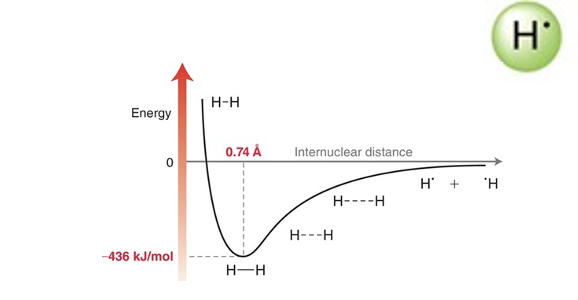
Where is the H-H molecule most stable on the potential-energy graph?
At the lowest point of the curve

What is the optimal internuclear distance for H-H shown on the slide?
0.74A
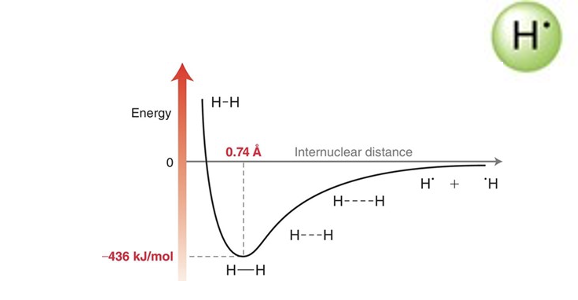
What is the potential energy at the minimum of the H-H graph shown on the slide?
-436kJ/mol
What is internuclear distance?
The distance between the nuclei of two atoms
What attractive forces help hold a covalent bond together?
Attraction between positively charged nuclei and negatively charged electrons
What force occurs between the two positively charged nuclei?
Repulsion
What force occurs between the two negatively charged electrons?
Repulsion
What are the three types of electrostatic interactions are present in H2?
Nucleus → electron = attraction
Nucleus → nucleus = repulsion
Electron → electron = repulsion
What charge does a proton have?
+1 charge
What charge does a neutron have?
Neutral (0) charge
Where are protons and neutrons located in an atom?
In the nucleus
What charge does an electron have?
-1 charge
Where are electrons located?
In orbitals outside the nucleus
What are valence electrons?
Electrons in the outermost shell of an atom
Why are valence electrons important in organic chemistry?
They are the electrons involved in bonding
How many total electrons does neutral carbon have?
6 electrons
How many of carbon’s 6 electrons are in its outermost shell?
4 electrons
How many valence electrons does carbon have?
4 valence electrons
If shown carbon’s electrons in shells, how do you identify its valence electrons?
Find the electrons in the outermost occupied shell
How are valence electrons connected to covalent bonding?
Valence electrons are the electrons involved in forming bonds
Does carbon have 6 valence electrons because it has 6 total electrons?
No. Carbon has 6 total electrons, but only 4 are valence electrons because they are in its outermost shell

Practice Problem
Hydrogen: 1
Nitrogen: 5
Sulfur: 6
Bromine: 7
Helium: 8
What do dots represent when drawing individual atoms for a Lewis structure?
Valence electrons
What do dots represent when drawing individual atoms for a Lewis structure?
Valence electrons
What are the two basic steps for drawing the simple Lewis structures shown on this slide?
Draw each atom’s valence electrons as dots
Put atoms together so they share electron pairs to complete their outer shells

What is an anion?
A negatively charged atom
What is a cation?
A positively charged atom
What does formal charge compare?
The valence electrons an atom owns in a molecule to the valence electrons it needs to be neutral
What determines how many valence electrons an atom “owns” in a molecule?
Its bonding pattern
What formal charge does an atom have if it owns the same number of valence electrons it needs to be neutral?
0 neutral
What happens if an atom owns MORE electrons than it needs to be neutral?
It has a negative formal charge
In other words: Extra e → negative
What happens if an atom owns fewer electrons than it needs to be neutral?
It has a positive formal charge
In other words: Fewer e → positive
Nitrogen normally has 5 valence electrons and owns 5 in a molecule. What is its formal charge?
0
Nitrogen normally has 5 valence electrons but owns 6 in a molecule. What is its formal charge?
-1
It owns one extra electron
Nitrogen normally has 5 valence electrons but owns only 4 in a molecule. What is its formal charge?
+1
It owns one fewer electron
Connection card: How are valence electrons, Lewis structures, and formal charge connected?
Normal valence e⁻ → Lewis structure shows bonding pattern → determine e⁻ ownership → determine formal charge.
What is electronegativity?
How strongly an atom attracts shared electrons
What does a more electronegative atom do to shared electrons in a covalent bond?
It attracts them more strongly toward itself
In what direction does electronegativity increase across a row of the periodic table?
Left → Right

In what direction does electronegativity increase within a column of the periodic table?
Bottom → Top

In what overall direction does electronegativity increase on the periodic table?
Toward the upper right
What is the most electronegative atom?
Fluorine (F)
What electronegativity value is given for fluorine on this slide?
4.0
Which is more electronegative, chlorine or bromine?
Chlorine
Electronegativity increases up a column
Which is more electronegative, carbon or oxygen?
Oxygen
C= 2.5 O=3.5
Electronegativity increases across
How are electronegativity and covalent bonding connected?
Electronegativity determines how strongly each bonded atom attracts the shared electrons.
If two bonded atoms have different electronegativities, which atom pulls the shared electrons more strongly?
The atom with the higher electronegativity.
Are electronegativity and number of valence electrons the same thing?
No
Valence electrons = outermost-shell electrons
Electronegativity = strength of attraction for shared electrons
What determines whether a bond is covalent, polar covalent, or ionic on this slide?
The electronegativity difference between the two bonded atoms
What electronegativity difference indicates a covalent bond according to this slide?
Less than 0.5