LIT LONG QUIZ
 Call Kai
 Learn
Learn Practice Test
 Spaced Repetition
 Match
Match Flashcards
 Knowt Play
1/53

There's no tags or description
Looks like no tags are added yet.
Name | Mastery | Learn | Test | Matching | Spaced | Call with Kai | Chat |
|---|
No analytics yet
Send a link to your students to track their progress
54 Terms
Classical literature
Literature from ancient Greece (approx. 800 BCE – 300 BCE) and Rome (approx. 300 BCE – 400 CE).
recognized for its high aesthetic quality, enduring universality, and structural importance
Classical literature theory
set of original rules and standards (Plato and Aristotle), that decided what makes a piece of writing successful, believable, and beautiful.
study of literature's job to affect the audience
Epic poetry
A long narrative poem detailing the journeys and achievements of a hero who embodies the values of his culture.
Tragedy (Drama)
A play that ends sorrowfully, often focusing on a great character's moral struggle that leads to their inevitable and devastating fall.
Anagnosis
a painful moment of discovery of one’s downfall
Comedy (Drama)
A play with a happy or hopeful ending that is often crude, exaggerated, and focuses on mocking social norms or political figures (satire)
Recurring themes
Fate vs. Free will
Hubris
Fate vs. free will
god gives prophecy (fate) but the heroes choices (free will) determine if/how the prophecy comes true
Hubris
excessive pride/arrogance of the main character. thinking you are equal or greater than the gods (always precedes a fall)
Theories
Plato and the attack on art
Aristotle and the defense of art
Plato and the attack on art
Plato attacks art, saying it is a lie and only an imitation of life
Art is a lie because it copies a physical object, which is itself a copy of a Form. It appeals to the emotions, making us irrational.
Plato
A supreme philosopher (c. 428–348 BCE), focusing on ideal, eternal truths.
Mimesis
also known as imitation; Plato believed art was an imitation, a lie and far removed from the truth
The forms
Plato’s concept of the perfect, eternal blueprints (Justice, beauty, strength)
Aristotle and the defense on art
Aristotle defends art, saying it has purpose
Aristotle
Plato's student (c. 384–322 BCE), who was more interested in analyzing the physical world and logic.
Catharsis
Also known as purification or cleansing; Aristotle says art has purpose in allowing us to release negative emotions and allows us to relate
Essential elements of tragedy
Plot- the arrangement of events, most important
Characters- second most important
Plot
the arrangement of events, most important
Character
second most important
Universal structure
For Aristotle, a story must have a beginning, middle and end
Significance of classical literature
established the DNA of Western storytelling. Most present storytellers either imitate or directly oppose
Catharsis explains why we choose sad music/movies. Art acts as a safe, temporary release of emotions
Mythology
field of scholarship dealing with myth but also a particular body of myths.
mythos=speech, message (spoken myth)
5th century BCE: entertaining but not really trustworthy tale
Myth
traditional tale with secondary, partial reference to something of collective importance.
Why does mythology matter?
It is the invisible foundation of the modern world
Provides the basic plot, character archetype, and conflicts
Greek mythology
the model (blueprint, the inspiration)
Greek civilization was highly advanced in art, philosophy, and literature.
Roman Mythology
the analogy (the inspired)
when the roman civilization rose to power, they admired or adopted much of greek culture
pietas
to the romans, worshipping the gods was a civic duty called:
Focus of greek mythology
drama and passion; individual city states (polis); local heros
Focus of roman mythology
value of duty and order; focus on the state and empire in general
Origins of the pantheon
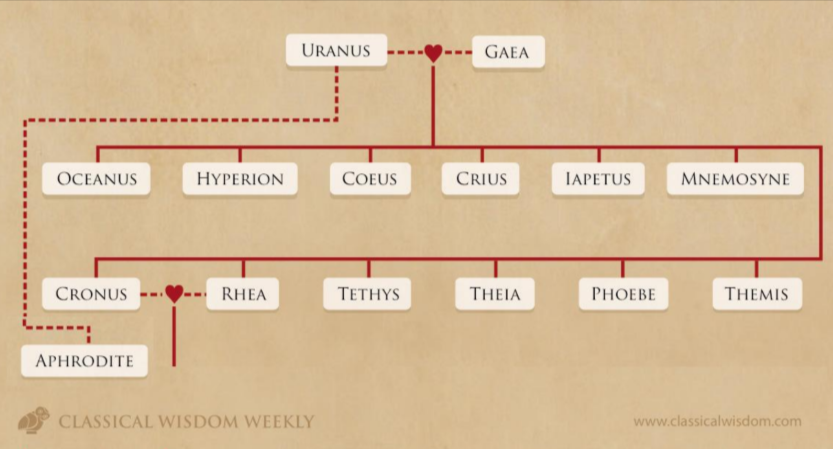
Uranus and Gaea (primordial deities)
Oceanus to Cronus (Titans)
Zeus to Dionysus (Olympians)
Hades is not an olympian
Zeus (Jupiter)
The powerful, but often lustful and temperamental
King of the Gods
He rules the Sky and wields the Thunderbolt
His animal is the eagle
Poseidon (Neptune)
God of the Sea, earthquakes, and horses
Known for his temper and wielding the Trident
Hades (Pluto)
Ruler of the Underworld and associated with subterranean wealth
He rarely leaves his dark realm and is not technically an Olympian, but one of the major gods.
Hera (Juno)
Zeus's wife and sister, the Queen of the Gods
She is the protective goddess of marriage, but is notoriously jealous and vengeful due to Zeus's infidelity
Demeter (Ceres)
is the Greek goddess of agriculture, harvest, and fertility
is known for her important myth involving her daughter, Persephone, and the changing seasons
Athena (Minerva)
Goddess of wisdom, strategic warfare, and handicrafts
She was born directly from Zeus's head, fully armored
Aphrodite (Venus)
Goddess of love, beauty, and desire
Betrothed to Hephaestus (symbolizes union of beauty and craft) by Zeus but is in love with Ares
Ares (Mars)
God of war (specifically the brutal, chaotic side)
His character is far less respected in Greece than his Roman counterpart
Apollo (Apollo)
The mother of Apollo and Artemis is Leto, a Titaness and goddess of motherhood. She was the consort of Zeus and the twins were the result of their union.
god of the sun, music, prophecy, and healing. He also represents order and reason.
Artemis (Diana)
The mother of Apollo and Artemis is Leto, a Titaness and goddess of motherhood. She was the consort of Zeus and the twins were the result of their union
the goddess of the hunt, wilderness, and the moon. She is fiercely independent and protective of nature.
Hermes (Mercury)
The quick-witted messenger of the gods, god of travel, thieves, and commerce
He wears winged sandals
Hephaestus (Vulcan)
The lame god of fire, metalworking, and craftsmanship
He is the divine blacksmith who helped Zeus crack his head to birth Athena
Dionysus (Bacchus)
the Greek god of wine, grape harvest, and wine-making
is also associated with religious ecstasy, madness, fertility, and theatre
The son of Zeus and a mortal woman named Semele, he is often called the "twice-born god" because Zeus saved him and sewed him into his thigh after his mother died.
The realms
Mount Olympus
The underworld
Mount Olympus
The literal and spiritual home of the Olympian gods.
The underworld
This is the realm of the dead, ruled by Hades. It's a shadowy realm where souls go after death.
Heroes
figures who possess courage, cunning, or immense strength and often undergo great hardship (The Hero's Journey).
They are frequently demigods (half-mortal, half-god).
Monsters
represent chaos, nature untamed, or challenges that test a hero's divine or human virtues.
Key Greek heroes
Hercules
Odysseus
Perseus
Key Roman Heroes
Aeneas
Romulus and Remus (founders of rome)
Iconic monsters
Minotaur
Cyclops
Hydra
Function of myths
Explaining nature
● Teaching morality and
warning against hubris
Importance of greek and roman mythology
the "cheat sheet" for understanding thousands of years of Western art, literature, and philosophy.
Concepts in psychology and language are derived from these myths (Oedipus complex, chaos)
The ancient Greeks and Romans wrestled with the same questions we do: Why is there suffering? What is true love? What does it mean to be a good leader? Their myths are their answers.