10.6/10.7: Torque and Newton's 2nd Law of Rotation
 Call Kai
 Learn
Learn Practice Test
 Spaced Repetition
 Match
Match Flashcards
 Knowt Play
1/5

There's no tags or description
Looks like no tags are added yet.
Name | Mastery | Learn | Test | Matching | Spaced | Call with Kai | Chat |
|---|
No analytics yet
Send a link to your students to track their progress
6 Terms
Torque Definition
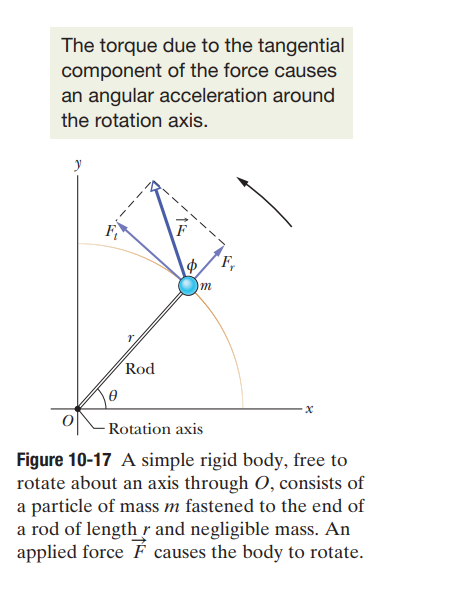
Torque is the rotational effect generated by the application of a force onto a point tangent to an object that is hinged about a rotational axis.
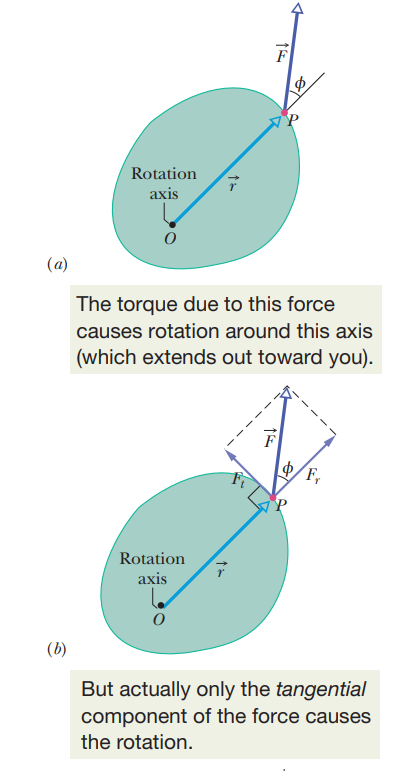
If a body has a rotational axis and has a force applied to it, then the only component of that force that will generate rotational motion is the tangential component of that force; the radial component moves in the direction of the radius and does not affect rotational motion.
Torque Magnitude
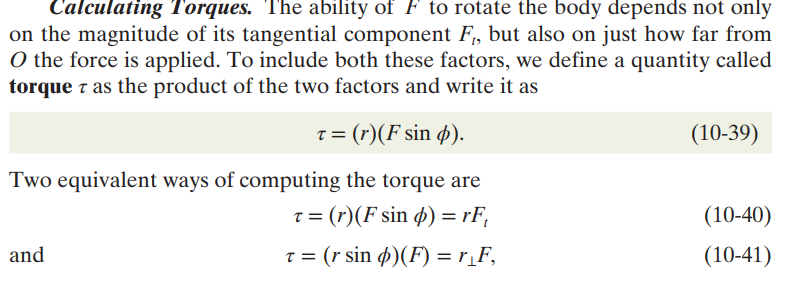
The magnitude of the torque force is dependent on the radial distance from the rotational axis to the point at which the force is applied; furthermore, it is also dependent on the force tangential to the object.
Phi is the angle between the force and the pivot point. If a force is applied parallel to the pivot point, then the angle is 0 and thus the torque is 0. Intuitively, this makes sense: exerting a horizontal force against a rod fixed against a rotational point will not cause any rotational force.
Newton’s Second Law for Rotational Dynamics
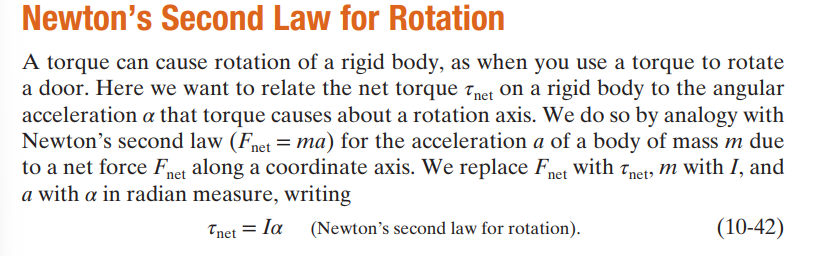
In the same way how there is the relationship F = ma, so too there is an equivalent for rotational dynamics:
T = I * a
T = torque force generated (NET force too)
I: Moment of inertia of the object
a: the angular acceleration of the object
Derivation of Newton’s Second Law for Rotational Dynamics
Visual of Torque