EBD Quiz 1
 Call Kai
 Learn
Learn Practice Test
 Spaced Repetition
 Match
Match Flashcards
 Knowt Play
1/15

There's no tags or description
Looks like no tags are added yet.
Name | Mastery | Learn | Test | Matching | Spaced | Call with Kai | Chat |
|---|
No analytics yet
Send a link to your students to track their progress
16 Terms
What is EBD? (evidence based dentistry)
Approach oral healthcare via
1. clinically relevant scientific evidence
2. relate patient oral/medical condition and history TO current treatment needs and preferences
3. Adding dentist clinical expertise
Why is EBD important in dental practice?
reduces unneeded variations in practice patterns
2. gain new knowledge for clinical / patient care
3. makes info overload and growing knowledge managable.
4. meet standards for dental education (problem solving/critical thinking / self directed learning / self assessment)
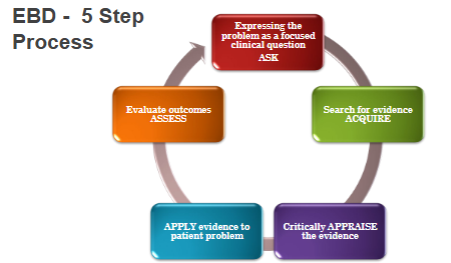
5 steps of EBD
ASK → ACQUIRE → APPRAISE (filter best evidence) → APPLY → ASSESS
What are the 2 types of questions used in EBD process?
Background Questions
The clinical question
Background Questions
Represent foundational knowledge
Info to help understand the problem
helps when making the clinical question
Not info you get from patient
Clinical Question
develops answer to clinical problem
Using info gathered from background questions
Uses PICO format
PICO
Patient / problem / population
Intervention
Comparison
Outcomes
P in Pico
patient / problem / population
(what is an important condition of the patient? problem? disease? age/race/gender/meds?
I in PICO
Intervention
What could be done for patient. test? treatment? recommendation?
C in PICO
Comparison
An alternative to the main intervention.
Specific and limited to 1.
optional (no alternative)
O in PICO
outcomes
Desired result
Should be measurable AND specific
4 categories of clinical questions
treatment/prevention
Diagnosis
Harm/Etiology
Prognosis
Treatment / Prevention Question
questions that look for answers that determine the effect of treatments

Diagnosis Questions
determine the degree to which is a test/diagnosis method is reliable and useful

Harm / Etiology Questions
Identifying the cause of a disease/condition.
Finding relationships between disease and risk factors

Prognosis Questions
Estimating the clinical course / progression of a disease / condition.
Finding the eventual complications
