Chapter 16: Polymers
 Call Kai
 Learn
Learn Practice Test
 Spaced Repetition
 Match
Match Flashcards
 Knowt Play
1/27

There's no tags or description
Looks like no tags are added yet.
Name | Mastery | Learn | Test | Matching | Spaced | Call with Kai | Chat |
|---|
No analytics yet
Send a link to your students to track their progress
28 Terms
What are polymers on a molecular level?
Huge, chain-like molecules in which atoms forming the backbone (usually carbon) are linked by covalent bonds
What are the three categories of polymers?
Thermoplastic
Thermosetting
Elastomers
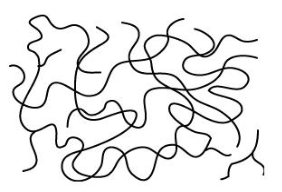
Thermoplastic
flexible linear chains
when heated, secondary bonds between chains weaken and chains can glide past each other
can be reshaped or recycled or softened
No cross-linking
ex. PVC, polyethylene
Thermosetting
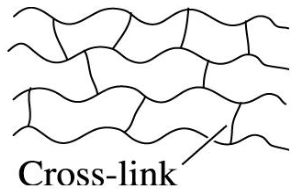
rigid 3D network
heating up = degradation
cannot be reshaped
strong cross-linking
chains can easily slide past each other if not properly linked
ex. epoxies, resins
Elastomers
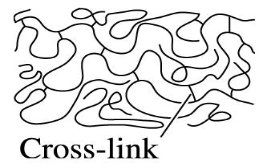
thermoplastics or lightly cross-linked thermosets consist of coil or spring-like molecules
not as many cross-links
cross-links prevents the chains from permanently sliding part
ex. rubber
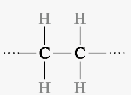
Polyethylene
Properties:
flexible
lightweight
chemically resistant
Application:
packing films
wire insulation
squeeze bottles
tubing
household items
What are some applications of polypropylene?
tanks
carpet fibers
rope
packaging
What are some applications of polystyrene?
packaging and insulation foams
lighting panels
appliance components
egg cartons
What are some applications of polyacrylonitrile?
textile fibers
precursor for carbon fibers
food container
What are some applications of polymethylmethacrylate?
windows
windshields
coatings
hard contact lenses
lighted signs
What are some applications of polychlorotrifluoroethylene?
valve components
gaskets
tubing
electrical insulation
What are some applications of polytetrafluoroethylene?
*Hydrogen is replaced by fluorine
seals
valves
nonstick coatings
Degree of polymerization
# of repeat units in a polymer chain
= average molecular weight of polymer chain / molecular weight of repeat unit
Which is usually bigger than the other: number-average molecular weight (Mn) or weight-average molecular weight (Mw)? Why?
Mw >= Mn
b/c long chains receive extra emphasis in the weight-average calculation
When are Mw and Mn equal?
When all polymer chains have exactly the same molecular weight
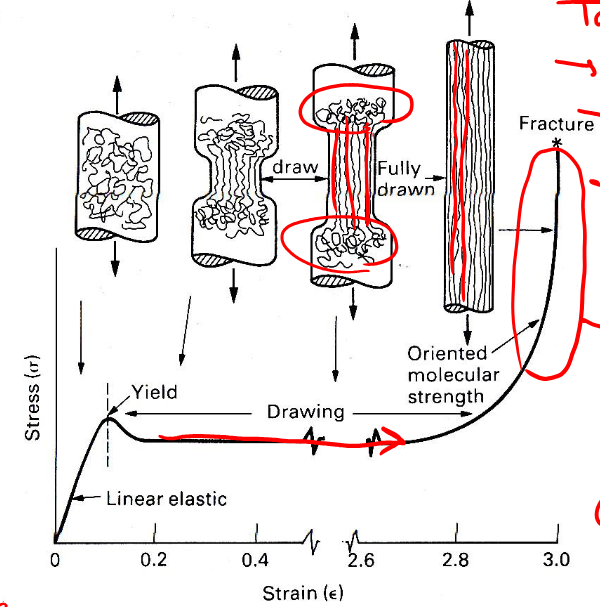
Describe the mechanical behaviour of polymers (for a ductile thermoplastic polymer)
Tangled chains → neck formation → chain alignment → fully drawn polymer → fracture
Strong strength-hardening b/c chains cannot untangle anymore, a higher force is needed to continue
At fracture, aligned chains and covalent bonds cannot withstand the load, so fracture occurs
What does relaxation modulus measure in polymers?
How well a polymer maintains stress under constant deformation
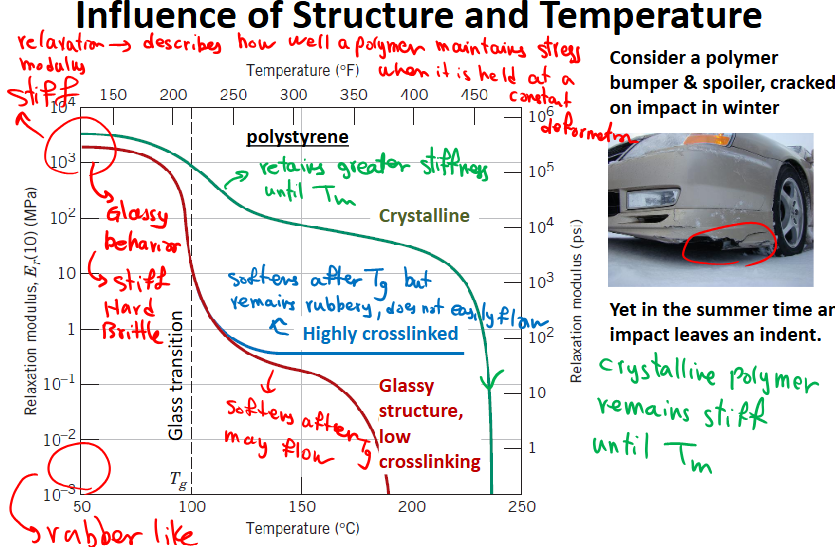
What is the behaviour of polystyrene below Tg?
Glassy, stiff, hard, brittle
What is the behaviour of polystyrene below Tg?
Softens and becomes rubbery
What is the meaning of Tg in polymers?
Glass transition temperature
What are the effect of high crosslinking?
Polymer softens after Tg but does not easily flow
What are the effect of low crosslinking?
Polymer softens after Tg and may flow
Why do crystalline polymers stay stiff until Tm?
Crystalline regions act as reinforcing structures
What happens to relaxation modulus as temperature increases?
It decreases, indicating reduced stiffness
Why does a car bumper crack in winter?
Polymer is below Tg and behaves brittle
Why do car bumpers dent in summer?
Polymer is above Tg and behaves rubbery
Which type of polymer retains stiffness until Tm?
Crystalline polymer
What structural feature prevents polymer chains from sliding past each other?
crosslinking