lecture 1
 Studied by 1 person
 Call Kai
 Learn
Learn Practice Test
 Spaced Repetition
 Match
Match Flashcards
 Knowt Play
1/24

There's no tags or description
Looks like no tags are added yet.
Name | Mastery | Learn | Test | Matching | Spaced | Call with Kai |
|---|
No analytics yet
Send a link to your students to track their progress
25 Terms
what is epithelium/epithelial tissue?
a thin layer of epithelial cells that covers the body surface and lines internal organs and cavities, providing protection, secretion and absorption functions
what is epithelial cells?
come in a variety of shapes: squamous, columnar, and cuboidal. Arranged in a single layer (simple) or in 2 or more layers (stratified).

what is epidermis?
The outermost layer of the skin, composed of stratified squamous epithelium. Note that your skin is not just epidermis though
what is the integumentary system?
•The body covering, which includes the skin and its appendages (e.g. hair, nails, oil and sweat glands), as well as blood vessels, lymphatic and nerve endings embedded in the skin.
integumentary system functions in terms of thermoregulation?
eccrine glands produce sweat, evaporation of sweat reduces body temperature
blood vessels in the dermis dilate to increase heat loss and constrict to reduce heat loss
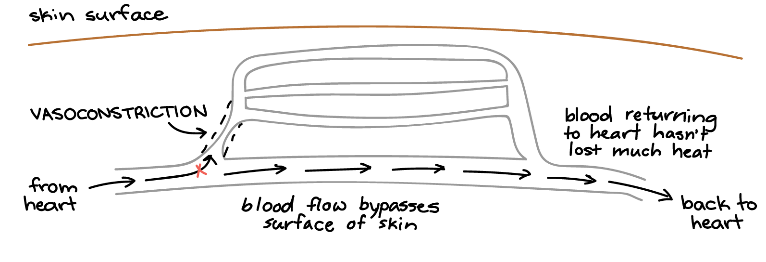
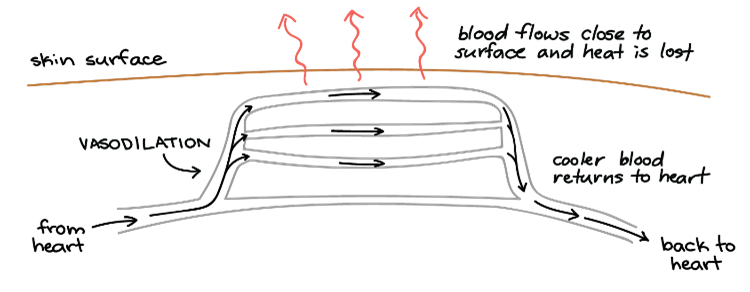
integumentary system functions in terms of protection from environmental insults?
protect the body from infection, chemicals, heat and mechanical damage
the acidic pH of sweat, and antimicrobials in sebum, reduce microbial growth
melanin protects against UV-mediated damage
immune sentinel cells patrol for signs of infection and tissue damage
integumentary system functions in terms of protection from dehydration?
Lipids released from lamellar granules protect against excessive evaporation of water from the skin, protecting against dehydration.
Lipids also prevent too much water entering the tissue
integumentary system functions in terms of sensation?
tactile, thermal, pain
integumentary system functions in terms of excretion and absorption?
•Comparatively limited role.
•400ml water lost daily through evaporation (independently of sweating).
•Salts, ammonia and urea excreted in sweat.
•Very limited absorption of water-soluble molecules.
•Lipid-soluble vitamins and drugs can be absorbed through the skin.
•Cutaneous respiration (but only ~1% of gas exchange).
there is a production of vitamin D3 in response to?
UVB
what is the skin layers surface area, body weight and varies in thickness?
surface area: 1.2- 2.2 m2
8% of body weight
varies in thickness 1.5 - 4mm)
what is the skin layer composed of?
epidermis outer epithelial layer; avascular
dermis: inner layer of dense connective tissue; vascularised; the bulk of the skin
describe hypodermis?
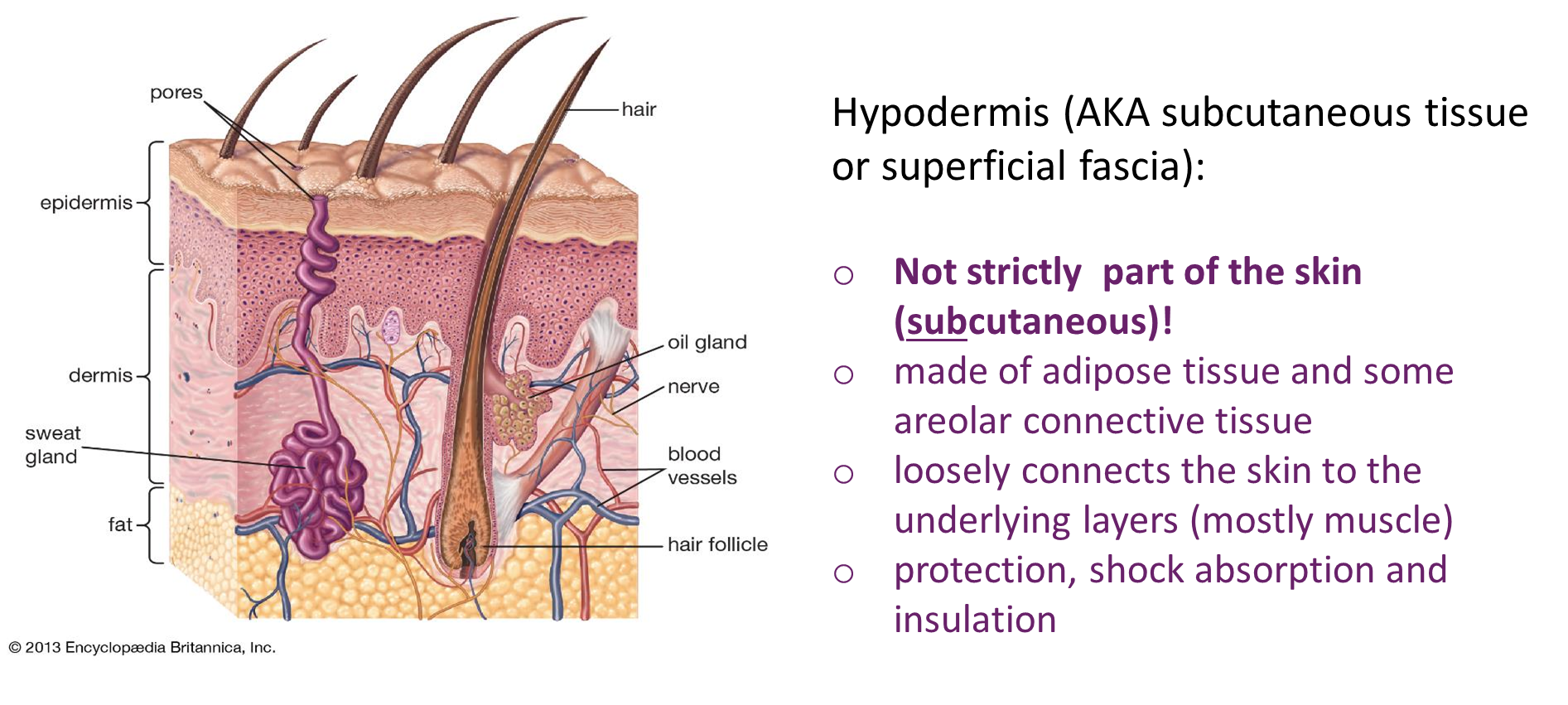
•Epidermis: keratinised stratified squamous epithelium
name the types of skin layers (deep to superficial)?
Stratum basale (basal layer)
Stratum spinosum (spinous or prickly layer)
Stratum granulosum (granular layer)
Stratum corneum (cornified or horny layer)
thick skin also has a stratum lucidum (clear layer, between granulosum and coeneum)
thick vs thin skin differences?
•Thin skin covers most of the body. It has hair follicles.
•Thick skin has no hair follicles, and is found only on the plantar (foot) and palmar surfaces (hands).
•The thickness of skin varies from 0.5mm (eyelids) to 4.0mm (heels).
the epidermis main cell type is?
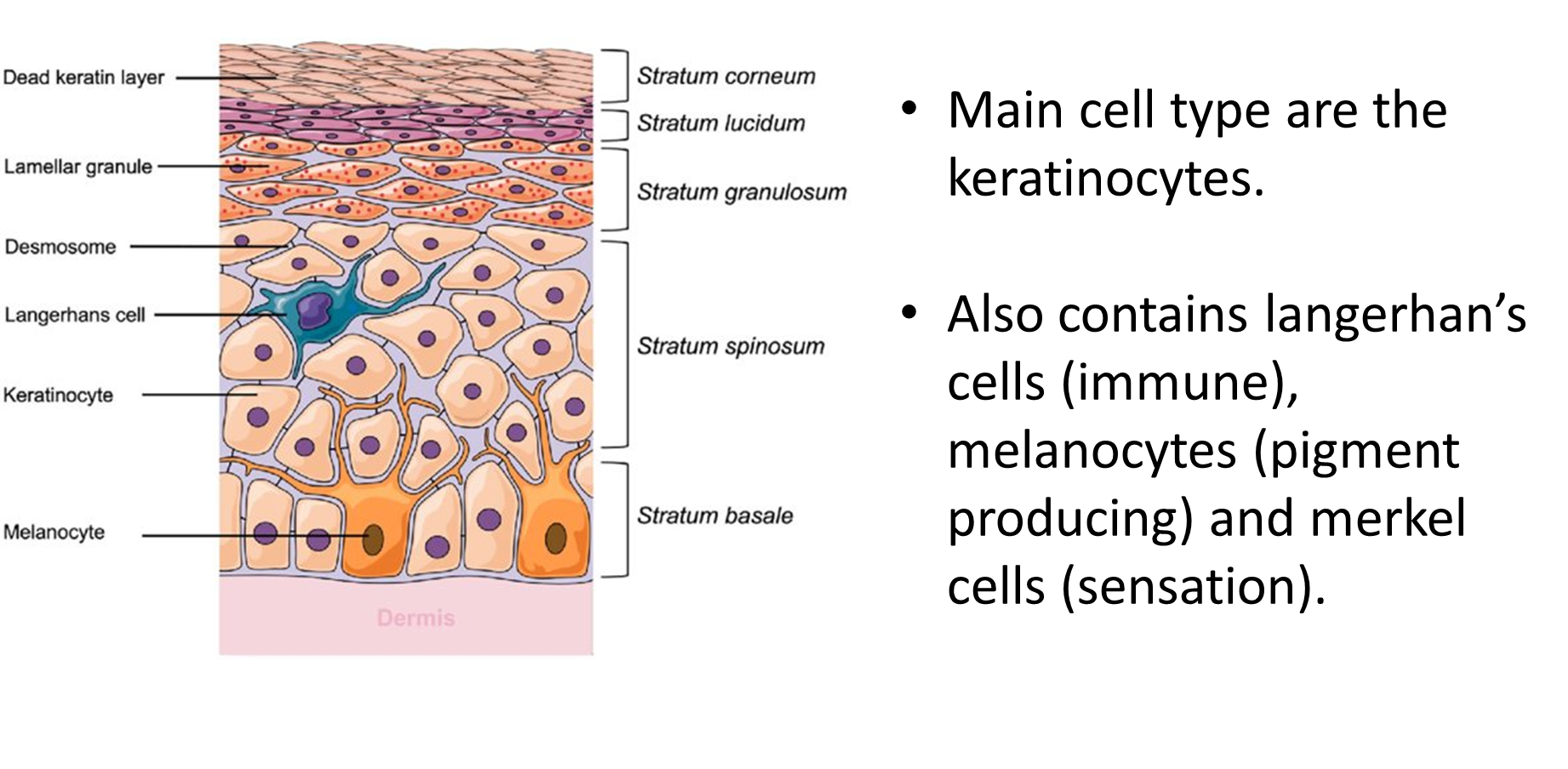
describe keratinocytes?
Most abundant cells in the epidermis (90-95%)
Produce keratin (a tough, fibrous protein) and lamellar bodies (generate lipid barrier in epidermis).
Held together by desmosomes and tight junctions
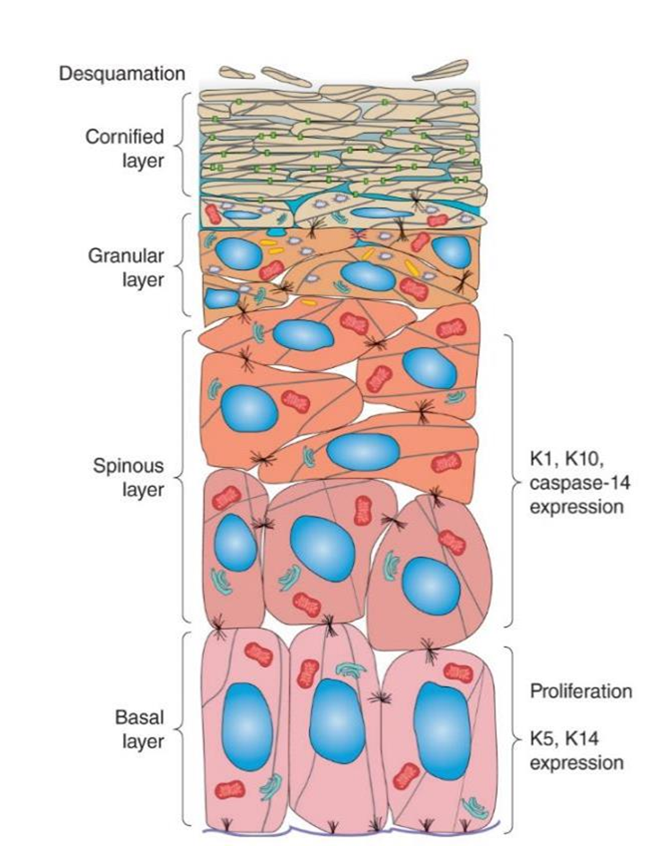
keratinocytes
stem cells are located in the basal layer (stratum basale) of the epidermis and in the hair follicles. these cells divide and produce new?
keratinocytes
as keratinocytes move upwards through the layers of the epidermis, they undergo a process of ?
differentiation
(they accumulate keratin in the cytoplasm [keratinization])
keratinocytes become less metabolically active and undergo?
cell death as they pushed towards the surface of the skin (due to calcium gradients, and the epidermal layers closer to the surface receiving fewer nutrients).
Cells at the surface are eventually sloughed off and replaced.
describe the keratinocyte journey: stratum basale?- in depth
•Deepest epidermal layer, sitting on basement membrane.
•Single layer of columnar or cuboidal keratinocytes.
•Stem cells, melanocytes and tactile epithelial (Merkel) cells also present.
•Keratinocytes contain scattered keratin intermediate filaments (pre-keratin).
Keratin intermediate filaments attach to desmosomes, which connect keratinocytes to their neighbours
•Keratinocytes arranged in several layers.
•They now contain thick bundles of keratin intermediate filaments anchored to desmosomes.
•Langerhans cells and melanocyte projections also present.
•3-5 layers of flattened keratinocytes.
•Nuclei and other organelles are beginning to degrade as the cells start to undergo organised cell death.
•Two types of granules can be seen:
oKeratohyaline: a protein that forms keratin from keratin intermediate filaments.
oLamellar: membrane-bound granules that fuse with the cell membrane to release a water-resistant glycolipid that occupies the spaces between cells.
describe the keratinocyte journey in terms of stratum lucidum and stratum corneum?
•Stratum lucidum only in thick skin and Stratum corneum in both thick and thin skin.
•Both contain flattened, dead keratinocytes, containing large amounts of keratin.
•Stratum corneum can be really thick (average 20-30 layers, up to 50 in thick skin).
•Cells in each layer overlap, and the plasma membranes form folds to hold the layers together.
•Embedded in a lipid mixture from the lamellar bodies.
other epidermal cell types
describe melanocytes?
•Found largely in the Stratum basale
•Produce melanin, but do not store it. Melanin is transferred to keratinocytes in membrane-bound organelles called melanosomes.
•Skin pigmentation and protection from UV damage
other epidermal cell types
describe langerhans cells?
•A type of tissue-resident macrophage with properties of dendritic cells
•Function as sentinel cells and antigen presenting cells (transport antigen to lymph nodes)
•Highly phagocytic.
Found in Stratum spinosum and papillary dermis
other epidermal cell types
describe merkel cells?
•Located in clusters at the epidermal-dermal junction.
•Involved in mechanotransduction (conversion of mechanical energy into electric signals in the peripheral nervous system)
•Intimately connected to sensory nerve endings
Sensation of light touch
 Note
Note  Flashcards (27)