Chapter 5 - Personality Judgment - The Personality Puzzle (8th Edition) - PSY 2530
 Call Kai
 Learn
Learn Practice Test
 Spaced Repetition
 Match
Match Flashcards
 Knowt Play
1/24

There's no tags or description
Looks like no tags are added yet.
Name | Mastery | Learn | Test | Matching | Spaced | Call with Kai | Chat |
|---|
No analytics yet
Send a link to your students to track their progress
25 Terms
What is another name for self-fulfilling prophecies?
expectancy effect or behavioral confirmation

What were the results of the Snyder, Tanke, and Berscheid (1977) study on social expectancy effects.
If the man had seen an attractive photograph, the woman was more likely to have behaved in a manner rated as warm, humorous, and poised than when he saw an unattractive photograph.
This finding implies that when the male student spoke to a woman he thought to be attractive, his behavior caused her to respond in a warmer and more friendly manner than she would have had he considered her unattractive.
Snyder interpreted this effect as another form of self-fulfilling prophecy: Attractive women are expected to be warm and friendly, and are treated in such a manner that they indeed respond that way.
The study suggests that our behavior with other people is influenced by how they expect us to act, sometimes based on superficial cues such as what we look like.
Snyder's results imply that, to some extent, we will actually become what other people perceive, or even misperceive, us to be.

What are the two primary criteria for evaluating personality judgments?
For personality judgments, the two primary converging criteria are interjudge agreement and behavioral prediction.
Psychological research can evaluate personality judgments by asking two questions:
(1) Do the judgments agree with one
another?
(2) Can they predict behavior?
To the degree the answers are Yes, the judgments are probably accurate.
convergent validation
The process of assembling diverse pieces of information that converge on a common conclusion.
For personality judgments, the two primary converging criteria are interjudge agreement and behavioral prediction.
If I judge you to be conscientious, and so do your parents, and so do your friends, and so do you, it is likely—though not certain—that you are conscientious.
Moreover, if my judgment that you are conscientious converges with the subsequent empirical fact that you arrive on time for almost all your class meetings for the next three semesters, and thereby demonstrates predictive validity, then my judgment of you is even more probably correct (although 100 percent certainty is never attained).
In sum, psychological research can evaluate personality judgments by asking two questions:
(1) Do the judgments agree with one
another?
(2) Can they predict behavior?
To the degree the answers are Yes, the judgments are probably accurate.
interjudge agreement
The degree to which two or more people making judgments about the same person provide the same description of that person's personality.
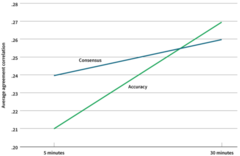
Familiarize yourself with research on first impressions.
It is possible for people to tell whether a person is high or low in two traits—extraversion and agreeableness—just from looking at the face.
In addition, we can do this for emotional stability in men—but (for some reason) not women.
What the findings probably mean in practice is that, from looking at someone's face, we are somewhat able to detect accurately the difference between
someone who is extremely extraverted and someone who is extremely introverted, or extremely agreeable versus extremely disagreeable.
Accurate discrimination in the middle range—where most people are found—is surely more difficult.

What are other visible signs of personality beyond the face?
[Clothing and hair choices, voice volume, state of bedroom, type of music, how they tell a story]
- The degree to which someone dresses fashionably and has a stylish haircut can lead perceivers to infer that she is extraverted, and they are correct more often than not.
- When a person speaks in a very loud voice, judges are apt to infer that he is extraverted, and that inference is usually accurate, too.
- Looking at the person's bedroom. People whose bedrooms house a variety of reading material are likely to be open to experience, whereas those who carefully make their beds and are otherwise neat tend to be conscientious
-The kind of music a person listens to. According to one study, people who enjoy reflective, complex music (New Age) tend to be inventive, imaginative, tolerant, and liberal. People who prefer aggressive and intense music (heavy metal) are more likely to be curious, risk-taking, and physically active. People who like upbeat and conventional music (pop) are relatively cheerful, outgoing, and helpful, but are not very interested in abstract ideas.
- The way a person tells a story. In one study, research participants wrote short stories and then other people read them and tried to assess what the writer was like. The personality ratings were remarkably accurate. Readers correctly inferred, among other cues, that sophisticated writing and creativity was a sign of openness to experience, and that using words that describe positive emotions and social orientation indicated that the writer tended to be agreeable
![<p>[Clothing and hair choices, voice volume, state of bedroom, type of music, how they tell a story]</p><p>- The degree to which someone dresses fashionably and has a stylish haircut can lead perceivers to infer that she is extraverted, and they are correct more often than not.</p><p>- When a person speaks in a very loud voice, judges are apt to infer that he is extraverted, and that inference is usually accurate, too. </p><p>- Looking at the person's bedroom. People whose bedrooms house a variety of reading material are likely to be open to experience, whereas those who carefully make their beds and are otherwise neat tend to be conscientious </p><p>-The kind of music a person listens to. According to one study, people who enjoy reflective, complex music (New Age) tend to be inventive, imaginative, tolerant, and liberal. People who prefer aggressive and intense music (heavy metal) are more likely to be curious, risk-taking, and physically active. People who like upbeat and conventional music (pop) are relatively cheerful, outgoing, and helpful, but are not very interested in abstract ideas.</p><p>- The way a person tells a story. In one study, research participants wrote short stories and then other people read them and tried to assess what the writer was like. The personality ratings were remarkably accurate. Readers correctly inferred, among other cues, that sophisticated writing and creativity was a sign of openness to experience, and that using words that describe positive emotions and social orientation indicated that the writer tended to be agreeable</p>](https://assets.knowt.com/user-attachments/7f409c37-df36-45ff-83e0-577f146bce46.png)
Research finds that by looking at someone's face,
a. we detect with some accuracy the difference between extremes of certain personality traits such as openness and neuroticism.
b. we detect with some accuracy the difference between extremes of certain personality traits such as extraversion and agreeableness.
c. we can discern a number of personality traits, such as courage, agreeableness, and emotional stability, with surprising accuracy.
d. the snap judgments we make about his or her personality have no real validity whatsoever.
We detect with some accuracy the difference between extremes of certain personality traits such as extraversion and agreeableness.
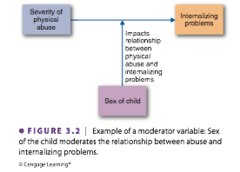
moderator variable
A variable that affects the relationship between two other variables.
What is the "transparent self" theory of psychological health?
Theorists have long postulated that it is psychologically healthy to conceal as little as possible from those around you, to exhibit what is sometimes called a "transparent self."
If you exhibit a psychological façade that produces large discrepancies between the person "inside" and the person you display "outside," you may feel isolated from the people around you, which can lead to unhappiness, hostility, and depression.
Acting in a way that is contrary to your real personality is a lot of work, and can be psychologically tiring.
Evidence even suggests that concealing your emotions may be harmful to physical health.
Recent research builds on this theory by pointing out that judgability itself—the "what you see is what you get" factor—is a part of psychological adjustment precisely because it stems from behavioral coherence and consistency.

In terms of moderators of accuracy, what are some "good traits" that make personality easier to judge?
- They are high in judgability.
- They are more well-adjusted, agreeable, and extraverted.
- Their future behavior can be predicted from past behavior.
More easily observed traits, such as "talkativeness," "sociability," and other traits related to extraversion, are judged with much higher levels of interjudge agreement than are less visible traits, such as cognitive and ruminative styles and habits.
judgability
The extent to which an individual's personality can be judged accurately by others.
Realistic Accuracy Model (RAM)
[relevance, availability, detection, utilization]
The Realistic Accuracy Model For an attribute of an individual's personality to be judged accurately, four things must happen:
1. The individual must do something relevant to the attribute
2. This behavioral information must be available to the judge
3. The judge must detect this information
4. The judge must utilize this information correctly.
![<p>[relevance, availability, detection, utilization]</p><p>The Realistic Accuracy Model For an attribute of an individual's personality to be judged accurately, four things must happen: </p><p>1. The individual must do something relevant to the attribute</p><p>2. This behavioral information must be available to the judge</p><p>3. The judge must detect this information</p><p>4. The judge must utilize this information correctly.</p>](https://assets.knowt.com/user-attachments/5ff5237b-ee78-4878-8e7b-084207a7f193.png)
Which answer below represents the proper sequence in which the four conditions of personality judgment must be met according to the Realistic Accuracy Model (RAM)?
a. detection, utilization, availability, relevance
b. availability, relevance, detection, utilization
c. detection, relevance, availability, utilization
d. relevance, availability, detection, utilization
relevance, availability, detection, utilization
Realistic Accuracy Model (RAM) Example
Consider an attempt to judge someone's degree of courage.
This may not be possible unless a situation comes along that allows a courageous person to reveal this trait. But if the target of judgment encounters a burning building, rushes in, and saves the family inside, then she has done something relevant.
Next, this behavior must occur in a manner and place that makes it possible for you, as the judge, to observe it. Someone might be doing something extremely courageous right now, right next door, but if you can't see it, you may never know and never have a chance to assess accurately that person's courage. But let's say you happen by just as the target of judgment rescues the last member of the family from the flames. Now the judgment has passed the availability hurdle.
That is still not enough: Perhaps you were distracted, or you are perceptually impaired (you broke your glasses in all the excitement), or for some other reason you failed to notice the hero. But if you did notice, then the judgment has passed the detection hurdle.
Finally, you must accurately remember and correctly interpret the relevant, available information that you have detected. If you infer that this rescue means the target person rates high on the trait of courage, then you have passed the utilization stage and achieved, at last, an accurate judgment.
Rosenthal's four-factor theory of expectancy effects
According to Rosenthal's theory, high-expectancy students perform better because their teachers treat them differently in four ways.
The first, climate, refers to the way that teachers project a warmer emotional attitude toward the
students they expect to do well.
The second, feedback, refers to the way teachers give feedback that is more differentiated—varying according to the correctness or incorrectness of a student's responses.
The third, input, refers to the way teachers
attempt to teach more material and more difficult material.
Finally, the fourth way high-expectancy students are treated differently, called output, reflects how teachers give them extra opportunities to show what they have learned.
Each of these aspects of teaching leads students to perform better.
In Rosenthal's four-factor theory of expectancy effects, __________ refers to the way teachers give their high-expectation students extra opportunities to show what they have learned.
- Output
- Climate
- Feedback
- Input
Output
In Rosenthal's four-factor theory of expectancy effects, __________ refers to the way that teachers project a warmer emotional attitude toward the students they expect to do well.
a. input
b. feedback
c. output
d. climate
Climate
In Rosenthal's four-factor theory of expectancy effects, __________ refers to the way that teachers give feedback that is more differentiated for their high-expectancy students; that is, it varies according to the correctness or incorrectness of the students' responses.
a. climate
b. feedback
c. output
d. input
Feedback
In Rosenthal's four-factor theory of expectancy effects, __________ refers to the way teachers attempt to teach more material and more difficult material.
a. input
b. feedback
c. output
d. climate
Input
constructivism
The philosophical view that reality, as a concrete entity, does not exist and that only ideas ("constructions") of reality exist.
critical realism
The philosophical view that the absence of perfect, infallible criteria for determining the truth does not imply that all interpretations of reality are equally valid; instead, one can use empirical evidence to determine which views of reality are more or less likely to be valid.
behavioral prediction
The degree to which a judgment or measurement can predict the behavior of the person in question.
predictive validity
The success with which a test predicts the behavior it is designed to predict; it is assessed by computing the correlation between test scores and the criterion behavior.
My judgment that you are conscientious converges with the subsequent empirical fact that you arrive on time for all your class meetings. This is an example of
a. predictive validity
b. interjudge agreement
c. the RAM model
d. construct validity
Predictive validity