Practice Test Solutions
 Call Kai
 Learn
Learn Practice Test
 Spaced Repetition
 Match
Match Flashcards
 Knowt Play
1/16

There's no tags or description
Looks like no tags are added yet.
Name | Mastery | Learn | Test | Matching | Spaced | Call with Kai | Chat |
|---|
No analytics yet
Send a link to your students to track their progress
17 Terms
Caffeine stimulates the release of adrenaline from the adrenal glands. Describe how this action results in an increase in body temperature.
Caffeine stimulates adrenal glands to release adrenaline into the bloodstream
Adrenaline increases the rate of cellular respiration and metabolic activity in body cells
The increased metabolic rate produces more heat, causing body temperature to rise
Caffeine acts as a dieuretic by reducing water absorption in kidneys. State and explain the effect of caffeine consumption
Urine volume increases, urine is less concentrated.
Less water is reabsorbed from COLLECTING DUCT and distal tubules of the nephrons
More water remains in filtrate, producing a larger volume of dilute urine.
Explain how caffeine consumption can affect blood pressure.
Blood pressure may decrease slightly if excessive water is lost through increased urine production, and less water is reabsorbed from filtrate into the bloodstream.
Hence blood volume is reduced, decreasing the pressure exerted on blood vessel walls
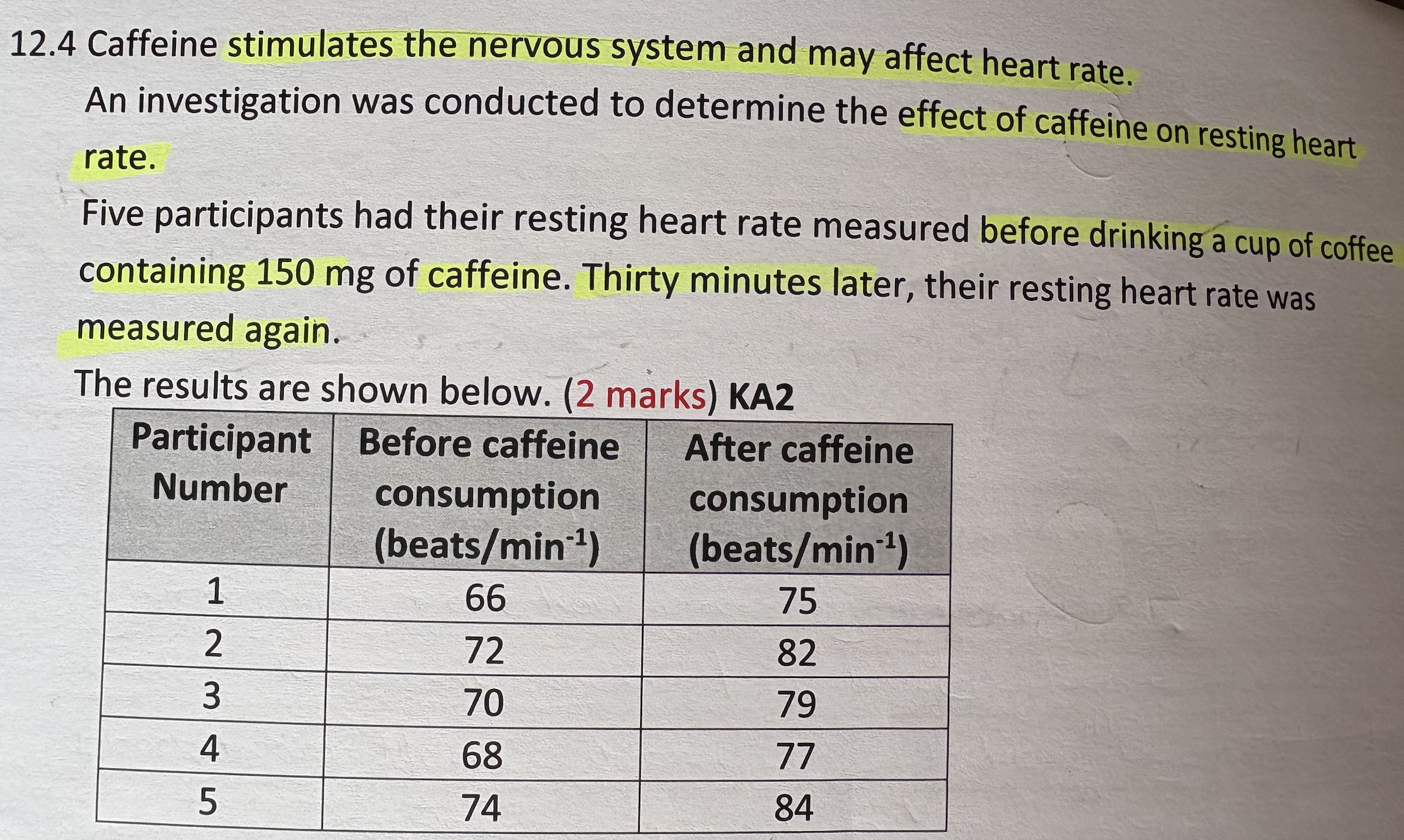
Identify the dependent variable in this investigation
State on factor that was held constant in this investigation
Resting heart rate (beats per minute)
Possible answers include:
Same caffeine dose (150mg)
Heart rate measured to 30min after consumption
Same method of measuring heart rate
Same participants were measured before and after caffeine
Participants were resting during each mesurement.
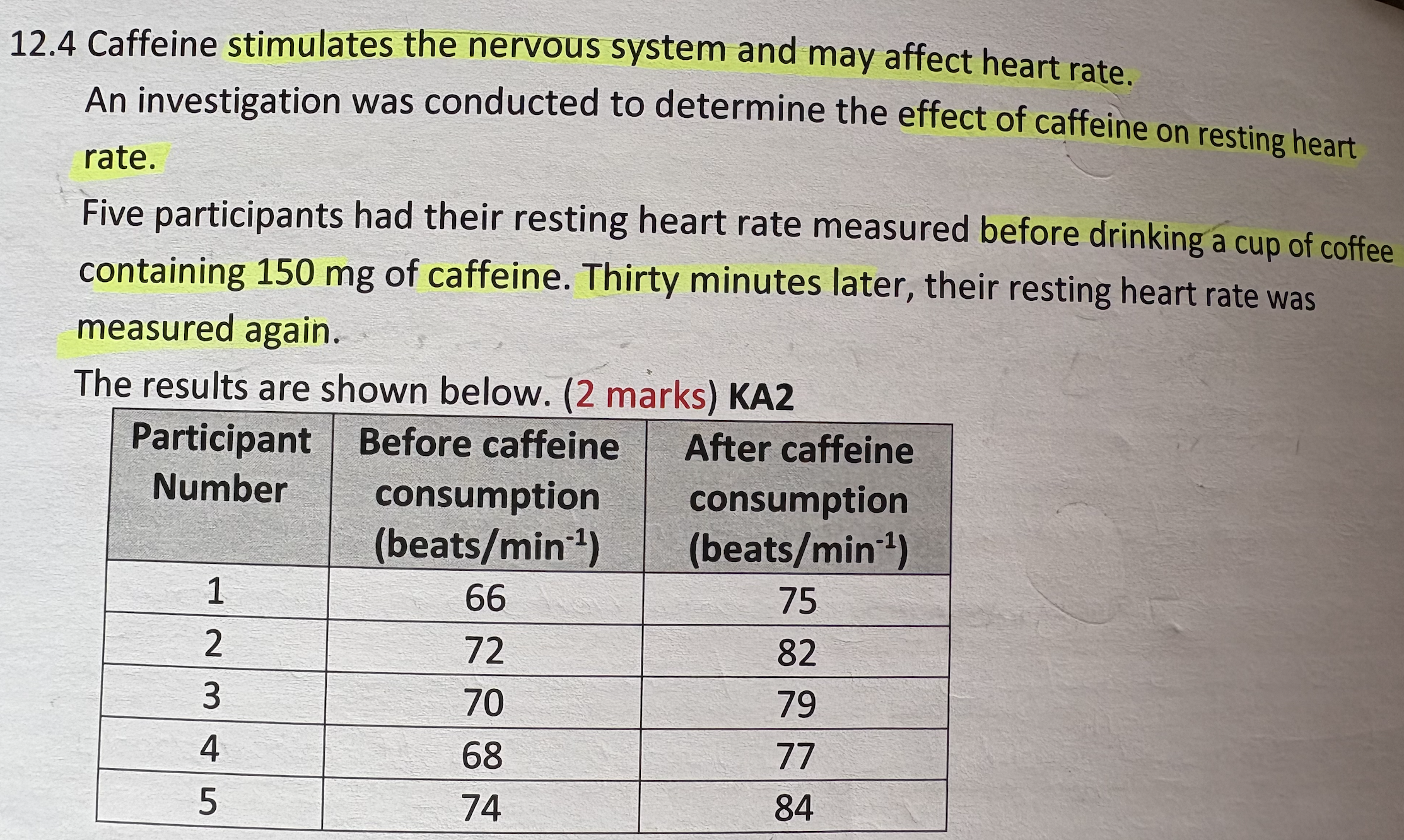
Identify one factor that cannot be held constant, and explain its effect on data
Possible answers include:
Individual caffeine tolerance. Due to genetics, metabolic rate (especially in the liver), enzyme levels, and receptor sensitivity control, individual tolerance differs. This increases variance amongst results, making results less reliable.
body mass. Participants of different body masses recieve different effective doses per kg. this may produce different heart rate responses and increase variability
stress or anxiety - some participants may be anxious during testing. Stress independently raises heart rate, reducing the validity of the investigation
sleep quality. tired participants may respond differently to caffeine. difference in alertness can infleucen the physiological response and increase variability
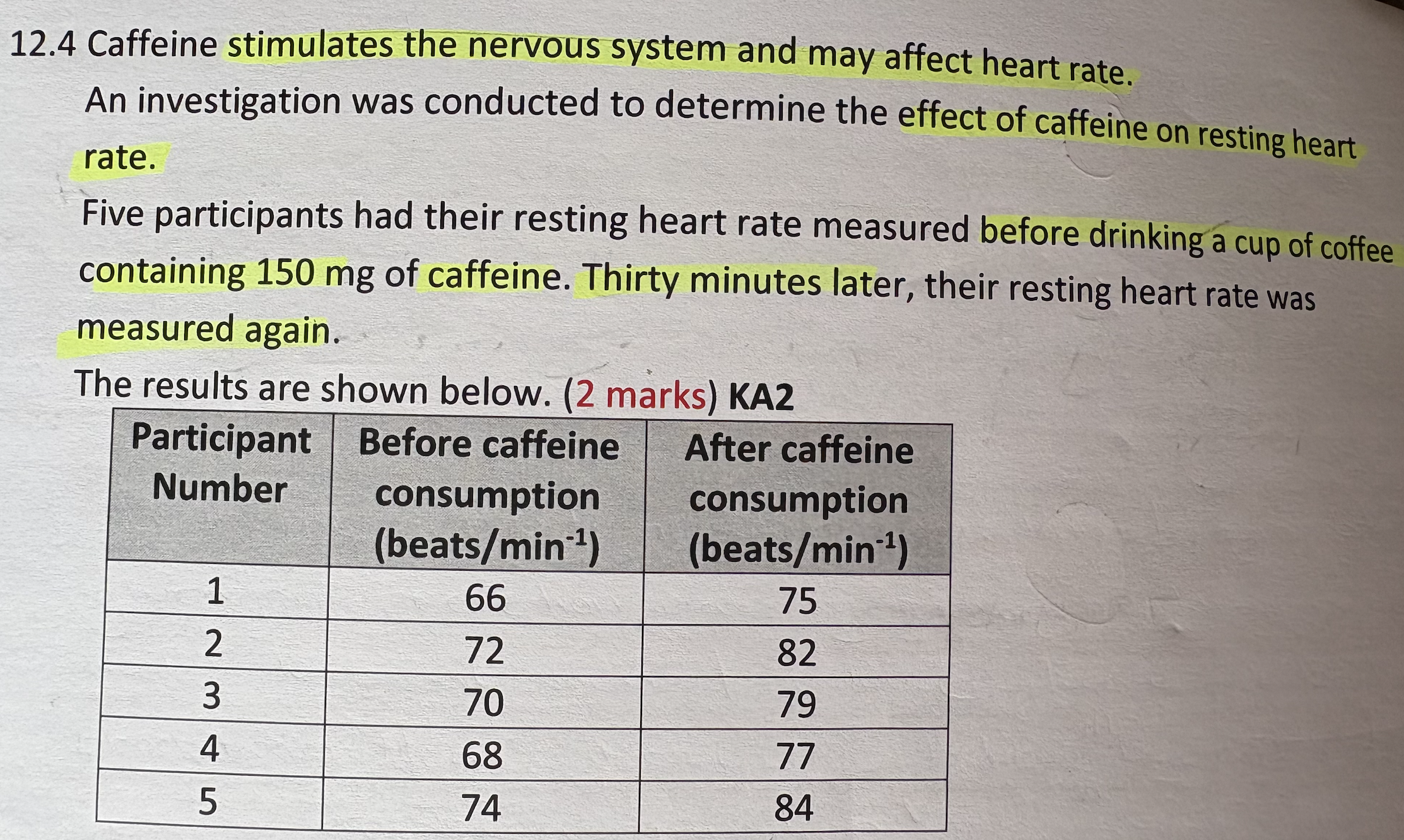
state one ethical consideration relevant to the investigation
obtain informed consent
participants should be screened for heart conditions
participants should be free to withdraw
keep participant data confidential
minimise risks associated with caffeine consumption
avoid excessive caffeine doses
ensure participants understand possible side effects
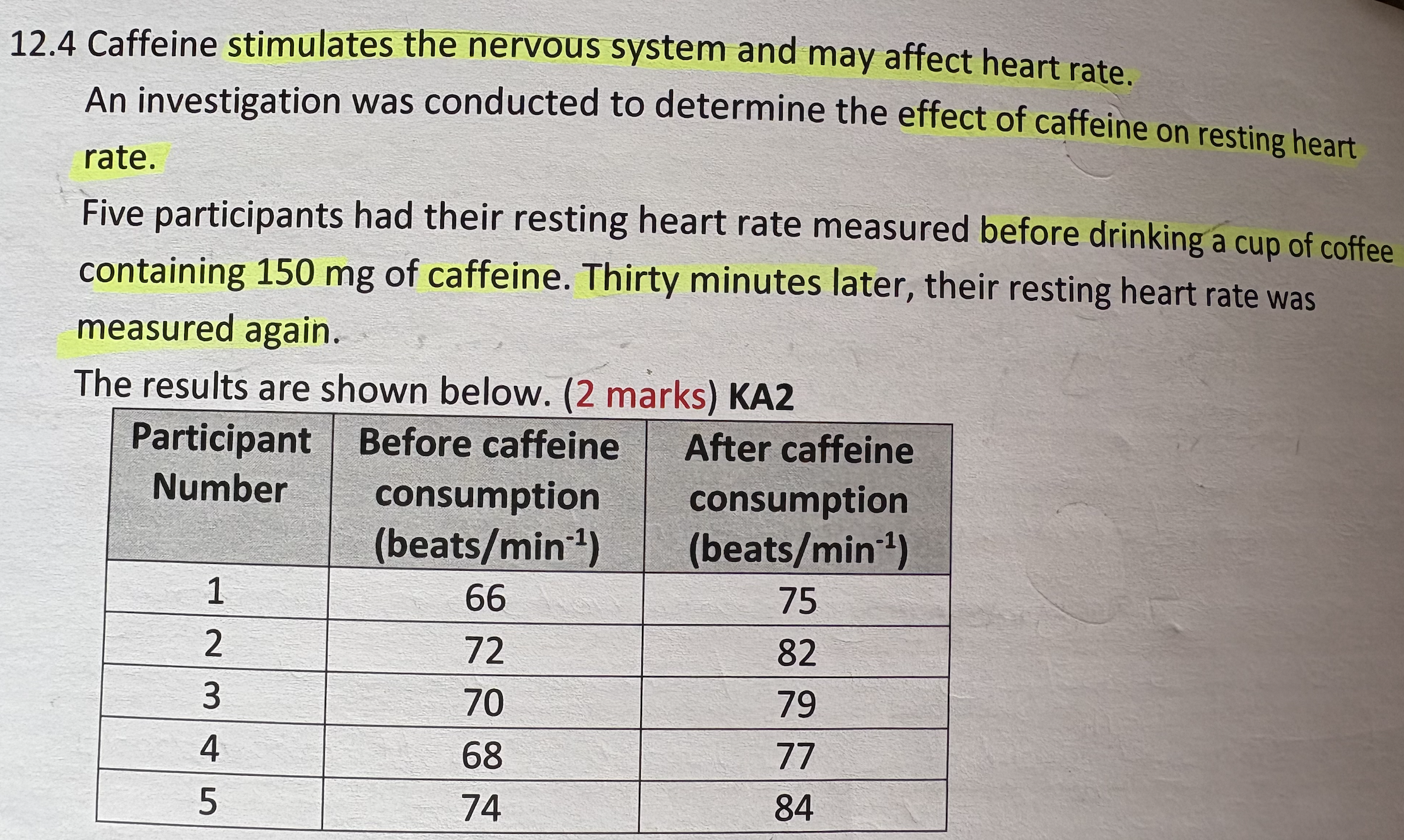
explain why some scientisits may question reliability of data
Only 5 participants were tested, making the sample size very small. only one trial appears to have een completed, increasing the effect of random error
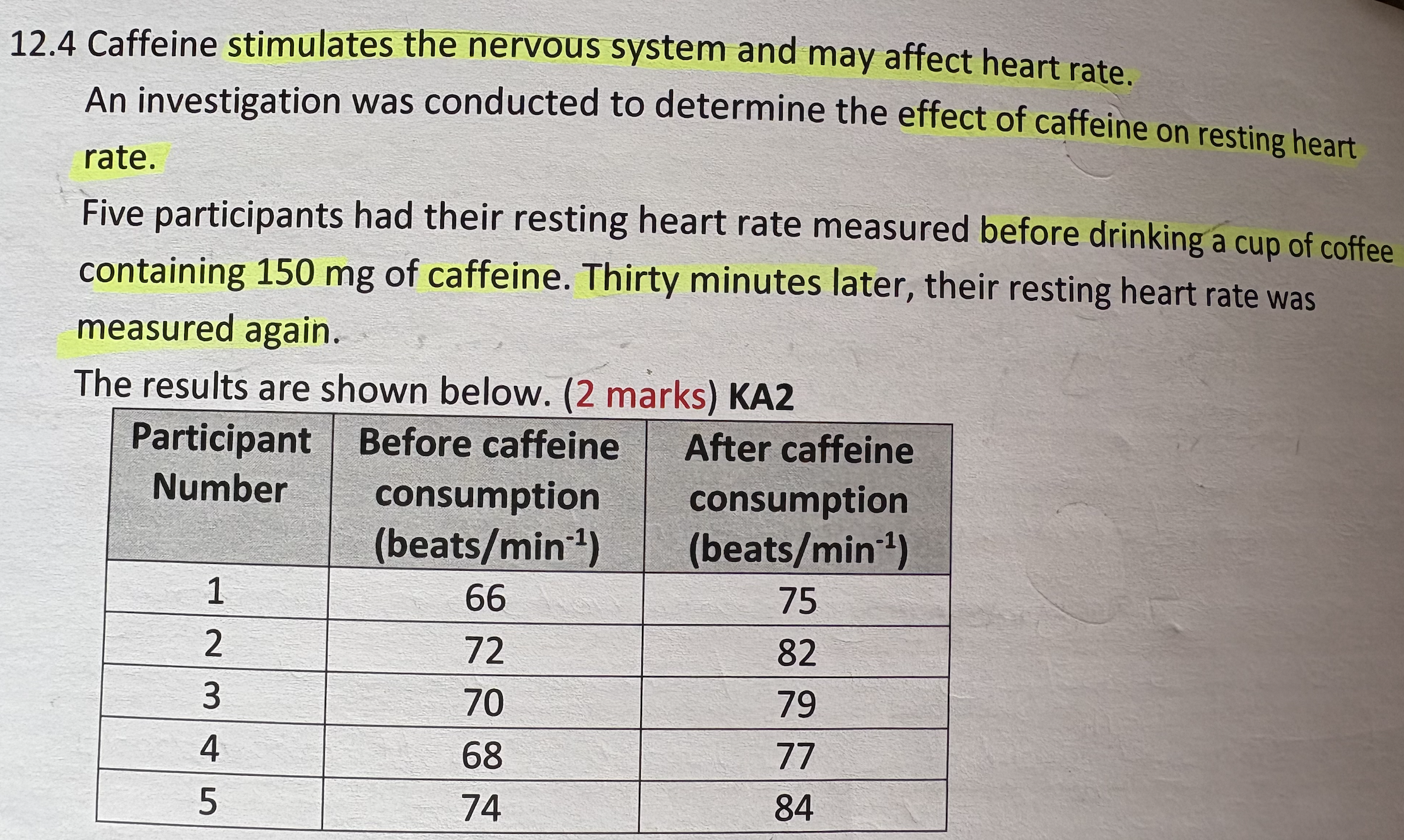
state one concusion supported by data in table
state one conclusion that is NOT supported by data in the table
possible answesr for 1:
hear rate inc for every participant after caffeine consumption
caffeine is associated with increase in resting heart rate
average resting heart rate inc after caffeine consumption
possible answers for 2:
caffeine causes increased heart rate in all people
higher caffeine doeses always produce larger increases in heart rate
caffeine permanently increases heart rate
caffeine causes heart disease
caffeine is unsafe
results are highly reliable
results apply to entire aus population

Explain how injecting thyorxine can improve an atheletes performance during endurance events
injecting thyroxine increases the body’s metabolic rate by stimulating cellular respiration
this increases ATP production and energy availability, allowing muscles to sustain activity for longer and potentially imrpvoing endurance performance

atheletes who misuse thyroxine risk developing hyperthyroidism, a condition characterised by abnormally high metaboluc rate.
state one consequence of hyperthyroidism for an athelete
possible answers include:
increased heart rate/tachycardia
excessive sweating
heat intolerance
weight loss
muscle weakness
anxiety or nervousness
tremors
fatigue
insomnia
increased breathing rate

atheletes who misuse thyroxine risk developing hyperthyroidism, a condition characterised by abnormally high metaboluc rate.
describe the response of the endocrine system when blood thyroxine levels rise above normal tolerance limits
High thyroxine levels are detected by the hypothalamus and the anterior pituitary gland.
The hypothalamus decreases secretion of thyrotropin-releasing hormone (TRH), causing the pituitary gland to release less thyroid-stimulating hormone (TSH)
reduced TSH decreases thyroxine secretion by thyorid gland until hormone levels return to normal range through negative feedback

use of thyroxine without medical need is prohibited in many sporting competitions
explain, with reference to imbalance of hormones regulating metabolic rate, why individuals with hypothyroidism require thyroxine replacement therapy
individuals with hypothyoridism produce insufficient thyroxine despite increased thyroid stimulating hormone (TSH) secretion
Thyroxine replacement restores normal metabolic rate (by increasing it), cellular respiration, and heat production, returning metabolism towards being within tolerance limits
a local anaesthetic blocs sodium ion channels in sensory neuron labelled B. explain how that would affect the withdrawl reflex
blocking sodium ion channel prevents the transmission of nervous signal to interneurons in the spinal cord/ prevents GENERATION AND PROPAGATINO OF ACTION POTENTIALS IN SENSORY NEURON
nerve impulses cannot reach spinal cord, so withdrawl reflex does not occur (*side note - can add message is not relayed to motor neuron and effector)
the brain becomes aware of painful stimulus shortly after hand is withdrawn, explain why hand is withdrawn before person consciously feels pain
hand withdrawl is a reflex action, occuring without signal transmission to the brain in order to minimise transmission time and increase speed of response. recognition of pain occurs via a seperate nerve pathway which travels to the brain to allow recognition, thus will take more time to occur.
describe negative feedback and explain its role in regulating body temperature
Negative feedback is where a response inhibits the initial stimulus
if body temperature increases, responses such as sweating, vasodilation etc work to lower it
if body temperature decreases, responses such as shivering, vasoconstriction etc work to increase it
these responses work to reverse the original stimulus, and that will be detected by thermoreceptors until the stimulus is no longer detected and temperatures are within tolerance limits.
explain why thirs increases during dehydration
Osmoreceptors in the hypothalamus detect the increased concentration of solute in the blood caused by water loss. the hypothalamus stimulates the thirst centre, encouraging the person to drink water and restore normal blood water concentration
Explain why the endocrine system is more effective than the nervous system at regulating blood glucose level. [/4 IAE3]
Endocrine responses are more widespread than nervous responses, allowing many cells which have complementary receptors to hormones to take in glucose or release glucose when required. Additionally, endocrine responses are longer lasting than nervous responses, making them suitable for glucose level control as regulation is a continuous process.