DAT Biology: Evolution, Ecology, + Animal Behavior
 Call Kai
 Learn
Learn Practice Test
 Spaced Repetition
 Match
Match Flashcards
 Knowt Play
1/32

There's no tags or description
Looks like no tags are added yet.
Name | Mastery | Learn | Test | Matching | Spaced | Call with Kai | Chat |
|---|
No analytics yet
Send a link to your students to track their progress
33 Terms
Sources of Evidence of Evolution
Paleontology, Biogeographic Evidence, Embryology, Comparative Anatomy, Biochemical Methods
What are examples of analogous structures?
Bird Wing and Bat Wing
Cat Leg and Praying Mantis Leg
Shark Fins and Dolphin Fins
What are examples of homologous structures?
Bird forearm and human forearm
What are some of the theories of evolution that existed over time?
Catastrophism, Use and Disuse, Natural Selection
Example of Use and Disuse
Giraffe reaches neck to get tall leaves, over time, the offspring’s neck’s get longer, not as a result of natural selection, but of inheritance of acquired traits/use and disuse
Requirements of Natural Selection
Resource demand exceeds supply, resulting in competition for survival
Variation of traits exist within a population
Variation in traits must be genetically heritable
Trait variation must be influential for reproduction and/or survival (fitness)
Genes improving fitness are favored, increase over generations, vv
Types of Natural Selection
Stabilizing Selection, Disruptive Selection, Directional Selection, Sexual Selection, Artificial Selection
Example of Sexual Selection
Birds have profound patterns and displays that make them distinct and good for females to select but bad for predators, showing how while it may be ideal for reproduction, it is unfavorable for survival.
Requirements for Hardy-Weinberg Equilibrium
Large, Random, M&M
Large Population to minimize genetic drift
Random Mating
No Mutation
No Natural Selection
No Migration/Gene Flow, Population is Isolated
Allele Frequency Equation p+q=1
Gene Frequency Equation p² + 2pq + q² =1
Factors Causing Microevolution
Genetic Drift, Non-Random Mating, Mutations, Natural Selection, Gene Flow
Sources of Genetic Variation (w/ Elaboration)
Mutations (must NOT be fatal)
Sexual Reproduction (crossing over, independent assortment, and random joining of gametes)
Polyploidy (plants have sets of multiple chromosomes introducing more variety and preserving different alleles) and mask effects of harmful recessive alleles
Balanced Polymorphism: maintains a variety of phenotypes in a population
Examples of Prezygotic Isolation Mechanisms
Habitat Isolation, Temporal Isolation, Behavioral Isolation, Mechanical Isolation, Gamete Isolation (Incompatibility)
Examples of Postzygotic Isolation Mechanisms
Hybrid Mortality (Inviability), Hybrid Sterility, Hybrid F2 Breakdown
Sympatric Speciation Examples
Balanced polymorphism, polyploidy, hybridization
Theories of Macroevolution Types
Phyletic Gradualism and Punctuated Equilibrium
Patterns by Which Evolution Occurs
Divergent Evolution, Convergent Evolution, Parallel Evolution, Coevolution
Parts of a Phylogenetic Tree
Root: represents the common ancestor of all the lineages shown
Node: a branch point representing divergence of a group into 2 groups (typically)
Polytomy: an internal node of a phylogenetic tree that leads to more than two tips
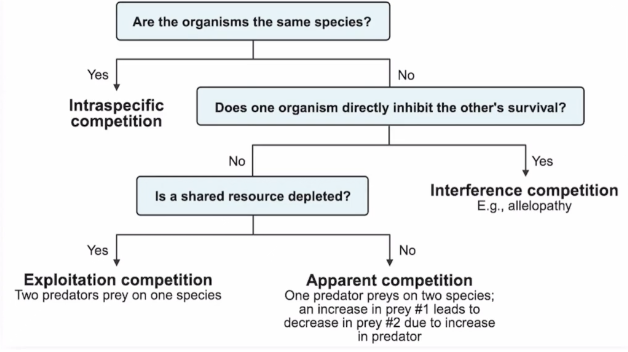
Types of Competition
Intraspecific Competition, Interspecific Competition, Exploitation Competition, Apparent Competition, Interference Competition
Types of Symbiosis
Mutualism (+/+), Parasitism (±), Commensalism (+/0)
Various Species Classifications
Invasive, non-invasive, naturalized, exotic
Trophic Levels in Order from Lowest to Highest
Primary Producers (Highest Biomass) → Primary Consumers → Secondary Consumers → Apex Predators (Lowest Biomass)
What happens when you move from one trophic level to the next?
Only 10% of the energy stored in a given trophic level is converted into organic tissue in the next trophic level
90% of the energy stored in a given trophic level is lost as heat due to inefficient heat transfer
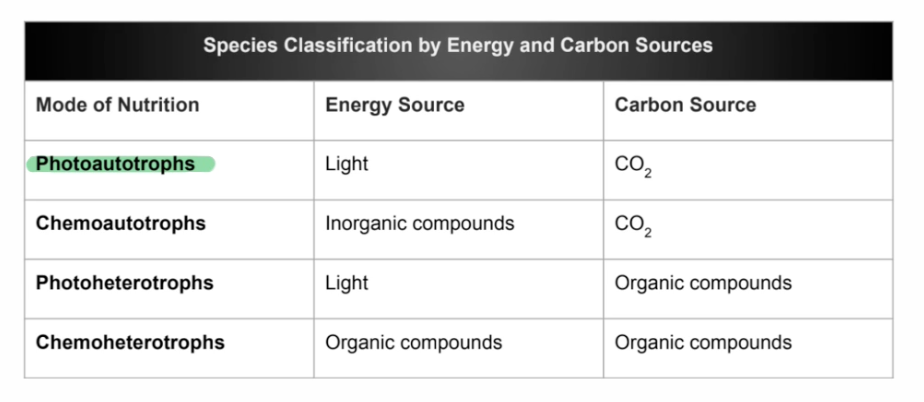
What can species be classified by?
Scavengers, Decomposers, Classified by their Energy and Carbon Sources, Fixing Carbon