ppn 101
 Call Kai
 Learn
Learn Practice Test
 Spaced Repetition
 Match
Match Flashcards
 Knowt Play
1/236

There's no tags or description
Looks like no tags are added yet.
Name | Mastery | Learn | Test | Matching | Spaced | Call with Kai | Chat |
|---|
No analytics yet
Send a link to your students to track their progress
237 Terms
what is nursing
profession focused on promoting health, preventing illness, providing care, relieving suffering, and supporting people throughout the lifespan.
roles: caregiver, advocate, educator, leader
grounded in knowledge, skills, ethics, and compassion
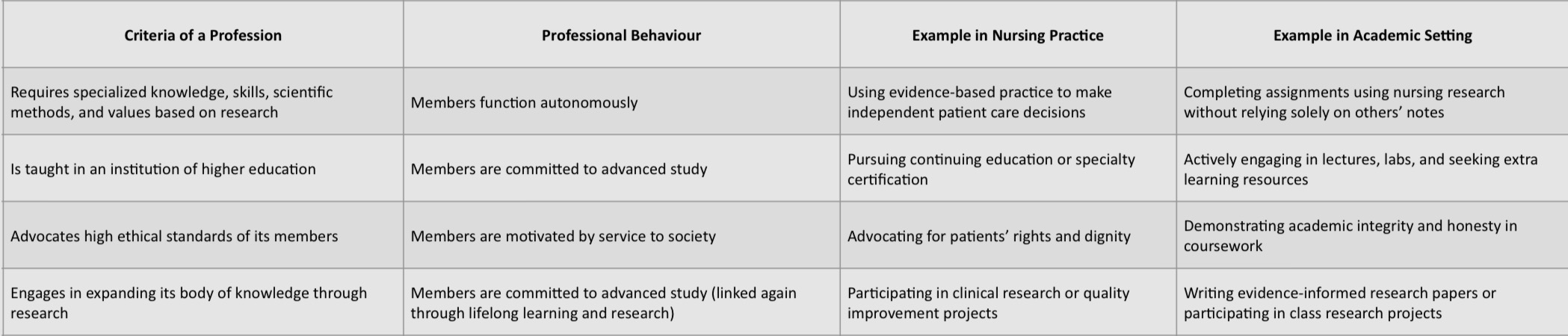
criteria of a profession, professional behaviour, nursing and academic link
nursing professionalism
behaving in a way that demonstrates the values, knowledge, skills, ethics, and responsibilities expected of a nurse.
commitment to high standards of practice
integrity responsibility and ethical behaviour
compassion and respect for patient dignity
collab w other health professionals
nursing as a profession
Practice Discipline: Nursing is a practice discipline, meaning the profession is centred around the actual care and practical actions performed with and for people.
Self-Regulation: Nursing is a self-regulated profession. This means that nurses, through specific regulatory bodies, set the expectations, standards, and rules for their own practice.
what does it mean that nursing is a practice discipline
nursing combines theory/knowledge with clinical application. nurses use what they learn in school in real patient care scenarios
what guides nursing practice
evidence informed decision making practice - use the best available evidence/research, along with their nursing knowledge and the patients situation to decide what to do
why is research important in nursing
it helps nurses use the best available evidence to provide safe and effective care
what does accountability mean in nursing
being responsible for your actions, decisions and the care you provide
what is nursing competency
having the knowledge, skills, judgement and abilities needed to provide safe and effective nursing care
what types of rules and guidance help ensure safe nursing care
codes of ethics, practice standards, best practice guidelines, laws, and regulations
competency vs accountability
accountability - being responsible for the care you provide
competency - being capable of providing safe care
what are practice standards
standards that describe what nurses are expected to do to provide safe competent care
what organizations help guide nursing practice in canada
the CNA and provincial regulatory bodies
who are nurses accountable to
the public, patients, nursing profession
what does it mean to be a self regulated profession
nurses have the responsibility and authority to regulate their own profession under government trust and oversight
what 3 things does a nurse use to make clinical decisions
research, critical thinking, professional judgement
what does the CNO do
regulatory body responsible for overseeing the profession. The CNO performs several critical functions:
* Approval of Programs: Evaluating and approving nursing education programs
* Registration and Licensure: Managing the process by which individuals become legally allowed to practice.
* Regulation of Practice: Ensuring that nurses meet the required standards to protect the public
what does the CNA do
The Canadian Nurses Association (CNA) provides a code of ethics that applies across the entire country
* Provincial/Territorial Codes: Each province and territory maintains its own specific regulatory documents and codes of ethic
Play a vital role in documenting nursing history to encourage critical thinking about past systemic inequities
key attributes of nursing (8)
Knowledge: The theoretical and practical foundation required for competent practice.
Accountability: Being answerable for one's own actions and decisions.
Autonomy and Self-regulation: The ability to make independent professional judgments and the capacity for the profession to govern its own standards.
Inquiry: The necessity for nurses to constantly ask questions about their work to improve outcomes
Research: Utilizing evidence-based research to drive the profession forward
Collegiality and Collaboration: The requirement to work within a team to provide comprehensive care; nursing cannot be practiced in isolation
Innovation: Developing new ways to improve care and processes.
Ethics and Values: Adhering to moral principles and professional standards in all interactions.
florence nightingale
she implemented changes focused on nutrition and cleanliness → before her interventions, soldiers were dying in large numbers from infections and other preventable issues rather than their actual battle wounds
during the crimean war in eastern europe she organized a group of nurses to serve at an army hospital in scutari.
advocate - spoke up for patients health
scholary & theorist - highly educated, contributed theories and writings that shaped modern nursing
innovater - introduced new standards of care, emphasizing hygiene, environment and patient dignity
considered the first nurse researcher & epidemiologist bc she used concrete evidence and stats to demonstrate the effectiveness of her changes
established a nursing school in Britain using an apprenticeship training model which served as a blueprint for nursing programs worldwide
florence nightingale critiques
lack of diversity - NS limited to white upperclass woman
colonialism - “daughter of the british empire” supporting colonial practices
mary seacole
A Black Jamaican nurse who independently established a "British Hotel" to care for soldiers during the Crimean War after being rejected by Nightingale's team
indigenous nursing and colonialism
indigenous people used local plants as medicine and provided essential midwifery and community health support
colonial impact: Canadian government sought to assimilate indigenous people which led to the suppression of traditional healing knowledge and the establishment of indigenous hospitals run by colonial staff
indigenous women were barred from entering NS until the 30’s
charlotte edith anderson montour
FIRST INDIGENOUS nurse in Canada
barred from NS in ontario but was accepted in NY, became an RN in 1914 and served with the American army in World War I before returning to the Six Nations Reserve as a nurse and midwife
Advocated for better health care access and opportunities for indigenous ppl
harriet tubman, mary eliza mahoney, lillian holland harvey
barrier breakers - challenged cultural and racial discrimination to care for their communities and advance nursing
advocates - championed equality, human rights and dignity 4 all ppl
role models - demonstrated grit, professionalism, perseverance
expanded opportunities for black nurses, strengthened nursing as a profession of equality
harriet tubman
american abolitionist, the underground railroad
nurse in the civil war, used natural remedies for dysentery and smallpox infections
continued nursing post war, started home for the elderly
mary elizabeth mahoney
1st licensed black nurse
1 of 4 to graduate her program at one of the first US nursing schools
worked as a private nurse, advocated for black healthcare and rights
lillian holland harvey
became the dean at the tuskegee school of nurses
used her position as dean to create ww2 opportunities for black nurses in army corps
bernice redmond
denied entry to canadian nursing schools so she studied in the US graduating w a nursing diploma in 1945 then she returned to canada and worked in public health nursing in nova scotia
became the first black nurse to join the Victorian order of nurses in Nova Scotia
her achievments increased pressure on canadian nursing schools to admit black women helping break racial barriers in nursing education
colleen campbell, marianne overton, ruth bailey, gwen barton
became among the first black woman to graduate from a nursing program in Canada 1948
the angel of mercy
stemming from the era of Florence Nightingale through World War I this emphasizes the nurse as a noble, religious, self-sacrificing, virtuous individual
the ‘mother’
following World War II, as women returned to domestic roles, the image of the nurse, as a maternal nurturing figure became more prominent
the sex symbol
late 1960’s
sexy nurse- sensual, romantic, promiscuous, low-intelligence archetype emerged in media and popular culture and persists in modern-day caricature and costumes
the careerist
current aimed image
intelligent, logical, progressive, empathetic, sophisticated, and assertive
less gender roles, more inclusive
Challenges to Address in nursing image
History Repeating – “Angel” label reinforces outdated religious origins of nursing.
Gender Stereotypes – Media portrays nursing as predominantly women’s work.
Political Pawns – Nurses framed as heroes/angels to serve political agendas.
Forgotten Heroes – Public respect can diminish; nurses sometimes villainized.
social factors that affect the image of nursing
Gender expectations
Cultural beliefs
Media portrayals
Stereotypes
Diversity within nursing
Changing expectations about gender roles
Historically, nursing was heavily associated with women and caregiving.
This contributed to stereotypes that nursing was “women’s work.”
economic factors affecting nursing image
COVID showed how essential nurse are in providing direct patient care, managing health crises and supporting healthcare system
Healthcare funding and working conditions influence how nursing is perceived.
Examples:
Nursing shortages
Staffing levels
Wages
Workload
Healthcare funding
Job opportunities
Working conditions
Economic pressures can contribute to burnout and affect public perceptions of the profession.
Recognizing nurses’ impact on patient outcomes can lead to greater recognition and higher status
political Factors affecting nursing images
Legislation affects scope of practice and authority (e.g., NP prescribing)
• Advocacy promotes understanding of nurses’ roles in health promotion and safety
Government policies influence nursing through:
Healthcare funding
Staffing policies
Scope of practice
Nursing education
Regulation
Public healthcare policy
Immigration policies
Labour legislation
what is a patient advocate
a healthcare professional who speaks up for and protects patients needs rights preferences and safety
what 2 ways can influence how society views nursing
advocacy and public education
why is the “virtue script” problematic
character over skill - emphasizes the calling of inherent kindness of the person rather than the technical, scientific expertise required
“hero” - promotes a culture of self sacrifice- can be used to justify in advocate resources, like insufficient, PPE or poor pay under the assumption that heroes will endure any hardship
it creates a paradox where nurses who advocate for better working conditions or safety may be viewed as bad nurses because they are not embodying the self sacrificing hero, ideal
strategies for positive, inclusive image
emphasize science - highlight nursing as a highly technical scientific career - attracts ppl interested in science
showcase diversity - ensure recruitment materials reflect diverse genders, ages and ethnicities - foster inclusivity and ensure nurses reflect the population they serve
highlight flexibility - promote various settings - attract those seeking career longevity
move beyond virtue - focus on transferable skills growth opportunities- rebrand nursing as viable high skill career rather than a calling
what is phenomenology
a philisophical and theoretical approach that studies how people experience the world and the meaning they give to their lived experiences. In nursing it helps us understand what illness, healing and care mean to each client.
what is critical social theory
A theoretical framework that examines and challenges how power, inequality, oppression and social structures influence people’s lives and health. focus: exposing hidden social relationships that influence health
how does phenomenology relate to nursing
helps nurses provide holistic, patient centered care by listening empathizing and understanding the unique meaning a client gives to their illness or care
how does cst relate to nursing
helps nurses identify and challenge barriers to health, unequal access to care, discrimination and power imbalances while advocating for health equity
how do phenomenology and cst complement each other
pheno helps nurses understand what an experience feels like for a person
cst helps nurses understand and challenge the systems that may be causing or worsening that experience
How might a nurse use phenomenology when a client is labelled 'non-compliant'?
The nurse explores the client's perspective instead of judging them. For example: 'Can you tell me what taking this medication has been like for you?' The client may find it frightening, burdensome, or disruptive.
What kinds of questions are typical of phenomenology?
Open-ended, non-judgmental questions about feelings, meaning, perspective, and personal experience, such as: 'What has this experience been like for you?'
What is a limitation of phenomenology?
If used alone, it may overlook the larger structural or systemic issues affecting a person's health.
What does CST aim to uncover about human freedom?
Constraints and barriers that limit people's choices, opportunities, and ability to control their lives.
What does CST mean by challenging power imbalances?
Questioning who has power, who benefits, who is disadvantaged, and how systems or institutions may marginalize vulnerable groups.
what is status quo
The existing way things are done or accepted in society. CST questions whether the current norms, policies, and practices are fair.
What is meant by 'taken-for-granted assumptions'?
Beliefs or practices people accept as normal or natural without questioning them, even when they may reinforce inequality.
What does CST aim to do beyond analyzing problems?
Disrupt the status quo, empower people, challenge oppression, promote justice, and create positive structural change.
nursing example of CST
A nurse notices that low-income patients cannot access diabetes education and follow-up care. The nurse organizes free workshops and works with clinics to improve access.
what is a limit of cst
If used alone, it may overlook personal, subjective experiences and the unique meaning an individual gives to their health situation.
social norms
Shared expectations about how people should behave and what is considered normal or acceptable.
Example: Gender roles or expectations about how a nurse should act.
social control
Ways society influences or regulates people's behaviour, choices, and beliefs.
Example: Pressure to behave according to accepted social expectations.
overt social control
Direct, visible rules, laws, or policies that influence behaviour.
Example: A policy restricting access to certain healthcare services.
covert social control
Hidden or indirect pressures that influence behaviour.
Example: A workplace culture discouraging nurses from speaking up about unsafe care.
Inadvertent social control
Unintended effects that reinforce stereotypes or inequality.
Example: Health education materials unintentionally portraying only one type of family.
social discourse
The ways language, media, and culture shape what society considers true, normal, right, or wrong.
Example: Calling nurses 'angels' instead of recognizing their professional expertise.
why does cst question social norms
Because norms may appear natural or acceptable but can limit freedom, reinforce stereotypes, marginalize groups, or maintain unequal power relationships. CST asks who benefits from the norm and who is harmed
What is the relationship between social discourse and CST?
Social discourse shapes how people understand reality. CST examines how dominant language, media, and cultural narratives can maintain power imbalances and works to challenge those narratives
Why can calling nurses "angels" be problematic according to CST
Although it sounds positive, it may reinforce gendered stereotypes and undervalue nursing as a skilled, professional discipline requiring knowledge, judgment, and expertise.
what is social justice
Fairness, equity, and dignity for all people, including equitable access to opportunities, rights, resources and healthcare.
how does cst relate to social justice
CST provides a lens for analyzing and challenging the root causes of injustice. Social justice is the value and goal: fairness, equity, dignity, and positive change.
What does it mean to challenge oppression in nursing?
Questioning policies, practices, or norms that disadvantage patients or groups, and advocating for changes that reduce inequity.
What is health equity?
Fair opportunity for everyone to achieve their best possible health by addressing barriers and providing support according to people's needs
What is the difference between equality and equity?
Equality means giving everyone the same thing. Equity means addressing different needs and barriers so people have a fair opportunity to achieve similar outcomes.
How can nurses promote social justice?
Advocate for equitable access to care, address social determinants of health, support policy change, provide culturally safe care, and challenge discrimination and bias.
What are social determinants of health?
The social and economic conditions in which people are born, grow, live, work, and age that influence their health, such as income, housing, education, and social support.
How does CST support culturally safe care?
It helps nurses recognize and challenge systemic racism, discrimination, and power imbalances, while respecting diverse cultures and patient perspectives.
what is an example of CST and social justice in practice?
A nurse advocates for transportation assistance or sliding-scale fees so patients who cannot afford frequent appointments can access healthcare.
what is oppression
Oppression is the control of one group by people or groups with greater power or status. It is a system of forces that reduces freedom, limits opportunities, and keeps certain groups subordinate to another group.
What does systemic oppression mean?
Systemic oppression occurs when inequality is built into society's institutions, policies, laws, traditions, or cultural norms.
Example: A healthcare policy that makes it harder for low-income patients to access necessary treatment.
What are the 3 key features of oppression?
Power imbalance: One group has greater authority or influence.
Systemic: Inequality is reinforced by policies, laws, traditions, or social norms.
Subordination: The oppressed group experiences reduced autonomy, rights, or opportunities.
What does subordination mean?
Subordination means being placed in a lower or less powerful position than another group.
Example: A group of nurses is repeatedly denied leadership opportunities because of discriminatory beliefs.
What are examples of oppression in healthcare?
Minority patients receiving lower-quality care because of stereotypes.
Women or minority nurses being overlooked for promotions.
Policies that make healthcare harder to access for low-income patients.
Healthcare systems that disadvantage certain cultural or racial groups.
How can oppression affect patients?
Oppression can limit patients' access to healthcare, reduce their autonomy, worsen health outcomes, and make them feel powerless or unheard.
Example: A patient facing discrimination may avoid seeking care because they do not trust the healthcare system.
What is the nurse's role in addressing oppression?
Nurses can:
Identify patterns of unequal treatment.
Advocate for fair policies.
Challenge discrimination and harmful assumptions.
Empower marginalized patients.
Promote social justice and equitable healthcare access.
Which ways of knowing help nurses address oppression?
Emancipatory knowing and Critical Social Theory (CST).
Emancipatory knowing helps nurses recognize injustice and work toward change.
CST helps nurses examine power structures, policies, and social inequalities.
marginalization
Marginalization is the process of pushing people or groups to the edges of society, away from the dominant or "main circle."
It often involves limited access to resources, opportunities, decision-making, and representation.
What does disempowerment mean?
having less power, control, or influence over decisions that affect your own life.
Example: A patient is excluded from care planning because healthcare providers assume they cannot make decisions for themselves.
How do stereotypes contribute to marginalization?
Stereotypes create false assumptions about people. These assumptions can lead to exclusion, unfair treatment, and fewer opportunities.
Example: Assuming a homeless patient is irresponsible may cause healthcare workers to dismiss their concerns.
What is the nursing response to both oppression and marginalization?
Nurses should identify inequities, provide culturally safe care, advocate for access and representation, challenge discrimination, and promote social justice.
Why are nurses uniquely positioned to promote social justice?
Nurses interact closely with patients and communities. They can recognize barriers to care, understand patients' needs, identify unequal treatment, and advocate for changes in healthcare systems.
What are 4 ways nurses promote social justice?
Advocate for policies addressing social determinants of health.
Provide culturally competent and culturally safe care.
Engage in community outreach for underserved groups.
Educate patients and communities about rights and available resources.
What does culturally safe care mean?
Care that respects patients' cultural identities, recognizes power imbalances, and works to prevent discrimination and harm. The patient should feel respected and safe.
Example: A nurse asks about a patient's cultural preferences instead of making assumptions.
A nurse notices that patients in a low-income neighbourhood have limited access to diabetes education. What action promotes social justice?
The nurse organizes free community workshops and collaborates with local clinics to improve follow-up care.
Why? This addresses a systemic barrier and promotes equitable access to healthcare.
A patient cannot afford transportation to appointments. What could a nurse do?
Advocate for transportation assistance, connect the patient with community resources, and help identify accessible follow-up options.
How can Malala's story be understood using all 3 frameworks?
Phenomenology: Understands her personal experiences of fear, oppression, and resilience.
CST: Examines the systems and power structures restricting girls' education.
Social justice: Advocates for educational rights, fairness, and equal opportunities.
What were Carper's original four ways of knowing?
Empirical, ethical, personal, and aesthetic knowing.
What is the fifth way of knowing?
Emancipatory knowing, which focuses on social, political, and economic contexts, social justice, advocacy, and systemic inequities.
Why are there five ways of knowing instead of only one?
Nursing is complex. Scientific evidence alone cannot address every patient situation. Nurses also need ethical reasoning, self-awareness, genuine relationships, holistic understanding, and social justice awareness.
What is the overall purpose of the five ways of knowing?
To help nurses understand patients, make safe and effective decisions, reflect on practice, and provide ethical, person-centred, and socially responsible care.
How do all five ways of knowing work together?
Empirical provides scientific evidence; ethical guides right and wrong; personal builds relationships; aesthetic supports holistic understanding and creative responses; emancipatory identifies and challenges injustice.
What is empirical knowing?
A way of knowing based on observation and evidence. It assumes knowledge can be accessed through the five senses and verified by others. It forms the scientific foundation of nursing practice. It provides scientific knowledge and research evidence that help nurses choose safe and effective interventions.
example: administering meds according to dose, using lab results to monitor health; following evidence based protocols
What are the three key features of empirical knowing?
1. Observable, measurable, and testable knowledge.
2. Focus on facts, data, and research evidence.
3. Supports safe, reliable, evidence-based practice.