Fixed Income 2: Yields, Interest Rates and Duration

0.0(0)
Studied by 0 people
call kaiCall Kai
Locked
learnLearn
examPractice Test
spaced repetitionSpaced Repetition
heart puzzleMatch
flashcardsFlashcards
GameKnowt Play
Card Sorting

1/15

encourage image

There's no tags or description

Looks like no tags are added yet.

Last updated 8:56 PM on 9/4/26
Name
Mastery
Learn
Test
Matching
Spaced
Call with Kai
Chat

No analytics yet

Send a link to your students to track their progress

16 Terms

1
New cards

Converting Annual Percentage Rates: Fixed rate bonds

m is months, n is years e.g. monthly compounded m = 12 and n = 1 for annualising

<p>m is months, n is years e.g. monthly compounded m = 12 and n = 1 for annualising</p>
2
New cards

Current Yield: Fixed rate bonds

focuses purely on interest income, ignores coupon frequency, time value of money and accrued interest

<p>focuses purely on interest income, ignores coupon frequency, time value of money and accrued interest </p>
3
New cards

Yield Convention Coupon Payment Styles: Fixed rate bonds

knowt flashcard image
4
New cards

Yield Spread Decomposition: Fixed rate bonds

YTM = benchmark rate + spread. Benchmark ("risk-free" rate) = expected real rate + expected inflation rate — captures top-down/macro factors. Spread (risk premium) = credit risk + liquidity + taxation — captures bottom-up/issuer-specific factors. Most-used benchmark: the on-the-run government bond (most recently issued, most actively traded, priced near par); older issues are off-the-run and typically trade at slightly higher yields than on-the-run bonds of similar maturity.
5
New cards

G-spread: Fixed rate bonds

Yield spread in bps over an actual or interpolated government (Treasury) bond yield of the same maturity. Calculation: (1) find the bond's own YTM using the BA II Plus TVM keys — enter N (periods to maturity), PV (= –price), PMT (coupon payment), FV (=100), then CPT I/Y; (2) if no government bond matches the maturity exactly, linearly interpolate the two nearest government bond yields (weighted by distance to target maturity); (3) G-spread = bond's YTM – interpolated government yield.
6
New cards

I-spread: Fixed rate bonds

Yield spread of a bond over the standard swap rate (interpolated if needed) for the same currency and tenor — used especially for pricing/quoting euro-denominated corporate bonds. Calculated the same way as G-spread on the calculator (TVM: N, PV = –price, PMT, FV = 100, CPT I/Y to get the bond's YTM), but subtract the swap rate instead of a government yield.
7
New cards

Z-spread: Fixed rate bonds

The constant spread that must be added to every spot rate on the benchmark (government or swap) curve so that the PV of the bond's cash flows equals its price — also called the static spread. Because each cash flow is discounted at a different spot rate + Z, this cannot be solved with a single BA II Plus TVM entry.

<p>The constant spread that must be added to every spot rate on the benchmark (government or swap) curve so that the PV of the bond's cash flows equals its price — also called the static spread. Because each cash flow is discounted at a different spot rate + Z, this cannot be solved with a single BA II Plus TVM entry.</p>
8
New cards

Option-Adjusted Spread (OAS): Fixed rate bonds

OAS = Z-spread − option value (stated in bps per year). Used for callable bonds: the value of the embedded call option (from an option-pricing model, given an assumed interest rate volatility) is subtracted from the Z-spread to isolate the credit/liquidity spread from the value of the option.
9
New cards
FRN Mechanics & Margins
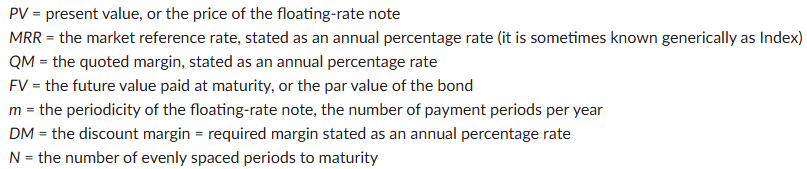
FRNs (floaters) pay a coupon that resets each period based on the market reference rate (MRR), set at period start with interest paid at period end ("in arrears"; day-count: actual/360 or actual/365). Because cash flows adjust with rates, price stays close to par through rate volatility, unlike a fixed-rate bond. Quoted margin (QM) = fixed spread over/under MRR stated in the note's terms (can be negative for very low-risk issuers). Required/discount margin (DM) = market-required spread over/under MRR needed to price the FRN at par on a reset date (driven by credit risk, liquidity, tax status). If DM = QM → priced at par (pulled to par between resets); if DM > QM → discount (PV of "deficient" interest annuity); if DM < QM → premium.
10
New cards
FRN Pricing & Discount Margin on the BA II Plus
The simplified pricing model uses the same MRR for every cash flow, so it collapses to an ordinary TVM problem. Pricing (forward): PMT = (MRR+QM)×FV/m; I/Y = (MRR+DM)/m (as %); enter N, I/Y, PMT, FV=100, CPT PV. Solving for DM from a known price (reverse): PMT = (MRR+QM)×FV/m; enter N, PV=–price, PMT, FV=100, CPT I/Y to get periodic rate r; then DM = (r×m) − MRR.
11
New cards

Money Market Instruments & Yield Conventions: Debt securities with original maturities ≤1 year (repos, bank CDs, commercial paper, T-bills, bankers' acceptances, time deposits on MRR). Vs. bond YTMs

Debt securities with original maturities ≤1 year (repos, bank CDs, commercial paper, T-bills, bankers' acceptances, time deposits on MRR). Vs. bond YTMs: money market yields are annualized but NOT compounded (simple interest); different maturities have different periodicities (=Year/Days, not a common one); and rates use non-standard equations rather than standard TVM. Quoted on discount rate (DR) or add-on rate (AOR) basis: DR basis quotes the face value at maturity (used for CP, T-bills, bankers' acceptances) and by construction understates the investor's return/issuer's cost since it divides by FV, not PV; AOR basis quotes the price at issuance (used for bank CDs, repos, MRR indexes).
12
New cards
Discount-Rate Basis Pricing Formula
PV = FV × (1 − (Days/Year) × DR). Prices a money market instrument quoted on a discount-rate basis (e.g., commercial paper, T-bills) given its face value, the discount rate, and days to maturity.
13
New cards
Solving for the Discount Rate
DR = (Year/Days) × [(FV − PV)/FV]. Backs out the discount rate from a known price and face value — the algebraic rearrangement of the discount-rate pricing formula.
14
New cards
Add-On-Rate Basis Pricing Formula
PV = FV / [1 + (Days/Year) × AOR]. Prices a money market instrument quoted on an add-on-rate basis (e.g., bank CDs, repos) given its redemption (face) value, the add-on rate, and days to maturity.
15
New cards

Solving for the Add-On Rate, The interest earning on a financial instrument

AOR = (Year/Days) × [(FV − PV)/PV]. Backs out the add-on rate from a known price and redemption value — the algebraic rearrangement of the add-on-rate pricing formula.
16
New cards
Bond Equivalent Yield & Periodicity
Bond equivalent yield (BEY) = a money market rate restated on a 365-day add-on-rate basis, used to compare instruments quoted on different bases (DR vs AOR) or different year conventions (360 vs 365 days). Money market rate periodicity = Year/Days (varies by maturity, unlike a bond's fixed compounding periodicity). To convert an annual rate between periodicities m and n: (1+APRm/m)^m = (1+APRn/n)^n.