Sedimentation Review
 Call Kai
 Learn
Learn Practice Test
 Spaced Repetition
 Match
Match Flashcards
 Knowt Play
1/80

Earn XP
Description and Tags
Handout Material
Name | Mastery | Learn | Test | Matching | Spaced | Call with Kai | Chat |
|---|
No analytics yet
Send a link to your students to track their progress
81 Terms
Clarifier
A large circular or rectangular tank or basin in which water is held for a period of time to allow the heavier suspended solids to settle to the bottom. Also called sedimentation basins.
Density
A measure of how heavy a substance is for its size. Expressed as a weight per unit of volume.
Density Current
A flow of water that moves through a clarifier and does not mix well due to a difference in density between the influent water and the water in the clarifier. This density difference is caused by a difference in temperature or suspended solids concentration.
Effluent
Water flowing out of a reservoir, basin, tank, treatment process or treatment plant.
Influent
Water flowing into a reservoir, basin, tank, treatment process or treatment plant.
Launders
Sedimentation basin and filter discharge channels consisting of overflow weir plates and conveying troughs.
Overflow Rate
One of the guidelines for the design of settling tanks and clarifiers in treatment plants. Used by operators to determine if the settling basin is hydraulically overloaded. Also called surface loading.
Plug Flow
Sedimentation
A water treatment process in which solid particles settle out of the water being treated in a large clarifier or sedimentation basin.
Short-Circuiting
Specific Gravity
The weight of a particle, substance, or chemical solution in relation to the weight of an equal volume of water.
Water has a specific gravity of __________.
1.000 at 4o C
Surface Loading
One of the guidelines for the design of settling tanks and clarifiers in treatment plants. Used by operators to determine if the settling basin is hydraulically overloaded. Also called overflow rate.
Viscosity
Typical Particle Size: Coarse Trubidity
Diameter (microns): 1 - 1,000
Typical Particle Size: Algae
Diameter (microns): 3 - 1,000
Typical Particle Size: Silt
Diameter (microns): 10
Typical Particle Size: Bacteria
Diameter (microns): 0.3 - 10
Typical Particle Size: Fine Turbidity
Diameter (microns): 0.1 - 1
Typical Particle Size: Viruses
Diameter (microns): 0.02 - 0.26
Typical Particle Size: Colloids
Diameter (microns): 0.001 - 1
Types of Basins two main classifications (conventional):
Rectangular, Circular
Conventional Rectangular Basin
Constructed of concrete or steel
Conventional Rectangular Basin
Floor sloped toward inlet
Conventional Rectangular Basin
Sludge collector scrapes sludge back to inlet
Conventional Rectangular Basin
Water flows end to end (rectilinear flow)
Conventional Rectangular Basin
Flow is evenly distributed across basin to minimize eddies and currents that would prevent particle settling
Conventional Center-feed Basin
Normally circular but can be square
Conventional Center-feed Basin
Constructed of concrete or steel
Conventional Center-feed Basin
Floor sloped toward the center
Conventional Center-feed Basin
Sludge is scraped toward center
Conventional Center-feed Basin
Water enters the center and flows outward (radial flow)
Conventional Center-feed Basin
Inlet baffle reduces hydraulic energy to minimize eddies and currents that would prevent particle settling
Regardless of the design, all sedimentation basins have ____ distinct zones that are intended to accomplish a specific purpose
four
The four zones are:
1. Influent Zone
2. Settling Zone
3. Effluent Zone
4. Sludge Zone
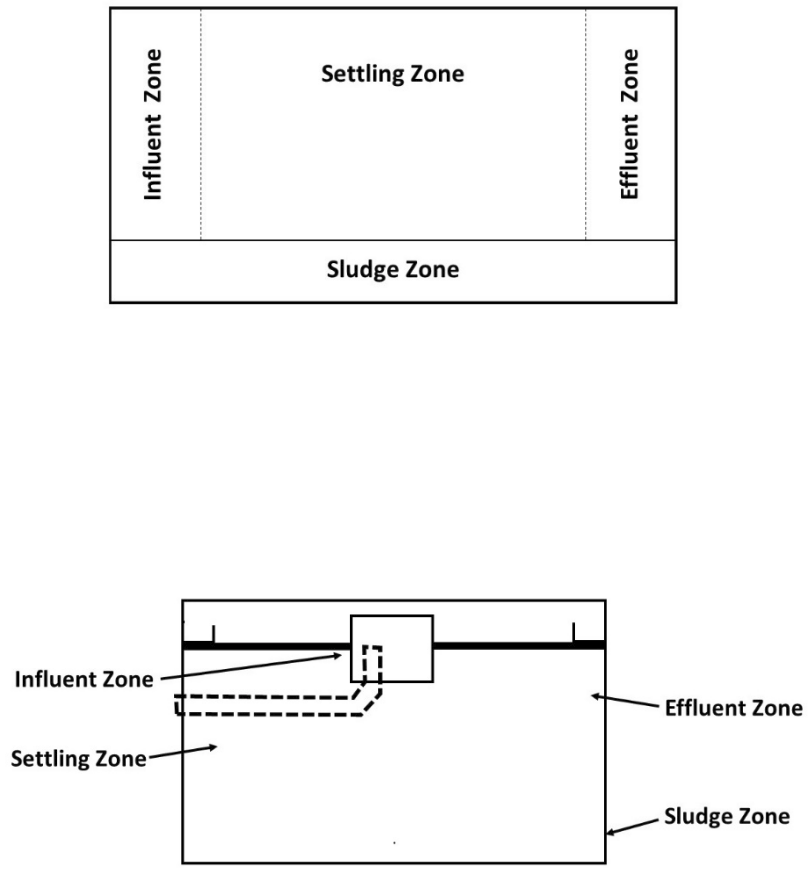
Influent Zone
Baffle reduces flow velocity
Influent Zone
Evenly distributes flow across basin
Influent Zone
Prevents short circuiting
Influent Zone
Prepares water for settling zone
Settling zone
Quiescent zone
Settling zone
Large water volume to allow settling
Settling zone
Largest of the four zones
Effluent Zone
Transition between settling zone and effluent weir
Effluent Zone
Currents or eddies can cause sludge to carryover effluent weir
Sludge Zone
Bottom of the basin
Sludge Zone
Where sludge collects
Sludge Zone
Sludge collection equipment is located in the sludge zone
Plate and Tube settlers are either one or the other.
Plates are spaced about 2 inches apart and are between 3 and 6 feet in length. Tubes are similar dimensions.
Plates or Tubes become self-cleaning when they are installed at a __________.
50 to 60o angle
Actiflo
proprietary process that allows high flow rates due to its design. It utilizes conventional coagulation and microsand-enhanced flocculation with lamellar settling to achieve the higher flow rates. This process is followed by a filtration process which meets the requirements of the SWTR.
The solids-contact basin is known by several names which include:
• Upflow clarifier
• Solids-contact clarifier
• Sludge-blanket clarifier
There are two distinct zones in the solids-contact basin which are the:
• Mixing Zone
• Settling Zone
Coagulants are added to the mixing zone where the _______ enters.
raw water
Flocculation occurs in the reaction area where the floc is ____ mixed.
gently
The water flows underneath the reaction ________ and is then directed upward through the sludge blanket.
area cone
The sludge blanket acts as a _____ and retains the floc while the clarified water continues upward toward the effluent launder.
filter
Advantages:
• Faster flocculation due to sludge recycling
• Shorter detention time
Disadvantages:
• Easily upset by rapid changes in water temperature
• Flow fluctuations can upset the sludge blanket
In applications where the raw water contains high levels of light organic material, ___________ may be a better solution to particle removal than traditional sedimentation
dissolved air floatation
Some treatment plants use dissolved air floatation in conjunction with conventional sedimentation to remove ___ precursors such as algae.
DBP
The system works by circulating 5-10% of the flow stream in to an air saturation chamber which is pressurized. The water is super-saturated with _________ and sent to the influent distribution box.
compressed air
When the pressure drops, the air comes out of solution and bubbles up through the water. The air bubbles attach to _______ and they float.
light particles
Pulsator Clarifier
Uses a pulsating hydraulic system to maintain a uniform sludge layer
The sludge layer is pulsated every 40 to 50 seconds to maintain a uniform sludge layer and to prevent short-circuiting. Design Use:
Low turbidity, highly colored water.
Superpulsator Clarifier
Combines sludge pulsation with inclined settling plates. Handles 2-3 times the flow of a Pulsator clarifier. Plate installation: 60o angle 12 to 20 inches apart.
Trident Contact Adsorption Clarifier
This is an upflow clarifier which combines the coagulation, flocculation and sedimentation processes. Water flows through a floating plastic medium and sticks to it. The plastic medium is cleaned when head loss is excessive or water quality drops. It is flushed with raw water and air every 4 to 8 hours.
Conventional Basin Parameters
• Detention Time – 4 hours
• Weir Overflow Rate – 20,000 gpd/ft.
• alum floc – 14,400 gpd/ft.
High-rate tube and plate settlers are installed to ____________________________ or in package plant applications. This requires the operator to ensure good coagulation and flocculation with these systems because they rely on floc that will settle rapidly.
increase the flow rate through conventional sedimentation basins
Periodically, the floc that accumulates _______________________ or removed by lowering the basin water level if possible. Sedimentation basins using plate or tube settlers remove more solids, therefore sludge removal will happen more frequently in these systems than in conventional systems.
on the tube openings of a tube settler should be gently hosed off
Solids-contact basin operating parameters vary depending on specific manufacturer design. General Parameters:
• Upflow rate – 1 gpm/ft2
• Detention Time – 1 to 2 hours (¼ to ½ DT of conventional basins)
• Weir Overflow Rate – < 10 gpm/ft.
Turbidity is the test used to determine if the settling process is performing adequately. These tests should be performed on the ______________________ at least every two hours. Online turbidity monitoring can provide continuous turbidity data which is a big help to operators.
influent and effluent of the sedimentation basin
If the turbidity removal in the sedimentation basin is inadequate, it may be the result of poor coagulation and flocculation or short circuiting of flow through the basin. Possible causes are:
• Improper chemical dose
• Incorrect flocculator energy
Sedimentation basins should be drained, cleaned and inspected annually. This annual maintenance should include the following:
• Power-wash walls and floors
• Check weirs to ensure level
• Inspect sludge collection equipment
• Inspect flocculation baffles for deterioration
Waste Disposal
Managing the sludge that is generated at the WTP during the coagulation, flocculation, and sedimentation processes requires a good deal of the operator’s time and attention.
Alum sludge (the most common type) is very hard to dewater because a large portion of the water is ___________ to the aluminum hydroxide floc.
chemically bound
The most common dewatering method in current practice at plants using alum as the primary coagulant is the use of _______.
sludge lagoons
Sand Drying Beds
The sludge is transferred to drying beds containing a layer of sand over gravel and drain tiles. This works relatively well as long as it is not raining and there is sufficient land space to accommodate the number of drying beds required.
If there is not sufficient land space to accommodate sludge lagoons or drying beds, there are mechanical methods of dewatering alum sludge. These include the use of:
• Vacuum filters
• Centrifuges
• Belt filter presses
Mechanical Dewatering
Pre-treating or thickening the alum sludge prior to mechanical dewatering is required for maximum solids/water separation. The use of a sludge thickener can prepare the sludge for any one of the several mechanical dewatering methods and help to produce dry sludge with a 20% total solids concentration which can go to the landfill.
Filter Backwash Water
The Filter Backwash Recycle Rule (FBRR) established guidelines for treating filter backwash water because of the high level of contaminants contained in the backwash water. It can either be added to the sedimentation basin sludge for dewatering and disposal, treated separately, or recycled by being sent to the plant headworks (requires waste stream audit).
Operating Problems:
• Poorly formed floc
• Small or loose
• Short circuiting
• Poor design or un-level weirs
• Density currents
• Due to solids or temperature
• Wind effects
• Currents on surface = short circuit
• Algae and slime growth
• Taste, odor, filter cloggers