IB Physics HL A1, A2, A3, and C1 Review

0.0(0)
studied byStudied by 0 people
0.0(0)
full-widthCall Kai
learnLearn
examPractice Test
spaced repetitionSpaced Repetition
heart puzzleMatch
flashcardsFlashcards
GameKnowt Play
Card Sorting

1/69

encourage image

There's no tags or description

Looks like no tags are added yet.

Study Analytics
Name
Mastery
Learn
Test
Matching
Spaced

No study sessions yet.

70 Terms

1
New cards

The _____ force acts perpendicular to the surface that counteracts the body

Normal

2
New cards

Elastic restoring force follows _____ law

Hooke’s

3
New cards

_____ Force opposes the motion of a body through a fluid

Drag

4
New cards

_____ is a product of the mass and the velocity of the body

Momentum

5
New cards

In inelastic collisions, _____ is conserved but _____ is not conserved

momentum; kinetic energy

6
New cards

A block of mass 2.0 kg accelerates from a speed of 15 m/s to a speed of 20 m/s without changing its direction. What impulse acts on the block

10 N s

7
New cards

A Body is held in translational equilibrium by 3 coplanar forces of magnitude 3N, 4N, and 5N. 3 statements about these forces are 1. All forces are perpendicular to each other. 2. The forces cannot act in the same direction. 3. The vector sum of the forces is equal to 0. Which statements are true?

2 and 3

8
New cards

An object is suspended from. A spring balance. When the object is in the air the spring balance read 900 N. When the object is completely submerged in water the spring balance reads 400 N. The density of water is 1000 kg / m³. What is the volume of the object?

0.05m³

9
New cards

A child stands on a horizontal rotating platform that is moving at constant angular speed. The centripetal force on the child is provided by

The friction of the child’s feet

10
New cards

A block is mass 45 kg is placed on a horizontal table. There is no friction between the block and the table. An object of mass 15kg is placed on top of the block. A force F acts on the block so that it accelerates. The acceleration of the object and the acceleration of the block are the same so that they do not move relative to each other. The coefficient of static friction between the block and the object is 0.60. State the nature and direction of the force that accelerates the 15kg object.

friction to the right

11
New cards

A block is mass 45 kg is placed on a horizontal table. There is no friction between the block and the table. An object of mass 15kg is placed on top of the block. A force F acts on the block so that it accelerates. The acceleration of the object and the acceleration of the block are the same so that they do not move relative to each other. The coefficient of static friction between the block and the object is 0.60. Determine the largest magnitude of F for which the block and the object do not move relative to each other.

360 N
12
New cards
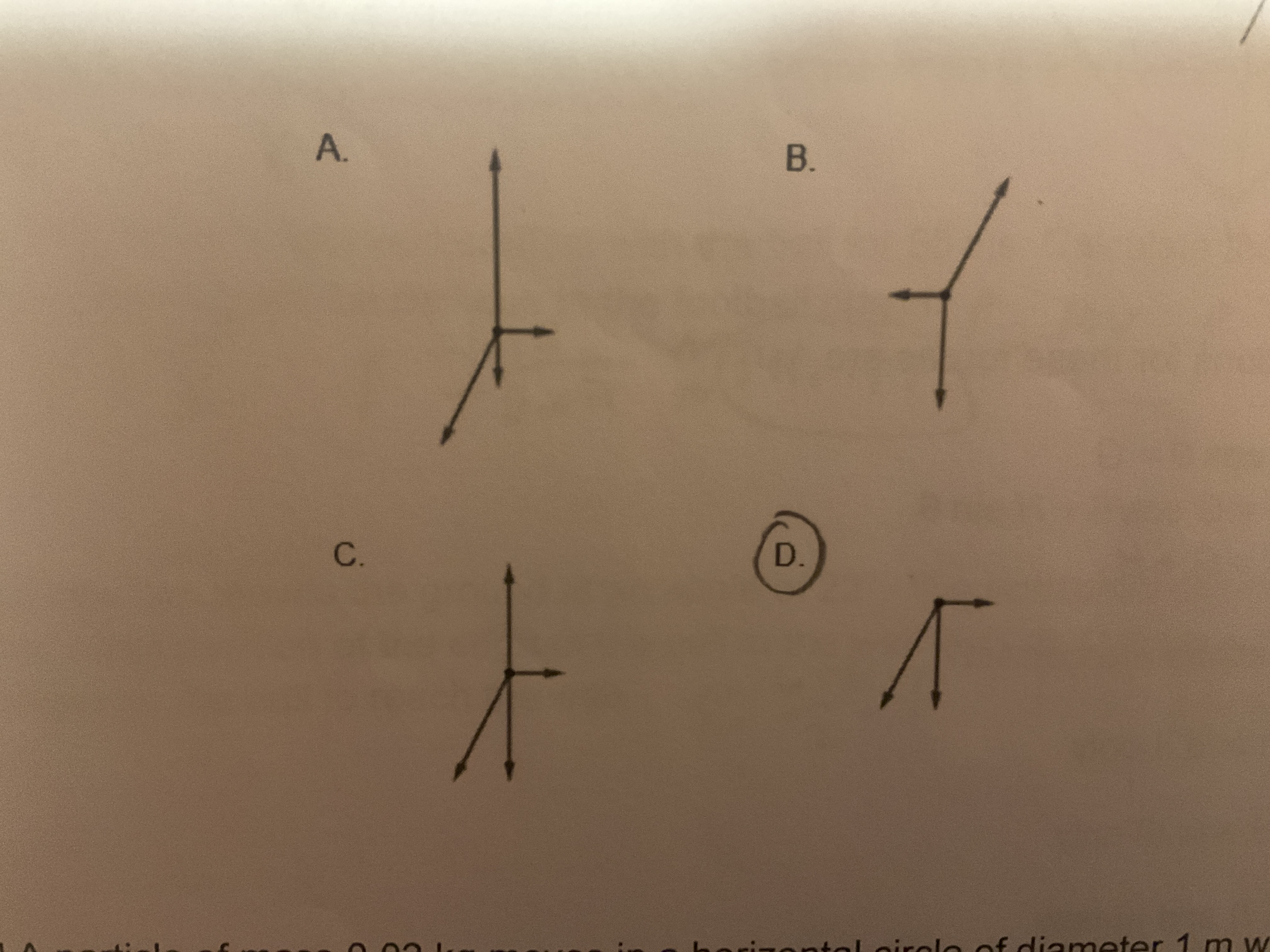
<p>A toy balloon floats at the end of a string. A wind blows to the right. The balloon is in translational equilibrium. What is the Free Body Diagram of the forces acting on the Balloon?</p>

A toy balloon floats at the end of a string. A wind blows to the right. The balloon is in translational equilibrium. What is the Free Body Diagram of the forces acting on the Balloon?

B

13
New cards

A particle of mass 0.2 kg moves in a horizontal circle of diameter 1 m with an angular velocity of 3 rad / sec. What is the magnitude and direction of the force responsible for this motion?

0.09π² towards center the circle
14
New cards
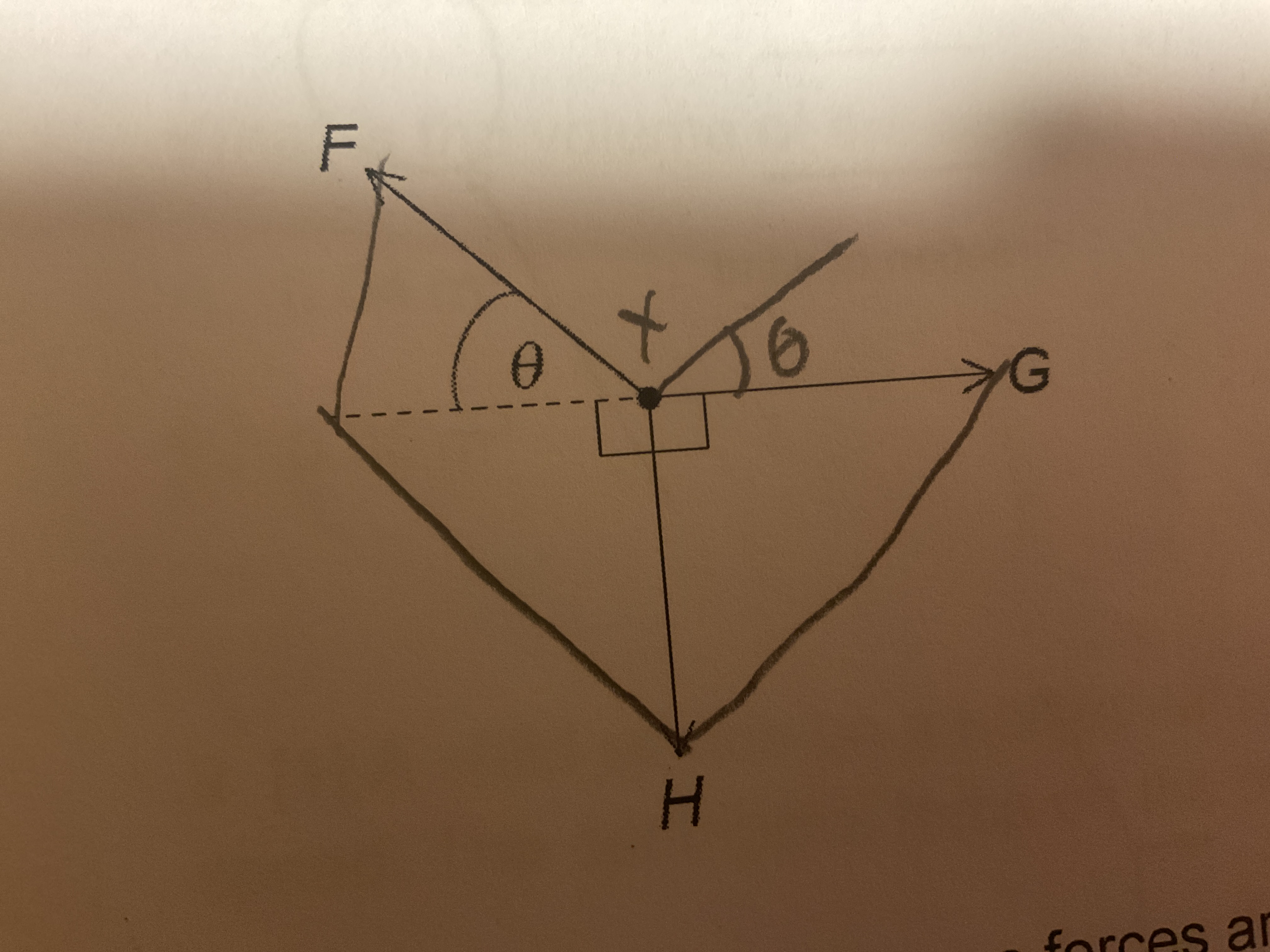
<p>An object is held in equilibrium by 3 coplanar forces of magnitude F, G, and H that act at a point in the same plane as shown. 3 equations for these forces are 1. F cos (ø) = G. 2. F = G cos (ø) + H sin (ø). 3. F = G + H. Which equations are correct? </p>

An object is held in equilibrium by 3 coplanar forces of magnitude F, G, and H that act at a point in the same plane as shown. 3 equations for these forces are 1. F cos (ø) = G. 2. F = G cos (ø) + H sin (ø). 3. F = G + H. Which equations are correct?

1 and 2
15
New cards
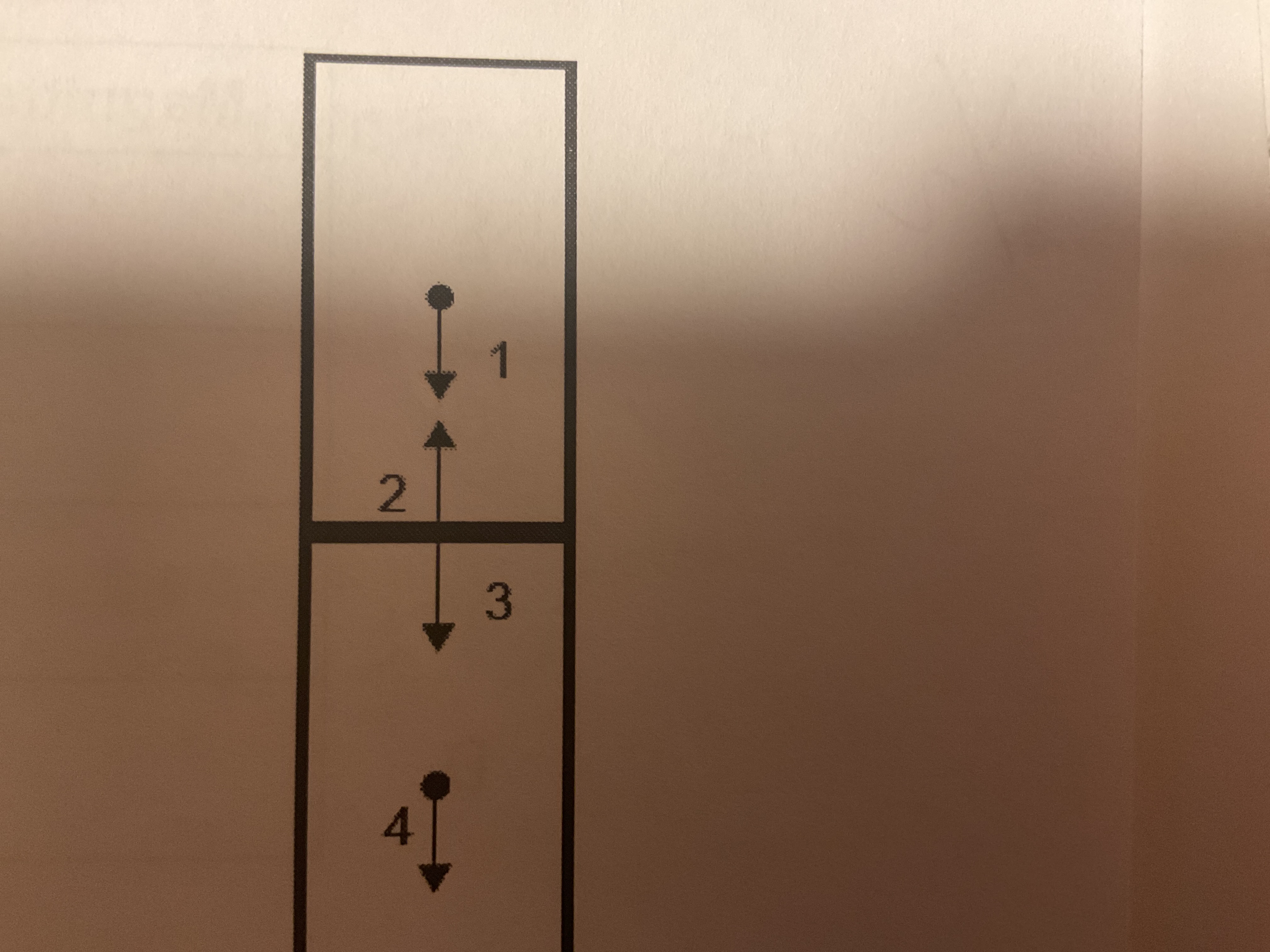
<p>2 Identical boxes are stored in a warehouse as shown in the diagram. 2 Forces acting on the top box and 2 forces acting on the bottom box are shown. Which is a force pair according to Newton’s 3rd law?</p>

2 Identical boxes are stored in a warehouse as shown in the diagram. 2 Forces acting on the top box and 2 forces acting on the bottom box are shown. Which is a force pair according to Newton’s 3rd law?

2 and 3

16
New cards

A football (soccer) player kicks a stationary ball of mass 0.45 kg

17
New cards
What is the difference between distance and displacement?
Distance is a scalar quantity (how much ground covered); Displacement is a vector quantity (overall change in position).
18
New cards
What are the "Big Four" Kinematic Equations for constant acceleration?
1) v = v_0 + at 2) x = x_0 + v_0t + 1/2at^2 3) v^2 = v_0^2 + 2a(x - x_0) 4) x = x_0 + 1/2(v + v_0)t
19
New cards
In projectile motion, what is the acceleration in the x-direction vs. the y-direction?
x-direction: a_x = 0; y-direction: a_y = -g (approx 9.8 m/s^2 downward).
20
New cards
Define Newton's Second Law of Motion.
The acceleration of an object is directly proportional to the net force and inversely proportional to its mass (F_{net} = ma).
21
New cards
What is the Impulse-Momentum Theorem?
The impulse applied to an object is equal to the change in its momentum (J = \Delta p).
22
New cards
What is the difference between an Elastic and an Inelastic collision?
Elastic: Momentum and Kinetic Energy are conserved. Inelastic: Momentum is conserved, Kinetic Energy is NOT conserved.
23
New cards
What is the general formula for Work done by a constant force?

W = F d \cos(\theta)

24
New cards
State the Work-Energy Theorem.
The net work done on an object is equal to the change in its kinetic energy (W_{net} = \Delta K).
25
New cards
What are two ways to calculate Power?
1) Rate of work (P = W/t) 2) Force times velocity (P = F v).
26
New cards
What is the defining condition for Simple Harmonic Motion (SHM)?
A restoring force directly proportional to displacement and pointing toward equilibrium (F_{restoring} = -kx).
27
New cards
What is the formula for the Period (T) of a Mass-Spring system?

T = 2\pi \sqrt{m/k}

28
New cards
What is the formula for the Period (T) of a Simple Pendulum?

T = 2\pi \sqrt{L/g}

29
New cards
Where are Velocity and Acceleration at their maximums in SHM?
Velocity is max at Equilibrium (x=0); Acceleration is max at Amplitude (x = \pm A).
30
New cards
Slope of a Position-Time (x-t) graph represents?
Velocity
31
New cards
Slope of a Velocity-Time (v-t) graph represents?
Acceleration
32
New cards
Area under a Velocity-Time (v-t) graph represents?
Displacement (change in position)
33
New cards
Area under an Acceleration-Time (a-t) graph represents?
Change in velocity
34
New cards
What is the vertical velocity of a projectile at the very top of its path?
Zero
35
New cards

What is the horizontal acceleration of a projectile (neglecting air resistance)?

0

36
New cards
If you drop a ball and throw one horizontally from the same height, which hits the ground first?
They hit at the same time (vertical motion is independent of horizontal).
37
New cards

Formula for average velocity?

v_{avg} = \Delta x / \Delta t

38
New cards
Newton's First Law is also known as the Law of...?
Inertia
39
New cards
Newton's Third Law states that for every action there is an equal and opposite reaction. These forces act on...?
Different objects (so they never cancel each other out).
40
New cards
Which is usually larger: Coefficient of Static Friction (\mu_s) or Kinetic Friction (\mu_k)?
Static Friction (\mu_s) is usually larger (harder to start moving than to keep moving).
41
New cards
Formula for the Force of Friction?
F_f = \mu F_N (where F_N is Normal Force)
42
New cards

Formula for the component of gravity acting parallel to (down) an inclined plane?

F_{g,x} = mg \sin(\theta)

43
New cards

Formula for the component of gravity acting perpendicular to an inclined plane?

F_{g,y} = mg \cos(\theta)

44
New cards
What is the reading on a scale (Apparent Weight) if an elevator accelerates upward?
Greater than true weight (mg + ma).
45
New cards
What is the reading on a scale (Apparent Weight) if an elevator accelerates downward?
Less than true weight (mg - ma).
46
New cards
The area under a Force-Time (F-t) graph represents?
Impulse (or change in momentum)
47
New cards
Conservation of Momentum applies only when...?
There are no net external forces acting on the system.
48
New cards
In a perfectly inelastic collision, what happens to the objects?
They stick together and move with a common velocity.
49
New cards
Is Kinetic Energy a scalar or a vector?
Scalar (direction does not matter, only magnitude).
50
New cards
Work done by a force perpendicular to the direction of motion is...?
Zero (\cos 90^{\circ} = 0).
51
New cards
Work done by a centripetal force is always...?
Zero (force is always perpendicular to velocity).
52
New cards

Formula for Gravitational Potential Energy (near Earth)?

U_g = mgh

53
New cards

Formula for Elastic (Spring) Potential Energy?

U_s = 1/2 k x^2

54
New cards
What does the area under a Force-Displacement (F-x) graph represent?
Work done
55
New cards
If the speed of an object doubles, what happens to its Kinetic Energy?
It quadruples (K \propto v^2).
56
New cards
Power is defined as the rate of change of...?
Energy (or the rate of doing Work).
57
New cards
Unit of Power?
Watt (Joules per second)
58
New cards
Unit of Force?
Newton (kg m/s^2)
59
New cards
Unit of Work and Energy?
Joule (N m)
60
New cards
For a spring in SHM, the restoring force is proportional to...?
Displacement (F = -kx).
61
New cards
In SHM, at what position is Kinetic Energy at its maximum?
At the equilibrium position.
62
New cards
In SHM, at what position is Potential Energy at its maximum?
At the amplitude (endpoints).
63
New cards
Total Mechanical Energy in simple harmonic motion is proportional to the square of...?
The Amplitude (E \propto A^2).
64
New cards
Does the period of a simple pendulum depend on the mass of the bob?
No (T depends only on Length and Gravity).
65
New cards
Does the period of a mass-spring system depend on gravity?
No (T depends only on Mass and Spring Constant).
66
New cards
What is the phase difference between Position and Velocity in SHM?
90^{\circ} (or \pi/2 radians).
67
New cards
What is the phase difference between Position and Acceleration in SHM?
180^{\circ} (or \pi radians).
68
New cards
If you double the length of a pendulum, how does the period change?
It increases by a factor of \sqrt{2}.
69
New cards
If you quadruple the mass on a spring, how does the period change?
It doubles (T \propto \sqrt{m}).
70
New cards
Condition for mechanical energy conservation?
Only conservative forces (gravity, spring force) do work; no non-conservative forces (friction, air resistance).