CH4.4 Muscle Tissue
 Call Kai
 Learn
Learn Practice Test
 Spaced Repetition
 Match
Match Flashcards
 Knowt Play
1/16

There's no tags or description
Looks like no tags are added yet.
Name | Mastery | Learn | Test | Matching | Spaced | Call with Kai | Chat |
|---|
No analytics yet
Send a link to your students to track their progress
17 Terms
Muscle Tissue
A primary tissue type composed of excitable cells that contract (shorten) to generate force for physical movement.
3 types: skeletal, cardiac, and smooth

Types of Muscle Tissue
skeletal muscle (striated, parallel fibers)
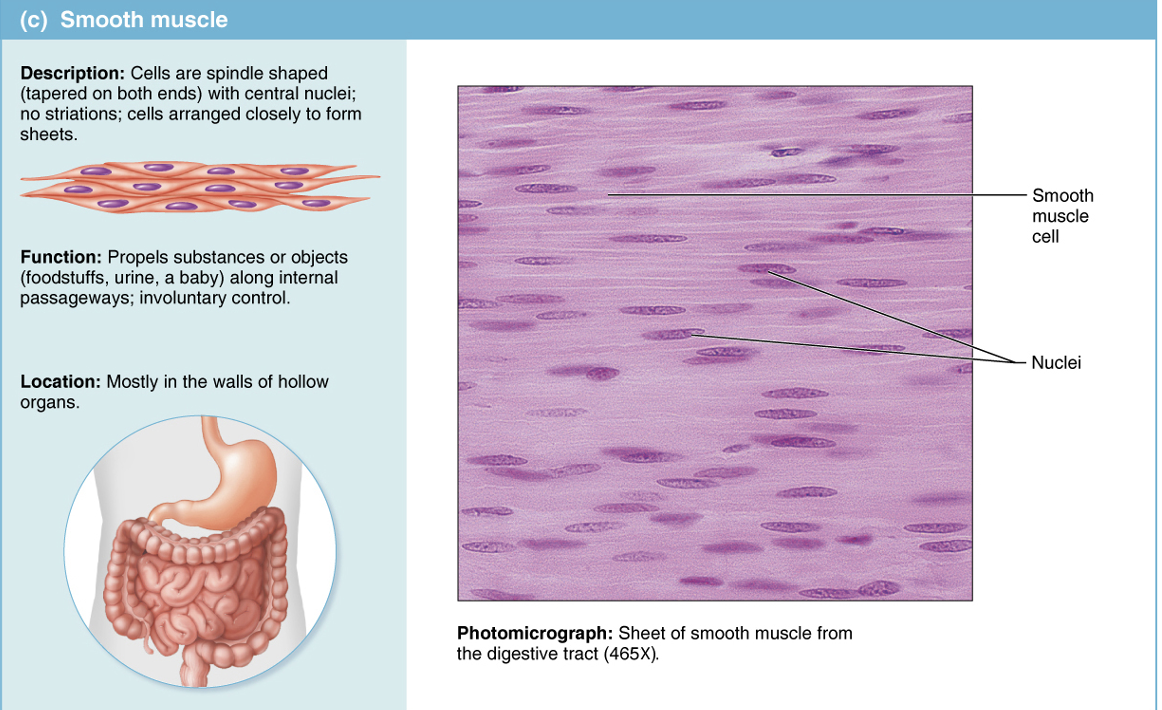
smooth muscle (spindle-shaped cells)
cardiac muscle (striated, branching cells).

Skeletal Muscle Tissue
Muscle tissue composed of long, cylindrical, multinucleate cells with obvious striations, under voluntary control, and located in skeletal muscles attached to bones, skin, or eyeballs.

Cardiac Muscle Tissue
Muscle tissue composed of short, branching, striated cells that are generally uninucleate (or one nucleus) and joined by intercalated discs (gap junctions, desmosomes), located in the heart wall under involuntary control.

Smooth Muscle Tissue
Muscle tissue composed of nonstriated, spindle-shaped cells with a single central nucleus, arranged in sheets in the walls of hollow organs under involuntary control
Intercalated Discs
Specialized junctional sites connecting cardiac muscle cells that contain gap junctions and desmosomes to allow coordinated contraction.
Striations
The prominent transverse light-and-dark banding pattern in skeletal and cardiac muscle produced by the organized arrangement of actin and myosin filaments.
Voluntary Control
Conscious control over muscle contraction, characteristic of skeletal muscle tissue.
Involuntary Control
Muscle contraction occurring automatically without conscious thought, characteristic of cardiac and smooth muscle tissues.
Multinucleate Cells
Cells containing multiple nuclei per individual cell, characteristic of long skeletal muscle fibers.
Uninucleate Cells
Cells containing a single nucleus, characteristic of smooth muscle cells and most cardiac muscle cells.
Spindle-Shaped Cells
Cells that are elongated and tapered at both ends with a single central nucleus, characteristic of smooth muscle.


Identify type of tissue.
Smooth Muscle Tissue; sheet-like arrangements of nonstriated, spindle-shaped cells with central oval nuclei.

Identify type of tissue.
Cardiac Muscle Tissue; branching, striated cells with single central nuclei and dark transverse intercalated discs.

Identify type of tissue.
Skeletal Muscle Tissue; large, cylindrical, unbranched fibers with distinct striations and multiple peripherally located nuclei.

Identify type of tissue.
Dense Regular Connective Tissue; A non-muscle tissue showing parallel wavy collagen fibers and flattened fibroblast nuclei, often mistaken for smooth muscle tissue.
The 3 muscle tissues:
