PHYSL 212 Lecture 1 - Cellular Structure (Questions)
 Call Kai
 Learn
Learn Practice Test
 Spaced Repetition
 Match
Match Flashcards
 Knowt Play
1/19

There's no tags or description
Looks like no tags are added yet.
Name | Mastery | Learn | Test | Matching | Spaced | Call with Kai | Chat |
|---|
No analytics yet
Send a link to your students to track their progress
20 Terms
What are the broad categories of cells?
Epithelial cells, connective tissue cells, nerve cells, muscle cells
What is the size, abundance, and location of the nucleus?
Largest organelle, typically one per cell, located in the center of the cell
What is the size, abundance, and location of the ribosomes?
Smallest organelle, most abundant, floating free in cytoplasm or attached to the endoplasmic reticulum
What are the differences in the roles of free ribosomes versus membrane-bound ribosomes?
Free ribosomes synthesize cytosolic proteins
Membrane-bound ribosomes synthesize membrane proteins
What is the size, abundance, and location of the smooth and rough ER?
Distributed throughout cell as a network of membrane-enclosed space, smooth ER continuous with nuclear envelope and rough ER continuous with smooth ER
What is the size, abundance, and location (orientation) of the golgi apparatus?
Comprised of a series of membranous cisternae, one per cell, cis face facing the rough ER and trans face facing the cell membrane
In which direction do proteins from the ER travel through the golgi apparatus? Explain why.
From cis to trans: proteins must go from the rough ER (where they are synthesized) to the golgi to be modified, then will exit through the trans face to reach the membrane/other organelles/be secreted
What is the size, abundance, and location of the endosomes?
Small, multiple, throughout the cell
What are the similarities and differences between lysosomes and peroxisomes?
Similarities: small, multiple, throughout the cell, breakdown of substances in the cell
Differences:
Lysosomes have an acidic environment to breakdown damaged organelles, engulfed bacteria and debris of dead cells. Peroxisomes have neutral pH and repurpose harmful/oxidative substances (fatty acids, alcohol)
What are the types of protein filaments found in the cytoskeleton?
Actin filament, intermediate filament, microtubules
How can ribosomes have their functions altered via disease/injury? What are the widespread bodily affects of ribosomopathy? Use the examples given in slides.
Disease, etc. → abnormal ribosomal biogenesis → ribosomes are improperly made → human genetic disease due to lack of necessary proteins
Ex. anemia (low red blood cell count due to lack of properly synthesized proteins)
Ribosomal proteins are directly affected, but other tissues are also affected (ex. facial, limb, cardiac, etc.)
How can the ER have its functions altered via disease/injury? What is the response of the ER?
Diseases stress the ER → altered ER function → accumulation of unfolded/misfolded proteins → unfolded protein response
Unfolded protein response causes autophagy of stressed ER sections + cellular reprogramming and adaptation. Can also lead to cell death by apoptosis if severe
How can mitochondria have their functions altered via disease/injury? What are the widespread bodily affects of mitochondrial disease? Use the examples given in slides.
Primary or secondary (associated with a disease that affects mitochondria) disease → mitochondrial dysfunction → inability to produce ATP
Ex. mitochondial myopathy: limb weakness, muscle fatigue, exercise intolerance
How can lysosomes have their functions altered via disease/injury? What are the widespread bodily affects of lysosome disorders, and how many types are recognized? Use the examples given in slides.
Lysosomal storage disorder → toxic material builds up in lysosomes → harm caused to affected bodily parts
70n recognized types. Ex. LAL deficiency (lipid accumulation) affects the gut, liver, blood vessels. Pompe disease (glycogen accumulation) affects muscle
How can peroxisomes have their functions altered via disease/injury, and how many recognized types are there? What are the widespread bodily affects of lysosome disorders? Use the examples given in slides.
Peroxisome biogenesis disorder → harmful substances build up in body → harm caused to affected bodily parts, often fatal
14 recognized types. Ex. Zellweger syndrome, fatal
Where is cholesterol found in a cell membrane? What is its purpose?
Found primarily in the outer membrane. Slightly amphipathic to maintain membrane fluidity
Describe the polarity of integral and peripheral membrane proteins. Why?
Integral membrane proteins are amphiphatic: polar sections to attach peripheral membrane proteins and interact with charge molecules, nonpolar sections to embed within the core of the phospholipid bilayer
Peripheral membrane proteins: non amphipathic (polar) to interact with integral proteins and cytosol
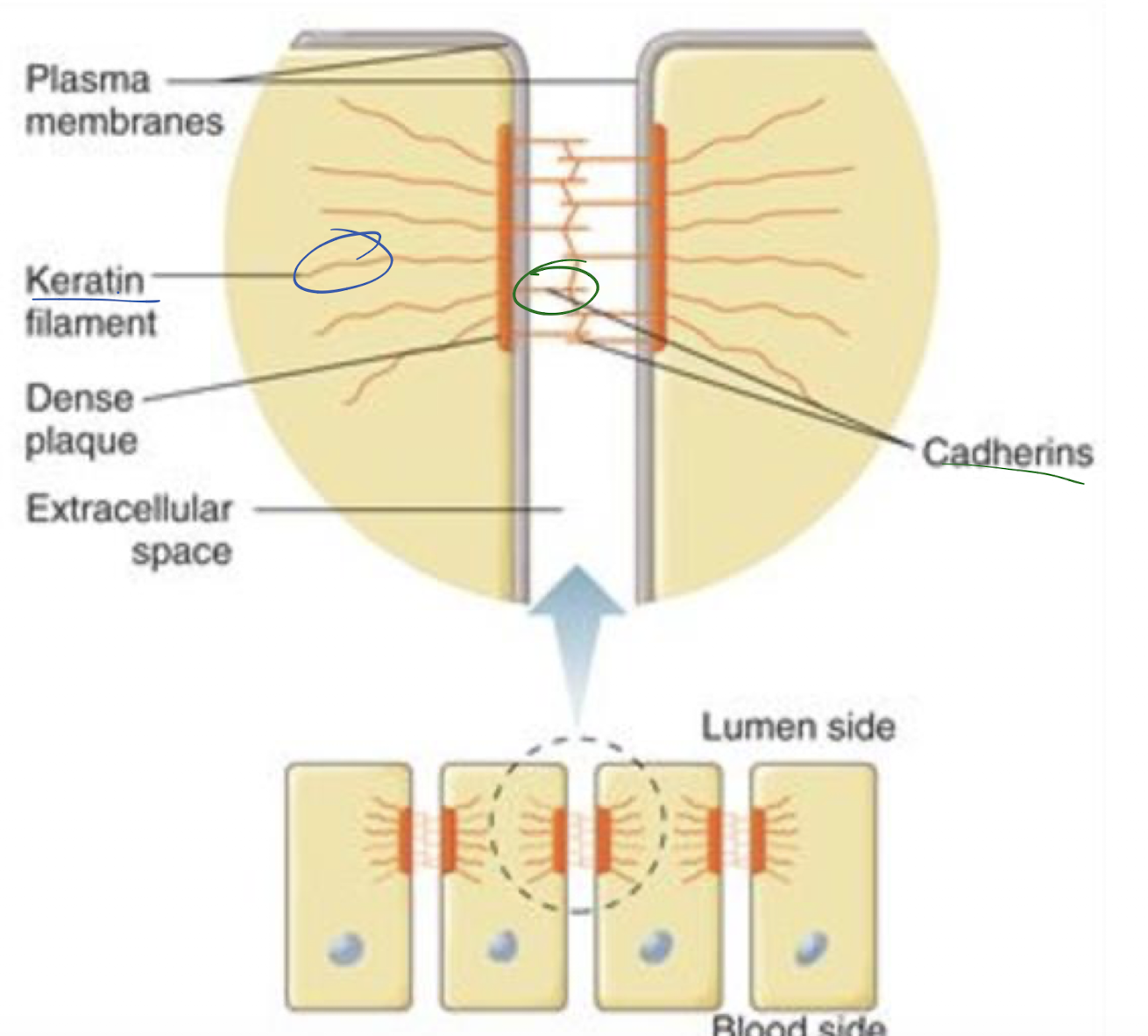
What are the characteristics of a desmosome (cell gap length, protein components)?
Adjacent cells separated by ~20 nm, cadherins extend into cell space to bind with cadherins on other cells + keratin anchors desmosome to cytoskeleton
What are the characteristics of a tight junction (cell gap length, protein components)?
No space between adjacent cells, >40 known protein components including occludins and claudins

What are the characteristics of a gap junction (cell gap length, protein components)?
~2-4 nm gap between adjacent cells, connexin protein component
