Lecture 1 Basis of Inheritance
 Studied by 0 people
 Call with Kai
 Learn
Learn Practice Test
 Spaced Repetition
 Match
Match Flashcards
 Knowt Play
1/12

There's no tags or description
Looks like no tags are added yet.
Name | Mastery | Learn | Test | Matching | Spaced | Call with Kai |
|---|
No study sessions yet.
13 Terms
Describe DNA; are strands parallel or antiparallel, what are they bound together by, how many carbons pyrimidines and purines have. what is a nucleotide
Carbons on pyrimidines & purines are numbered 1-6 or 1-9
• Carbons on the sugars are numbered 3’ end and 5’end
• 2 strands are antiparallel •
2 strands are bound by hydrogen bonds
G & C make 3 bonds,
T & A make 2 bonds
Each nucleotide consists of a sugar, a phosphate, and a base Each strand runs parallel to the other strand and connects through the bases Specific binding of purines and pyrimidines determines the genetic code
Structure discovered by Rosalind Franklin (x-RAY) ²
Watson, Crick and Wilkins discovered it in 1953 *
Received the Nobel Prize
What is a nucleosome? Histone,Linker DNA, Solenoid, Protein scaffold, describe chromosome condensation during mitosis, and epigenetic modifications.
Nucleosomes: Basic units of DNA packaging, with DNA wrapped around histone cores
Histones:
• H2A, H2B, H3, and H4 form the nucleosome core •
H1 stabilizes DNA at the nucleosome entry and exit points
Linker DNA: Connects individual nucleosomes
Solenoids: Higher-order structures formed by the coiling of nucleosome fibers
Protein scaffold: Provides a structural framework that helps organize chromatin and chromosomes
Chromosome condensation during mitosis: During mitosis, chromosomes become highly condensed, facilitated by the protein scaffold and further coiling of the DNA, facilitating segregation
Epigenetic modifications: Found primarily on histones (e.g., acetylation, methylation) and on the DNA itself, influencing gene expression.
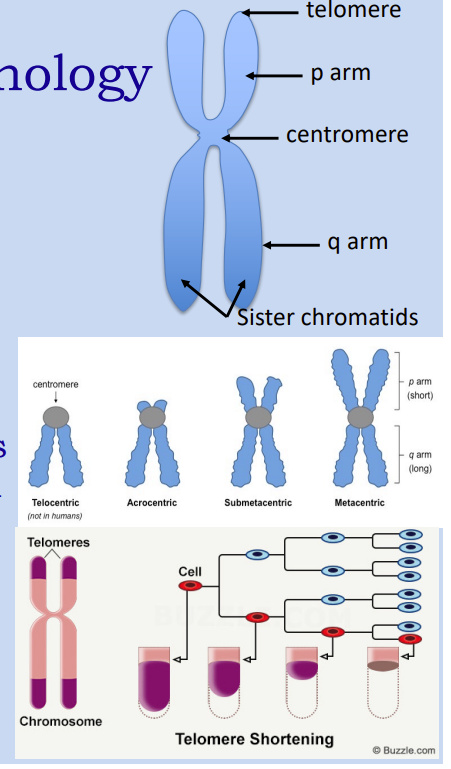
What are the classifications of chromosomes i.e., acrocentric submetacentric, metacentric, and telocentric?
What are telomeres and how long are they?
What are centromeres and how long are they?
What is the p arm and the q arm?
Classification
Acrocentric
Submetacentric
Metacentric
Telocentric (not in humans)
p arm is the short arm
q is the long arm
Review
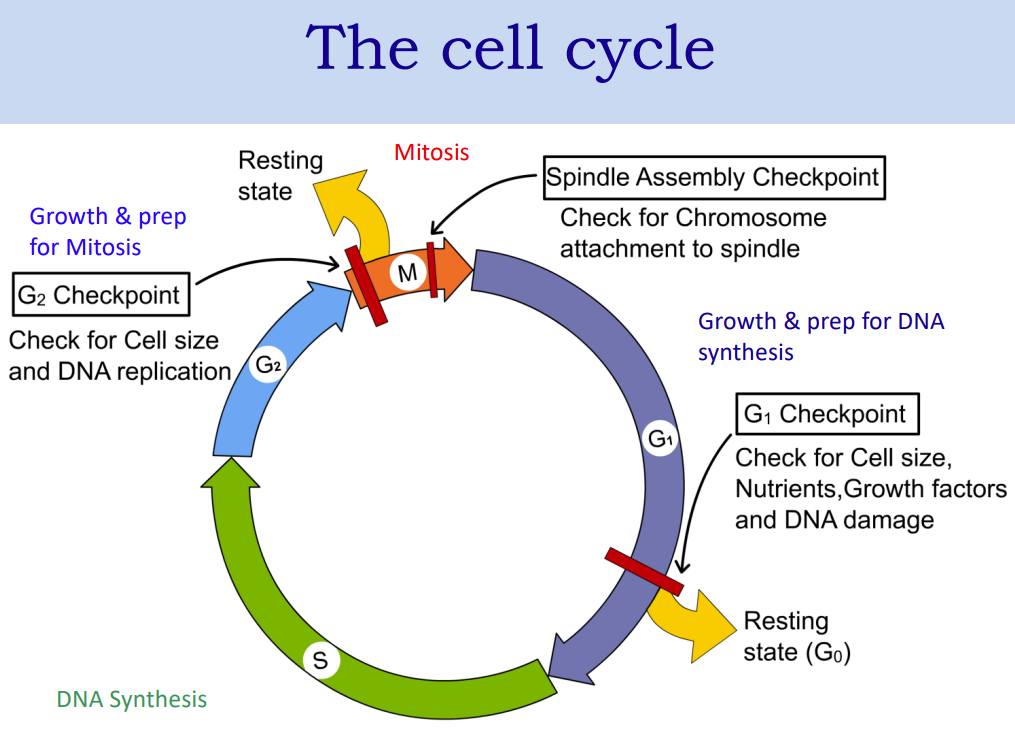
Describe the cell cycle; what is G1? What is the G1 checkpoint? What is G0? What is S phase? What is G2? What is G2 Checkpoint? What is Resting state? What is mitosis?
The cell cycle consists of
Mitotic (M) phase (mitosis and cytokinesis)
Interphase (cell growth and copying of chromosomes in preparation for celldivision)
•Interphase (about 90% of the cell cycle) can be divided into subphases
G1 phase (first gap)
S phase (synthesis)
G2 phase (secondgap)
The cell grows during all three phases, but chromosomes are duplicated only during the S phase
Describe Mitosis. What is it? Are cells idenitical or different? How many sister chromatids are made? When do sister chromatids replicate? What are the stages in order?
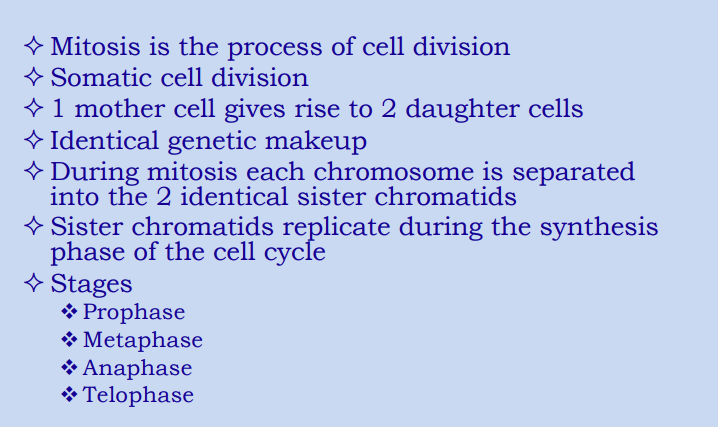
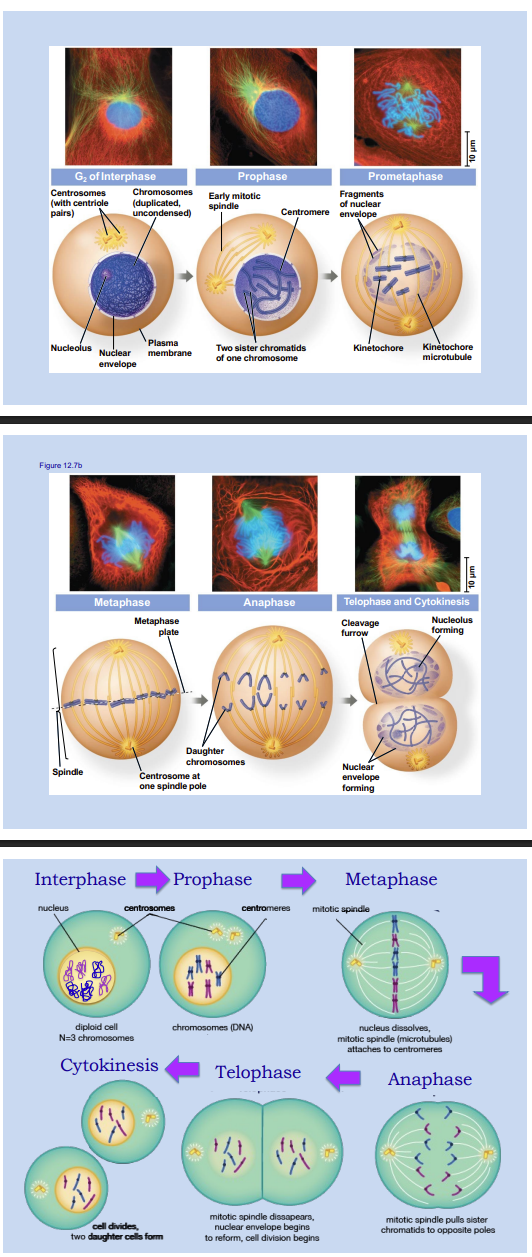
Describe G2 of interphase, prophase, prometaphase, metaphase,anaphase, telophase and cytokinesis.
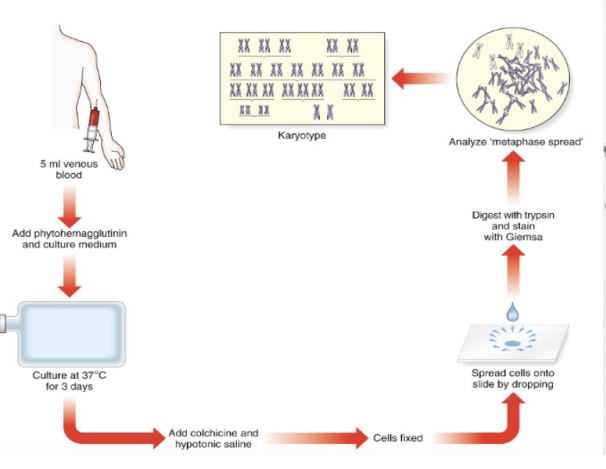
How do you study chromosome? What is Giemsa (G) banding?
How do you study chromosome?
DNA can be isolated from cells
Cells are blocked in metaphase (colchicine) to obtain chromosomes
Treatment with trypsin to remove excess proteins and improve visualization
Stained with dyes
Giemsa stain – G banding
Heterochromatin- dark, condensed DNA, not expressed
Euchromatin- light bands, less condensed, actively expressed
Describe karyotype analysis. What is phytohemagglutinin, colchicine, and trypsin.
Karyotype is a test to identify and evaluate the size, shape, and number of chromosomes in a sample of cells
Phytohemagglutinin: Stimulates cell division
Colchicine: Arrests cells in metaphase
Trypsin: Enhances chromosome banding by breaking down nonhistone proteins
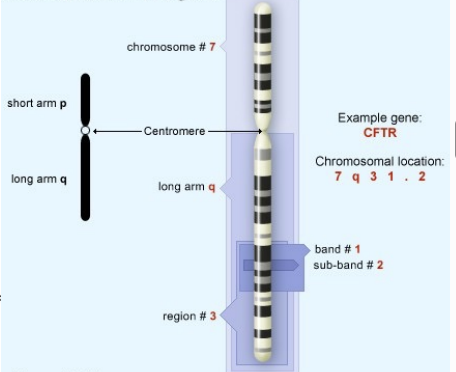
²Bands are numbered from the centromere towards the telomere ²Each band is divided into sub-bands ²
E.g. cytogenetic map location of the CFTR gene is 7q31.2, which indicates it is on chromosome 7, q arm, band 3, sub-band 1, and sub-sub-band 2
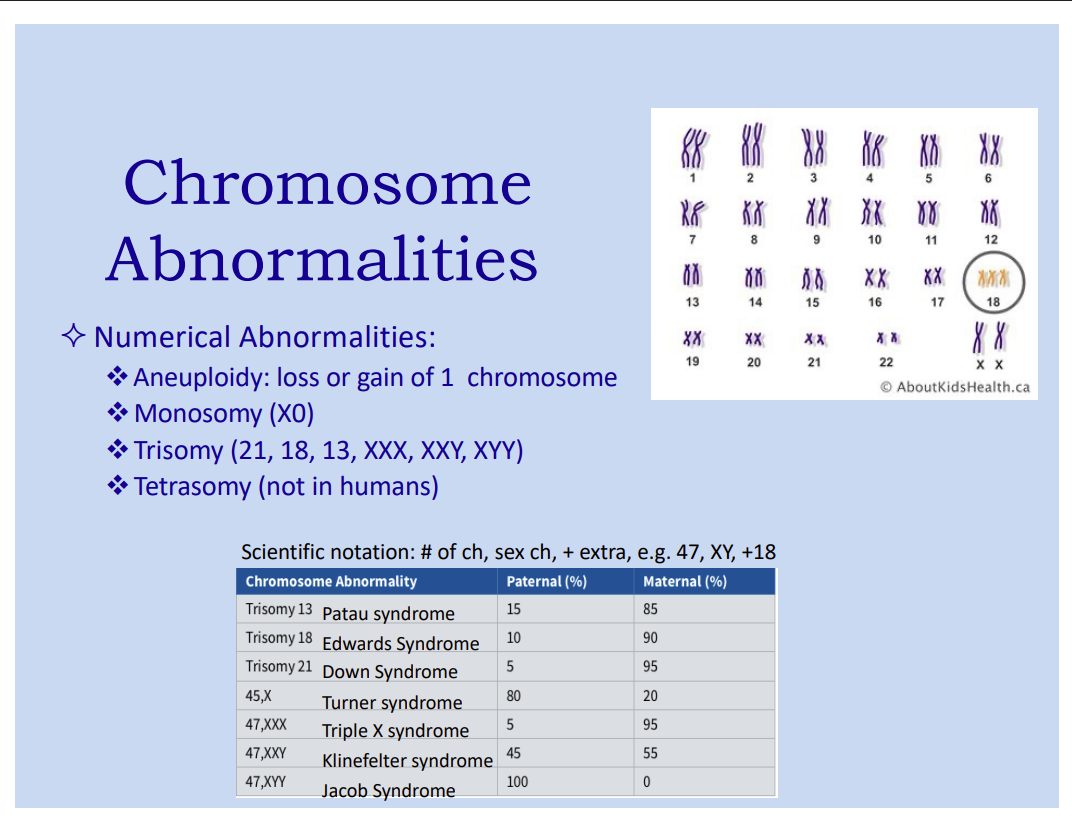
Regarding chromosome abnormalities, describe aneuploidy, monosomy, trisomy, tetrasomy, and polyploidy?
Numerical Abnormalities:
Aneuploidy: loss or gain of 1 chromosome
Monosomy – missing one chromosome
Trisomy –one extra chromosome
Tetrasomy (not in humans)
Only some are compatible with life: depends on the genes on the chromosome: Dosage effect is crucial
Polyploidy: gain of 1 complete haploid complement
2 spermatozoa fertilize 1 oocyte
Miscarriage
No cytokinesis
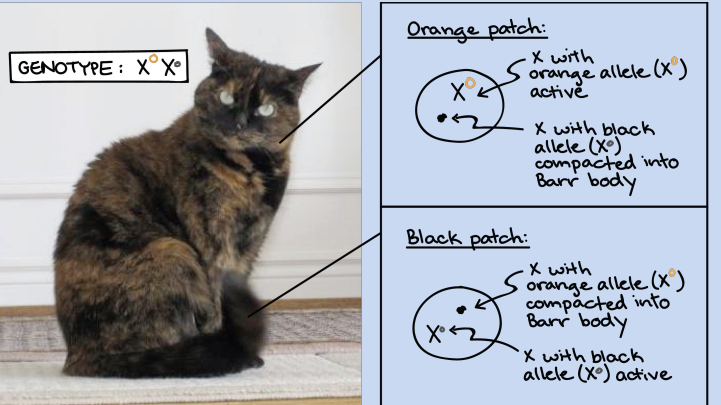
What is lyonization? When does it happen?
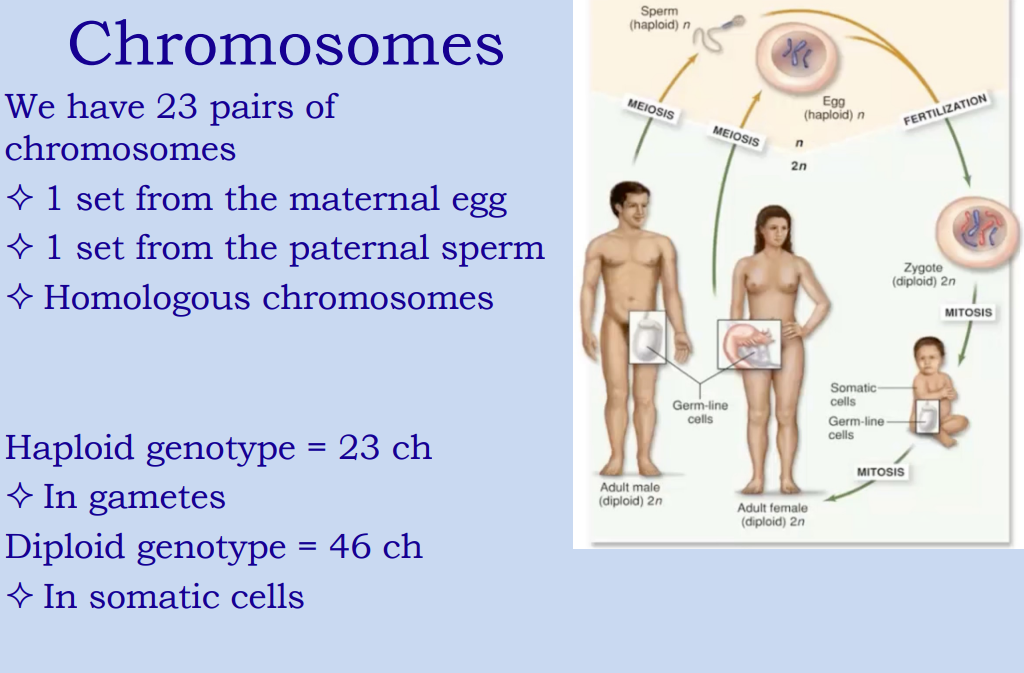
We have 23 pairs of chromosomes v2 sex chromosomes •
XX or XY ²Permanent X inactivation to compensate for the extra X in females vAKA lyonization
vBecause of dosage-sensitive genes vEarly in embryonic life v
Usually random v
Each cell selects one X chromosome to inactivate
vThe decision is transmitted to all daughter cells
vInactivation is the condensation of of one x chromosome to form the Barr Body
Give some examples of chromsosome abnormalities (specific syndromes)