Epithelial Malignancies
 Call Kai
 Learn
Learn Practice Test
 Spaced Repetition
 Match
Match Flashcards
 Knowt Play
1/37

There's no tags or description
Looks like no tags are added yet.
Name | Mastery | Learn | Test | Matching | Spaced | Call with Kai | Chat |
|---|
No analytics yet
Send a link to your students to track their progress
38 Terms
Oral Cancer Subsites: Oral Cavity
Includes ANTERIOR 2/3 OF TONGUE, floor of mouth, buccal/labial mucosa, HARD PALATE, and gingiva.
Oral Cancer Subsites: Oropharynx
Includes SOFT PALATE, POSTERIOR 1/3 (base) OF TONGUE, palatine tonsils, and posterior pharyngeal wall.
Most common extrinsic factors in OSCC etiology
tobacco
EtOH
sunlight (lip vermilion)
oncogenic viruses - HPV 16
Instrinic factors in OSCC etiology
nutritional deficiencies (Fe, vitamin A)
immunosuppression
genetic mutations (TP53, RB1, CDKN2A, RAS, MYC, EGFR, PIK3CA)
Clinical morphology of Oral SCC
Exophytic
Endophytic
Leukoplakic
Erythroplakic or erythroleukoplakic
+/- pain, induration, destruction of underlying bone, paresthesia
Oral SCC High-Risk Sites
Posterior lateral and ventral tongue, and the floor of the mouth.

Primary Oncogenic Virus in Oropharyngeal SCC
Human Papillomavirus type 16 (HPV 16).
Clinical Morphology of Oral SCC
Can present as exophytic, endophytic, leukoplakic, or erythroplakic lesions.

Lip Vermilion SCC Etiology & Location
Most commonly affects the lower lip due to chronic ultraviolet (UV) light exposure.

Lip Vermilion SCC
~90% lower lip
chronic UV light exposure
light-skinned
relatively slow growing
mets late (

Oropharyngeal SCC
Esp. tonsillar region
Close association with HPV 16
Sore throat, dysphagia, odynophagia, painless neck mass
Metastasis often present at diagnosis

HPV-Positive Oropharyngeal SCC Clinical Features
Occurs mainly in tonsils/base of tongue, presents with early lymph node metastasis, but carries a favorable prognosis.

SCC: Microscopic Features

Field Cancerization
Diffuse mucosal changes increased by carcinogens leading to multiple primary synchronous or metachronous tumors.
TNM Staging: 'T' Definition
Refers to the size and depth of invasion (extent) of the primary tumor.
TNM Staging: 'N' Definition
Refers to the spread to regional lymph nodes
TNM Staging: 'M' Definition
Distant metastasis
Basic Treatment Options for Oral SCC
Surgery (conventional resection, transoral robotic surgery for OPSCC)
Radiation (IMRT, de-escalation for HPV-positive OPSCC)
Chemotherapy (cisplatin, carboplatin, 5-FU, deintensification for HPV-positive OPSCC)
Biologics (cetuximab, immune checkpoint inhibitors)
Oral SCC: Importance of Follow-up / FIELD CHARACTERIZATION
~3-7% of head and neck cancer SCC patients per year develop an additional primary malignancy, with 20-year cumulative risk of 36%
SCC Variants: Verrucous Carcinoma Characteristics
A low-grade SCC variant linked to chronic tobacco use with rare metastasis.

SCC Variant: Basaloid Squamous Cell Carcinoma
cells with dark nuclei/little cytoplasm; often oropharynx/HPV positive
CARCINOMA OF THE MAXILLARY SINUS
Uncommon
Mainly older adults

Carcinoma of the Maxillary Sinus: Etiology
Etiology largely unknown
not related sinusitis or nasal polyps
only weak assoc. w/tobacco
wood/leather dust (intestinal-type variant only
recent evidence of increasing HPV-positive subset

Maxillary Sinus Carcinoma Presentation
Chronic unilateral nasal stuffiness and facial pain/paresthesia often mimicking a toothache.

Nasopharyngeal Carcinoma Primary Etiologic Factors
Epstein-Barr virus (EBV) infection, genetic susceptibility, and dietary nitrosamines (salted fish), tobacco (weak association)
Nasopharyngeal Carcinoma
Unilateral otitis media, hearing loss, epistaxis, nasal obstruction, pain
50-60% pts: 1st sign enlarged cervical lymph node
Treatment: radiation +/- systemic therapy
Prognosis: Overall 5-yr survival ~61%

BASAL CELL CARCINOMA
Most common skin cancer
Most common of all cancers
Arises from the basal cell layer of epidermis

Basal Cell Carcinoma (BCC) Origin & Common Site
Arises from epidermal basal cells; 80% occur in head and neck skin from sun exposure.
Basal Cell Carcinoma: Features
locally invasive, slowly spreading malignancy
etiology: chronic sun exposure
esp. fair complexioned adults
~80% cases occur in skin of head and neck
Basal Cell Carcioma: Types
>20 clinicopathologic types
more common types:
noduloulcerative
pigmented
morpheaform (sclerosing)
superficial
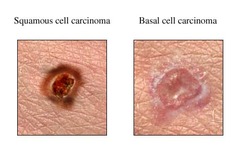
Basal Cell Carcinoma: Treatment
Excision, electrodessication, curettage
If high risk for recurrence: Mohs surgery

Basal Cell Carcinoma: Prognosis
Recurrence uncommon
Metastasis very rare
Need periodic follow-up (~44% develop 2nd lesion within 3 years)
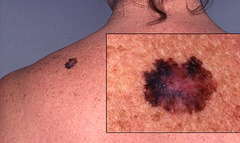
MELANOMA
Malignancy of melanocytes
3rd most common skin cancer (after BCC and SCC)
Accounts for most skin cancer deaths
Melanoma: Risk Factors
light complexion/hair/eyes
history of severe sunburns in childhood
tendency to sunburn or freckle easily
family or personal history of melanoma
Melanoma: Sites
Skin > mucosa
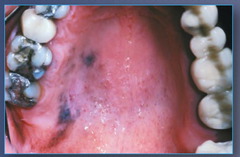
Oral mucosal melanoma is very rare
Melanoma Clinical Diagnostic Criteria (ABCDE)
Asymmetry, Border irregularity, Color variation, Diameter >6 mm, and Evolution/Elevation.

Oral Mucosal Melanoma Predilection & Prognosis
Most common on the hard palate/maxillary mucosa; carries an extremely poor prognosis (5-yr survival 10-25%).
Melanoma: Treatment & Prognosis
guided by TNM staging
oral melanoma: extremely poor prognosis (5-yr survival ~10% to 25%)