Chapter 3: Cell metabolism
 Call Kai
 Learn
Learn Practice Test
 Spaced Repetition
 Match
Match Flashcards
 Knowt Play
1/16

There's no tags or description
Looks like no tags are added yet.
Name | Mastery | Learn | Test | Matching | Spaced | Call with Kai | Chat |
|---|
No analytics yet
Send a link to your students to track their progress
17 Terms
Reactions are bidirectional-what pushes them in either direction?
Law of Mass Action)
Forward 🡺 Reactants transformed into products
Reverse 🡺 Products transformed into reactants
Hydrolysis reaction
What goes in? → Water (H₂O)
What happens? → Water breaks a bond
What comes out? → Smaller molecules
Purpose: Breaks down larger molecules
Type: Catabolic
Energy: Catabolic reactions generally release energy
Condensation reaction
What goes in? → Smaller molecules
What happens? → A water molecule is removed and a bond forms
What comes out? → Larger molecule + water
Purpose: Builds larger molecules
Type: Anabolic
Energy: Usually requires/uses energy
Phosphorylation & Dephosphorylation
What types of enzymes catalyze each of these reactions?
Phosphorylation
What happens? → A phosphate group (Pi) is added to a molecule.
Purpose: Often helps store or transfer energy or change a molecule's activity.
Enzyme: Kinase
Remember: Kinase = adds phosphate
Dephosphorylation
What happens? → A phosphate group is removed from a molecule.
Purpose: Can release energy or change a molecule's activity.
Enzyme: Phosphatase
Remember: Phosphatase = removes phosphate
Oxidation-Reduction. What does it mean to be oxidized?
Oxidation is a loss of electrons. And reduced is to gain an electron.
Reduction and Electron Transfer
In a reduction reaction, electrons can be transferred in two ways:
Directly as electrons (e⁻)
As part of a hydrogen atom (H)
NAD⁺ → NADH
NAD⁺ accepts 2 electrons total:
1 e⁻ is transferred directly to NAD⁺
1 e⁻ is transferred as part of a hydrogen atom (H)
So:
NAD⁺ + 2e⁻ + H⁺ → NADH
Energy
The capacity to do work
Facts
Kinetic & Potential Energy
Kinetic energy = energy of motion
Potential energy = stored energy
Energy can be converted between kinetic and potential forms.
In cells, energy can also be stored in molecules such as ATP.
ADP + Pi ⇌ ATP
ADP + Pi → ATP: energy is stored in ATP.
ATP → ADP + Pi: stored energy is released for cellular work.
If energy isn't captured...
If energy released from a reaction is not captured and stored in another molecule, it is released as heat.
Laws of Thermodynamics
1) First law of Thermodynamics – Energy cannot be created or destroyed
2) Second law of Thermodynamics – Processes proceed in the direction that spreads out energy
Larger molecules breaking to smaller ones (catabolic)
Movement of molecules from high concentration to low concentration (diffusion)

Which releases energy? Catabolic. Which uses/stores energy? Anabolic
Catabolic=products have less energy than the reactants. And anabolic: products have more energy than the reactants.
What affects reaction rates? How do they affect reaction rates?

1) Concentration of reactants or products (Law of Mass Action) (Figure 3.2). More reactants mean more collisions mean a faster reaction. More products can push the reaction in the reverse direction.
2) Temperature: Higher temp means molecules move faster, so more collisions and a faster reaction, and vise versa.
What else affects reaction rates? How do they affect reaction rates?

3)
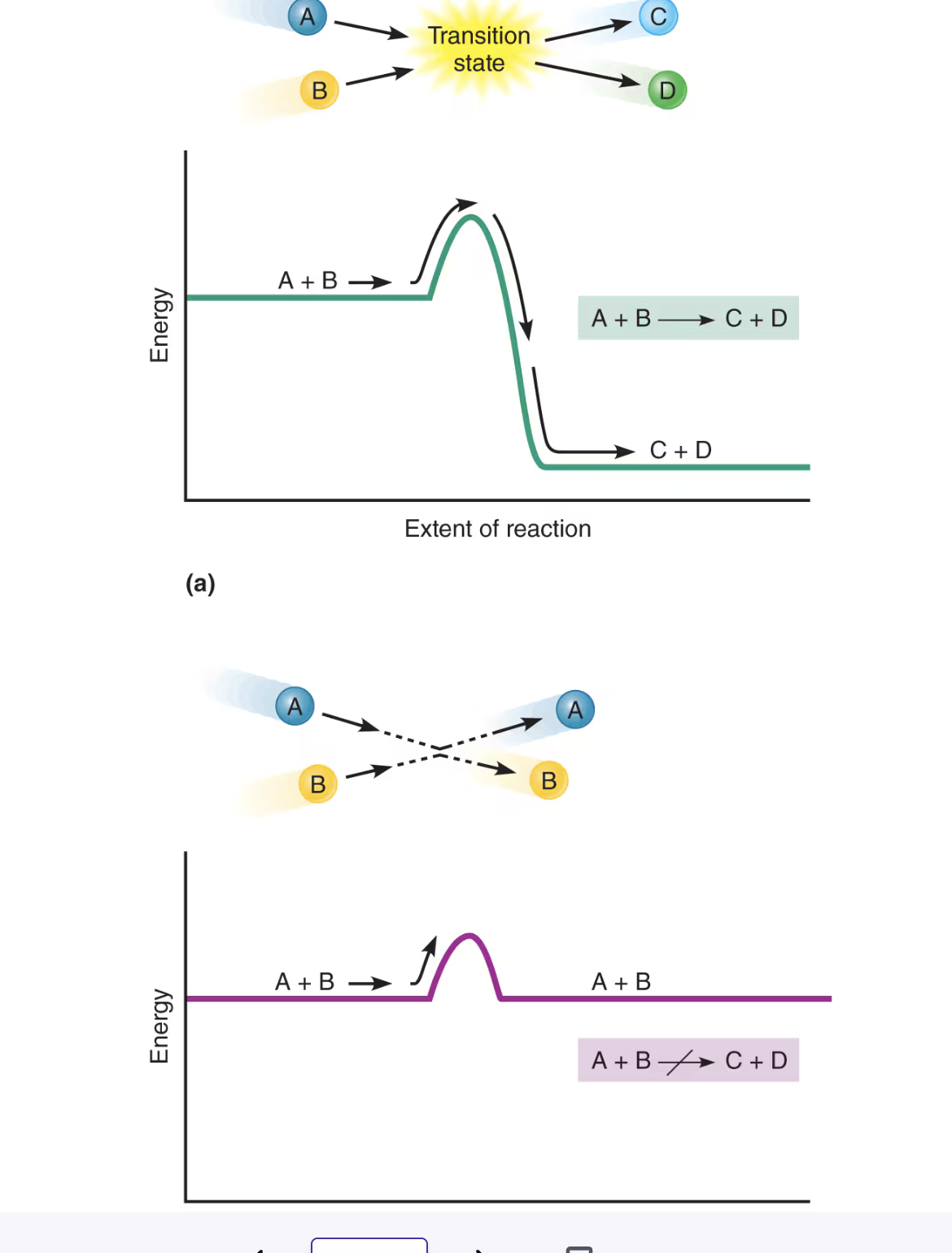
Activation energy height (Figure 3.3 & 3.4): Decreased activation energy height=increased reaction rate (so easier to overcome and a faster reaction), and a higher height means harder to overcome, so the reaction is slower.
How is it normally overcome? By increasing the energy of the molecules. Such as by increasing the temperature.
Last factor affecting reaction rate:
Enzymes: Enzymes decrease the activation energy barrier so the reaction rate can increase. They also help reduce the height.
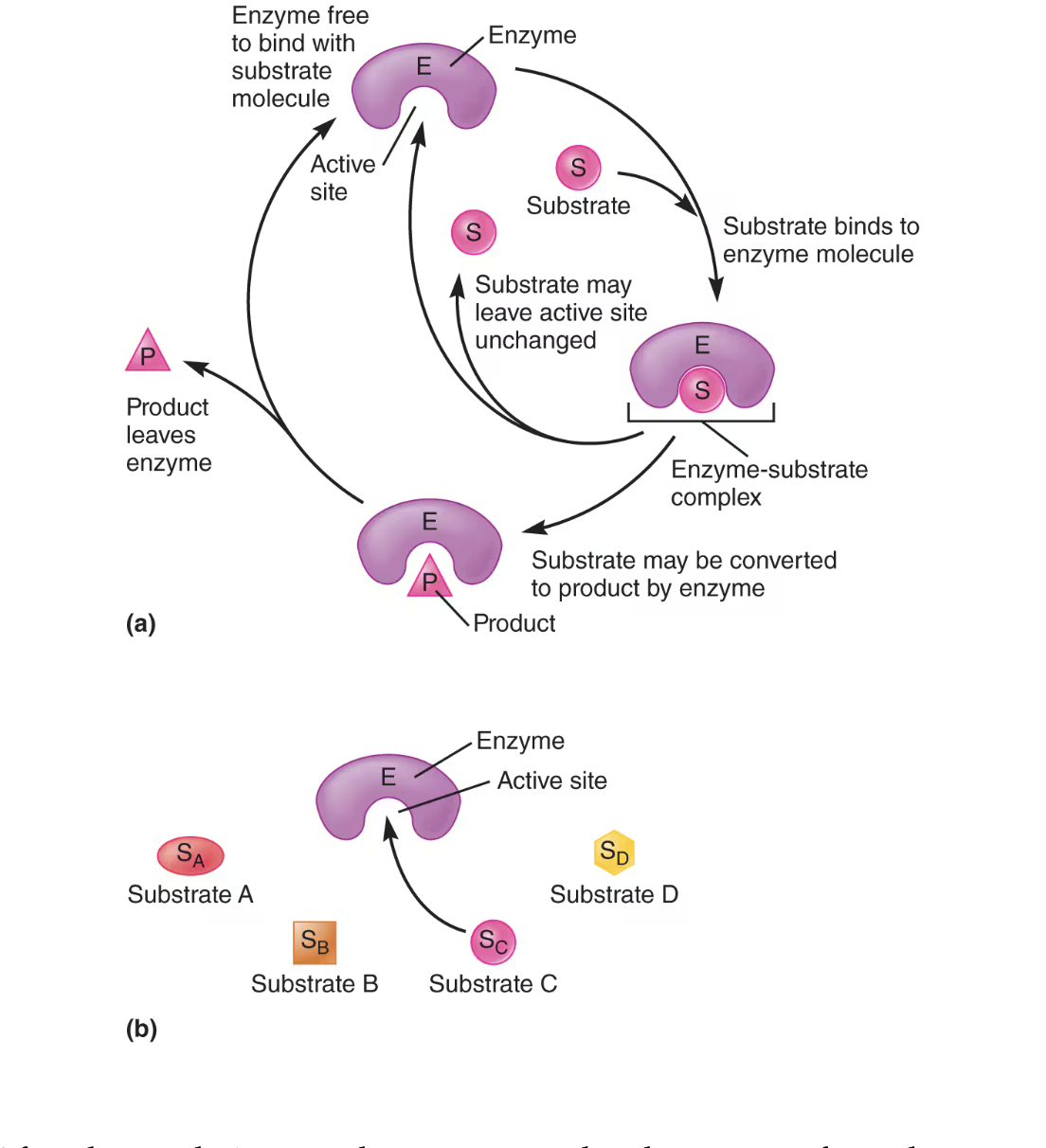
Are they consumed by reactions?- No. They are not.
Are they changed by reactions? (Figure 3.6)No, they are not, and they can be used again,
Specificity –enzymes are specific to particular substrates.

The Induced-Fit model allows reactions to go in reverse (Figure 3.7). When the substrate binds, the enzyme changes shape slightly to better fit the substrate. Enzymes can catalyze reactions in either direction,
What are cofactors?
Cofactors: Non-protein molecules or ions that help enzymes function.
Examples: Mg²⁺, Cu²⁺, Zn²⁺, Fe²⁺/Fe³⁺
Role: Help substrates bind and maintain enzyme shape.
Coenzymes – What are they?
Coenzymes: Organic cofactors that help enzymes function.
Example: NAD⁺, FAD, CoA
Role: Transfer small chemical groups between reactions.