finance - a level business p1
 Call Kai
 Learn
Learn Practice Test
 Spaced Repetition
 Match
Match Flashcards
 Knowt Play
1/13

Earn XP
Description and Tags
eduqas a level business
Name | Mastery | Learn | Test | Matching | Spaced | Call with Kai | Chat |
|---|
No analytics yet
Send a link to your students to track their progress
14 Terms
what is the role of the finance department
Finance department: manages a business's money and financial resources.
Key roles
Financial planning → determines how much finance the business needs and when.
Budgeting → sets financial targets and controls spending.
Cash-flow management → ensures enough cash is available to meet short-term obligations.
Raising finance → identifies appropriate internal/external sources.
Financial reporting → produces financial information such as income statements.
Performance analysis → uses profit figures and ratios to assess performance.
Financial control → monitors actual performance against plans/budgets.
A* point: Finance decisions affect profitability, liquidity, growth, risk and stakeholders.
define budget and explain its purposes and give the formula for budget variance (what is a favourable and adverse variance )
budget: a financial plan showing expected income and expenditure for a future period.
Purpose of budgets: Set financial targets, Plan future income/expenditure, Control costs, Allocate resources, Identify potential financial problems, Provide a basis for performance evaluation, Support decision-making.
Budget: variance: (formula: Variance = Actual figure − Budgeted figure)
Favourable variance → actual result is better than budget.
Adverse/unfavourable variance → actual result is worse than budget.
what are the advantages / disadvantages of the use of budgets to a business and its stakeholders
Advantages
Business: Better financial planning, Identifies problems early., Encourages managers to meet targets, Helps resource allocation.
Managers/employees: Clear targets, Performance can be measured.
Owners/shareholders: Greater financial control may improve profitability.
Disadvantages:
Forecasts may be inaccurate.
Unexpected changes make budgets outdated.
Time-consuming/costly to prepare.
Strict budgets may reduce flexibility.
Budgetary slack → managers deliberately underestimate revenue/overestimate costs to make targets easier.
A* evaluation: Budgets are most useful when the business operates in a relatively predictable environment and regularly reviews/adapts them.
Stakeholder conflict: strict cost control may benefit owners but reduce employee satisfaction or product quality.
Explain what is meant by cash flow(give examples of cash inflows and outflows) and what is meant by a cash flow forecast
Cash flow = movement of cash into and out of a business.
Cash inflows=Cash entering: Cash sales, Receipts from credit customers, Loans, Share capital, Sale of assets
Cash outflows=Cash leaving: Wages, Rent, Raw materials, Suppliers, Loan repayments, Tax, Capital expenditure
Key distinction: Cash flow ≠ profit
A profitable business can have cash-flow problems because profit may include credit sales where cash has not yet been received.
cash-flow forecast: estimates future cash inflows, cash outflows and cash balances over a specified period.
Construct, calculate and interpret cash flow forecasts
Key calculations :
Net cash flow = Cash inflows − Cash outflows
Closing balance = Opening balance + Net cash flow
Next period's opening balance = Previous period's closing balance
INTERPRETING CASH-FLOW FORECASTS
Positive net cash flow: Inflows > outflows → Cash balance increases.
Negative net cash flow: Outflows > inflows → Cash balance decreases. negative cash flows are presented in brackets eg: (11)= -11
Negative closing balance: Business has a cash shortfall and may need additional finance.
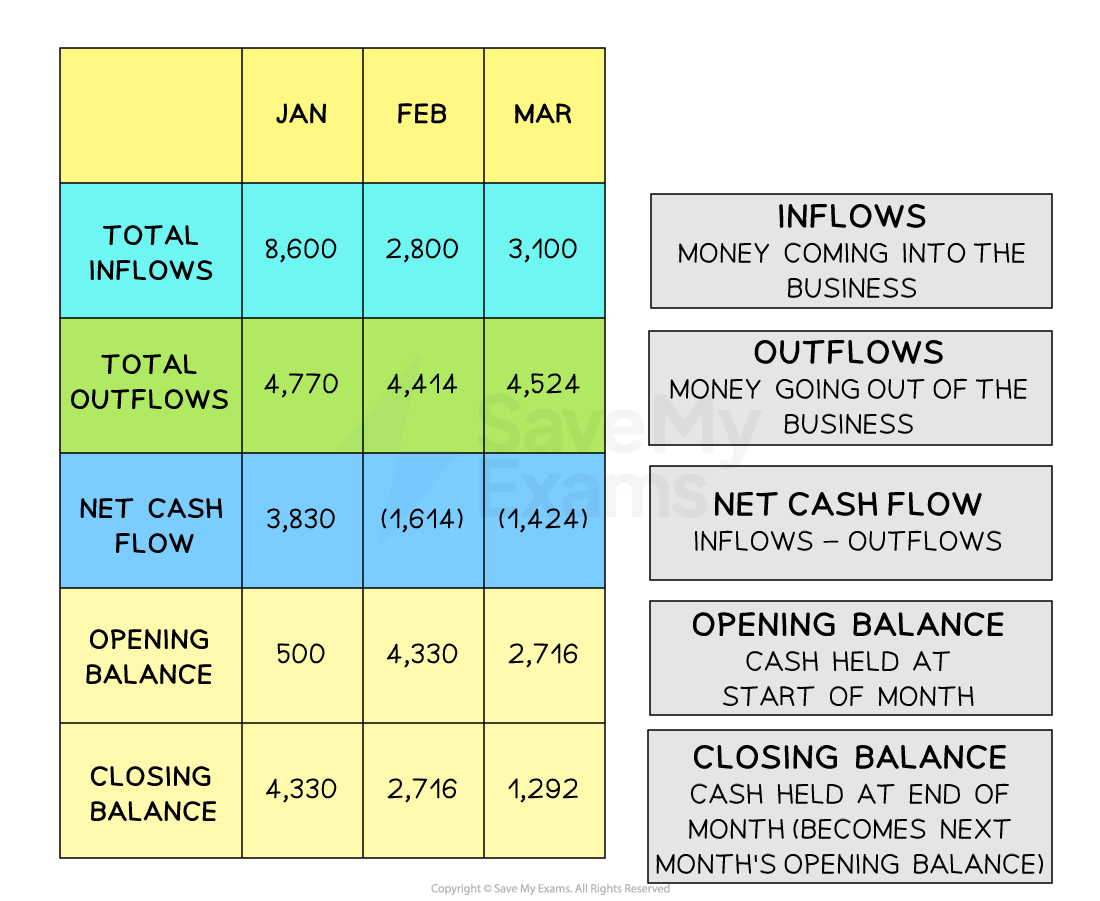
why do cash flow forecasts matter and what are causes of cash flow problems
Why forecasts matter: Identify future cash shortages, Arrange finance in advance, Plan expenditure, Time investment, Manage working capital, Avoid insolvency.
CAUSES OF CASH-FLOW PROBLEMS
Internal causes: Poor cash-flow management, Excessive spending, Rapid expansion, Overstocking, Low sales, Unexpected costs.
External causes: Economic downturn, Increased supplier prices, Customers/businesses failing, Seasonal demand, Changes in market conditions.
A* distinction
Liquidity problem: insufficient cash to meet short-term obligations.
Profit problem: revenue is insufficient relative to costs.
A business can be profitable but illiquid.
Explain strategies by which a business can improve cash flow
Increase cash inflows
Increase sales → More cash received.
Risk: discounts/promotions may reduce profit margin.
Improve credit control→ Encourage customers to pay faster. Methods: Credit checks, Clear payment terms, Chase late payments, Incentives for early payment.
Debt factoring → Receive cash before customers pay.
Reduce/delay cash outflows
1. Delay payments to suppliers→ Retain cash for longer.
Risk: damaged supplier relationships / loss of discounts.
Negotiate longer payment periods → Improves short-term liquidity.
Reduce costs→ Lower cash outflows.
Risk: cost cuts may reduce quality/motivation.
Reduce stock → Less cash tied up in inventory.
Risk: insufficient stock could lead to lost sales.
Lease rather than purchase assets → Avoid large immediate cash outflow.
Obtain finance: Overdraft, Loan, Share capital, Retained profit, Other appropriate sources
A*: Borrowing can solve a cash shortage but does not solve an underlying loss-making business model.
Explain the benefits and limitations of cash flow forecasts
Benefits
Identifies potential cash shortages.
Helps arrange finance early.
Supports financial planning.
Helps control expenditure.
Identifies periods of surplus cash.
Supports investment decisions.
Limitations
Based on estimates, so may be inaccurate.
Sales may differ from forecasts.
Costs may unexpectedly change.
Customer payment timing may change.
External economic conditions are unpredictable.
A* judgement : A cash-flow forecast is a planning tool, not a guarantee. Its usefulness depends on the accuracy of assumptions and how frequently it is updated.