model 2 for modern art
 Call Kai
 Learn
Learn Practice Test
 Spaced Repetition
 Match
Match Flashcards
 Knowt Play
1/48

There's no tags or description
Looks like no tags are added yet.
Name | Mastery | Learn | Test | Matching | Spaced | Call with Kai | Chat |
|---|
No analytics yet
Send a link to your students to track their progress
49 Terms
Kouros, Attica, Greece, c. 600 BCE

Kouros, from Anavysos, Greece, ca. 530 BCE

Peplos Kore, from the Acropolis, Athens, Greece, ca. 530 BCE

Kritios Boy, from the Acropolis, Athens, Greece, ca. 480 BCE

Polykleitos, Doryphoros (Spear Bearer). Roman copy from Pompeii, Italy, of a bronze
statue of ca. 450-440 BCE

Centauromachy, Metope from the South Side of the Acropolis, Athens, Greece, ca. 447-
438 BCE

Praxiteles, Aphrodite of Knidos. Roman copy of a marble statue of ca. 350-340 BCE

Athanadoros, Hagesandros, and Polydoros of Rhodes, Laocoön and His Sons, from Rome,
Italy, early first century CE

Temple of Hera I, Paestum, Italy, ca. 550 BCE

Iktinos, Parthenon (looking southeast), Acropolis, Athens, Greece, 447-438 BCE

Kouros (Kore)
A standing male youth figure type from the Archaic period, usually nude, stiff pose, one foot forward.
Contrapposto
a relaxed standing pose where weight rests on one leg, creating asymmetry of hips and shoulders and suggesting potential movement
Metope
sculpted or plain rectangular panel between triglyphs (triples).
Stylobate
platform on which a temple stands; typically reached by steps running around the building.
Pediment
the triangular gable at the end of a temple roofline, often filled with sculptural groups.
Column
vertical channels cut into the column shaft.
Capital
the topmost element of a column transitioning to the entablature.
Entablature
the horizontal structure above columns; composed of architrave, frieze, and cornice.
Architrave
the lowest part of an entablature directly above the capitals.
Frieze
middle band of the entablature; in Doric divided into "triples" (lecture term) and metopes; in Ionic often continuous and sculpted
Cornice
projecting uppermost section of an entablature.
Doric
oldest, stout columns with no base, bowl-like capitals, entablature with plane architrave and frieze divided into "triples" and metopes.
Ionic
columns rest on a base, capitals with volutes (spirals); architrave divided in three bands, frieze often continuous for narrative sculpture.
Corinthian
similar proportions to Ionic but with ornate capitals carved as baskets of acanthus foliage.
Archaic
Early period of Greek sculpture (in instructor's framing starting c. 600 BCE) characterized by stylized, rigid figures (e.g., kouros).
Classical
Classical sculptors developed a canon — a set of proportional relationships for the ideal human figure
Late Classical
modify the Classical canon: limbs lengthen, heads become proportionally smaller, and contrapposto is often exaggerated — creating a different ideal of beauty.
Hellenistic
emphasizes drama, pathos, extreme movement, and often emotional narrative.
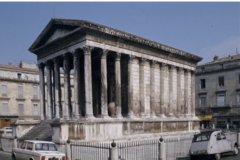
Maison Carrée, Nîmes, France, ca. 1-10 CE
Man with portrait busts of his ancestors, from Rome, Italy, late first century BCE

Head of Pompey the Great, early first-century CE copy of a portrait of ca. 70-60 BCE

Portrait of Augustus as imperator (general), from Primaporta, Italy, early-first-century CE copy of a bronze original of ca. 20 BCE

Ara Pacis Augustae (Altar of the Augustan Peace), Rome, Italy, 13-9 BCE

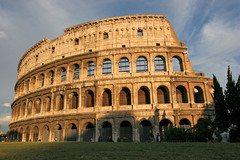
Colosseum (Flavian Amphitheater)
Column of Trajan, Rome, Forum of Trajan, dedicated 112 CE

Equestrian Portrait of Marcus Aurelius, ca. 175 CE

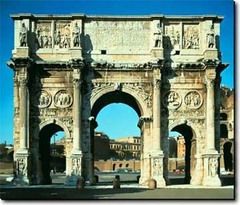
Arch of Contantine, Rome, 312-315 CE
Four Tetrachs, from Constantinople, c. 300 CE

Pantheon, Rome, 125 CE

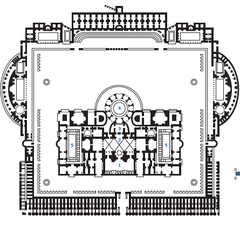
Baths of Caracalla, Rome, Italy, 212-216 CE
Basilica Nova (or Basilica of Constantine), Rome, Italy, ca. 306-312 CE

Etuscan
high podium, frontal steps leading to an open porch with columns, multiple entrances into a sanctuary that spans the building width. Not peripteral.
Pseudoperipteral
a classical structure with freestanding columns across the front porch and engaged columns (columns attached or embedded into the exterior walls) along the sides and back
Concrete
a genre of abstract art that is entirely autonomous, featuring no basis in observed reality, figurative meaning, or symbolic association
Arch
a curved structural element that spans an opening and supports weight from above by transferring compressive stress outward and downward to supporting pillars or abutments
Vault
a self-supporting arched ceiling or roof made of stone, brick, or concrete
Dome
a rounded, hemispherical or semi-spherical roof or ceiling that spans an open space and rests on a circular, polygonal, or elliptical base
Oculus
a circular opening in the center of a dome or in a wall that lets in natural light and air
Canon
the accepted list of "great" artists, artworks, and styles that are studied, taught, and displayed as the most important in human culture