Lab 11: Aldol Condensation
 Call Kai
 Learn
Learn Practice Test
 Spaced Repetition
 Match
Match Flashcards
 Knowt Play
1/28

There's no tags or description
Looks like no tags are added yet.
Name | Mastery | Learn | Test | Matching | Spaced | Call with Kai | Chat |
|---|
No analytics yet
Send a link to your students to track their progress
29 Terms
is this acidic or base catalyzed
basic
what is involved in this reaction
it is a base catalyzed coupling of two carbonyl compounds (either can happen between identical carbonyl compounds or dissimilar carbonyl compounds)
how does our experiment this week differ from the usual method
only one of the species has alpha hydrogens to form the enolate intermediate, so there will not be a mixed reaction/crossed aldol reaction but only one product
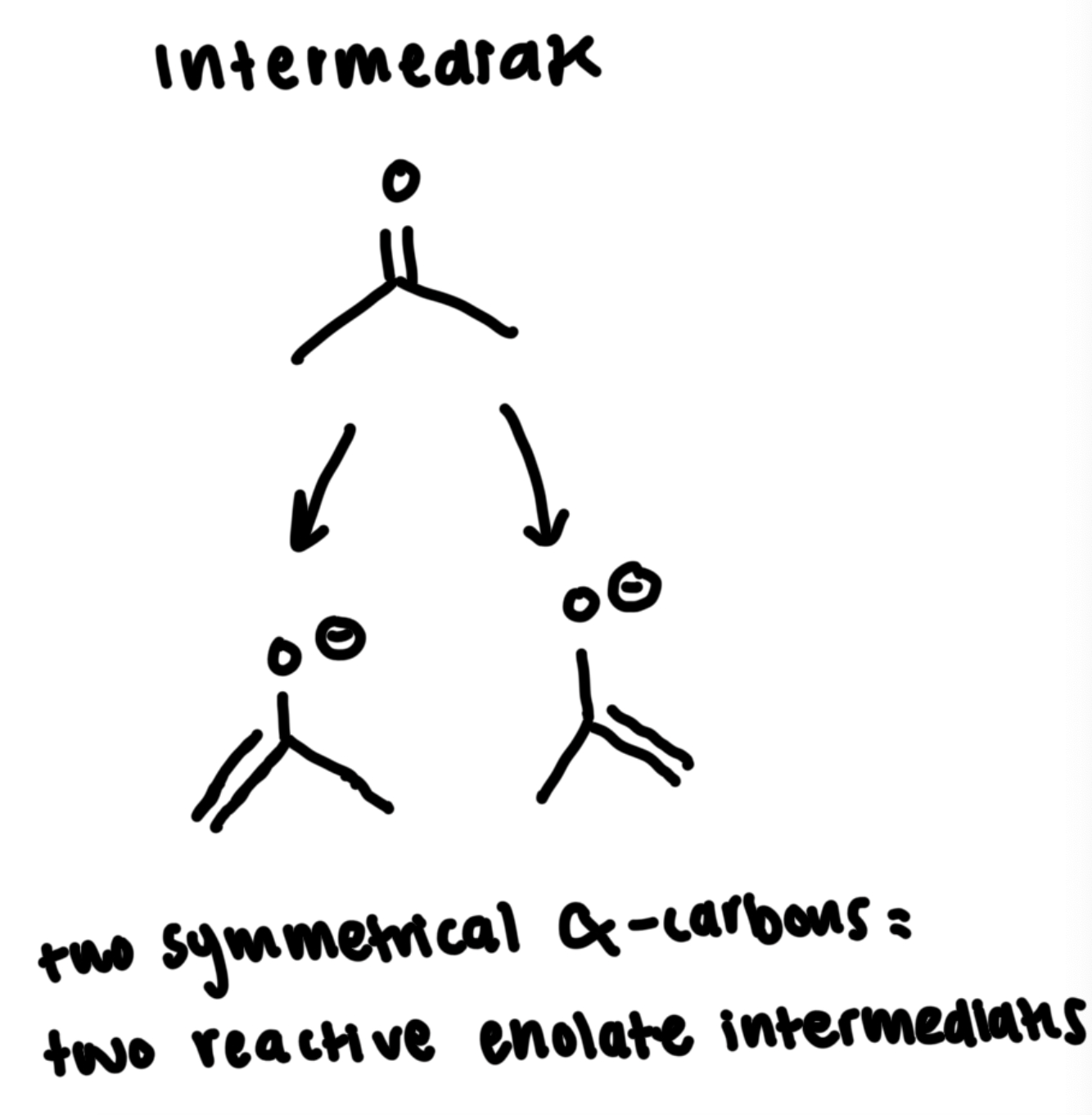
there are two sets of symmetrical alpha carbons, so two reaction enolate intermediates will form (in a stepwise fashion). this is why we have two equivalents of the aldehyde because it will add on both sides to form a disubstituted product
what is an enone
a combination of alkene and carbonyl group (ketone)
techniques used
suction filtration, recrystallization, melting point determination, IR spec
reagents
Acetone (structure, MW, BP, density)
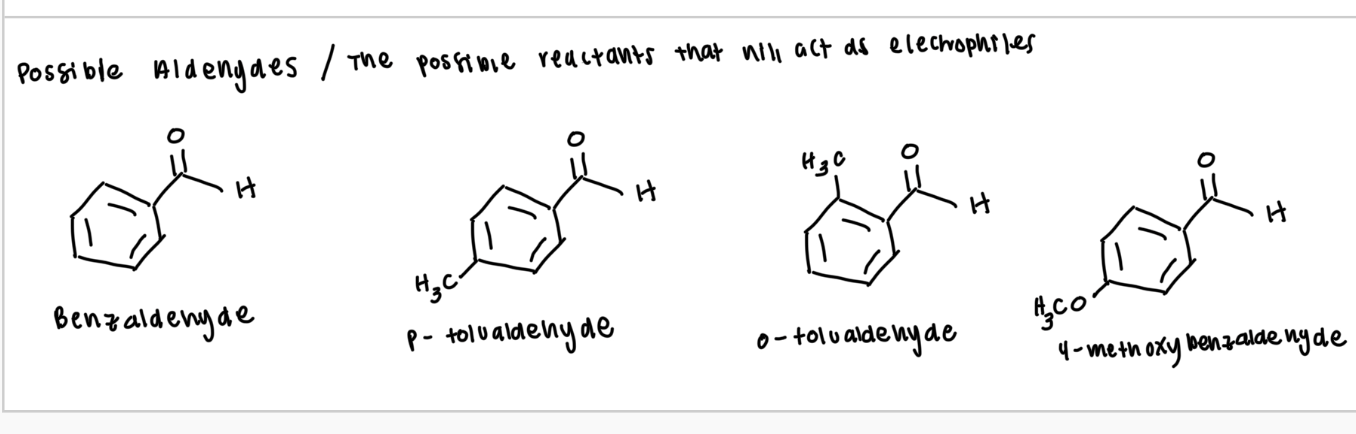
p-Tolualdehyde (structure, MW, BP, density)
o-Tolualdehyde (structure, MW, BP, density)
4-Methoxybenzaldehyde (structure, MW, BP, density)
Benzaldehyde (structure, MW, BP, density)
Ethanol (structure, MW, BP, density)
Sodium hydroxide (structure, MW, MP)
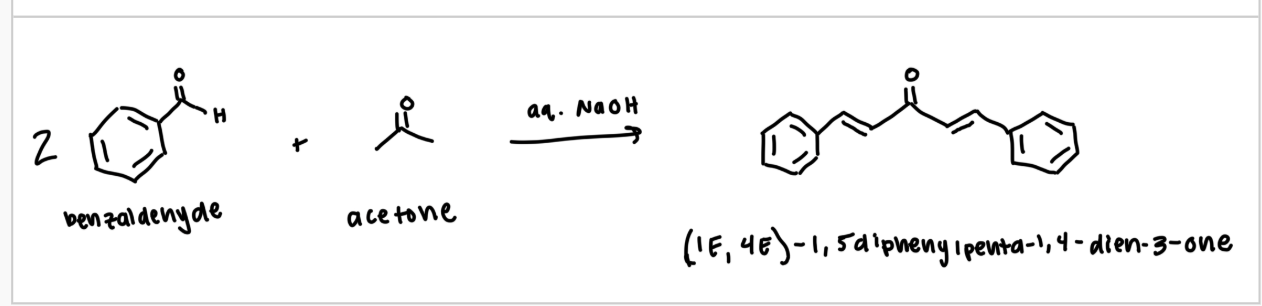
(1E,4E)-1,5-diphenylpenta-1,4-dien-3-one (structure, MW, MP = 110-111 oC)
(1E,4E)-1,5-di-o-tolylpenta-1,4-dien-3-one (structure, MW, MP = 98-100 oC)
(1E,4E)-1,5-di-p-tolylpenta-1,4-dien-3-one (structure, MW, MP = 174-177 oC)
(1E,4E)-1,5-bis(4-methoxyphenyl)penta-1,4-dien-3-one (structure, MW, MP = 128-132 oC
broad description of the protocol
add 95% ethanol to your unknown aldehyde and acetone in a conical vial and mix for like 15 mins
once formed, chill vial in water
then collect crude product by suction filtration
wash with water about three times
after fourth wash, test the pH of the solution (you want it to be neutral and not basic)
recrystallize in warm ethanol
describe alpha hydrogens acidity in nature
weakly acidic (resonance stablization of enolate anion)
how to Bronsted-Lowry bases catalyze keto-enol tautomerization
by abstracting an alpha hydrogen and forming a reacting enolate intermediate (which will then act as a nucleophile and react with the electrophil to yield the addition products)
why are enolates more reactive than their neutral version
because of the higher overall electron density
what is the electrophile in this?
the carbonyl group
what is the product of the first elemination
b-hydroxy aldehyde, aka an aldol (basically an aldehyde and an alcohol)
for the dehydration of an aldol product, are we in basic or acidic conditions
basic conditions
what is the dehydration mechanism known as
E1cB
which one is more reactive: an aldehyde or a ketone
aldehyde because it is more electrophilic
what is the molar ratio of the electrophilic starting material to the final product
2:1
what are the four possible reactants today
benzaldehyde, p-tolualdehyde, o-tolualdehyde, 4-methoxybenzaldehyde
draw the enolate intermediate for this reaction that will act as nucleophile
enolate of acetone
what is used to catalyze this reaction
sodium hydroxide (hence the basic conditions)
draw the four possible products

balanced equation
2 aldehyde
1 acetone
1 product
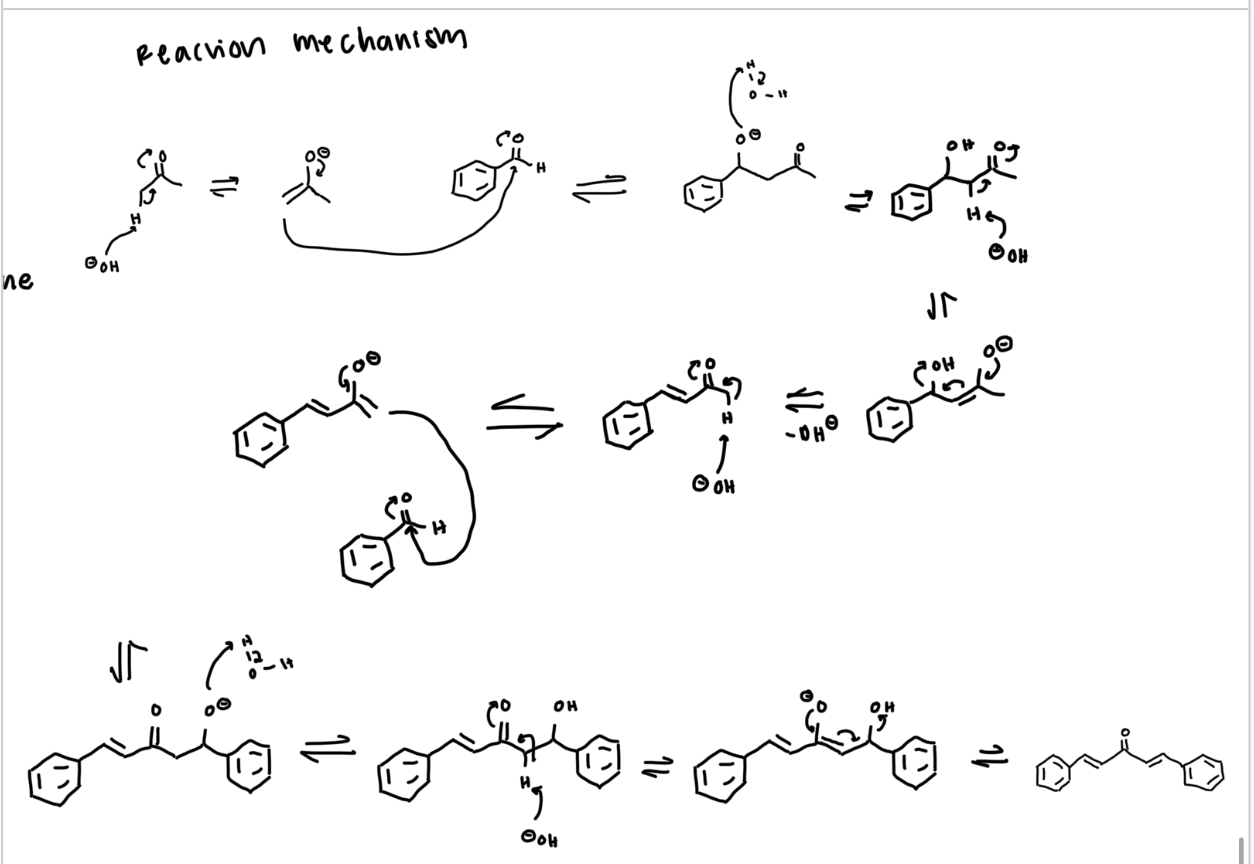
draw the mechanism
first part: form the enolate or when the H gets eliminated to form that enolate
nucleophilic attack
nucleophile will attack benzaldehyde to form the enol. then the alpha H in the middle will get eliminated to form a double bond near the once carbonyl. then rearrangement will happen to reform the carbonyl and kick off the OH
compare and contrast IR of the starting
First, benzaldehyde has two weak peaks around 2720 and 2820 cm-1 because of the aldehyde C-H bonds. Also the C=O stretch in benzaldehyde is around 1700-1720 cm-1. These two aspects change in the product IR. First the C=O stretch in the product is a lower wavenumber—around 1650-1680 cm-1. This is because of the conjugation with the adjacent C=C bonds to the C=O bond in the product. Next, there is a strong peak around 1600 cm-1 because of the C=C bonds in the alkene chain. Lastly, the aldehyde C-H bonds in the benzaldehyde IR should be gone because these bonds are not present in our product.
p-chlorobenzaldehyde is incapable of undergoing an aldol reaction with itself, explain why. Be specific in your answer:
it lacks alpha hydrogens so it cannot form the enolate
what reagent was in excess and why?
aldehyde because it was added twice to the nucleophile since there were symmetrical alpha carbon sets on both sides
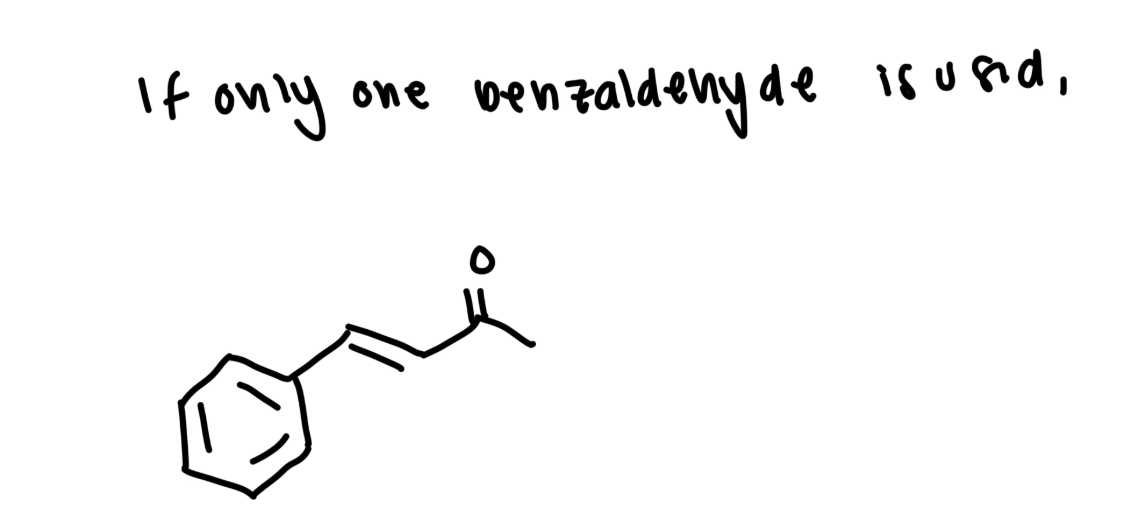
draw the product if only one aldehyde is present
there should only be benzyl group present in this product
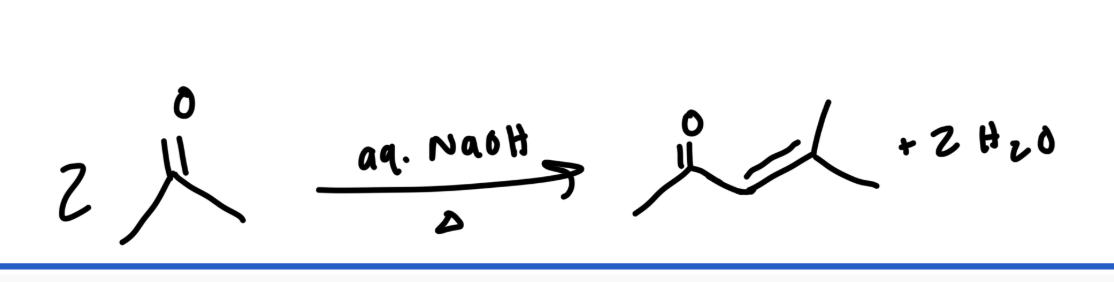
Students were instructed to mix the benzaldehyde and acetone starting materials in their conical vials before adding the ethanolic sodium hydroxide solution. Why was this essential to the success of the reaction?
this ensure cross-aldol will occur instead of acetone reacting with itself
what would it look like if acetone reacted with itself (balanced equation)
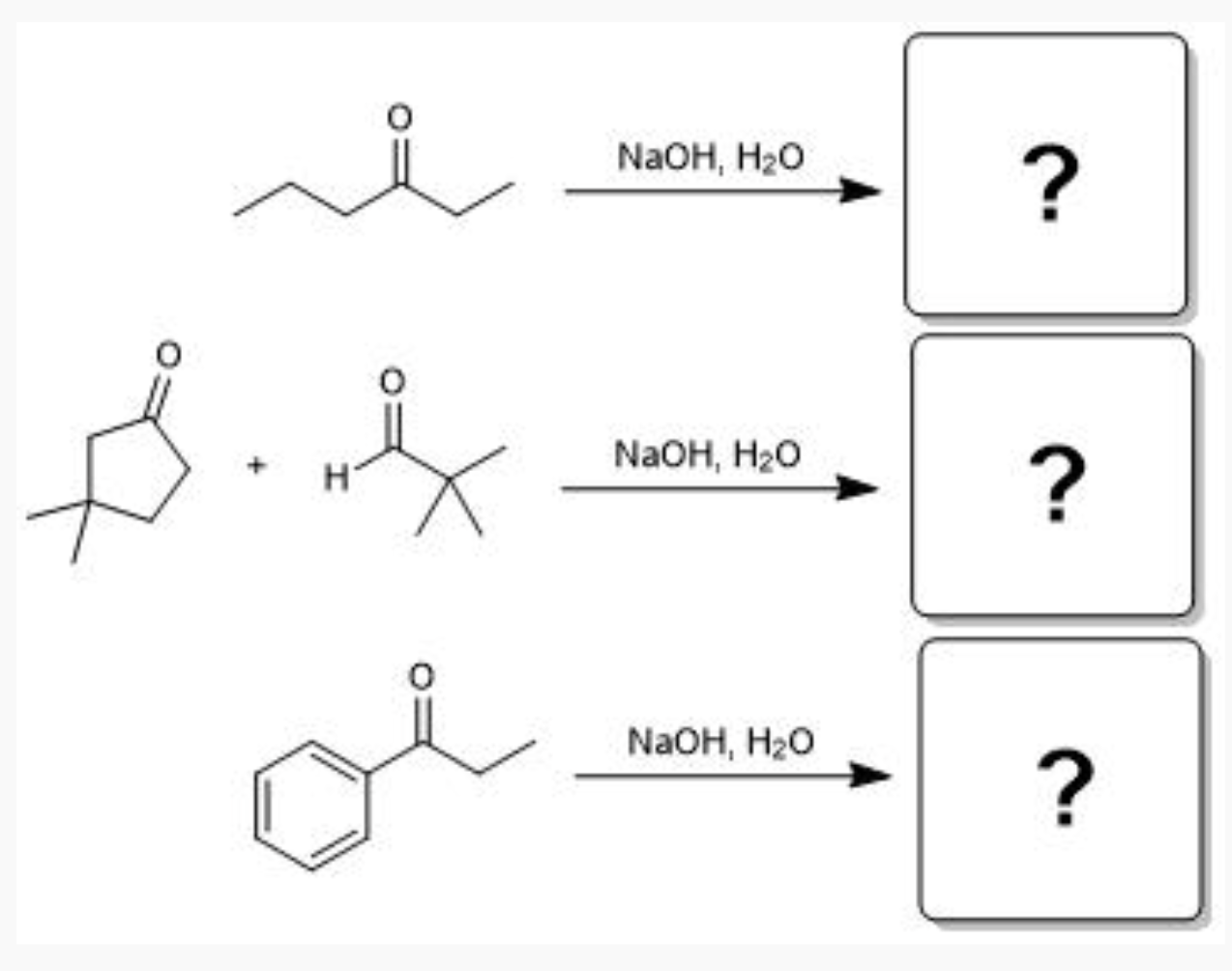
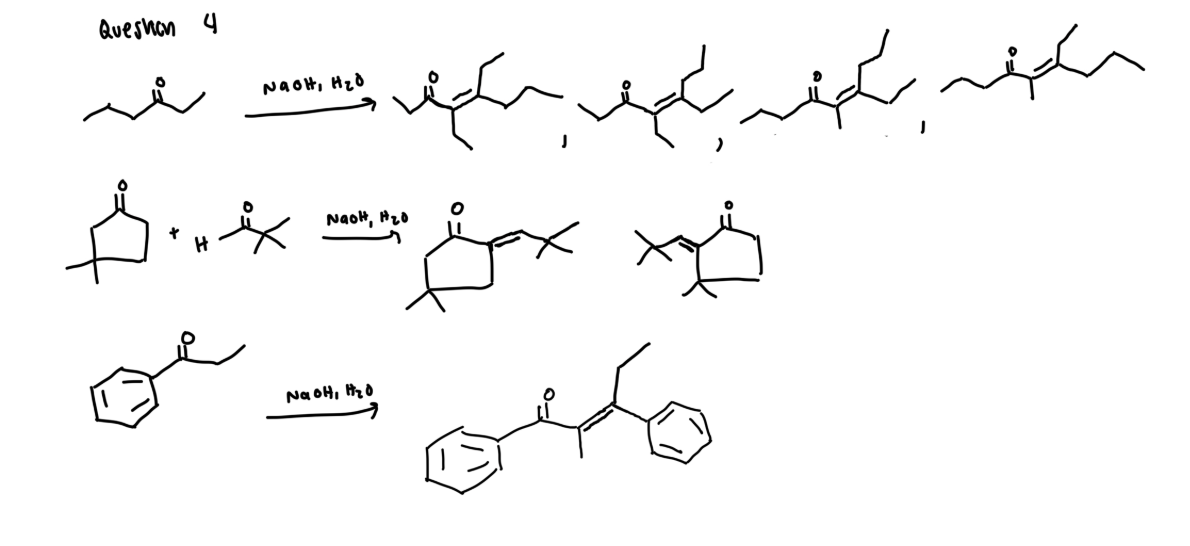
Provide skeletal structures of the aldol products that form when the following compounds or mixtures of compounds are reacted under basic (NaOH) conditions: