Chapter 19: Aldehydes and Ketones: Nucleophilic Addition Reactions
 Call Kai
 Learn
Learn Practice Test
 Spaced Repetition
 Match
Match Flashcards
 Knowt Play
1/31

There's no tags or description
Looks like no tags are added yet.
Name | Mastery | Learn | Test | Matching | Spaced | Call with Kai | Chat |
|---|
No analytics yet
Send a link to your students to track their progress
32 Terms
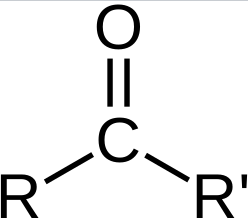
Carbonyl Group
The C=O bond is polar, as oxygen is electronegative and withdrawing electrons. So, a carbonyl carbon is an electrophile, and the oxygen is electron rich. Nucleophiles attack carbonyl carbons
Aldehyde Naming
Find longest chain containing the Aldehyde
Your aldehyde carbon is carbon #1
Ends in -al

Ketone Naming
Find the longest Carbon chain containing C=O
Number closes to carbonyl
Ends in -one

Preparing Aldehydes (Alcohol Oxidation: Primary alcohol —> Aldehyde )
Primary alcohol —> Aldehyde
Reagents: PCC & Dess-Martin Periodinane
It stops at aldehyde and does not overoxidize.

DIBAL Reduction (preparing an aldehyde)
makes an ester into an aldehyde. This is a partial reduction

Preparing Ketone (Alcohol Oxidation: Secondary alcohol —> Ketone)
see image

Friedel-Crafts Acylation
makes an aromatic ketone from Benzene + Acyl chloride

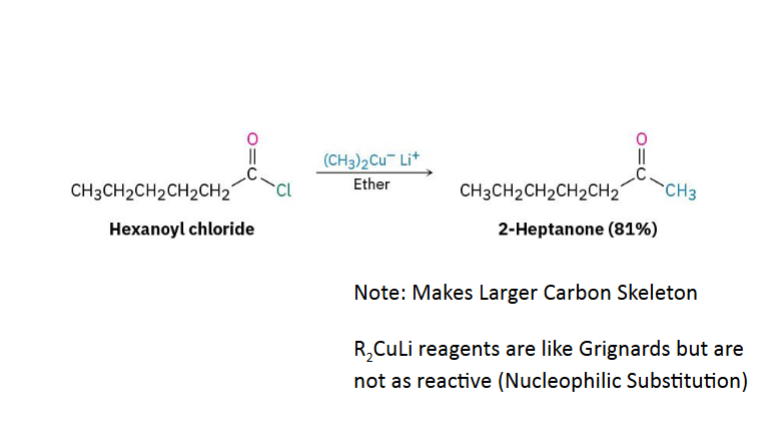
Gilman Reagents (used to make ketones)
Reagent: R2CuLi
Similar to Grignard but: Less reactive and does a substitution
Oxidations of Aldehydes
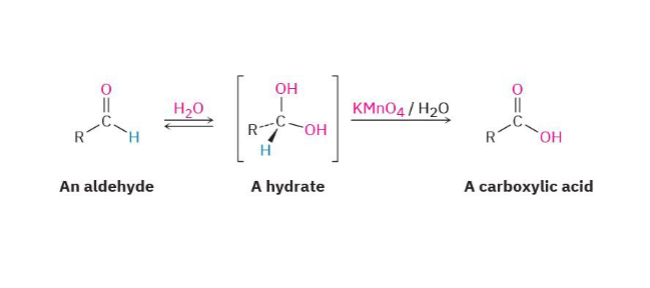
Aldehydes oxidize easily, and become carboxylic acids
Reagents:
KMnO4
CrO3/H +
Na2Cr2O7/ H +
(PCC and Dess-Martin do not make carboxylic acids, they stop at aldehyde.)
Ketone Oxidation
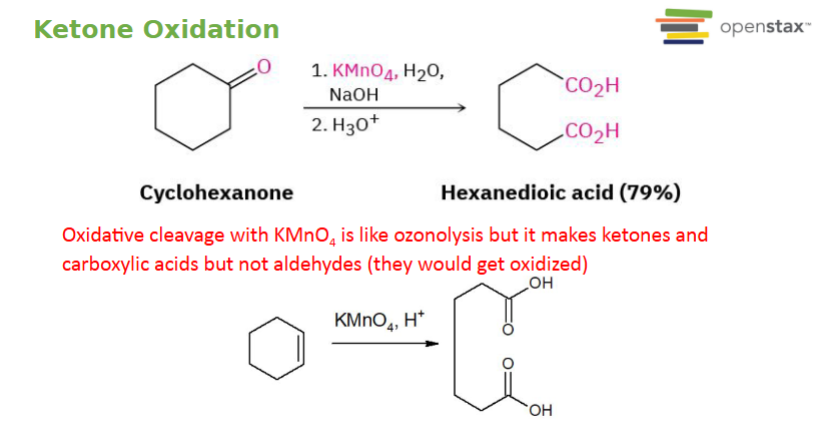
Ketones are harder to oxidize. A strong oxidation with KMnO4 causes oxidative cleavage, which breaks C-C bonds. It produces Ketones & carboxylic acids.
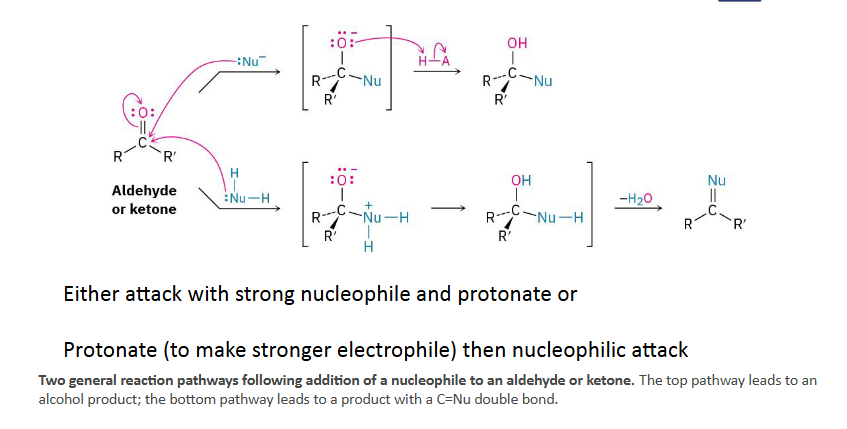
Nucleophilic Addition
Aldehydes and Ketones undergo nucleophilic addition, not substitution, because aldehydes and ketones do not have leaving groups.
Nucleophilic Addition Mechanism
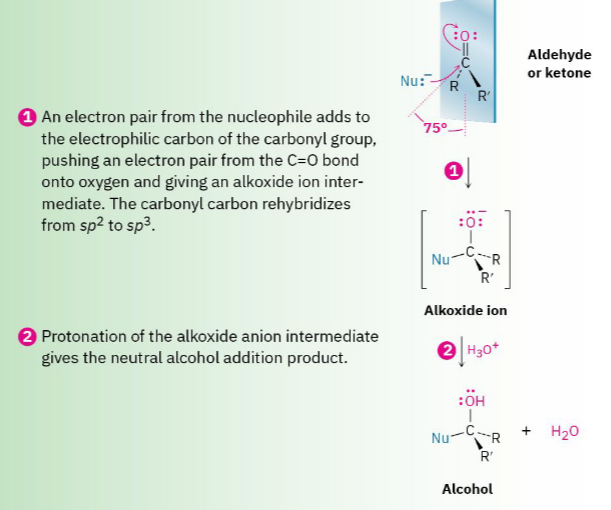
Nucleophile attacks carbonyl carbon (The C=O electrons move onto oxygen) This produces an alkoxide intermediate.
Protonation: O- grabs H+, produces an alcohol
Acid Conditions:
Carbonyl oxygen gets protonated first
Nucleophile attacks
Basic Conditions:
Nucleophile attacks first
Protonation second
A nucleophilic addition reaction to an aldehyde or ketone. The nucleophile approaches the carbonyl group from an angle of
approximately 75° to the plane of the sp2 orbitals, the carbonyl carbon rehybridizes from sp2 to sp3, and an alkoxide ion is
formed. Protonation by addition of acid then gives an alcoho
Why are aldehydes more reactive than ketones?
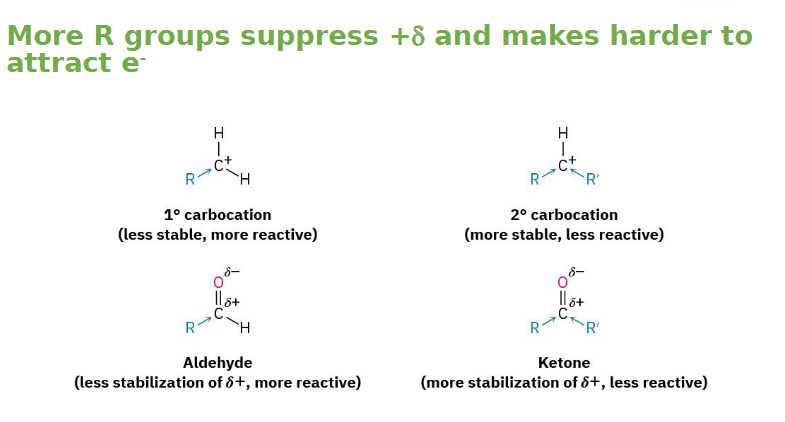
Sterics: Aldehydes have only one large group, making it less crowded. While ketones have 2 large groups, making it more crowded.
Electronegativity: Ketones have 2 electron donating alkyl groups, making the carbonyl carbon less positive (less reactive).
Aldehyde > Ketone reactivity
Nucleophilic Addition
see image
Nucleophile strength
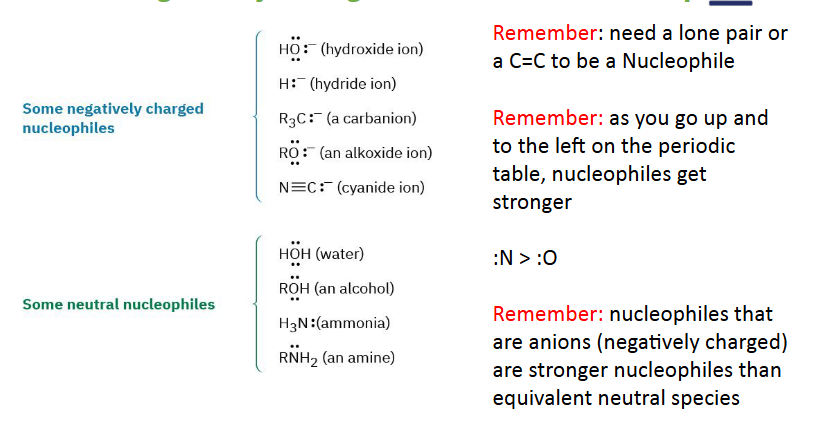
Strong nucleophiles are:
Negatively charged
Atoms with lone pairs
Anions > neutral molecules
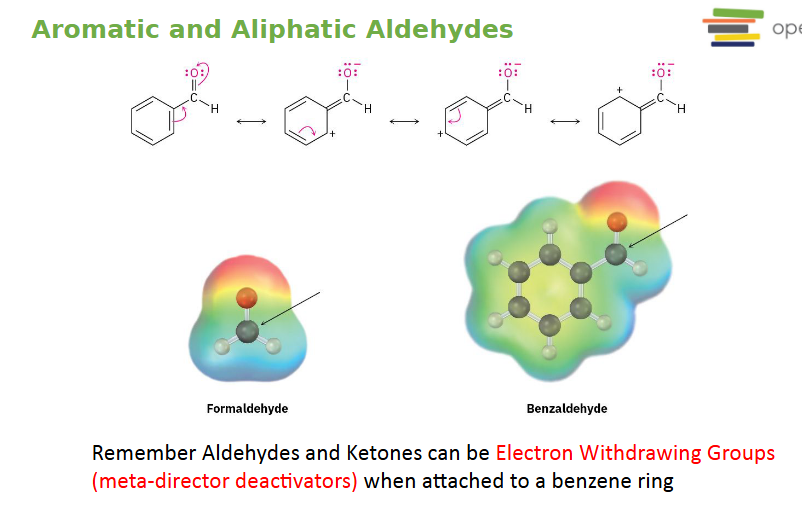
Aldehydes and Ketones can be electron withdrawing groups (meta-director deactivators) when
attached to a benzene ring (see image)
Hydration (adding water)
Reaction: Carbonyl + H2O —> Geminal Diol (Two OH groups on the same carbon)
Hydrates are geminal diols. Hydrates are favored when electron withdrawing groups are nearby

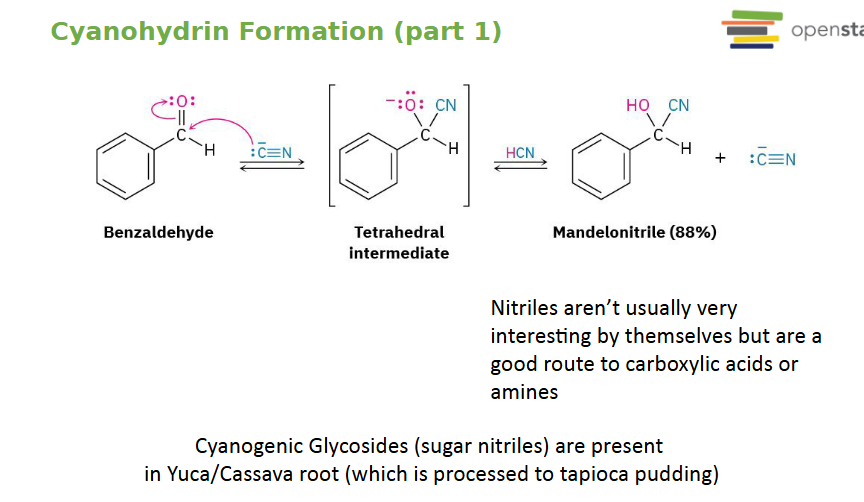
Cyanohydrin Formation
Reagent: HCN
Adds: CN + OH
Product: Cyanohydrin
Nitriles can become:
Carboxylic acids
amines
Alcohol Formation: Hydride Reduction
Reagents: NaBH4 or LiAlH4
Both add hydride (H-) to carbonyl.
Products: Aldehyde (primary alcohol) & Ketone (secondary alcohol)
LiAlH4 and NaBH4 do not reduce C=C bonds

Alcohol Formation: Hydride Reduction mechanism is a
Nucleophilic Addition
Note: Reductions maintain carbon skeleton

Alcohol Formation: Grignard Reactions
Reagent: RMgX
The carbon behaves like a nucleophile.
Grignard increases carbon skeleton

Alcohol Formation: Grignard Reactions Mechanism
Carbon attacks Carbonyl
Alkoxide forms
Acid workup protonates Oxygen
Product is an alcohol
Grignard increases carbon skeleton

Amine Reactions (Imines)
Primary amines making Imines
Reagent: RNH2
Product: C=N
Mechanism:
N attacks Carbonyl
Carbinolamine forms
Water leaves
Imine forms

Amine Reaction (Enamines)
Secondary amines make Enamines
Reagent: R2NH
Forms C=C-N (Enamine)
(Cannot make C=N because Nitrogen has no H to remove)

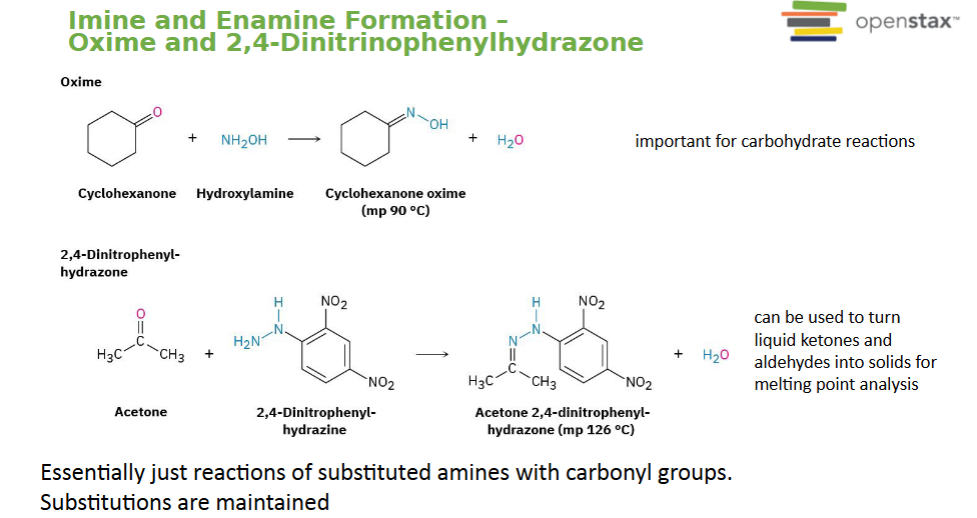
Oximes and Hydrazones
Carbonyl + Substituted amine forms derivatives
Used for identifying aldehydes/ketones and melting point analysis
Wolff-Kishner Reaction
Purpose: Carbonyl —> Alkane
Reagents: Hydrazine + Strong base
This removes Oxygen completely

Acetyl Formation
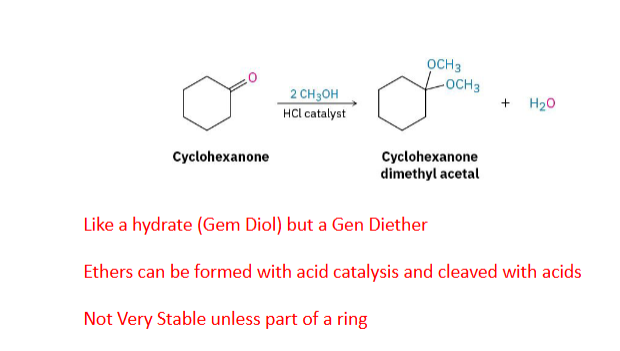
Carbonyl + Alcohol —> Acetal (two OR groups on the same Carbon, OR + OR)
Acetals are protecting groups. Used when you want to protect a carbonyl from reactions like an LiAlH4 reduction
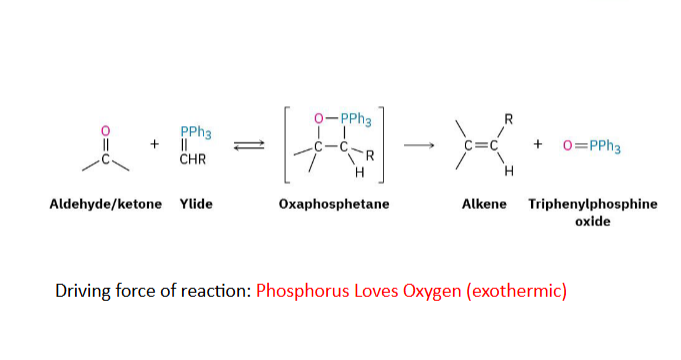
Wittig Reaction
Purpose: Carbonyl —> Alkene
Reagent: Phosphorus Ylide
Changes a C=O to a C=C, driving force, phosphorus loves oxygen.
Cannizzaro Reaction
An aldehyde can oxidize and reduce itself with base catalysis

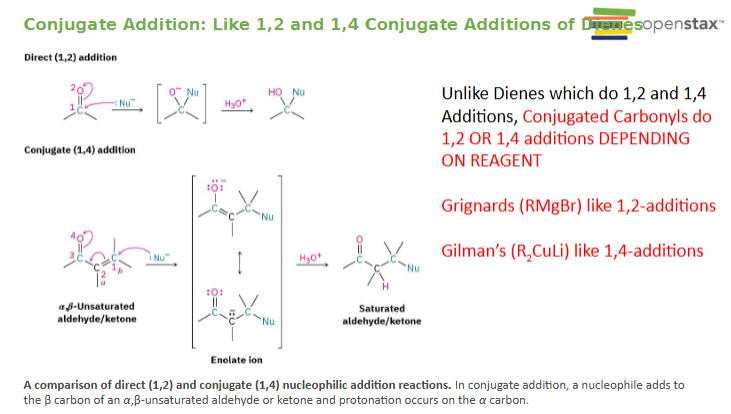
Conjugate Addition
For: α,β-unsaturated carbonyls
Two possible additions:
1,2 Addition
Direct attack at carbonyl carbon
Favored by:
Grignards (RMgBr)
1,4 Addition
Attack at β carbon
Favored by:
Gilman reagents
R₂CuLi
Product forms:
enolate → enol → ketone/aldehyde
Spectroscopy
IR:
Carbonyl C=O has a strong peak at 1700 cm-1
1 H NMR:
Aldehyde protons: 9-10 ppm
Carboxylic acid: 10 ppm
13 C NMR:
Carbonyl Carbon: 160-220 ppm
Mass Spec:
Alpha Cleavage: Major fragmentation near Carbonyl
McLafferty rearrangement: Occurs when Carbonyl compound has suitable hydrogen arrangement.
summary
see image
