biology anelli 2
 Call Kai
 Learn
Learn Practice Test
 Spaced Repetition
 Match
Match Flashcards
 Knowt Play
1/26

There's no tags or description
Looks like no tags are added yet.
Name | Mastery | Learn | Test | Matching | Spaced | Call with Kai | Chat |
|---|
No analytics yet
Send a link to your students to track their progress
27 Terms
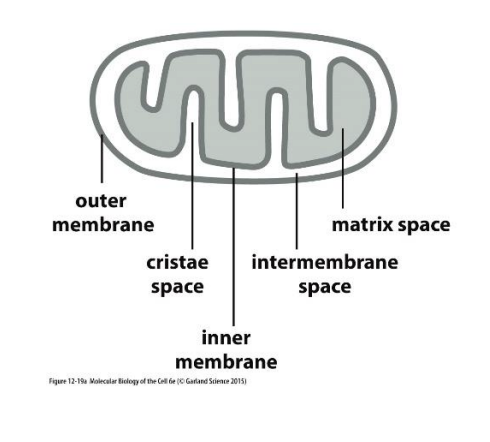
Describe the structure and main functions of mitochondria
Mitochondria have a double membrane with an outer membrane, intermembrane space, and an inner membrane forming cristae. The inner space (matrix) contains enzymes, ribosomes, and mitochondrial DNA. Their main functions include energy production (Krebs cycle and respiratory chain), fatty acid β-oxidation, regulation of calcium and redox signaling, and initiation of apoptosis via cytochrome c release.
what is the endosymbiotic theory
It states that certain organelles—especially mitochondrion (and chloroplasts in plants)—were once free-living bacteria that were engulfed by an ancestral cell. Instead of being digested, they formed a symbiotic relationship, benefiting both the host cell and themselves.
👉 In short: endosymbiosis = one cell living inside another, leading to permanent integration.
proofs that mitochondria is formed by endosymbiosis
-double membrane
-presence of circular DNA
-presence of some proteins similar to bacterial ones (porins)
-mitochondria ribosomes resemble to prokaryotic ribosomes rather than eukaryotic
-mitochondria proteins start with N-formyl methionine while other proteins start with methionine. so the genetic code is different than nuclear DNA
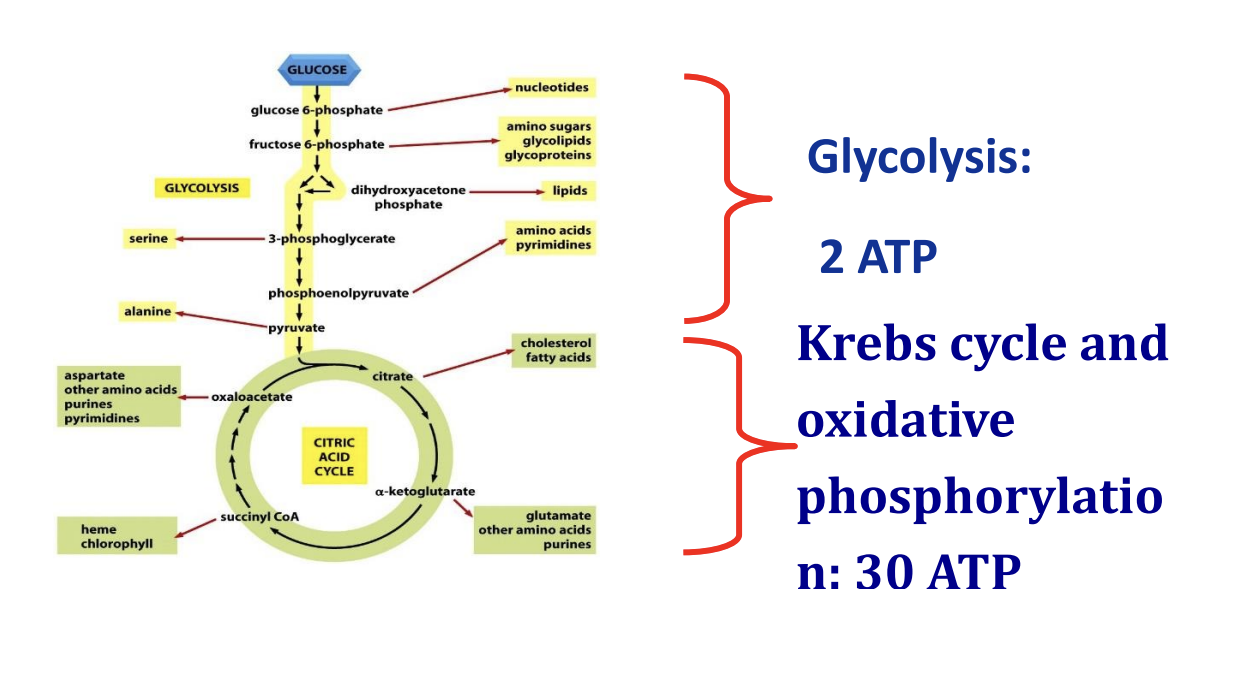
what is the Krebs cycle
one molecule of glucose is used in the cytosol of the cell through a series of reactions (glycolysis) and at the end of this first series of reactions glucose is converted to pyruvate with the generation of 2 ATP molecules. pyruvate then enters the Krebs cycle and oxidative phosphorylation in the mitochondria and other 30 ATP molecules are obtained.
how can proteins reach the localisation inside the mitochondria
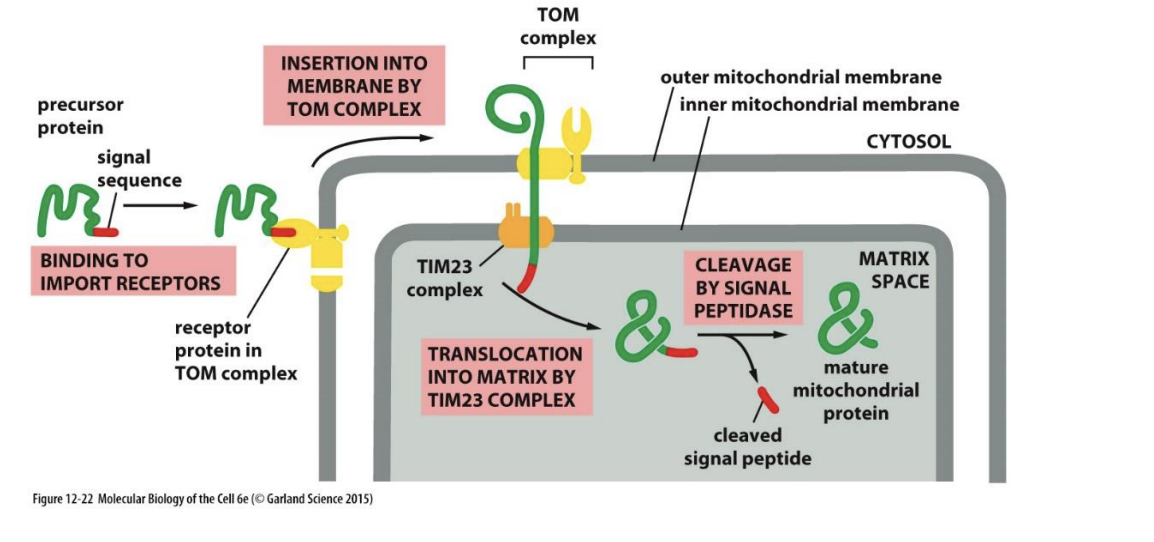
Protein translocation into the mitochondrion is a post-translational process where proteins synthesized in the cytosol are imported in an unfolded state to the organelle.
They are recognized by an N-terminal amphipathic signal sequence and transported across the outer and inner membranes using specific translocator proteins (channels).
Explain the role of the TOM and TIM complexes in the import of proteins into the mitochondrion.
The TOM complex (Translocase of the Outer Membrane) recognizes proteins with an N-terminal signal sequence and transports them across the outer membrane. The TIM complex (Translocase of the Inner Membrane) then facilitates their passage across the inner membrane into the matrix. After import, the signal peptide is cleaved, producing the mature protein.
why do we need chaperons
the presence of unfolded proteins in the cytosol could bring other proteins to interact with unfolded proteins and then generate a protein aggregate (und proteins stick together). that is why we need chaperons in order to keep our proteins unfolded
Describe the role of Hsp70 and Hsp60 chaperones and the involvement of ATP during protein import into the mitochondrion.
Hsp70 binds unfolded proteins in the cytosol using ATP, preventing aggregation and helping deliver them to the TOM complex. ATP is required both for binding and release of the protein, as well as for translocation into the mitochondria. Once inside the mitochondria, Hsp60 assists in folding the protein into its native conformation, also using ATP.
How are β-barrel proteins inserted into the mitochondrial outer membrane?
β-barrel proteins are first translocated through the TOM complex and then inserted into the outer membrane by the SAM complex.
Why are some mitochondrial proteins synthesized inside the mitochondria instead of in the cytosol?
Some proteins, especially multi-transmembrane proteins of the respiratory chain, are difficult to keep unfolded and import from the cytosol, so they are synthesized directly in the mitochondrial matrix from mitochondrial DNA.
What are the main functions of Peroxisome and which enzymes are involved?
Peroxisomes carry out oxidation of organic compounds (e.g., β-oxidation of fatty acids), producing H₂O₂, and detoxification, converting H₂O₂ into water. Key enzymes include catalase and urate oxidase.
Why are peroxisomes important for the nervous system?
Peroxisomes produce plasmalogens, which are essential components of myelin. Myelin is necessary for proper nerve signal conduction, and defects in plasmalogen synthesis can lead to neurological diseases.
to ways of importing proteins into peroxisomes
from the ER: mainly membrane (transmembrane) proteins
from the cytosol: both membrane proteins and soluble proteins that function inside the peroxisomal lumen
do organelles get into functional contact
Yes. Organelles can form functional contact sites without vesicle exchange, using transmembrane proteins to interact directly.
For example, the endoplasmic reticulum connects with the mitochondrion (also Golgi, peroxisome, lysosome) at MAM sites, enabling calcium signaling between them.
how can we define an intracellular organelle
A membrane-bound structure with its own lipid bilayer (e.g. large organelles visible and isolatable), or
A functional compartment defined by specific marker proteins and biochemical activities, even if not clearly separated by a membrane.
👉 In general: intracellular organelles are cell regions with specific markers and functions that carry out defined biochemical reactions.
what are membranes organelles
multicomponent cellular structures without a surrounding membrane, formed by the assembly of biomolecules (e.g., proteins and RNA) that concentrate to perform specific functions. They often form through phase separation, similar to polymer condensation.
some membrane less organelles
nucleoli: regions in the nucleus where ribosomes are made
centrosomes:
nuclear canal bodies: where spliceosomes are generated
p-granules:
RNA granules:
stress granules:
what can enter the nucleus
Lamins, molecules needed for the synthesis of the DNA and RNA such as polymerases, transcription factors, DNA associated proteins and histones
what should exit from the nucleus
RNAs, transcription factors and proteins that have to be degraded such as polymerases and damaged histones.
What is chromatin and what is the difference between heterochromatin and euchromatin?
Chromatin is the complex of DNA and proteins that helps organize and package DNA in the nucleus. Heterochromatin is highly condensed and transcriptionally inactive, while euchromatin is less condensed and transcriptionally active.
What are nuclear lamins and what is their function?
Nuclear lamins are intermediate filament proteins located beneath the inner nuclear membrane. They maintain the shape of the nucleus, help organize chromatin, and regulate nuclear structure. Their assembly and disassembly are controlled by phosphorylation during cell division.
Describe the structure of the nuclear pore complex, also explain the role of nucleoporins in transport specificity.
The nuclear pore complex (NPC) is a very large protein assembly (~125 MDa, ~120 nm in diameter) located in the nuclear envelope. It is an octameric structure composed of a ring of proteins with cytosolic and nuclear fibrils. Each nucleus contains about 3000–4000 nuclear pores. The NPC is made of ~30 different nucleoporins (with 500–1000 subunits per pore). Nucleoporins form FG-repeat loops that extend into the pore and regulate selective transport, allowing high specificity and a high transport rate (~500 macromolecules per second in both directions).
Explain how transport through the nuclear pore complex is regulated based on molecular size and transport signals, including passive diffusion, active transport, NLS, NES, nucleoporins, and Ran proteins.
Transport through the NPC depends on molecular size and signaling. Small molecules (<5 kDa) diffuse freely, while larger molecules (>~60 kDa) require active transport. Active transport depends on specific signals: the nuclear localization signal (NLS), a stretch of basic amino acids (Arg and Lys), which can be continuous or bipartite, directs nuclear import, while the nuclear export signal (NES) directs export. Nucleoporins (Nups) form the transport channel and FG-repeat regions help guide transport. Ran proteins regulate directionality of transport. A single amino acid mutation in the NLS can block nuclear import.
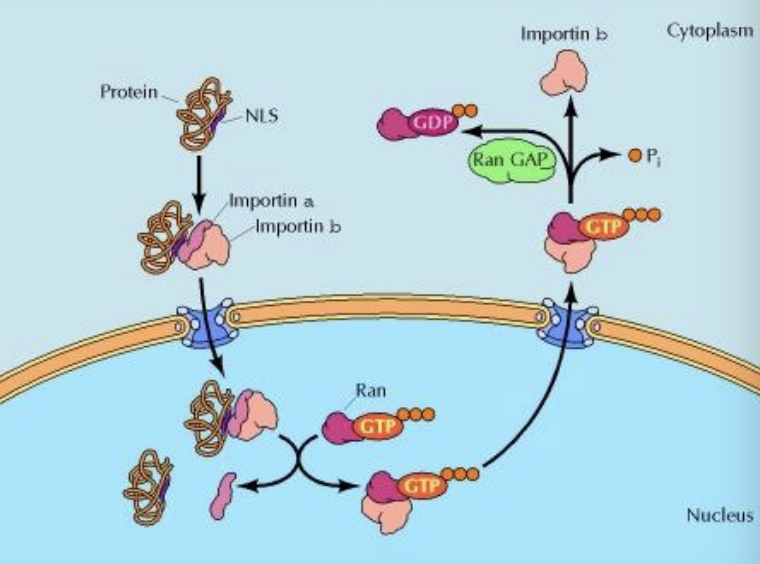
How can a protein with a nuclear localization signal enter the cell
A protein with an NLS binds to an importin α/β dimer, which helps it dock and pass through the nuclear pore complexinto the nucleus.
Inside the nucleus, Ran-GTP binds importin and causes the release of the cargo protein. The Ran–importin complexthen returns to the cytosol, where Ran hydrolyses GTP to GDP, leading to dissociation of importin and Ran, completing the cycle.
Explain what a GTPase is and describe how its activity is regulated by GAP and GEF proteins.
A GTPase is a regulatory protein that acts as a molecular switch: it is active when bound to GTP and inactive when bound to GDP.
Its activity is controlled by:
GAP (GTPase-activating protein), which stimulates hydrolysis of GTP to GDP, turning the GTPase off
GEF (guanine nucleotide exchange factor), which promotes exchange of GDP for GTP, turning the GTPase back on
This cycle allows precise regulation of cellular processes such as nuclear transport.
Explain how proteins are exported from the nucleus, including the roles of NES, exportins, Ran-GTP, and Ran-GAP.
Proteins with an NES bind exportins and Ran-GTP in the nucleus, forming a complex that exits via the nuclear pore complex. In the cytosol, Ran-GAP stimulates GTP hydrolysis, releasing the protein and exportin.
non sonuna bak anlamadım