[FUNACC] (P1) Chapter 2 | Accounting Principles and Reporting Standards
 Studied by 2 people
 Call with Kai
 Learn
Learn Practice Test
 Spaced Repetition
 Match
Match Flashcards
 Knowt Play
1/34

There's no tags or description
Looks like no tags are added yet.
Name | Mastery | Learn | Test | Matching | Spaced | Call with Kai |
|---|
No study sessions yet.
35 Terms
entity
is something that can be recognized as having its own separate identity, such as an individual, a town, a university, or a business.
economic entity
The term ________ usually refers to a business or organization whose major purpose is to produce a profit for its owners.
Social entities
Type of entity that are nonprofit organizations, such as cities, public schools, and public hospitals.
business
A ______ requires investments to enable it to pay for the infrastructure, equipment and personnel.
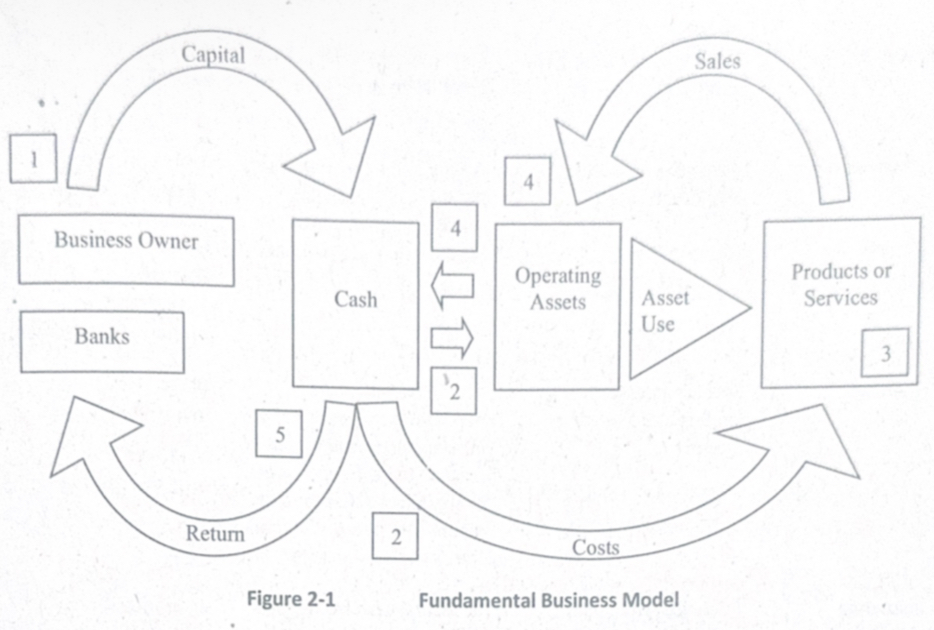
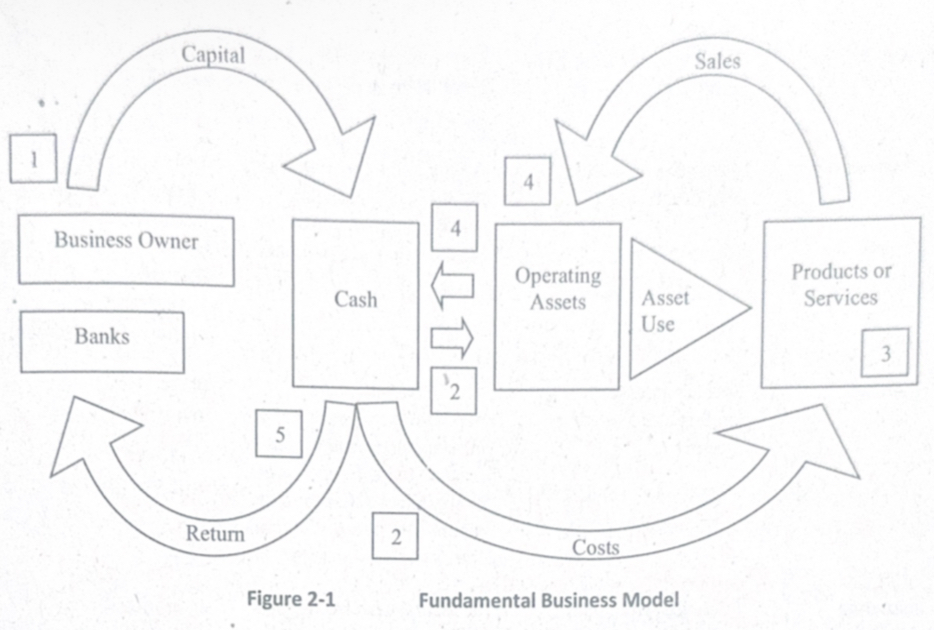
FUNDAMENTAL BUSINESS MODEL
The model illustrates the way money flows around a business and provides the basis of accounting. To manage a business effectively it is important to know how the cash has been spent and how profitable the products or services have been to the business. The availability of this historic information helps management to make judgments on how to improve the performance of business.
Services
Activity: Selling people's time
Structure: Hiring skilled staff and selling their time
Examples: Software development, Accounting, Legal
Trader
Activity: Buying and selling products
Structure: Buying a range of raw materials and manufactured goods and consolidating them, making them available for sale in locations near to their customers or online for delivery
Examples: Wholesaler, Retailer
Manufacture
Activity: Designing products, aggregating components and assembling finished products
Structure: Taking raw materials and using equipment and staff to convert them into finished goods
Examples: Vehicle Assembly, Construction, Engineering, Electricity, Food and drink, Chemicals, Media, Pharmaceuticals, Water
Raw materials
Activity: Growing or extracting ______.
Structure: Buying blocks of land and using them to provide raw materials
Examples: Farming, Mining, Oil
Infrastructure
Activity: Selling the utilization of ______.
Structure: Buying and operating assets (typically large assets); selling occupancy often in combination with services
Examples: Transport (airport operator, airlines, trains, ferries, buses), Hotels, Telecoms, Sports facilities, Property management
Financial
Activity: Receiving deposits, lending and investing money
Structure: Accepting cash from depositors and paying them interest; using the money to provide loans to borrowers, charging them fees and a higher rate of interest than the depositors receive.
Examples: Bank, Investment house
Insurance
Activity: Pooling premiums of many to meet claims of a few
Structure: Collecting cash from many customers; investing the money to pay the losses experienced by a few customers. By understanding the risk accepted and the likelihood of a claim, more premium income can be earned than claims paid.
the sole proprietorship, the partnership, and the corporation.
There are three major legal forms of business entity: (3)
Sole Proprietorship
This business organization has a single owner called the proprietor who generally is also the manager. Sole proprietorships tend to be small service-type (e.g. physicians, lawyers and accountants) businesses and retail establishments. The owner receives all profits, absorbs all losses and is solely responsible for all debts of the business.
Partnership
is a business owned and operated by two or more persons who bind themselves to contribute money, property, or industry to a common fund, with the intention of dividing the profits among themselves. Accounting considers this as a separate organization.
Corporation.
is a business owned by its stockholders. It is an artificial being created by operation of law, having the rights of succession and the powers, attributes and properties expressly authorized by law or incident to its existence. Is a separate legal entity.
One Person Corporation (OPC)
The Revised Corporation Code of the Philippines (Republic Act 11232, effective Feb. 23, 2019) added a new type of corporation, the ____________________. This is a corporation with a single stockholder, who may be a natural person, a trust or an estate.
micro, small and medium enterprises (MSMEs)
Big business may be the country's top taxpayers and highest paying employers. Collectively, though, ______________________ provide employment for 61% of the country's labor force. According to the National Statistics Office, ______ in 2010 accounted for 99.6% of the total business enterprises at 777,687. The 99.6% ism• broken down as follows: micro enterprises, 91.6% and SMEs, 8%.
Republic Act No. 9501
On May 23, 2008, Republic Act No. _____ was signed into law by President Gloria Macapagal-Arroyo. This law seeks to address problems facing MSMEs, particularly the lack of capital and access to credit. The new law also gives the Small Business Corporation, the government financial institution created to assist MSMEs, more financial muscle by increasing its authorized capital stock to P10.0 billion.
Micro
The law also updated the definitions of MSMEs by increasing the net assets threshold:
____ enterprises are those with assets, before financing, of P3.0 (before P1.5 million) or less and employ not more than nine workers.
Small
The law also updated the definitions of MSMEs by increasing the net assets threshold:
____ enterprises are those with assets, before financing, of above P3.0 (before P1.5 million) to P15 million and employ 10 to 99 workers.
Medium
The law also updated the definitions of MSMEs by increasing the net assets threshold:
____ enterprises have assets, before financing, of above P15 million to P100 million and employ 100 to 199 workers.
small-and medium-scale enterprises (SMEs)
In the US, 97% of the 28 million firms are _________________ with less than US$1.0 million annual gross sales. This means that even in advanced economies, ____ make up a big majority in terms of numbers. In China, entrepreneurship has taken 250 million Chinese out of poverty over the last decades.
financing, investing, and operating.
The three types of organizational activities: (3)
Financing Activities
________ are the methods an organization uses to obtain financial resources from financial markets and how it manages these resources. Primary sources of financing for most businesses are owners and creditors, such as banks and suppliers. Repaying the creditors and paying a return to the owners are also this.
Investing Activities
involve the selection and management including disposal and replacement of long-term resources that will be used to develop, produce, and sell goods and services. This include buying land, equipment, buildings and other resources that are needed in the operation of the business, and selling these resources when they are no longer needed.
efficient, effective
An ______ business is one that provides goods and services at low costs relative to their selling prices. An _____ business is one that is successful in providing goods and services demanded by the customers.
Operating Activities
involve the use of resources to design, produce, distribute, and market goods and services. This include research and development, design and engineering, purchasing, human resources, production, distribution, marketing and selling, and servicing.
measured.
Before the effects of transactions can be recorded, they must be _______.
Money
In order that accounting information will be useful, it must be expressed in terms of a common financial denominator which is ______. This serves as both a medium of exchange and a measure of value.
classified and summarized.
By simply measuring and recording transactions, the resulting information will be of limited use. To be useful in making decisions, the recorded data must be ______ and ______.
Classification
_____ reduces the effects of numerous transactions into useful groups or categories.
Summarization
________ of financial data is achieved through the preparation of financial statements or financial reports. These usually summarize the effects of all business transactions that occurred during some period.
interpreted or analyzed
After going through the preceding phases, it is imperative that the result of the summarization phase be ____ or ____ to evaluate the liquidity, profitability and solvency of the business organization.
decision-makers
Accounting provides the _______ with information to make reasoned choices among alternative uses of scarce resources in the conduct of business and economic activities.