Wake PA Unit 2: Thyroid and Adrenal Endocrinology
 Call Kai
 Learn
Learn Practice Test
 Spaced Repetition
 Match
Match Flashcards
 Knowt Play
1/62

There's no tags or description
Looks like no tags are added yet.
Name | Mastery | Learn | Test | Matching | Spaced | Call with Kai | Chat |
|---|
No analytics yet
Send a link to your students to track their progress
63 Terms
a single thyroid nodule is found on a patient during physical exam. what is the likelihood that it is benign?
95% of single thyroid nodules are benign
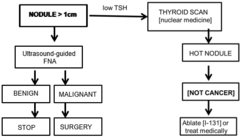
list the diagnostics used to determine if a thyroid nodule is benign or malignant
- nuclear medicine scan with radioactive iodine: used to assess the functional capacity of the nodule.
- ultrasound: used to distinguish between solid and cystic lesions.
- fine needle aspiration biopsy: preferred initial test used in place of scans that are less specific.
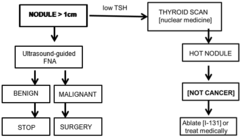
what is a "cold" thyroid nodule? what can it indicate?
Nonfunctioning or poorly functioning areas of the thyroid that take up little radioactive iodine in a nuclear medicine scan.
Can indicate a cyst, blood, scar tissue, the thyroid gland suppressed by nearby autonomous thyroid gland, or thyroid cancer.
-more suspicious for thyroid cancer BUT, only 30% of cold nodules are malignant.
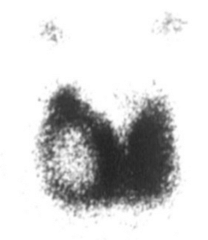
what is a "hot" thyroid nodule?
Hyperfunctioning thyroid nodule that takes up the radioactive iodine in a nuclear medicine scan.
- least likely to be malignant.
- patient probably has elevated T4

what is a multinodular goiter?
An enlarged thyroid gland with two or more nodules suggests a metabolic rather than a neoplastic process.
Some thyroid cells are functioning more than others, and proliferating at different rates.
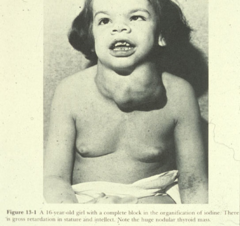
list the causes of a multinodular goiter
- iodine deficiency (typically developing areas of the world)
- enzyme deficiency (rare)
what does a multinodular goiter indicate? what are the risks/complications?
Functional abnormality of the thyroid gland:
- low risk of malignancy
- high risk of eventual hyperthyroidism
what is a diffuse goiter? what causes it?
TSH-induced response to autoimmune disease such as Graves' or Hashimoto's.
- low risk of malignancy

list the symptoms of hyperthyroidism
nervousness
increased sweating
heat intolerance
palpitations, tachycardia
fatigue, weakness
weight loss with increased appetite
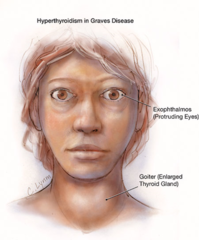
list the causes of hyperthyroidism
Graves' Disease
Hyperfunctioning adenoma
Multinodular goiter
Thyroiditis
Factitious/Iatrogenic
hCG-related [pregnancy, cancer]
TSH-related [rare!!!]
explain the autoimmune component of Graves Disease vs pregnancy-related hyperthyroidism
Graves Disease: thyroid stimulating immunoglobulins fit into and bind to the TSH receptor in the thyroid (TSH decreased)
Pregnancy-related hyperthyroidism: hCG, LH, and FSH can also bind to the TSH receptor (TSH decreased) due to having the same alpha subunits but slight different beta subunits
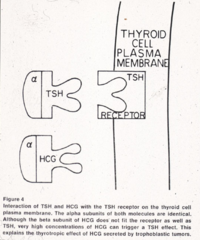
list the symptoms of hypothyroidism
weakness, fatigue, lethargy
dry and coarse skin, coarse hair
slow speech, impaired mentation
cold intolerance
edema (facial, periorbital, and lower extremities)
constipation
weight gain
hoarseness
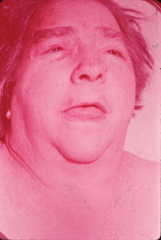
List the causes of hypothyroidism
- autoimmune (Hashimoto's thyroiditis)
- iodine deficiency
- central hypothyroidism (decreased TSH production)
- malignancy
- medication-related
List the drugs that can cause hypothyroidism
- hyperthyroidism therapy
- amiodarone
- lithium
- interferon-alpha
- tyrosine kinase inhibitors
- silfonylureas
- valproic acid
what is the treatment of hypothyroidism?
replacement of l-thyroxine is required --> Levothyroxine
start at low dose, especially in the elderly (25 - 50 mcg daily)
increase dose slowly, at ~6 week intervals (half-life of T4 is one week)
therapeutic goal is normalization of TSH in patients with primary hypothyroidism; normalization of free T4 in secondary hypothyroidism
what is the treatment of hyperthyroidism?
- radioactive iodine is a common and definitive treatment
- medical therapy (propylthiouracil [PTU] or methimazole) is an alternate choice and is first choice in situations where radioactive iodine is contraindicated (pregnancy) or less desirable (young children)
1. more hepatic abnormalities with PTU; therefore methimazole is 1st choice
2. exception: in first trimester of pregnancy, as PTU crosses placenta less
- surgical treatment has become a less common treatment
What lab values would you expect to see in a patient with hypothyroidism (TSH, Total T4, Free T4, Total T3)?
- TSH: High
- Total T4: Low
- Free T4: Low
- Total T3: Low
What lab values would you expect to see in a patient with hyperthyroidism (TSH, Total T4, Free T4, Total T3)?
- TSH: Low
- Total T4: High
- Free T4: High
- Total T3: High
what is subclinical hypothyroidism?
elevated serum TSH level with a normal T4 level
repeat measurement of TSH level is recommended, particularly in an asymptomatic patient, as it will normalize in up to 30% of patients by 6 weeks
which cases of subclinical hypothyroidism require treatment?
- patients under 65: TSH >7
- patients over 65: TSH >10
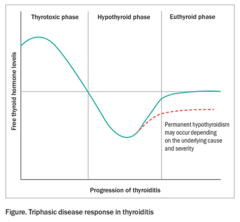
list the types of thyroiditis
(inflammation of the thyroid gland)
acute (bacterial): suppurative
subacute (viral): granulomatous & deQuervain's
chronic (autoimmune): lymphocytic & Hashimoto's
what is acute thyroiditis?
aka bacterial. suppurative thyroiditis.
VERY RARE
usually immonocompromised patients
very ill, fever, dysphagia, anterior neck pain,
TFT's usually normal but can get high or low T4 symptoms increased WBC, ESR
diagnosis: biopsy
treatment: pain medications, antibiotics, drain abscess
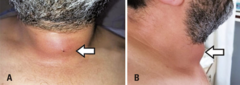
what is subacute thyroiditis?
aka viral thyroiditis. granulomatous or deQuervain's thyroiditis.
From an infection ex: EBV, coxsackie --> abrupt onset of thyroiditis. They will have fever, malaise, thyroid/jaw pain, weight loss (s/s of hypothyroid). High ESR and TSH, low T3 and T4
Treatment: Steroids! (can also give aspirin and NSAIDs and BBs) - no surgery
Note: this will not have antithyroid antibodies since it is not autoimunne, rather it is an acute *inflammatory dz*
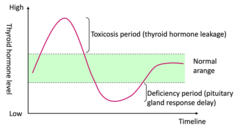
what is chronic thyroiditis?
aka autoimmune thyroiditis: lymphocytic or Hashimoto's thyroiditis.
most common cause of thyroid disease in children and teens; accounts for largest % of juvenile hypothyroidism; occurs most frequently after 6y.o. and peaks during adolescence
what is silent or postpartum thyroiditis?
painless autoimmune condition that happens postpartum.
During pregnancy, immune system is tamped down & after pregnancy, immune system may target thyroid as it flares back to normal.
treatment: beta blocker, may need thyroid hormone if no recovery
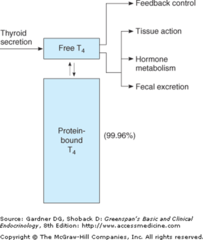
compare and contrast total T4 vs. free T4 tests
- total T4: because 99.96% of T4 is protein-bound and has no biological activity, this test can be a misleading measure of thyroid status.
- free T4: measurement of the T4 that is not-protein bound, available to the tissue, and functionally active
what is the TSH test?
- the most sensitive test of thyroid function; typically first line test.
- elevated TSH: primary hypothyroidism
- decreased TSH: hyperthyroidism
shortcomings: when used by itself, the test will not detect someone's inability to produce TSH.
what does elevated TSH + normal free T4 indicate?
subclinical hypothyroidism
what does suppressed TSH + normal free T4 indicate?
subclinical hyperthyroidism
what does low TSH + high free T4 indicate?
hyperthyroidism
what does low TSH + low free T4 indicate?
secondary hypothyroidism
what is Euthyroid sick syndrome?
- Altered conversion of T4 to T3 in peripheral tissues, leading to low T3 levels.
- Increased reverse T3 (rT3), an inactive form of T3, due to altered deiodinase activity.
- Changes in thyroid hormone-binding proteins in response to illness.
- Cytokine-mediated effects on the HPT axis.
Infections, Trauma, Myocardial infarction, Chronic kidney disease, Liver cirrhosis, Malnutrition, Surgery
list the clinical manifestations of Cushing's Syndrome
Glucocorticoid excess
• Central obesity, "buffalo hump," "moon facies"
• Catabolism: thin skin, striae, myopathy, osteoporosis
• Insulin resistance and hyperglycemia/diabetes
• Psychiatric: irritability, depression, psychosis
• Immune impairment
Mineralocorticoid excess
• Sodium retention: hypertension, edema
• Hypokalemia
Androgen excess
• Hirsutism
• Amenorrhea

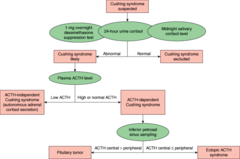
how do you diagnose Cushing's Syndrome?
- midnight salivary cortisol test.
- Dexamethasone suppression test
- 24-hour urine cortisol levels
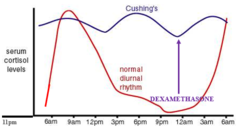
how does the dexamethasone suppression test indicate Cushing's Syndrome?
a normal test: CRH from hypothalamus suppressed, so ACTH, adrenal activity, and cortisol levels should be suppressed as well.
in Cushing's: CRH suppressed, but adrenal tumor still producing ACTH (adrenal activity), and serum cortisol levels are normal.
what are the causes of Cushing's Syndrome?
-Adrenal Tumors - increase cortisol
-Pituitary Tumors - increase ACTH
-Ectopic ACTH from cancer or another source
-Exogenous steroids
in the adrenal cortex, what does the zona glomerulosa produce?
aldosterone
in the adrenal cortex, what does the zona fasciculata produce?
cortisol
in the adrenal cortex, what does the zona reticularis produce?
andogens
what is ACTH? what is its target? what regulates it?
adrenocorticotropic hormone; target = adrenal cortex --> cortisol release; regulation by circadian rhythm
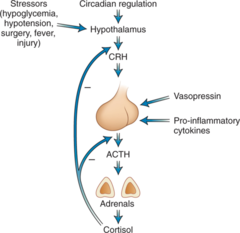
what is primary adrenal insufficiency?
Addison's Disease
Adrenal Glands do not produce enough Cortisol leading to more ACTH
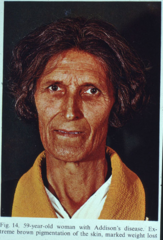
what are the clinical manifestations of primary adrenal insufficiency?
Glucocorticoid deficiency
• Nausea, vomiting, anorexia, weight loss
• Asthenia, weakness
• Hyperpigmentation
• Hypoglycemia
Mineralocorticoid deficiency
• Sodium wasting
Hyponatremia (90%)
Hypovolemia
Hypotension (orthostatic)
Azotemia (pre-renal)
• Hyperkalemia (65%)
• Metabolic acidosis
how do you diagnose primary adrenal insufficiency?
- low serum cortisol levels with elevated ACTH levels.
- decreased cortisol response to ACTH stimulation.
Cosyntropin is synthetic ACTH injected (IM or IV) and cortisol should be elevated.
what are the causes of primary adrenal insufficiency?
Autoimmune (70%)
• immunological destruction of adrenal gland
Tuberculosis (20%)
Other (10%)
• Fungal infection
• Adrenal hemorrhage
• Congenital adrenal hyperplasia
• Sarcoidosis
• Amyloidosis
• AIDS
• Adrenoleukodystrophy
• Metastatic cancer
what is secondary adrenal insufficiency?
insufficient secretion of ACTH from the pituitary
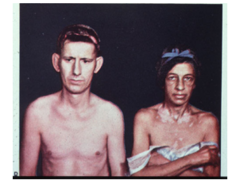
what are the clinical manifestations of secondary adrenal insufficiency?
- similar to those of Addison's, but without hyperpigmentation or mineralocorticoid deficiencies:
- nausea, vomiting, anorexia, weight loss
- asthenia, weakness
- hypoglycemia
- hyponatremia (from free water retention)
how do you diagnose secondary adrenal insufficiency?
- low cortisol levels with low/inappropriately normal ACTH levels
- blunted and delayed cortisol response to cosyntropin (ACTH) stimulation
- lack of response to stressful stimuli: hypoglycemia with insulin injection
why does the cosyntropin/ACTH stimulation test work to diagnose secondary adrenal insufficiency?
by the time someone shows symptoms of secondary adrenal insufficiency, their adrenal glands are 95% atrophied.
cosyntropin introduction should make cortisol levels spike, but because they are atrophied, cortisol remains low.
what are the causes of secondary adrenal insufficiency?
ACTH Suppression from chronic glucocorticoid therapy
Suppression after treatment of Cushing's syndrome
Pituitary or hypothalamic lesions
• Pituitary adenoma
• Craniopharyngioma
• Meningioma
• CNS radiation
• Sheehan's syndrome
• Infiltrative disease: Hemochromatosis or Sarcoidosis
what is primary hyperaldosteronism?
excessive secretion of aldosterone from an abnormality of the adrenal cortex (possibly an adenoma)
what are the clinical manifestations of primary hyperaldosteronism?
- elevated BP
- unexplained hypokalemia
explain the expected levels of renin and angiotensin I/II in primary hyperaldosteronism
adenoma in adrenal cortex pumps out aldosterone. kidneys sense elevated aldosterone levels and stop secreting renin (angiotensin I is not activated), but aldosterone levels remain high.
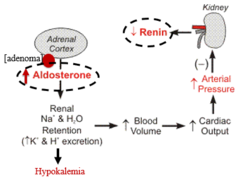
how do you diagnose primary hyperaldosteronism?
Aldosterone:Renin ratio:
- increased serum aldosterone
- decreased plasma renin
explain the mechanism of secondary hyperaldosteronism?
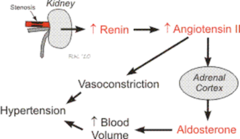
atherosclerosis in renal artery causes kidney to interpret dangerous state.
increases renin production --> increased angiotensin I and II --> increased aldosterone
what is congenital adrenal hyperplasia?
21-hydroxylase deficiency that can present in its most severe, classic form as a newborn female infant w/ ambiguous genitalia and life-threatening salt wasting. Milder forms present later in life. 11Beta-hydroxylase deficiency is a less common cause of adrenal hyperplasia.
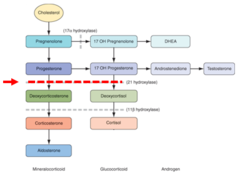
what are the clinical manifestations of congenital adrenal hyperplasia?
- cortisol deficiency features: malaise, anorexia, weight loss, decreased stress response
- aldosterone deficiency features: hyponatremia, hyperkalemia, decreased BP
- androgen excess features: virilization, hirsutism
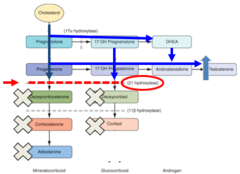
how do you diagnose congenital adrenal hyperplasia?
screened at birth
- decreased cortisol, increased cortisol precursors
- increased adrenal androgens
- decreased aldosterone (in patients with 21-hydroxylase block)
- gender identity/assignment issues
what is the treatment for congenital adrenal hyperplasia?
replace glucocorticoid (prednisone or equivalent) and mineralocorticoid (fludrocortisone)
explain how hyperparathyroidism can cause hypercalcemia
increased PTH = increased breakdown of bones into calcium and phosphate. phosphate is excreted by kidneys.
what are the major indications for surgery in primary hyperparathyroidism?
- calcium >12.0
- kidney stones, hypercalciuria, declining GFR
- osteoporosis
- age
what is a sestamibi scan?
sestamibi is a large synthetic molecule of isonitrile TC99M.
this imaging is used to identify parathyroid adenoma. ultrasound of neck not good enough to visualize parathyroid glands.
list the major causes of hypercalcemia
increased bone turnover:
- primary hyperparathyroidism
- cancer (skeletal metastases, humoral mechanisms
- hyperthyroidism
increased GI absorption of calcium:
- vitamin D intoxication
- granulomatous disease (TB, sarcoidosis)
misc:
- milk-alkali syndrome
- lithium therapy
- vitamin A intoxication
what is PTH-RP?
an essential fetal hormone similar in structure to PTH. its presence in an adult indicates cancer since it is no longer normally produced after childhood.