Energu Changes
 Call Kai
 Learn
Learn Practice Test
 Spaced Repetition
 Match
Match Flashcards
 Knowt Play
1/10

There's no tags or description
Looks like no tags are added yet.
Name | Mastery | Learn | Test | Matching | Spaced | Call with Kai | Chat |
|---|
No analytics yet
Send a link to your students to track their progress
11 Terms
What is an energy change?
Energy changes occur in all chemical reactions where energy can either be taken in or given out
Define ‘enthalpy change’
→ Enthalpy changes marks the transfer of thermal energy
What is an exothermic reaction?
→ A chemical reactions where the reactants have more thermal energy than the products.
Causing heat to be released to its surroundings.
It has a (-) enthalpy change because it is losing heat energy
What is the rule for total energy in a reaction?
Energy of reactants = energy of products
Give examples of exothermic chemical reactions
→ Oxidation
→ Combustion
→ Neutralisation
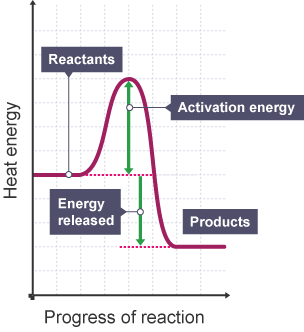
Draw a energy change diagram for exothermic reactions
→ Energy of reactants > energy of products
→ Arrow touching lines
→ Arrow of enthalpy change pointing downwards
→ activation energy arrow pointing up
What is an endothermic reaction?
→ The total energy of the product is greater than the total energy of the reactants
Meaning thermal energy must be taken in from its surroundings
The enthalpy change of the reactions is (+) because the reaction is gaining thermal energy
Give an example of an endothermic reactions
Thermal decomposition
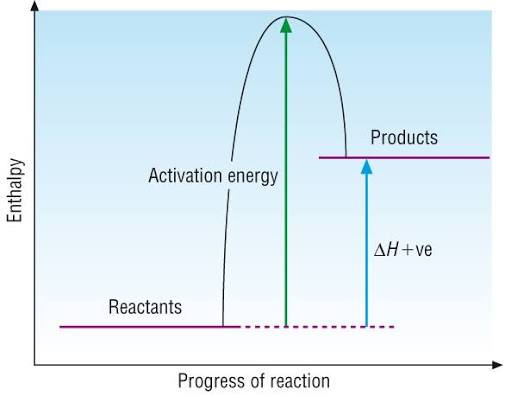
Draw the graph for an endothermic energy change
→ Energy of reactants < Energy of products
→ Enthalpy change arrow pointing up
→ Activation energy arrow pointing up
→ Reactant line goes horizontally through
How do we calculate energy change?
Energy required to break bonds - energy required to form bonds
What value is energy change represented in ?
kJ/mol