TAGs & beta-oxidation

0.0(0)
studied byStudied by 0 people
0.0(0)
full-widthCall Kai
learnLearn
examPractice Test
spaced repetitionSpaced Repetition
heart puzzleMatch
flashcardsFlashcards
GameKnowt Play
Card Sorting

1/8

flashcard set

Earn XP

Description and Tags

L20 fat metabolism

Study Analytics
Name
Mastery
Learn
Test
Matching
Spaced

No study sessions yet.

9 Terms

1
New cards

How does hormone signals fatty acid chain release?

  • epinephrine & glucose signal via GPCRs on adipose cells

  • involves: Ga-ATP release → adenylyl cyclase activation → cAMP production → PKA activation → phosphorylates & activates triacylglycerol lipase → hydeolyzes ester bonds to produce free fatty acids & glycerols

  • FFAs are transported in blood via albumin for cellular use
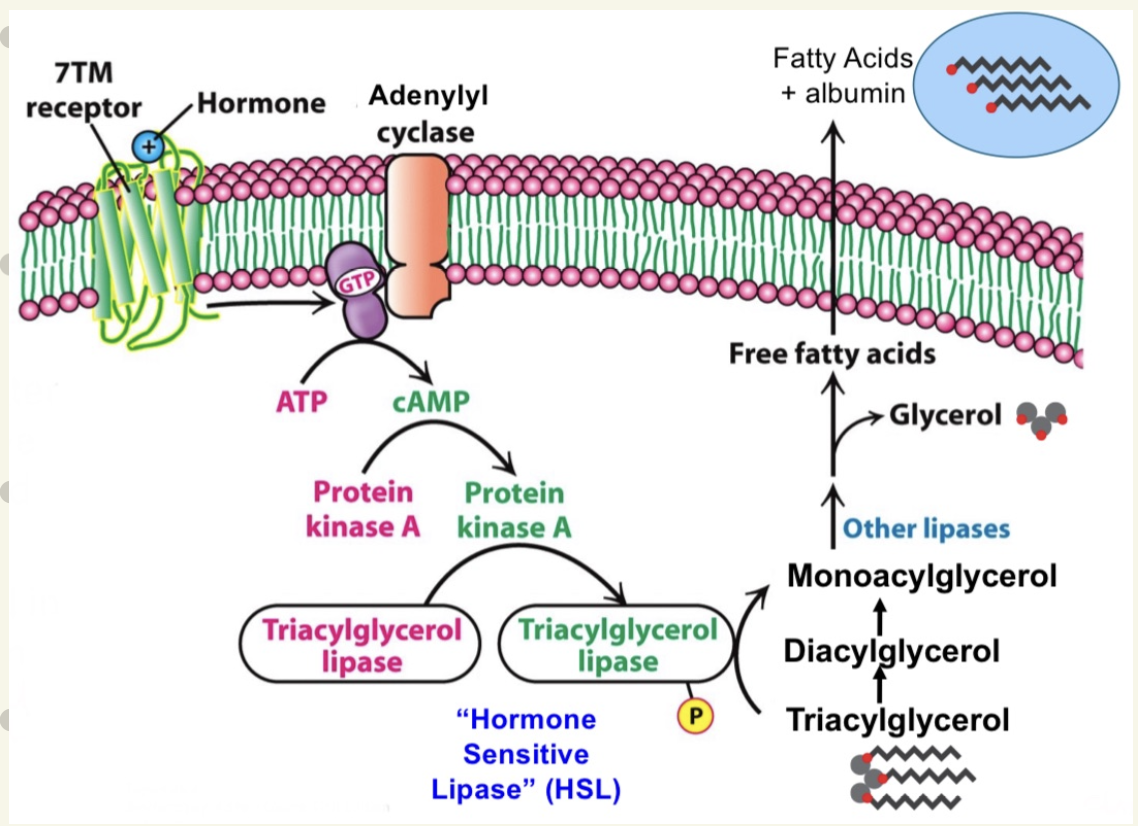
<ul><li><p><strong>epinephrine &amp; glucose </strong>signal via <strong>GPCRs</strong> on adipose cells</p></li><li><p>involves: Ga-ATP release → adenylyl cyclase activation → cAMP production → PKA activation → phosphorylates &amp; activates <strong>triacylglycerol lipase</strong> → hydeolyzes ester bonds to produce <strong>free fatty acids &amp; glycerols</strong></p></li><li><p>FFAs are transported in blood via <strong>albumin</strong> for cellular use</p></li></ul><p></p>
2
New cards

acyl-CoA vs. acetyl-CoA?

Acyl-CoA:

  • broad term, any FA conjugated to CoA via thioester linkage

Acetyl-CoA:

  • 2C acyl CoA

<p><strong>Acyl-CoA:</strong></p><ul><li><p>broad term, any FA conjugated to CoA via thioester linkage</p></li></ul><p><strong>Acetyl-CoA:</strong></p><ul><li><p><u>2C</u> acyl CoA</p></li></ul><p></p>
3
New cards

How does fatty acid activation occur in cytoplasm? what’s needed?

  • after entering cells from bloodstream, acyl chains are trapped to prevent diffusion back out by forming covalent thioester bond with CoA

    • catalyzed by Acyl CoA Synthetase

    • reversible reaction, uses ATP → AMP + PPi

    • PPi hydrolysis makes this reaction favorable

    • to use AMP, it must be converted to ADP by sacrificing a 2nd ATP

→ Fatty acid activation by CoA requires 2ATP (1 for activation, 1 for ADP production) & 1H2O to hydrolyze PPi
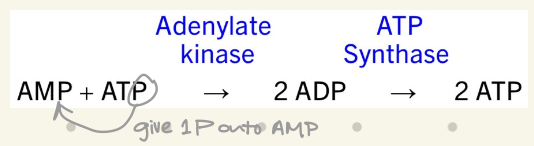
<ul><li><p>after entering cells from bloodstream, acyl chains are trapped to prevent diffusion back out by forming covalent thioester bond with CoA</p><ul><li><p>catalyzed by <strong>Acyl CoA Synthetase</strong></p></li><li><p>reversible reaction, uses <strong>ATP → AMP + PPi</strong></p></li><li><p>PPi hydrolysis makes this reaction favorable</p></li><li><p>to use AMP, it must be converted to ADP by <u>sacrificing a 2nd ATP</u></p></li></ul></li></ul><p>→ Fatty acid activation by CoA requires <strong>2ATP</strong> (1 for activation, 1 for ADP production) &amp; <strong>1H2O</strong> to hydrolyze PPi</p><p></p>
4
New cards

where does acyl-CoA & β-oxidation occur?

acyl-CoA = cytoplasm
β-oxidation = matrix

5
New cards

How is acyl-CoA transported into matrix?

via Carnitine Shuttle (CoA is hydrophilic)

  • temporarily transfers acyl group to carnitine (can cross membrane)

  • shuttle has 3 components:

    • carnitine acyltransferase I (CAT1)

    • translocase (antiporter)

    • carnitine acyltransferase II (CATII)

  • CATI moves acyl chain onto carnitine from CoA

  • translocase moves acyl-carnitine in, free carnitine out

  • CATII moves acyl chain back onto CoA

  • acyl-CoA can then be catabolized in β-oxidation
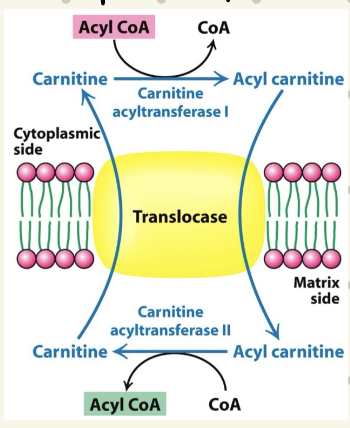
<p>via <strong>Carnitine Shuttle</strong> (CoA is hydrophilic)</p><ul><li><p>temporarily transfers <u>acyl group to carnitine</u> (can cross membrane)</p></li><li><p>shuttle has 3 components:</p><ul><li><p>carnitine acyltransferase I (CAT1)</p></li><li><p>translocase (antiporter)</p></li><li><p>carnitine acyltransferase II (CATII)</p></li></ul></li><li><p><strong>CATI moves acyl chain onto carnitine from CoA</strong></p></li><li><p><strong>translocase moves acyl-carnitine in, free carnitine out</strong></p></li><li><p><strong>CATII moves acyl chain back onto CoA</strong></p></li><li><p><strong>acyl-CoA can then be catabolized in β-oxidation </strong></p></li></ul><p></p>
6
New cards

how to calculate the number of rounds needed in β-oxidation?

#of rounds = (number of carbon/2) - 1

<p>#of rounds = (number of carbon/2) - 1</p>
7
New cards

which carbon does fatty acid oxidation occur on?

β-carbon (3rd C)
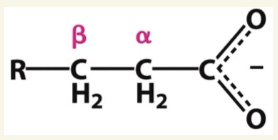
<p>β-carbon (3rd C)</p>
8
New cards

TCA is dependent on the amount of ___ present

oxaloacetate

9
New cards

how many enzymes are needed in beta-oxidation?

4
