2.22-2.27 Extraction and uses of metals
 Call Kai
 Learn
Learn Practice Test
 Spaced Repetition
 Match
Match Flashcards
 Knowt Play
1/38

There's no tags or description
Looks like no tags are added yet.
Name | Mastery | Learn | Test | Matching | Spaced | Call with Kai | Chat |
|---|
No analytics yet
Send a link to your students to track their progress
39 Terms
Name four metal/metal compounds that the Earth’s crust contains…
Gold
Copper
Iron oxide
Aluminium oxide
What is an ore?
An ore is a metal chemically combined with other substances
What is a metal ore?
A rock that contains enough of the metal to make it worthwhile extracting
How are metals extracted from their ores? Through what processes?
Metals are extracted through electrolysis, using a blast furnace or reacting with more reactive material
What is another name for iron oxide ore?
Haematite
What is another name for aluminium oxide ore?
Bauxite
Think of two unreactive metals in the Earth’s crust:
Gold and platinum
What is the reactivity series of metals? (most to least)
Potassium
Sodium
Lithium
Calcium
Magnesium
Aluminium
Zinc
Iron
Copper
Silver
Gold
What three raw materials are used in a blast furnace? (Describe each)
Iron ore (hematite)
Coke (an impure form of carbon)
Limestone
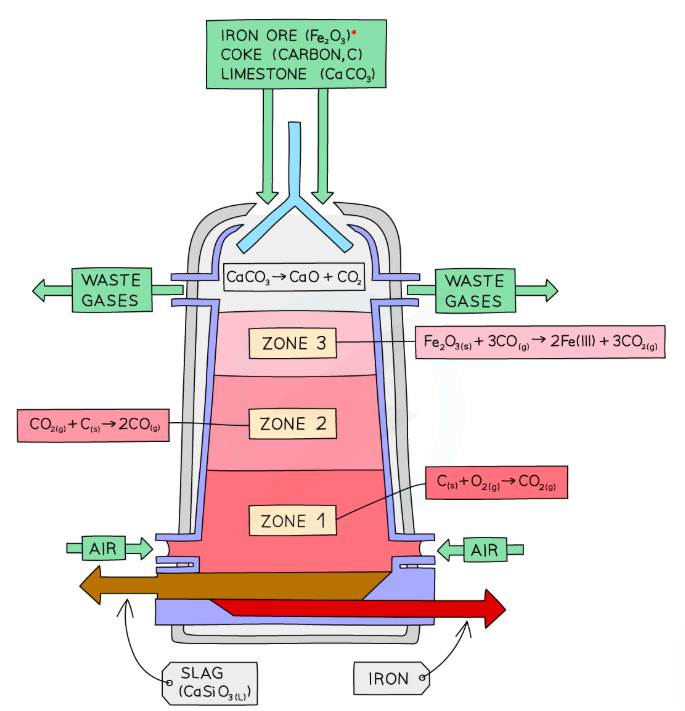
How is the blast furnace heated up?
Hot air is blown in through the bottom
Why is limestone used in a blast furnace?
To neutralise acidic impurities
What does coke do in a blast furnace? What does it form, and how does this impact the temperature of the blast furnace?
Coke burns in hot air, forming carbon dioxide. The reaction is exothermic, heating the surface.
At higher temperatures in the furnace, what does the coke react to?
The coke reacts to carbon dioxide, reducing it to carbon monoxide
What does carbon monoxide do to the iron(III) oxide in the hematite?
Carbon monoxide reduces the iron(III) oxide in the hematite to form iron
How does limestone (calcium carbonate) reduce acidic impurities in the ore?
1. Calcium carbonate [ ] [ ] to form calcium [ ]
The calcium oxide reacts with the [ ] [ ], an impurity in [ ], to form calcium [ ] by neutralisation
This melts and collects as a molten [ ] floating on top of the molten iron
1. Calcium carbonate thermally decomposes to form calcium oxide
The calcium oxide reacts with the silicon dioxide, an impurity in hematite, to form calcium silicate by neutralisation
This melts and collects as a molten slag floating on top of the molten iron
Why is aluminium extracted from bauxite using electrolysis?
Aluminium is higher in the reactivity series than carbon
Why is aluminium oxide dissolved in molten cryolite (bauxite is purified to produce aluminium oxide first)?
Aluminium oxide has a melting point of over 2000 degrees C which would use a lot of energy and be cost-ineffective
Which metal ions collect at the cathode?
The aluminium ions - the molten aluminium is siphoned off from time to time and fresh Al2O3 is added to the cell
Which metal ions gather and which gas is produced at the cathode?
Oxide ions, which lose electrons (oxidation) to form oxygen
Why does the anode have to be replaced regularly (in Al2O3 electrolysis)?
The carbon in the graphite anodes reacts with the oxygen gas produced to produce carbon dioxide, which wears away the anode
Why is Al2O3 electrolysis a major expense?
A lot of electricity is required for this process
What is aluminium used in and why?
Aircraft bodies because it has a low density (and so a high strength-to-weight ratio)
Why is aluminium used for saucepans?
Very good conductor of heat and unreactive
Why is aluminium used for overhead electrical cables?
Very good conductor of electricity
hat properties make aluminium suitable for food cans?
Non-toxic, resistant to corrosion, and resistant to acidic foodstuffs
What properties make copper suitable for electrical wiring?
Very good conductor of electricity and ductile
Why is copper used for saucepans?
Very good conductor of heat, unreactive, and malleable
What properties make copper ideal for water pipes?
Unreactive (does not react with water), non-toxic, and malleable
Why is iron used as a building material?
Good strength, malleable, ductile, and relatively inexpensive
How does iron function as a catalyst?
Increases the rate of a chemical reaction without being used up (due to its variable oxidation state)
What is the composition, use, and key property of Mild Steel?
Iron alloyed iwht 0.25% carbon
Car body panels and wiring
Soft and malleable
What is the composition, use, and key property of High Carbon Steel?
Iron alloyed with 0.5–1.4% Carbon
Tools (for example, chisels)
Hard
What is the composition, uses, and key properties of Stainless Steel?
Iron alloyed with 20% Chromium (Cr) and 10% Nickel (Ni)
Cutlery, sinks, and chemical plants
Strong and resistant to corrosion
What does malleable mean in the context of metals?
Able to be hammered, pressed, or rolled into thin sheets without breaking
What does ductile mean in the context of metals?
Able to be drawn out into thin wires without breaking
How does carbon content affect the properties of steel?
Lower carbon content (mild steel) makes it softer and more malleable; higher carbon content makes it harder
What is an alloy?
A mixture of two or more metals or metal with a non-metal such as carbon
What is a common example of an alloy and what is it made of?
Steel, which is made from iron and carbon
Why are alloys harder than pure metals?#
Alloys contain atoms of [ ] sizes
This [ ] the [ ] [ ] of atoms
So it is more [ ] for the layers of atoms to [ ] over each other
Alloys contain atoms of different sizes
This distorts the regular arrangements of atoms
So it is more difficult for the layers of atoms to slide over each other
