4.7 - Transport in plants
 Call Kai
 Learn
Learn Practice Test
 Spaced Repetition
 Match
Match Flashcards
 Knowt Play
1/23

There's no tags or description
Looks like no tags are added yet.
Name | Mastery | Learn | Test | Matching | Spaced | Call with Kai | Chat |
|---|
No analytics yet
Send a link to your students to track their progress
24 Terms
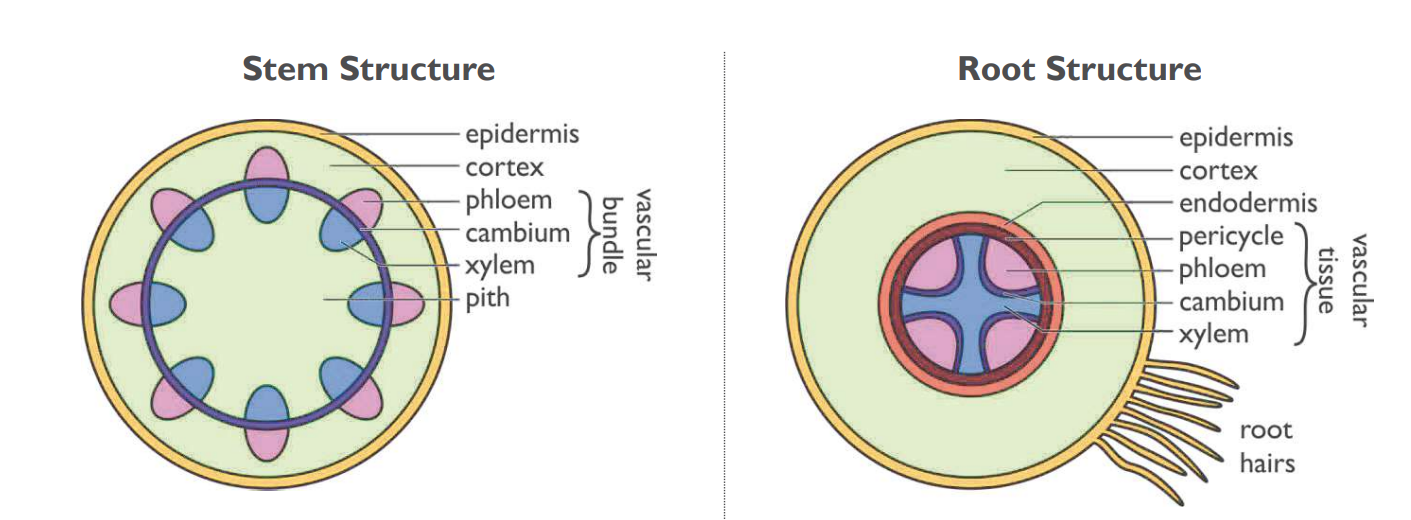
How to tell the difference between xylem & phloem in root vs stem?
Phloem = Periphery (in stem)
Xylem = X-shaped (in root)
What is the structure of xylem tissue?
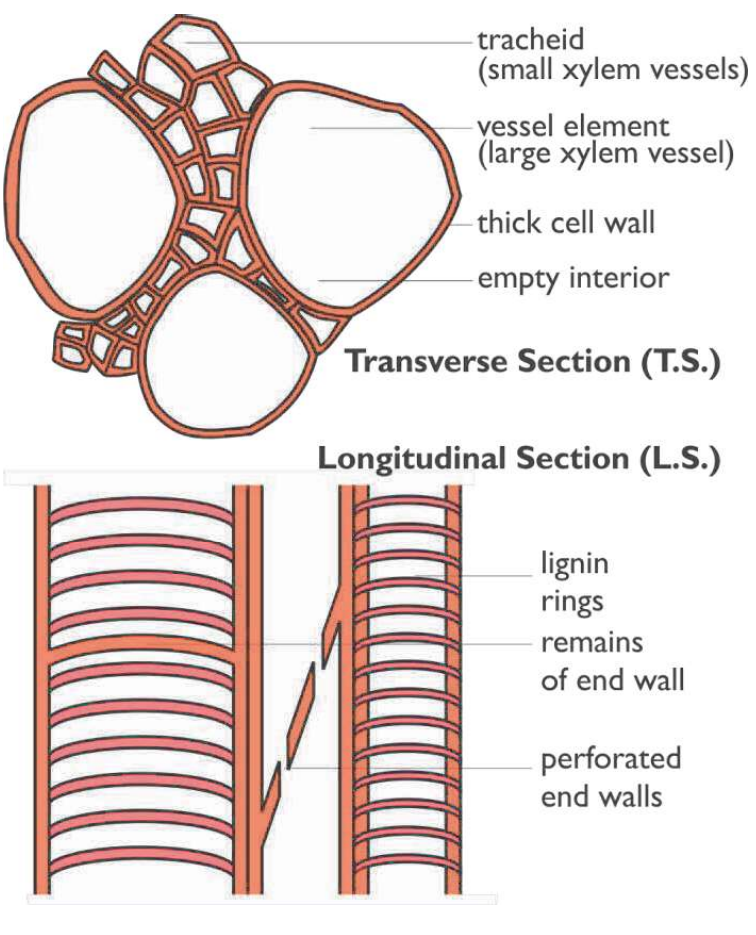
Composed of dead cells joined together to form long, empty tubes → allows transportation of water
Before death, the cells form thick cell walls containing lignin (often laid down in rings) → makes xylem vessels very strong, so they don’t collapse under pressure/provides structural support
how to remember: ‘x’ for xylem → dead eyes in cartoons, so dead cells → extra water, so carries water & dissolved minerals ions (linear direction)
What is the structure of phloem tissue?
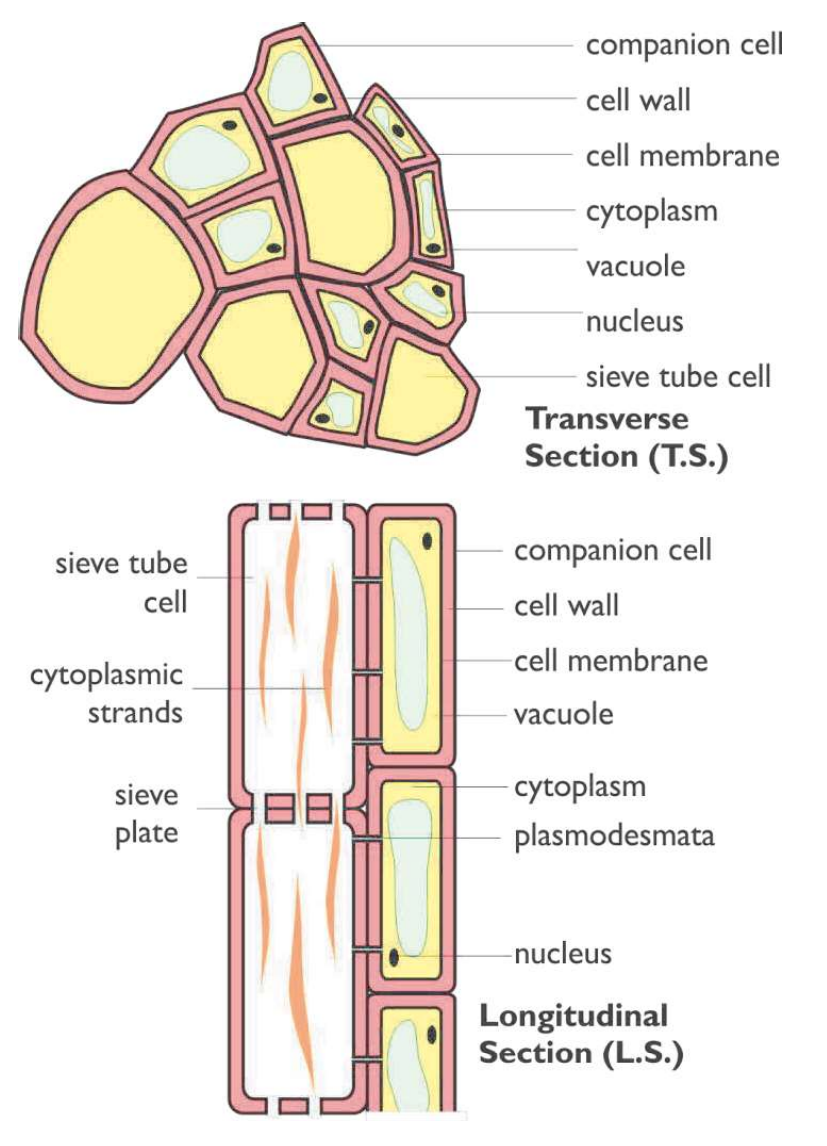
Composed of sieve tube cells → long columns of living cells with porous end walls (sieve plates)
Lack nuclei & most organelles, leaving cytoplasm as thin strands that pass through sieve plates to form continuous filaments, while the tube centre remains empty
Each sieve tube is supported by companion cells, which contain nuclei & organelles & supply proteins, ATP & nutrients via plasmodesmata (allows flow of substances between cells)
how to remember: ‘f’ for phloem → so carries food (sugars like glucose & water) + unidirectional
What is the definition of transpiration?
The loss of water vapour from the stomata of a plant by evaporation
Outline the symplast pathway
Water is absorbed into the root hair cells by osmosis, as the cells have a lower water potential than water in soil
Water then diffuses from the epidermis through the root to the xylem down a water potential gradient
The cytoplasm of all the cells in the root are connected by plasmodesmata, so there are no further membranes to cross, so no further osmosis
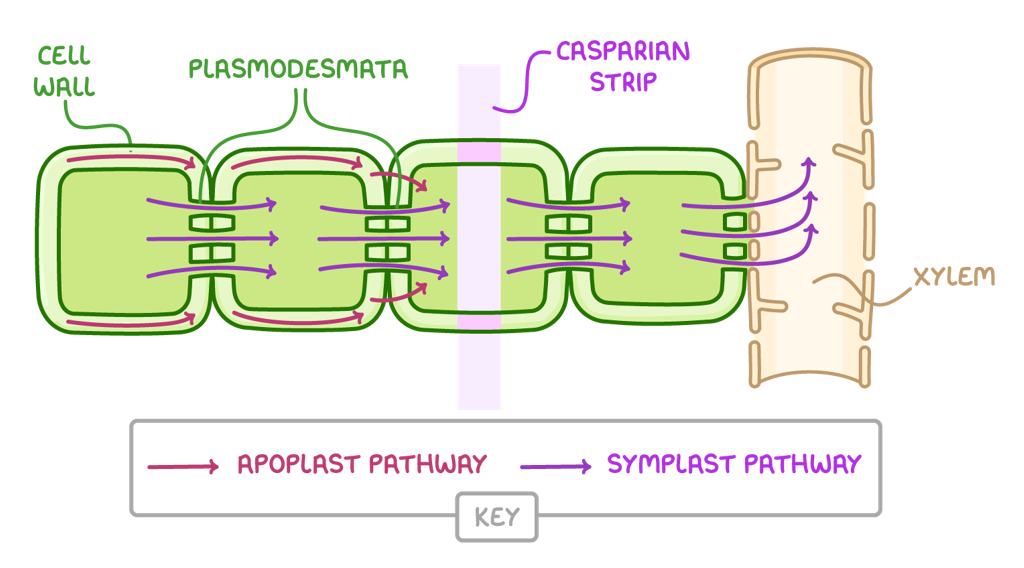
Outline the apoplast pathway
The cells walls are very thick & open, so water can diffuse down a water potential gradient → there are no cell membranes to cross, so this is diffusion not osmosis
The apoplast pathway stops at the endodermis due to the water-proof Casparian strip, which seals cell walls
Water has to cross the cell membrane by osmosis & enter the symplast pathway → this allows the plant some control over the uptake of water into xylem

How does root pressure affect water movement?
The root pressure is the force that is produced by the uptake of water by osmosis that pushes water up the xylem:
high mineral content gives the root a low water potential, meaning there is strong osmotic flow into the roots
this creates a weak push effect, moving water from the roots into the stem
What is the driving force for mass flow in the xylem?
Transpiration in the leaves:
causes low pressure in the xylem vessels, so water is sucked up the stem to replace the lost water
column of water in the xylem is under tension, but due to high tensile strength (cohesion), the water column does not break
Explain the cohesion-tension mechanism
Water molecules form hydrogen bonds with each other, causing them to ‘stick’ together (cohesion) → the surface tension of the water also creates this sticking effect
Therefore, as water is lost through transpiration, more can be drawn up the stem from the roots

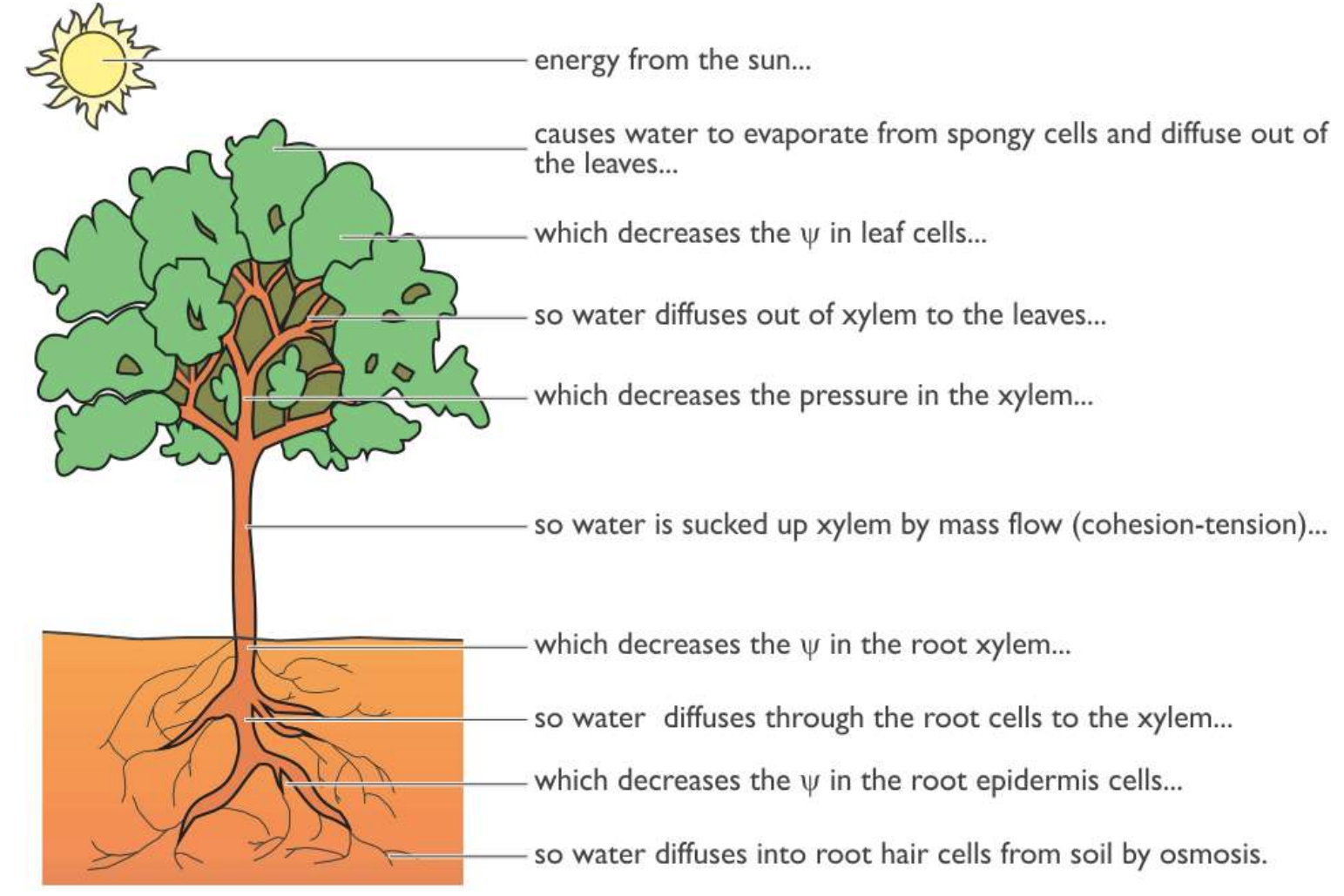
Outline the mechanism of water movement in plants
Energy from the sun causes water to evaporate from the spongy mesophyll cells & diffuse out the leaves by the stomata
This decreases the water potential in leaf cells, so water diffuses out of xylem into the leaves
This decreases the pressure in the xylem, so water is sucked up the xylem by mass flow (cohesion-tension)
This decreases the water potential in the root xylem, so water diffuses through root hair cells into the xylem
This decreases the water potential in the root epidermis cells, so water diffuses into root hair cells from soil by osmosis
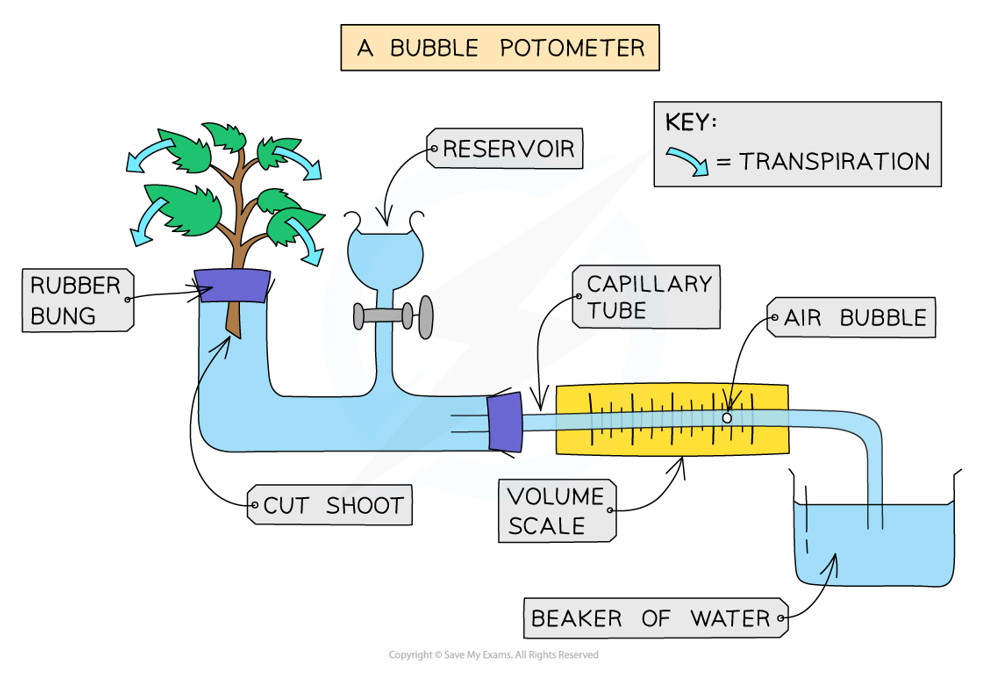
What can the rate of transpiration be measured with?
A potometer (measures the rate of water uptake by the cut stem)
How does temperature affect the rate of transpiration?
Increases rate of transpiration:
an increase in temperature, increases the kinetic energy & speed of movement of water molecules
water evaporates more rapidly from cells within leaf & diffuse more quickly through stomata
How does humidity affect the rate of transpiration?
Decreases rate of transpiration:
humidity affects the water potential gradient between the air spaces within the leaf & the air outside the leaf
when the air outside the leaf is very humid, the water potential gradient decreases
How does air movement/wind speed affect the rate of transpiration?
Increases rate of transpiration:
windy conditions will disperse water vapour at the leaf’s surface, which decreases humidity & so, increases the water potential gradient
How does light affect the rate of transpiration?
Increases the rate of transpiration:
light stimulates plants to open their stomata for the diffusion of carbon dioxide for photosynthesis
also means when stomata are open, water molecules diffuse from air spaces within the leaf, through the open stomata & into the atmosphere
What is the role of:
nitrate ions
phosphate ions
magnesium ions
calcium ions
Nitrate ions: makes DNA & amino acids
Phosphate ions: makes phospholipids, nucleic acids & ATP
Magnesium ions: makes chlorophyll
Calcium ions: makes calcium pectate for the middle lamellae of cell walls
What is translocation?
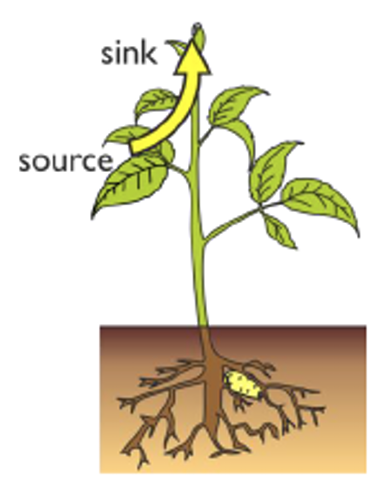
The mass flow of assimilates from the source to the sink
What is the mass flow hypothesis?
The theory that explains the movement of water & solutes from a high to low concentration across a selectively permeable membrane
Outline the mechanism of translocation (mass-flow theory)
(whole process is an example of indirect active transport)
H+ ions are actively transported out of the companion cells, into the adjacent source cells (e.g. palisade cell) in which the sucrose is made
This creates a H+ ion concentration gradient (higher concentration of H+ ions in source cell, then in the adjacent companion cell)
The H+ ions diffuse down their concentration gradient, back into the companion cell, through a co-transport protein
This carrier also pulls sucrose into the companion cell. Sucrose now passes into the neighbouring sieve tube elements by facilitated diffusion → sucrose has been ‘loaded’

What is the evidence for the mass flow hypothesis?
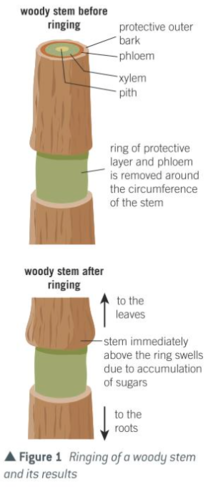
If a ring of bark is removed from a woody stem (with phloem, not xylem), a bulge forms above the ring, which has a higher concentration of sugars than the fluid below the ring → evidence there’s a downward flow of sugars
A radioactive tracer (e.g. 14C) can be used to track the movement of organic substances in a plant
Pressure in the phloem can be investigated using aphids (pierce the phloem, allowing sap to flow out). The sap flows out quicker nearer the leaves than further down the stem → evidence there’s a pressure gradient
If a metabolic inhibitor (stops ATP production) is put into the phloem, translocation stops → evidence that active transport is involved
What is the evidence against the mass flow hypothesis?
Sugar travels to many different sinks, not just to one with the highest water potential, as the model would suggest
The sieve plates would create a barrier to mass flow → a lot of pressure would be needed for the solutes to get through at a reasonable rate
When are the leaves a source & the roots a sink?
During the summer → sugar is mostly transported from the leaves, where it is made by photosynthesis (source) to the roots, where it is stored (sink)
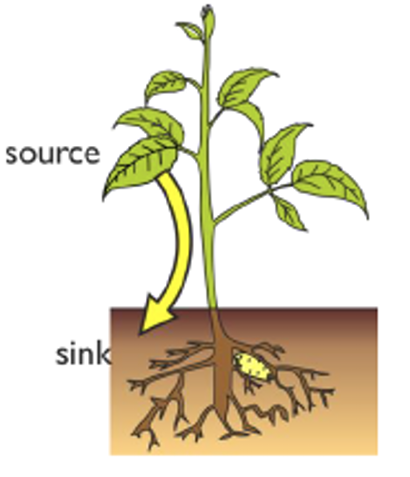
What are the leaves are sink & the roots a source?
During the spring → sugar is transported from the underground root store (source) to the growing leaf buds (sink)
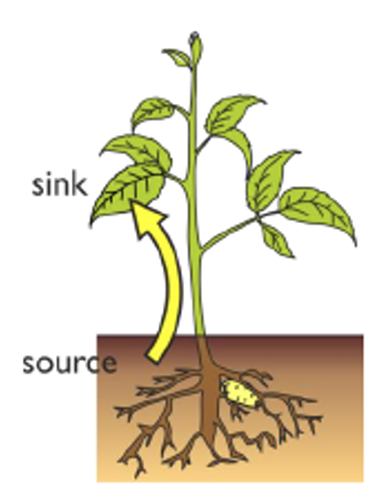
What are the leaves & roots both sources?
Flowers & young buds aren’t photosynthetic, so sugars can also be transported from leaves or roots (source) to flowers or buds (sink)