Foundations of Analysis Exam #1
 Studied by 36 people
 Call Kai
 Learn
Learn Practice Test
 Spaced Repetition
 Match
Match Flashcards
 Knowt Play
1/57

There's no tags or description
Looks like no tags are added yet.
Name | Mastery | Learn | Test | Matching | Spaced | Call with Kai |
|---|
No analytics yet
Send a link to your students to track their progress
58 Terms
Supremum
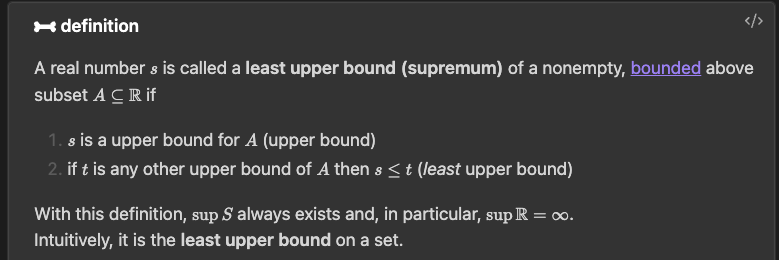
Axiom of Completeness

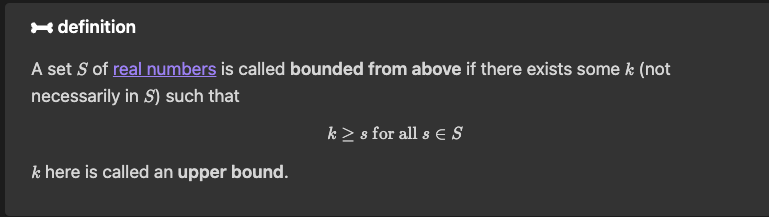
Bounded
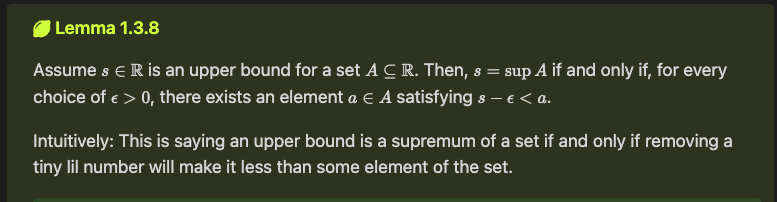
Lemma 1.3.8 (Supremum Lemma)
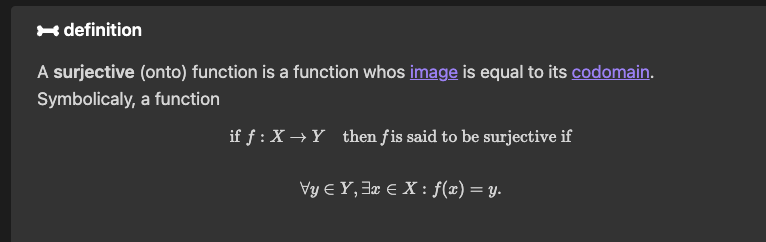
Surjective
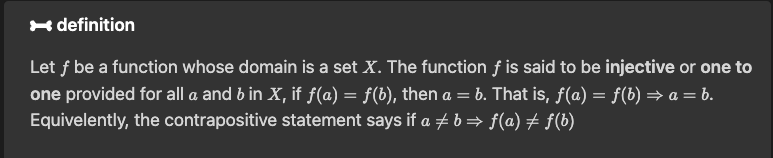
Injective
Squeeze Theorem

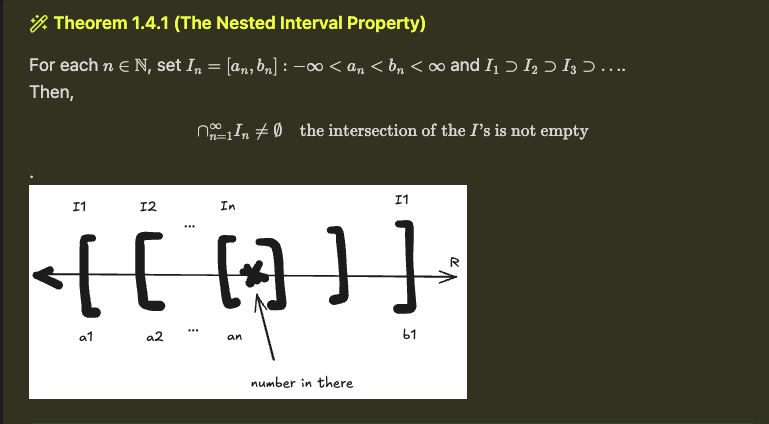
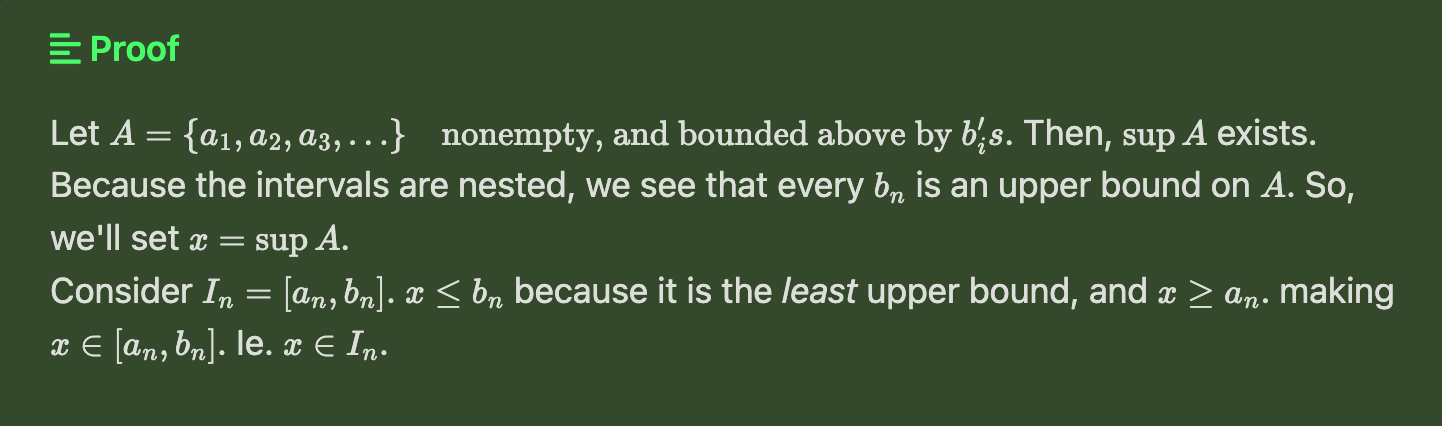
Theorem 1.4.1 (Nested Interval Property)
Sequence

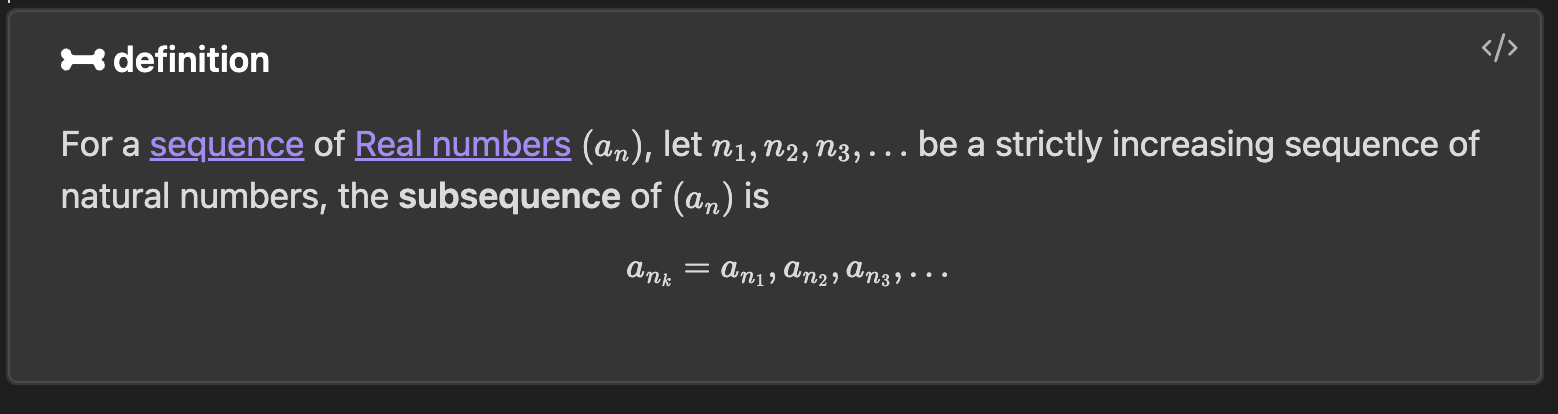
Subsequence
Theorem 2.5.2 (Convergence of Subsequences)

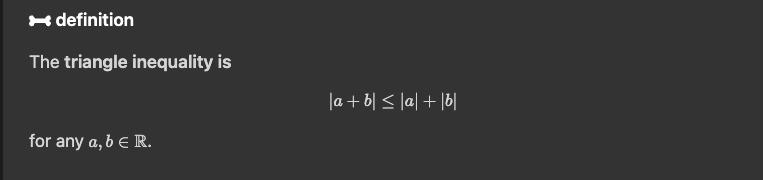
Triangle Inequality
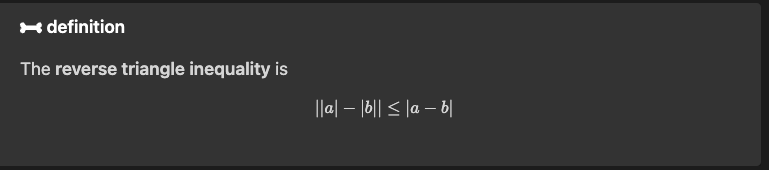
Reverse Triangle Inequality
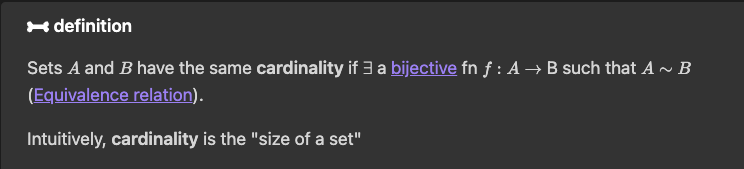
Cardinality
Theorem 1.5.6 (Countability of R)
R is uncountable lol
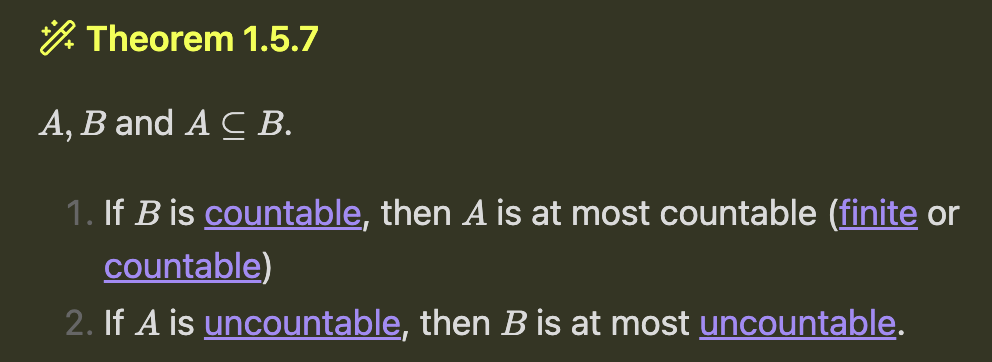
Theorem 1.5.7 (Countability of subsets)
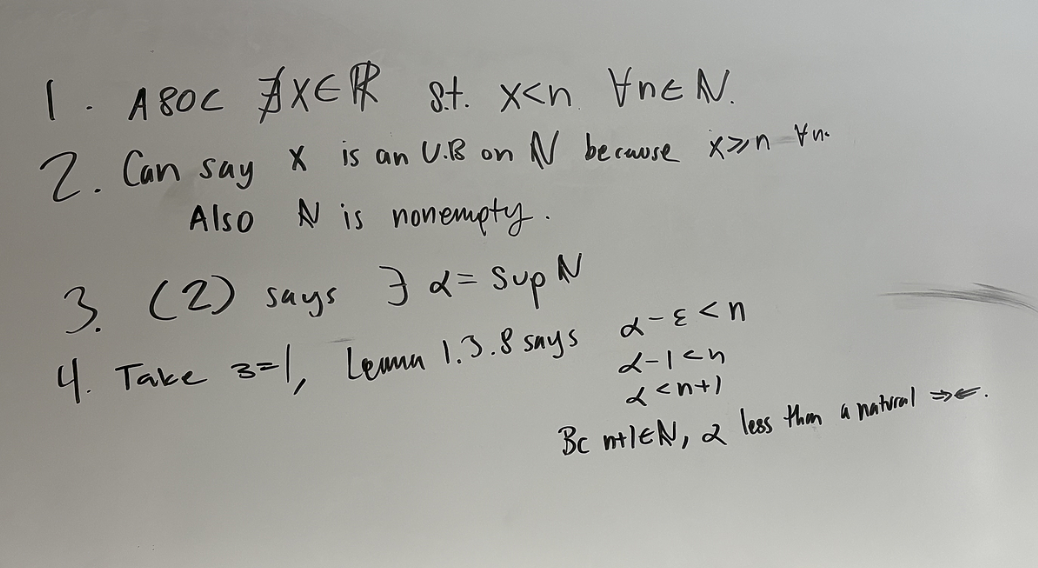
Archimedean Property #1

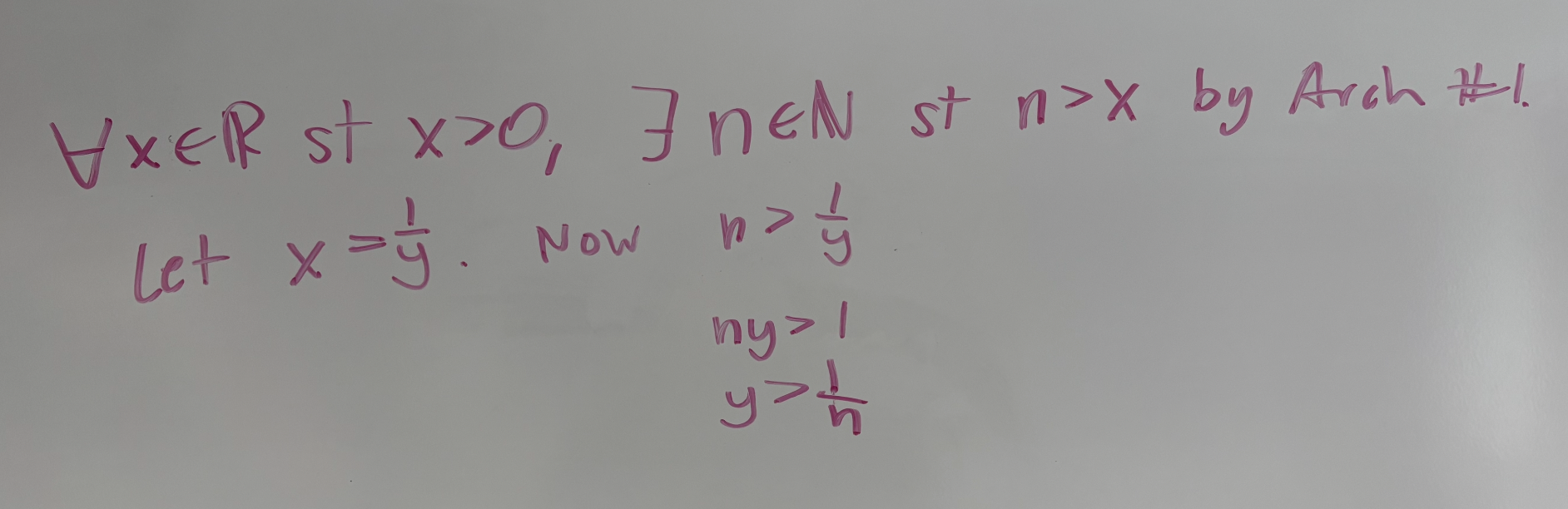
Archimedean Property #2

Countable

uncountable

Theorem 1.5.8 (Unions of countable sets)

Monotone
A sequence is monotone if it is strictly non-decreasing or non-increasing
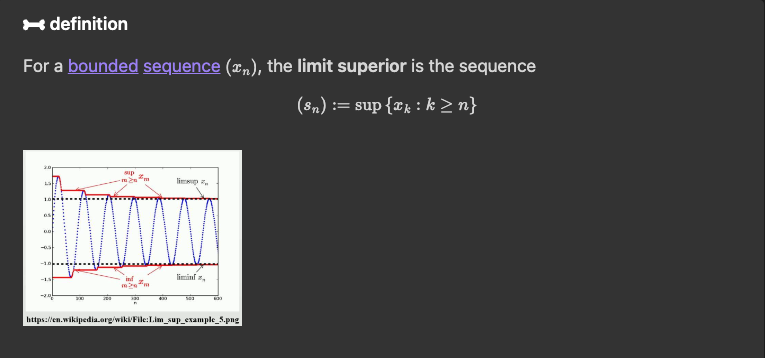
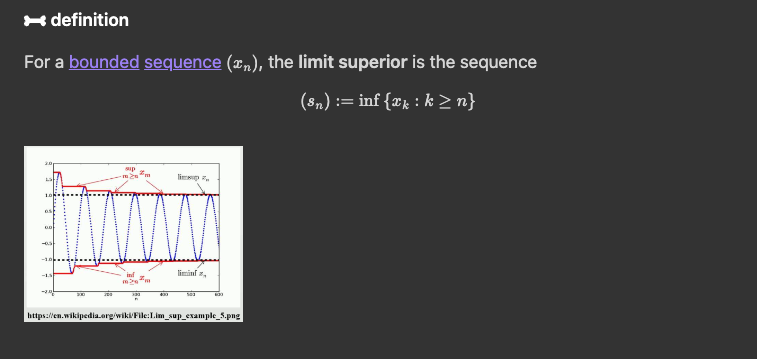
Limit Superior
Limit inferior
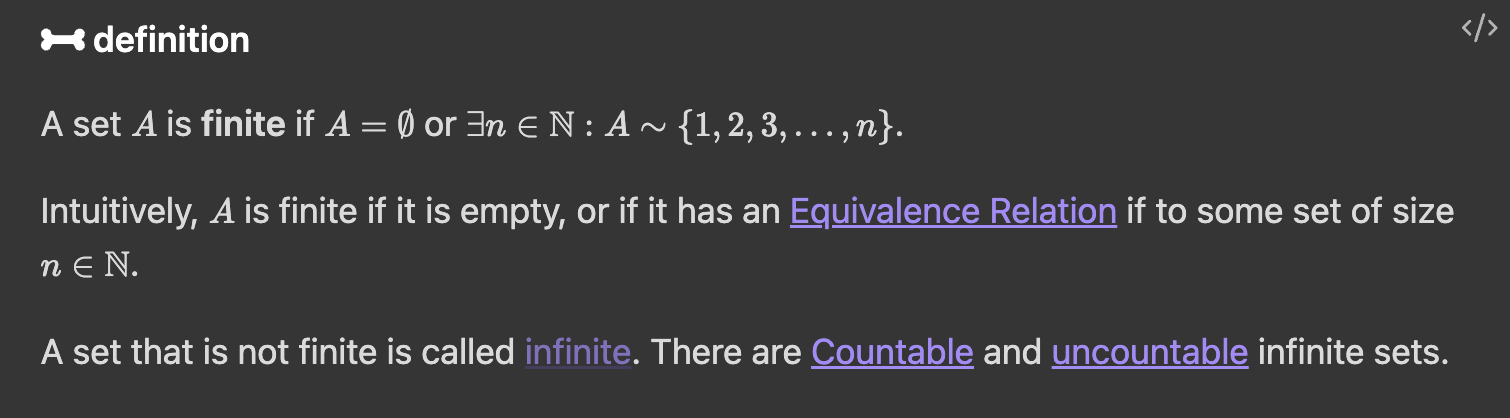
Finite
Cauchy

Theorem 2.6.2 (Cauchy sequences’ convergence)

Lemma 2.6.3 (Boundedness of Cauchy Sequences)

Theorem 2.6.4 (Convergent sequences’ Cauchy-ness)

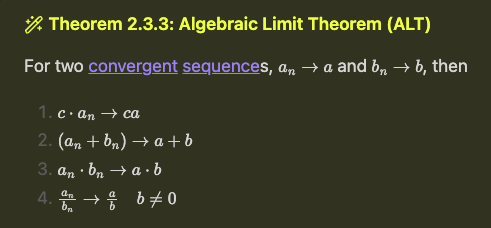
the 4 Algebraic Limit Theorems (2.3.3)
Theorem 1.5.6.1 (Countability of Q)
Q is countable
Theorem 2.5.3 (Bolzano Weierstrauss Theorem)

Theorem 2.3.2 (Boundedness of convergent sequences)
Every convergent sequence is bounded. The converse is not true.
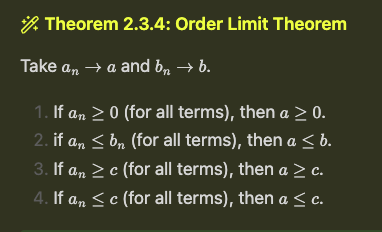
Theorem 2.3.4 (Order Limit Theorem)
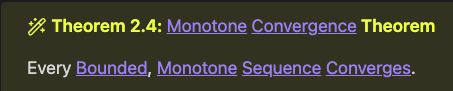
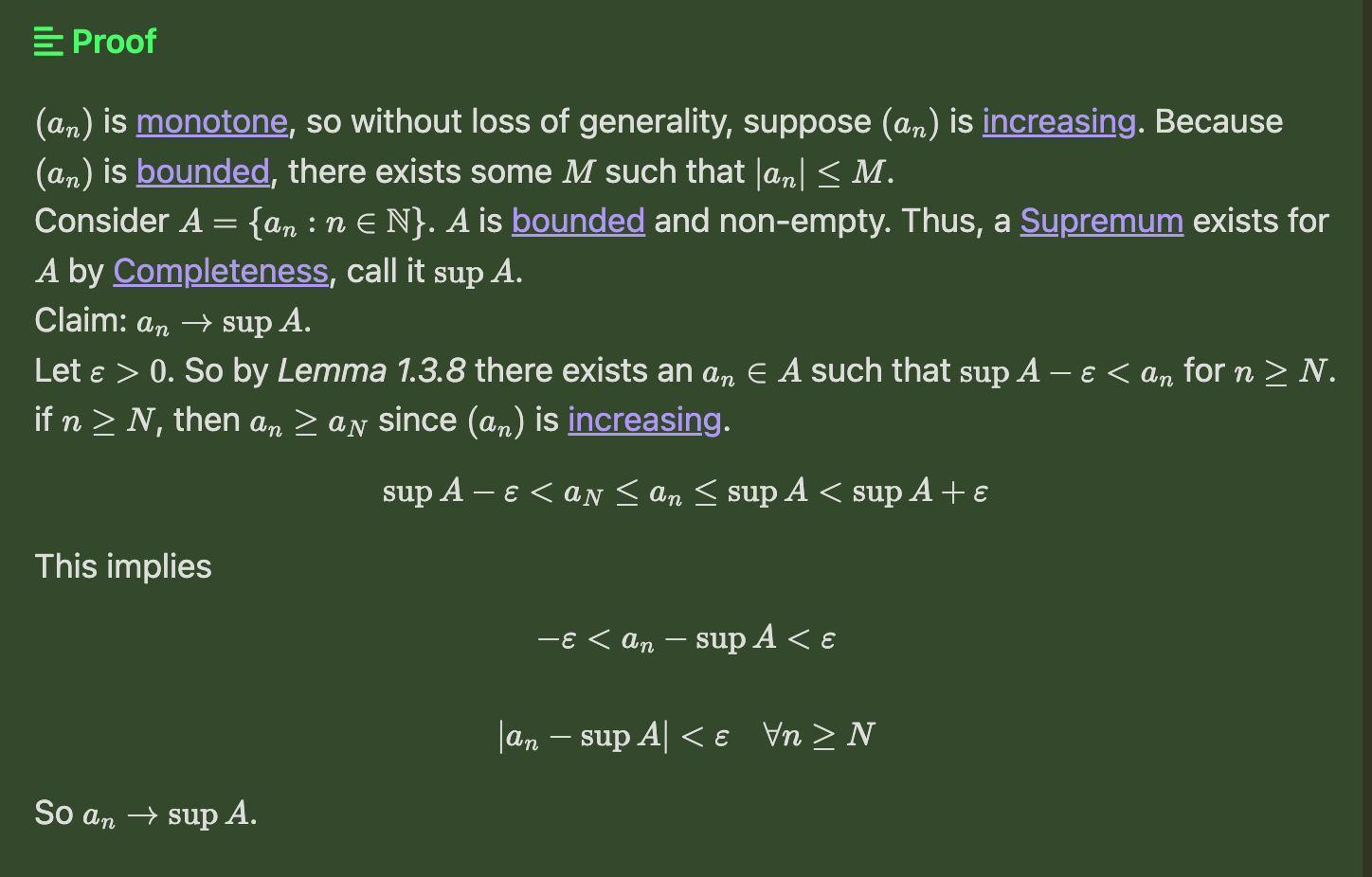
Theorem 2.4 (Monotone Convergence Theorem)
Upper Bound

Equivalence Relation
Two sets are equivalent if they have the same cardinality.
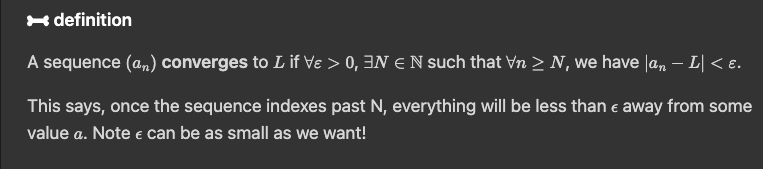
Convergent
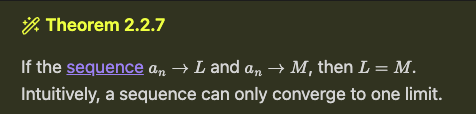
Theorem 2.2.7 (Sequences have one limit)
Integer Spacing Lemma

Corollary 1.4.4 (existence of irrationals)

HW#1 Problem #6 (Supremum in the set)
If a is an upper bound for A, and a in A, then a = sup A.
HW#1 Problem #5 (Supremum of a subset)
For nonempty, bounded above, A,B in R with B subseteq A. Then, supB <= supA
HW#2 problem #2 (supremum of unions)

HW#2 Problem #6 (Supremum of sets of integers)

HW#3 Problem #1 (supremum of nonempty, finite sets)

HW #3 #2 (infimum of {1/n}?)

HW#6 Problem #6: intersection of [0,1] and (a, 1)

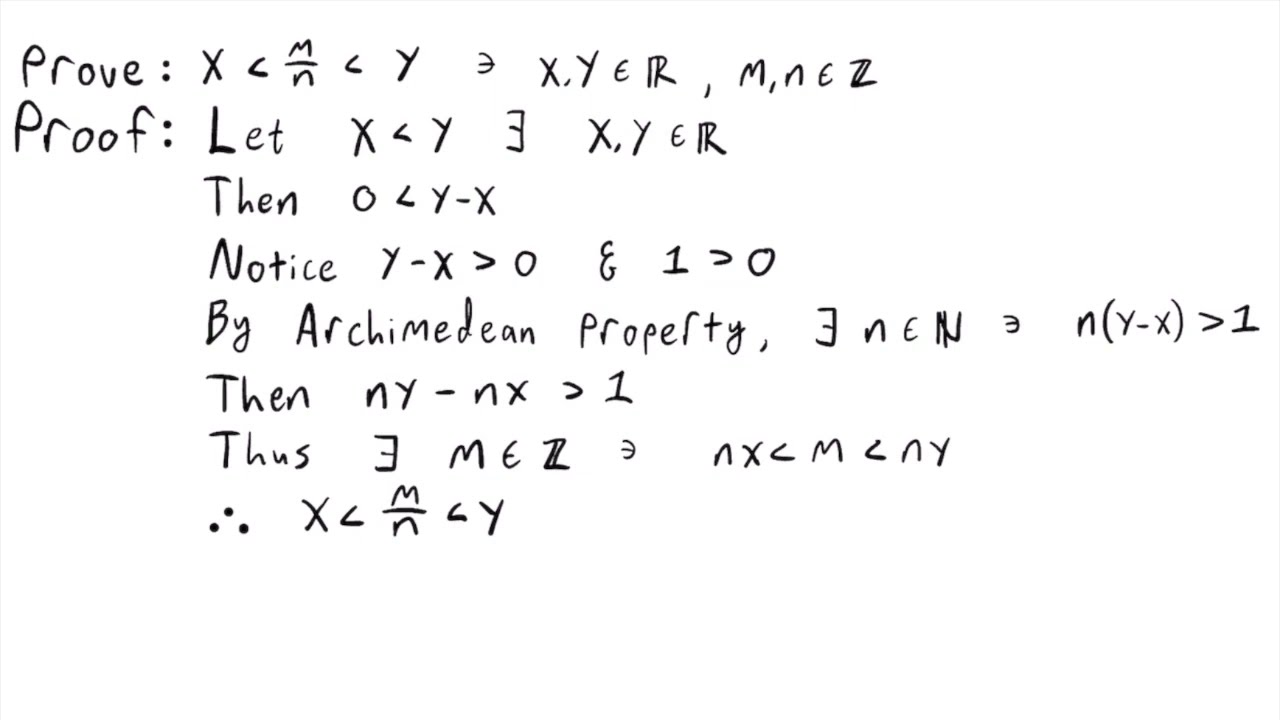
Proof of Density of Rationals in the Reals
Proof of Archimedean #1
Proof of Archimedean #2
Proof of Nested Interval Property
Proof of Monotone Convergence Theorem
If a monotone sequence has a convergent subsequence, then _____
The sequence is convergent.
Strategy for solving a sequence built from a recurrence relation.
Show the sequence is convergnt (Use MCT, Cauchy-ness, Monotone with a convergent subsequence,
Use the recurrence relation and set s_n=s_{n-1}=s and solve for s.
Proof that R is uncountable
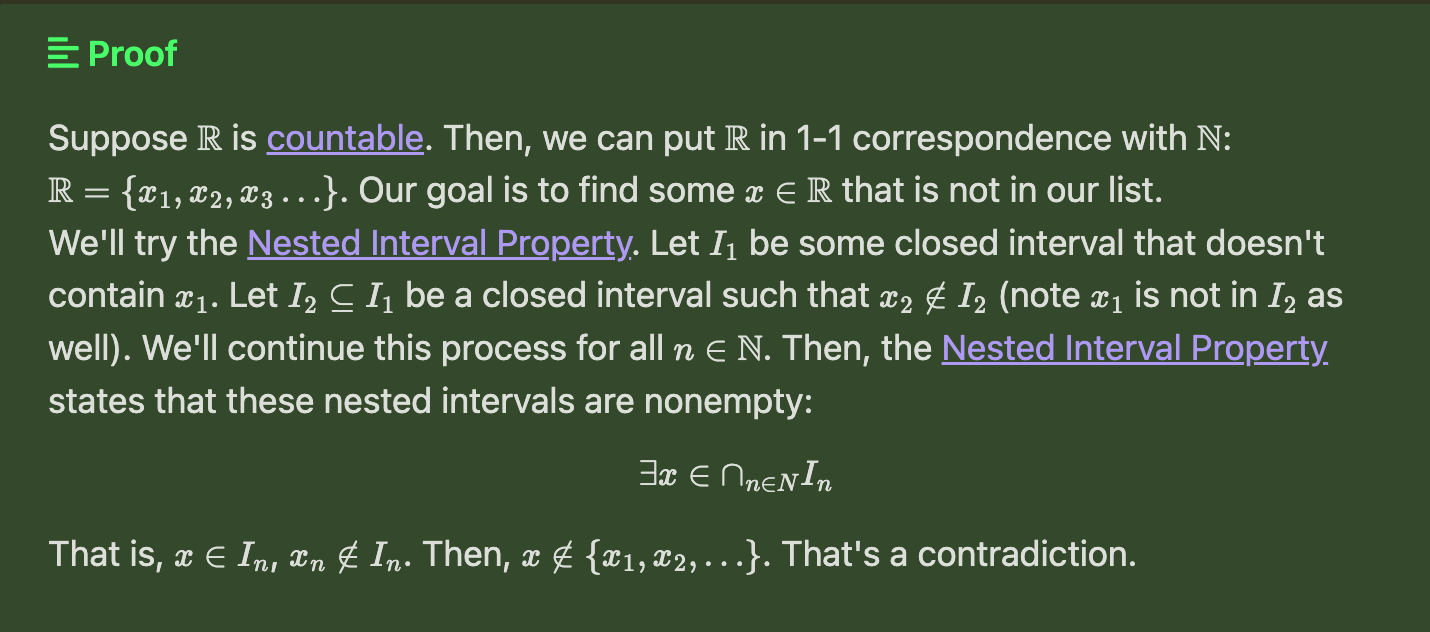
It is also sufficient to show that (0,1) is uncountable as it is a subset of R.
Proof that a countable number of unions of countable sets is countable.
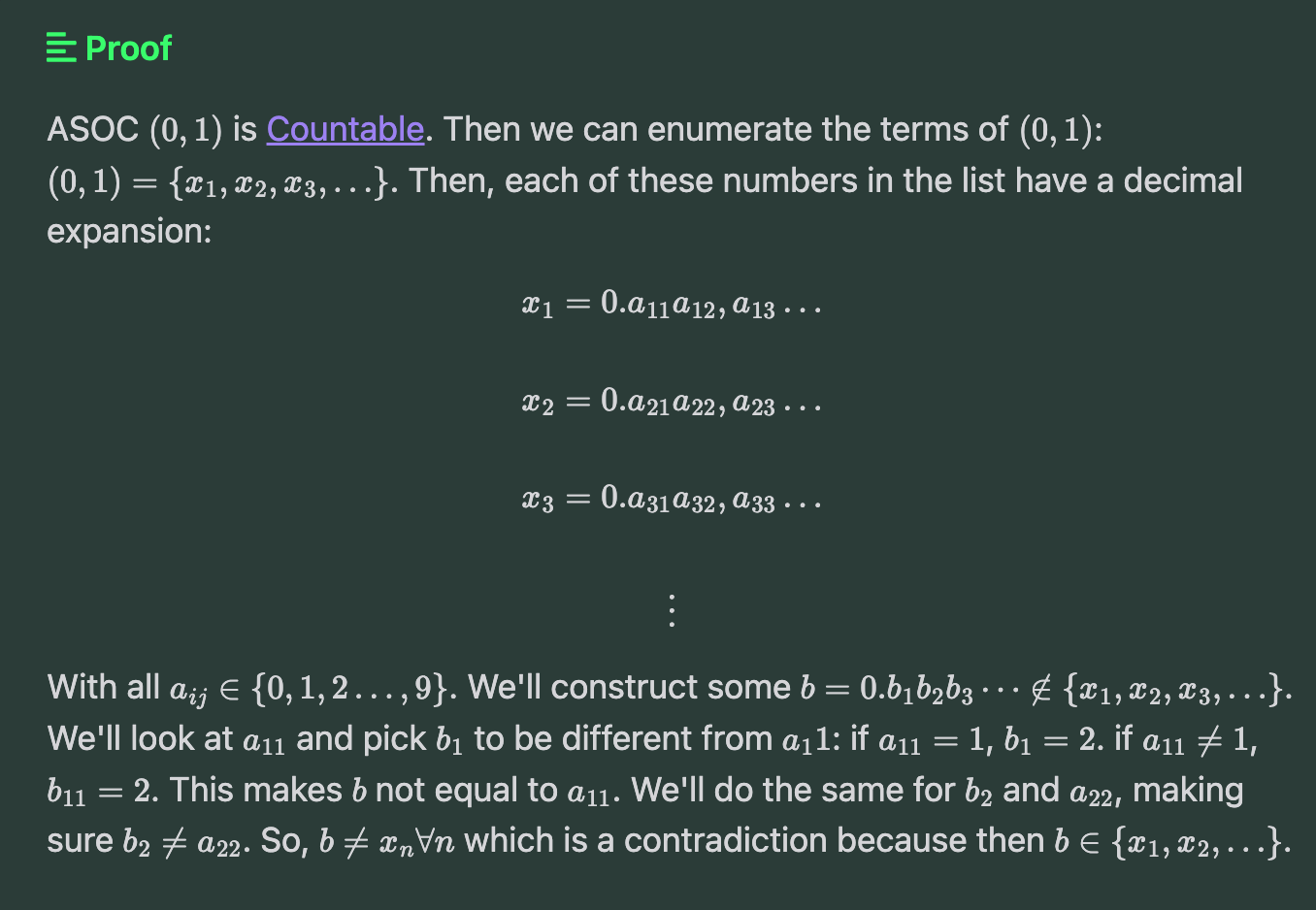
Prove (0,1) is uncountable.
 Note
Note  Flashcards (500)