phys exam 1
 Call Kai
 Learn
Learn Practice Test
 Spaced Repetition
 Match
Match Flashcards
 Knowt Play
1/57

There's no tags or description
Looks like no tags are added yet.
Name | Mastery | Learn | Test | Matching | Spaced | Call with Kai | Chat |
|---|
No analytics yet
Send a link to your students to track their progress
58 Terms
paracellular
what is it and what is it limited by
diffusion between adjacent epithelial cells
limited by TIGHT JUNCTIONS
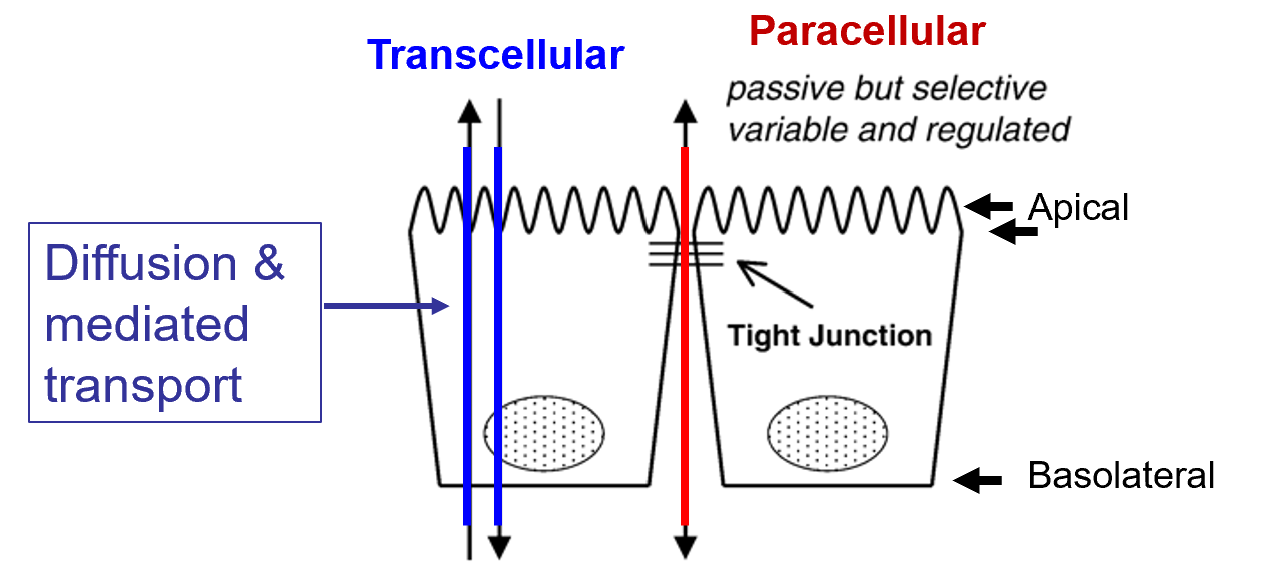
where is tight junctions located in epithelial cells
apical membrane
transcellular
movement through the apical or basolateral membrane
diffuse across cytosol and exit opposite side

which membrane of the epithelial cell has the Na+/K+ pump
basolateral membrane
which membrane of the epithelial cell has Na+ channel for diffusion?
apical membrane
e.g. Na+ reabsorption from nephron back into blood
explain reabsorption of glucose in kidney
Na+/K+ pump on basolateral membrane establish Na+ gradient (low in epithelial cell relative to blood AND lumen
the Na gradient enables SGLT to do active transport of glucose (cotransport with Na+) to get glucose and Na+ into the epithelial cell
glucose then enters blood through facilitated diffusion

where is aquaporin located on epithelial cells
apical membrane
transepithelial osmosis
water moving by osmosis across an entire layer of epithelial cells
through aquaporins and paracellular pathway (tight junctions)
e.g. if kidney reabsorb Na+, it will also reabsorb water
where does energy for secondary active transport come from?
from electrochemical gradient, but it is still established by Na+/K+ pump that uses ATP
rate of mediated transport depends on
solute concentration
affinity of transporter
number of transporter
rate of conformational change
hyponatremia
could be caused by__ and can lead to __
decreased plasma Na+
could be caused by water intoxication (too much water intake e.g. marathon)
cause ECF to be hypotonic, brain swell
hypernatremia
could be caused by__ and can lead to __
increased plasma Na+
caused by water loss e.g. dehydration, excessive sweat, excessive salt intake
ECF becomes hypertonic → cell shrink
electrochemical gradient
diffusional gradient + electrical gradient
Fick’s Law
rate of diffusion = (diffusion coefficient x conc gradient x surface area)/distance
where are intracellular receptors located
cytoplasm or nucleus
intracellular receptors is faster/slower than membrane receptors? why?
slower bc they need time for protein synthesis
down regulation of receptor
decreased receptor number when exposed to high conc of messenger
up regulation of receptor
increased receptor number in response to low messenger conc
loss of function of receptor
receptor doesn’t respond to messengers in a normal way
gain of function of receptors
receptors may have overactive response to ligand or act even without binding
what kind of ligand/messenger bind to intracellular receptors
nonpolar messengers like thyroid hormone and steroids
cortisol
aldosterone
testosterone
which type of receptor does insulin have
receptor that has tyrosine kinase enzyme
which type of receptor does cytokines have
cytoplasmic kinases → janus kinase
2 important effector protein in G-protein coupled receptor
adenylyl cyclase → turns cytosolic ATP into cAMP
phospholipades C
how is cAMP action terminated/concentration lowered
phosphodiesterase enzyme terminates its action
inhibitory G protein receptor also inhibit adenylyl cyclase and lower cAMP level
how does beta 1 receptor work
G protein receptor
epinephrine binds to the G protein receptor (beta 1)
adenylyl cyclase makes cAMP
cAMP activates protein kinase
protein kinase cause more Ca2+ to be available for heart contraction
stronger heart contraction
heart also relaxes faster
how does ADH increase water reabsorption in kidney
when ECF osmolarity is high/blood volume low → ADH secreted and bind to G protein receptor → activate adenylyl cyclase → makes cAMP → cAMP activates protein kinases → phosphorylate proteins → increase insertion of aquaporins → increase water reabsorption
how does digitalis work
usually Ca2+ goes out of the cell by secondary active transport (relies on Na+/K+ pump and then Na+/Ca2+ countertransport)
blocks Na+/K+ pump
increase intracellular Na+ bc usually 3 Na+ go out but now they can’t
reduce function of Na+/Ca2+ secondary transporter
Ca2+ accumulate inside the cell
Ca/ATPase pump move Ca2+ into SR
more Ca2+ released from SR after action potential
increase cardiac force
what is Ca2+ ATPase
primary active transport
move Ca2+ from cytosol to extracellular or into organelles
hypokalemia
concentration of K+ outside of cell is low
Nernst equation
Ek=-60 log [K+]i/[K+]o
what happens is extracellular K conc is high
cell becomes more excitable - cardiac arrhythmias and death
how does aldosterone work
ECF K+ is high
aldosterone is produced
aldosterone act on kidney to increase K+ secretion in urine
what’s the point of bulk flow (fluid exchange) between capillary and interstitial fluid
bring glucose and O2 from capillaries to IF and then cells
how can arterial diameter affect filtration
vasodilation - increase filtration (less resistance → less pressure dropped)
vasoconstriction - decrease filtration
facilitated diffusion vs ligand gated channels
for ligand gated, the ligand bind to the receptor and changes its shape, allowing the solute to go in
for facilitated diffusion, the solute binds to the receptor, changes its shape and then goes in
what linkage between cells for tissue
desmosomes and tight junctions
what linkage between cells form communication
gap junction - linking the cytosol
what is desmosomes made of
intermediate filaments
important example of tight junction
blood brain barrier
intestinal cell
what do peroxisomes do
use O2 to remove H+ from organic molecules
reaction can form hydrogen peroxide, which is cytotoxic but is destroyed by peroxisomes
protein subunit of microtubule
tubulin
cilia and flagella are made of
microtubule
ribosomes are produced and assembled in
nucleolus
amino acids are made of
carboxyl group (cooh) + amino group (nh2) + side chain
affinity of hemoglobin is inversely proportional to
temperature, DPG, acidity, and CO2
all increase during exercise - reduce affinity of O2 binding and promote O2 unloading at tissue
saturation of a ligand depends on
concentration
affinity
competition of ligand depends on
relative concentration and affinity
cellular metabolism can be regulated by altering
enzyme concentration
enzyme activity
substrate concentration
ATP hydrolysis equation
ATP + H2O → ADP + Pi + H+ + energy
end product of glycolysis + krebs cycle + etc
34-38 ATP + 6CO2 + 6H2O
respiratory vs metabolic acidosis/alkalosis
respiratory depends on CO2, metabolic depends on H+
glycogenolysis
breakdown of glycogen in liver and muscle to glucose
lipolysis
triglycerides in adipose tissue break down into fatty acids and glycerol
glucose sparing
body use fat for energy
produce ketone from fatty acids to provide energy for tissues including brain
use fatty acids to produce ATP to provide energy for most tissues except brain
explain how G-protein pathway works (adenylyl cyclase)
ligand bind to receptor, change shape → activate G-protein
increase G-protein alpha subunit affinity for GTP (replace GDP with GTP) → alpha subunit+GTP dissociate from beta/gamma subunit]
alpha subunit activates effector protein (e.g. adenylyl cyclase) → GTP becomes GDP and Pi
adenylyl cyclase turns cytosolic ATP into cAMP
cAMP act as second messenger to activate protein kinase
protein kinase phosphorylates a lot of enzymes
action of cAMP is terminated by
phosphodiesterase
how does phospholipase C work
ligand binds to receptor, change shape
increase affinity for alpha subunit…
alpha subunit activates effector protein (phospholipase C)
phospholipase C converts PIP2 into second messengers IP3 and DAG
IP3 acts as a ligand on ER Ca2+ channels
DAG activates protein kinase C