Chapter 3 - Anatomical Kinesiology
 Call Kai
 Learn
Learn Practice Test
 Spaced Repetition
 Match
Match Flashcards
 Knowt Play
1/48

There's no tags or description
Looks like no tags are added yet.
Name | Mastery | Learn | Test | Matching | Spaced | Call with Kai | Chat |
|---|
No analytics yet
Send a link to your students to track their progress
49 Terms
What is biomechanics?
Biomechanics = study of mechanics as it relates to the functional and anatomical analysis of biological systems, especially humans.
What is mechanics, and what are its two divisions?
Mechanics = study of the physical actions of forces.
Two divisions:
Statics
Dynamics
What is the difference between statics and dynamics?
Statics
No acceleration
At rest OR moving at constant velocity
Forces are balanced
Body is in equilibrium
Dynamics
Movement with acceleration
Forces are unbalanced/unequal
Does statics always mean the body is motionless?
No.
Statics includes:
Body at rest
Body moving at constant velocity without acceleration
Key: No acceleration + balanced forces
What is the difference between kinematics and kinetics?
Kinematics = description of motion
Time
Displacement
Velocity
Acceleration
Space
Kinetics = study of forces associated with motion
Kinematics = motion
Kinetics = forces
Types of Machines + Mechanical Advantage…
What is mechanical advantage?
Mechanical advantage = Load ÷ Effort
Allows a relatively small effort to move a greater resistance, or a small movement to produce a larger movement elsewhere.
What are the 4 functions of machines in the musculoskeletal system?
Balance forces
Enhance force / reduce force required
Enhance ROM and speed
Change direction of force
What 3 types of machines are found in the musculoskeletal system?
Levers — most common
Wheel and axles
Pulleys
Not found: inclined planes, screws, wedges.
levers…
What is a lever?
A rigid bar that rotates around an axis/fulcrum.
In the body:
Bones = levers
Joints = axes
Muscles = apply force
What are the 3 components of a lever?
A = Axis → point of rotation
F = Force → effort, usually at muscle insertion
R = Resistance → load being moved
How are the 3 classes of levers arranged?
1st = FAR → Axis in middle
2nd = ARF → Resistance in middle
3rd = AFR → Force in middle

First- Class Levers…
How does axis position affect a 1st-class lever?
Axis midway → balance; MA = 1
Axis closer to force → speed/ROM; MA < 1
Axis closer to resistance → force; MA > 1
What does the mechanical advantage value tell you?
MA = 1 → effort = resistance
MA < 1 → effort > resistance
MA > 1 → effort < resistance
What is the lever arrangement during triceps elbow extension?
1st-class lever
A = elbow
F = triceps insertion on olecranon
R = unsupported forearm
How does triceps elbow extension change during a push-up?
Normally → 1st-class lever
Hand fixed on floor during push-up → 2nd-class lever
What characterizes a 2nd-class lever?
Resistance is in the middle (resistance is closer to the axis of rotation so this is why it produces force movements).
A–R–F
Produces force movements
MA > 1 → effort < load
What is the classic 2nd-class lever example in the human body?
Rising onto the toes
A = ball of foot
R = body weight at tibiofibular articulation with talus
F = plantar flexors pulling on calcaneus
Are 2nd-class levers common in the human body?
No. Relatively few 2nd-class levers occur in the body.
What characterizes a 3rd-class lever?
Force is in the middle
A–F–R
Favors speed + ROM
MA < 1 → effort > load
Most common lever in the body
During biceps elbow flexion, what are A, F, and R?
A = elbow joint
F = biceps insertion at radial tuberosity
R = forearm resistance at its center of gravity
→ 3rd-class lever

Why is the brachialis considered a “true” 3rd-class lever?
It pulls directly on the ulna below the elbow, and the ulna cannot rotate.
What are examples of 3rd-class levers in the body?
Biceps/brachialis → elbow flexion
Hamstrings → knee flexion while standing
Iliopsoas → hip flexion

When classifying a muscle as part of a lever system, do you use the location of the muscle belly or its insertion?
Use the muscle insertion, NOT the muscle belly.
The muscle belly may be on one side of the joint, but force is applied where the muscle inserts on the bone.
Example: Hamstrings
Muscle belly = posterior thigh
Insertion = below the knee
The insertion is where F (force) is located.
Think: Where do the hamstrings PULL the lower leg? → at their insertion below the knee → that is where F goes.
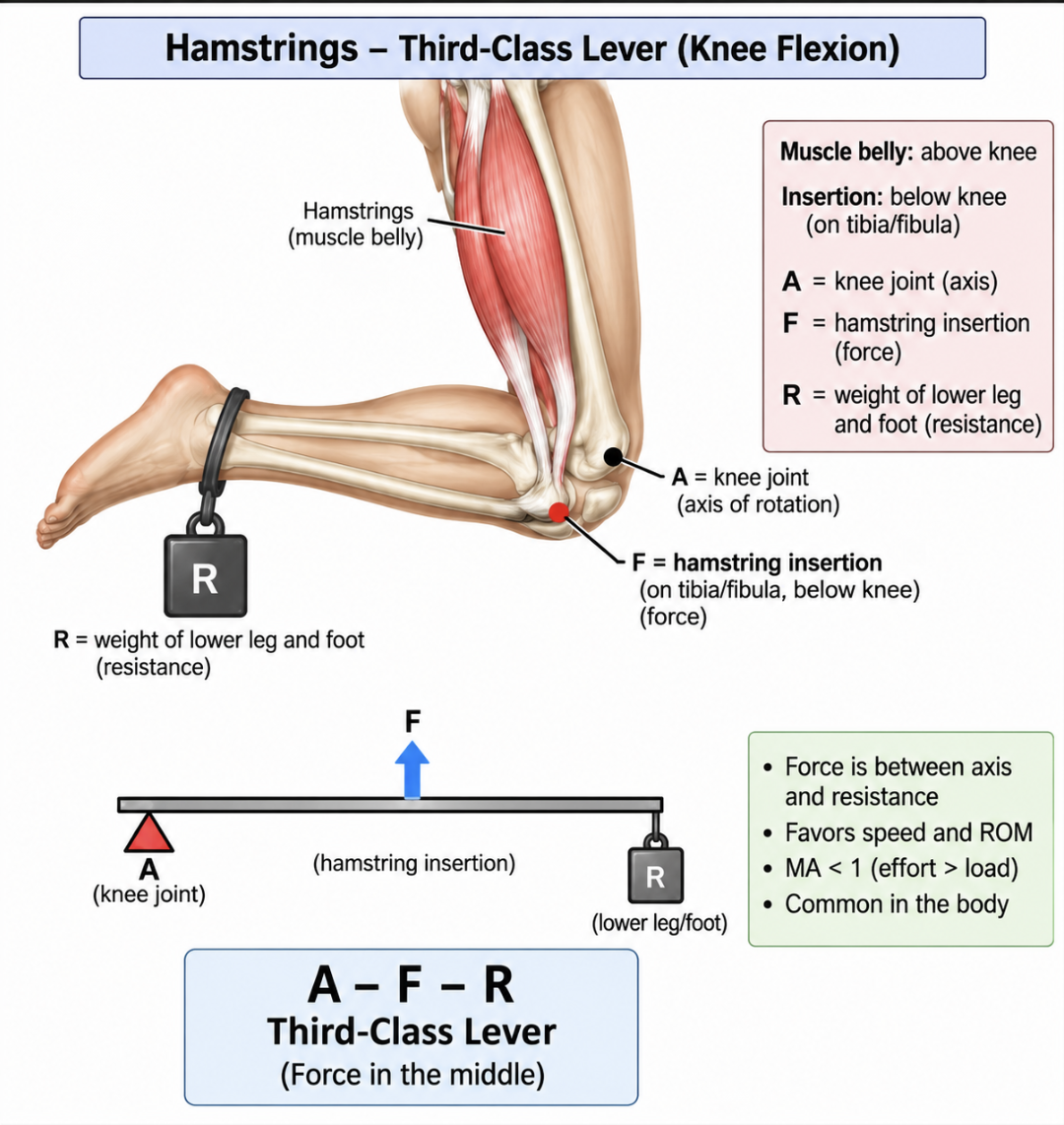
Why is the brachialis considered a true/direct 3rd-class lever compared with the biceps brachii?
Brachialis: inserts on ulna, which cannot rotate → direct elbow flexion.
Biceps brachii: produces elbow flexion + forearm supination.
→ Its 3rd-class leverage applies specifically to its elbow flexion function.
Torque, Force Arm + Resistance Arm…
What is torque?
Torque = turning effect of an eccentric force.
T = Force × Force arm
What does eccentric force mean when discussing torque?
Force applied off-center/not in line with the center of rotation.
It does NOT mean eccentric muscle contraction.
What is the force arm?
Perpendicular distance from the axis to the line of action of the force.
Also called moment arm/torque arm.
↑ Force arm → ↑ Torque
What is the resistance arm?
Distance from the axis to the point where resistance is applied.
How can you distinguish force arm from resistance arm?
Force arm = Axis → Force
Resistance arm = Axis → Resistance
Force Arm, Resistance Arm + Mechanical Advantage…
This is what I would really know for the exam:
↑ Force arm → ↑ torque → ↓ force needed
↑ Resistance arm → ↑ force needed
Resistance closer to axis → easier
Force farther from axis → easier
Force closer to axis → more speed/ROM, but requires more force
How does changing the force arm affect the amount of force required?
↑ Force arm → ↓ force required
↓ Force arm → ↑ force required
How does changing the resistance arm affect the force required?
↑ Resistance arm → ↑ force required
↓ Resistance arm → ↓ force required
If resistance or the resistance arm increases, what must happen?
Need greater force and/or a longer force arm.
In a 2nd-class lever, what happens when resistance moves closer to the axis?
↑ Mechanical advantage
↓ Distance resistance moves
In a 3rd-class lever, what happens when force is applied closer to the axis?
↑ Speed and ROM
But more force is required.
In a 3rd-class lever, what happens when force is applied closer to the resistance?
Less force is required.
What equation is used to determine the force required in the biceps curl examples?
Force × Force Arm = Resistance × Resistance Arm
What happens to force required when the force arm increases?
↑ Force arm → ↓ Force required
Example:
Force arm 0.10 → 0.15 m
Force required 112.5 → 75 N
This produced the greatest decrease in force required in the examples.
What happens to force required when the resistance arm decreases?
↓ Resistance arm → ↓ Force required
Example:
Resistance arm 0.25 → 0.20 m
Force required 112.5 → 90 N
What happens to force required when the resistance/load decreases?
↓ Resistance → ↓ Force required
Example:
Resistance 45 → 44 N
Force required 112.5 → 110 N
Most important comparison:
Increasing the force arm had the greatest effect on decreasing the force required in these examples.
Human Leverage/ Sport Applications…
What is human leverage generally designed to favor?
Speed and ROM at the expense of force
Short force arms + long resistance arms → greater muscular force required.
What is the advantage of a longer lever in sports?
Longer lever → greater velocity / linear force
Example: Straight-arm tennis swing → longer lever → harder hit
Also useful in baseball, hockey, golf, and field hockey.
What is the advantage of a shorter lever in sports?
Shorter lever → greater quickness
Examples:
Catcher brings hand near ear → quicker throw
Sprinter flexes knee, bringing heel toward glute → quicker leg movement