Ligand substitution and precipitation
 Call Kai
 Learn
Learn Practice Test
 Spaced Repetition
 Match
Match Flashcards
 Knowt Play
1/6

There's no tags or description
Looks like no tags are added yet.
Name | Mastery | Learn | Test | Matching | Spaced | Call with Kai | Chat |
|---|
No analytics yet
Send a link to your students to track their progress
7 Terms
What is ligand substitution
Where one ligand in a complex ion is replaced by another ligand
How does aqueous copper (II) ions occur with water
Copper (II) sulfate forms a pale blue complex ion in water [Cu(H2O)6]2+
How does ligand substitution occur with ammonia
When excess ammonia is added to [Cu(H2O)6]2+ the pale blue solution changes to form a dark blue solution
[Cu(H2O)6]2+(aq) + 4NH3 (aq) → [Cu(NH3)4(H2O)2]2+ (aq) + 4H2O (l)
In the reaction four ammonia ligands have replaced four water ligands
Both coloured solutions are octahedral complexes
![<ul><li><p>When excess ammonia is added to [Cu(H<sub>2</sub>O)<sub>6</sub>]<sup>2+ </sup>the pale blue solution changes to form a dark blue solution</p></li><li><p>[Cu(H<sub>2</sub>O)<sub>6</sub>]<sup>2+</sup><sub>(aq)</sub><sup> </sup>+ 4NH<sub>3 (aq)</sub> → [Cu(NH<sub>3</sub>)<sub>4</sub>(H<sub>2</sub>O)<sub>2</sub>]<sup>2+ </sup><sub>(aq)</sub> <sup> </sup>+ 4H<sub>2</sub>O<sub> (l)</sub></p></li><li><p>In the reaction four ammonia ligands have replaced four water ligands</p></li><li><p>Both coloured solutions are octahedral complexes</p></li></ul><p></p>](https://assets.knowt.com/user-attachments/7fdf96c6-835a-4a63-9d0e-7047f17cc58b.png)
How does ligand substitution occur with chloride ions
Conc. HCl used as source of chloride ions, and when excess is added to [Cu(H2O)6]2+ pale blue solution changes colour to form yellow solution
Six water ligands have been replaced by four chloride ligands
As chloride ligands are larger than water ligands then the complex shape formed is tetrahedral so fewer ligands can fit around the Cu2+ ion changing the co-ordination number
![<ul><li><p>Conc. HCl used as source of chloride ions, and when excess is added to [Cu(H<sub>2</sub>O)<sub>6</sub>]<sup>2+ </sup>pale blue solution changes colour to form yellow solution</p></li><li><p>Six water ligands have been replaced by four chloride ligands</p></li><li><p>As chloride ligands are larger than water ligands then the complex shape formed is tetrahedral so fewer ligands can fit around the Cu<sup>2+</sup> ion changing the co-ordination number</p></li></ul><p></p>](https://assets.knowt.com/user-attachments/a9598815-30ea-4730-b229-ace6cb36c4d2.png)
How does ligand substitution occur with chromium (III) ions
When chromium (III) potassium sulfate, KCr(SO4)2.12H2O dissolves in water, the pale purple solution formed contains complex ion [Cr(H2O)6]3+ is formed.
When chromium (III) sulfate is dissolved a green solution containing chromium (III) forms, this is the complex ion [Cr(H2O)5SO4]+ where one water ligand is replaced with sulfate ion
![<ul><li><p>When chromium (III) potassium sulfate, KCr(SO<sub>4</sub>)<sub>2</sub>.12H<sub>2</sub>O dissolves in water, the pale purple solution formed contains complex ion [Cr(H<sub>2</sub>O)<sub>6</sub>]<sup>3+</sup> is formed.</p></li><li><p>When chromium (III) sulfate is dissolved a green solution containing chromium (III) forms, this is the complex ion [Cr(H<sub>2</sub>O)<sub>5</sub>SO<sub>4</sub>]<sup>+</sup> where one water ligand is replaced with sulfate ion</p></li></ul><p></p>](https://assets.knowt.com/user-attachments/7c236f5d-e5e5-4811-a8a8-3fd043fa4308.png)
How does [Cr(H2O)6]3+ react with ammonia
When aqueous ammonia is added dropwise to the chromium (III) solution a grey precipitate of Cr(OH)3 is formed. This precipitate dissolves in excess ammonia to form the complex ion [Cr(NH3)6]3+ which is purple
[Cr(H2O)6]3+(aq) + 6NH3 (aq) → [Cr(NH3)6]3+(aq) + 6H2O (l)
![<ul><li><p>When aqueous ammonia is added dropwise to the chromium (III) solution a grey precipitate of Cr(OH)<sub>3</sub> is formed. This precipitate dissolves in excess ammonia to form the complex ion [Cr(NH<sub>3</sub>)<sub>6</sub>]<sup>3+</sup> which is purple</p></li><li><p>[Cr(H<sub>2</sub>O)<sub>6</sub>]<sup>3+</sup><sub>(aq)</sub><sup> </sup>+ 6NH<sub>3 (aq) </sub>→ [Cr(NH<sub>3</sub>)<sub>6</sub>]<sup>3+</sup><sub>(aq)</sub> + 6H<sub>2</sub>O <sub>(l)</sub></p></li></ul><p></p>](https://assets.knowt.com/user-attachments/71c1f7bb-69f8-4e89-9fe7-c48e9ffe148d.png)
How does ligand substitution occur with haemoglobin
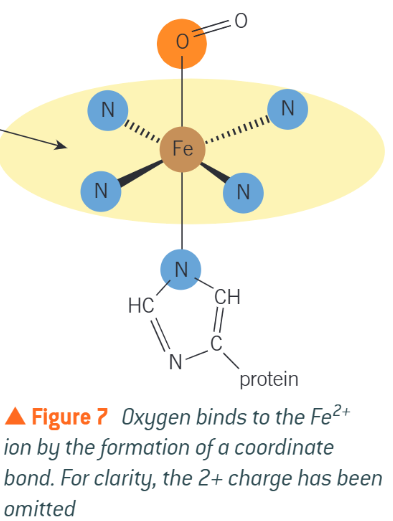
Haemoglobin forms oxyhaemoglobin with oxygen and releases it when it is needed, this can form because of the Fe2+ ion that binds to O2, CO2 can also bind with haemoglobin and is exhaled when carried back to lungs
A ligand substitution occurs when carbon monoxide binds to haemoglobin replacing oxygen and binds more strongly, to form carboxyhaemoglobin. The bond is so strong it is irreversible so if conc. of carboxyhaemoglobin gets too high it limits oxygen transport and can lead to death