U3 AOS 1 Gut-Brain Functioning
 Call Kai
 Learn
Learn Practice Test
 Spaced Repetition
 Match
Match Flashcards
 Knowt Play
1/27

Earn XP
Description and Tags
Acute and Chronic Stress, Gut-Brain axis, and
Name | Mastery | Learn | Test | Matching | Spaced | Call with Kai | Chat |
|---|
No analytics yet
Send a link to your students to track their progress
28 Terms
What is stress
Stress is a state of physiological and psychological arousal produced by internal or external stressors. It can be acute, or chronic.
What are stressors
Stimuli that cause or produce stress and challenge our ability to cope.
They can be internal (from within the person) or external (from outside the person).
The stress response (used interchangeably with ‘stress’) has the primary function of:
Priming us to deal with the stressor more effectively
Internal stressors
Originate within the individual from their mental processes and physical body.
e.g. low self-esteem; pain
External stressors
Originate outside the individual from situations and events in the environment.
e.g. homework; an accident
Acute stress is stress that _____. List the traits.
Stress that lasts for a relatively short time.
•Response is initially intense (high arousal)
•Stressor is overcome or removed
•Response fades quickly
•Cannot be sustained for long periods
•Normal and adaptive for dealing with urgent demands and sudden danger
What happens when very intense acute stress results from actual or perceived threat of loss of life, serious injury, or assault?
Post-traumatic stress disorder.
What happens in the fight-flight-freeze response
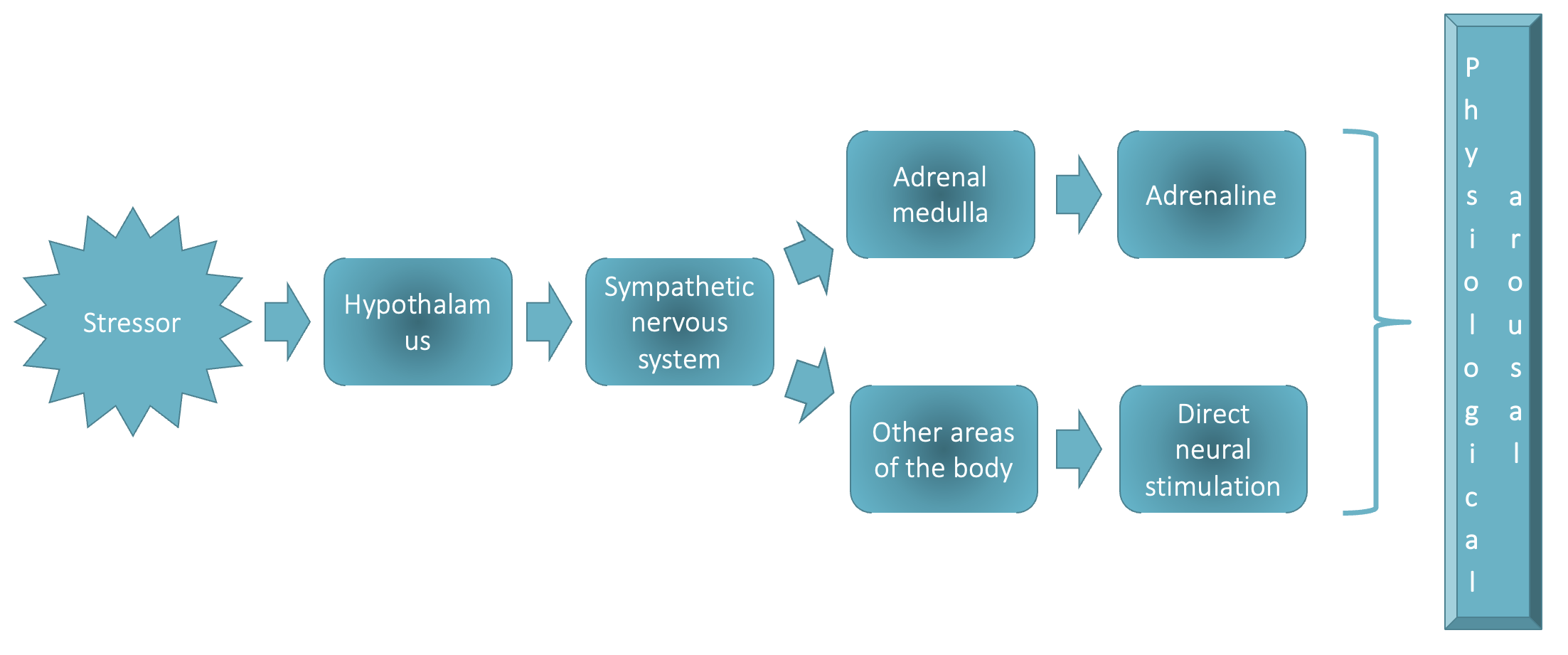
When an immediate threat is perceived, the sympathetic nervous system is activated to prepare the body to resist the stressor through either a fight, flight or freeze response.
Explain what happens in fight, flight, and freeze
•fight – confronting and fighting off the threat
•flight – escape by running away to safety
•freeze – keeping still and silent to avoid detection / provocation; known as tonic immobility (i.e. tense and still, not relaxed and still)
Which two main mechanisms does the sympathetic nervous system stimulate arousal in the body via
1.The efferent nerves from the sympathetic nervous system directly stimulate the body at various effector sites, including the heart, liver, pupils, and bronchiole in the lungs
2.Projections also connect to the adrenal medulla (part of the adrenal glands, just above the kidneys) to stimulate the release of adrenaline
Adrenaline is _____. List some traits or symptoms
A hormone that increases physiological arousal.
•Can sometimes feel the release of adrenaline as a sort of ‘rush’ in your torso area
•Triggered by intense emotion, especially fear
•Can cause symptoms of panic
•Enters the bloodstream quickly due to being directly stimulated by the sympathetic nervous system
•Slower to leave the bloodstream as the hormone needs to be processed out of the blood, but still relatively quick (minutes to an hour)
Draw a flow chart of what happens during the fight-or-flight-or-freeze
Chronic stress (plus list some traits - S.L.A.N.C). Explain what Chronic stress is associated with in terms of health.
A stress that continues for a prolonged period of time.
•Stressor has not been overcome or removed in a short period
•Less intense response is also initiated at the same time as the acute response
•Acute response (f-f-f) fades, but chronic stress response maintains arousal
•Normal and adaptive for dealing with ongoing demands over time
•Can be sustained for long periods
(FYI: Chronic stress is associated with various poor health outcomes such as susceptibility to viral infections, poor sleep, digestive problems and even heart disease.)
Cortisol (also talk about it in reference to adrenaline.)
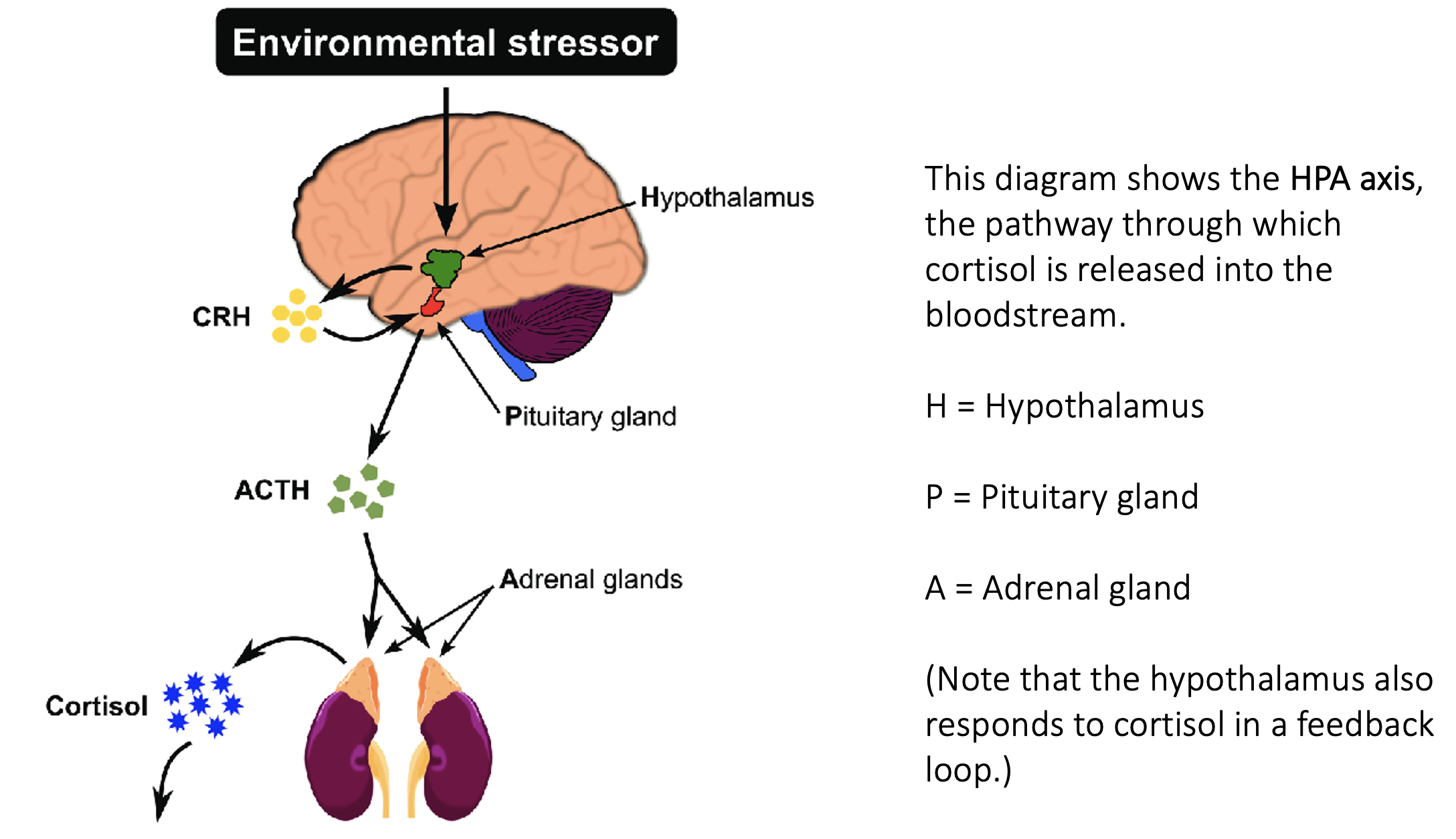
A hormone that is released from the adrenal cortex during stress. It can can be sustained for longer periods than adrenaline, and has the same basic effects of adrenaline but less intense. It is slower to kick in, as it is mediated by various other hormones through the HPA axis.
What are the problems with cortisol when we experience chronic stress
Cortisol helps us ‘get up and go’ – it is a normal part of regulating our body’s activity. Its normal pattern is to spike in the morning and wear off throughout the day. However, when we experience chronic stress, its effects can be sustained for days and weeks on end, and this causes wear and tear on the body’s organs.
Make a diagram of the HPA axis
What are the two lines of defence mechanisms that stress initiates
The sympathetic nervous system (SNS)- it’s rapid
The hypothalamic-pituitary-adrenocortical (HPA) axis- it’s slower
What is something that can reduce the effects of chronic stress
Cardiovascular exercise can reduce the effects, as it ‘uses up’ the stress hormones, leaving us with lower levels of them in our bloodstream post-exercise.
What is the gut-brain axis (GBA) and what does it involve
A bidirectional (two-way) multi-faceted communication link between the CNS and Enteric NS. It involves direct and indirect pathways between cognitive and emotional areas in the brain with the gastrointestinal tract.
Microbiota
Within the gut, there are living organisms called microbiota that maintain gut health and functioning. The gut microbiota (GM) and brain communicate with each other through the gut-brain axis (GBA). GM can also influence the production of serotonin and other neurotransmitters within the gut.
The GBA/GBMA (Gut-brain-microbiota axis) is
A complex interconnected circuit with multiple pathways (ANS, endocrine system, immune system, HPA axis and other bodily systems).
Stress can disturb the balance of GM and GM, and can influence:
- susceptibility to stress
- physiological stress responses
- stress induced changes to psychological processes & behaviour.
- stress resilience
- recovery from stress-induced changes
An example of the GBA in action is
If someone has bowel inflammation, it can impact their brain function, and likewise, if someone has depression, it can impact their gut health.
Key points of General Adaption Syndrome (GAS) -The acronym to remember this can be P.O.G.
•Physiological stress response is non-specific
•Organisms move sequentially through three physiological stages in which their resistance to a stressor varies
•Generic symptoms of illness (e.g. fatigue, weight loss) can be put down to stress
What are the stages of GAS
Alarm reaction, resistance, and exhaustion.
Stage 1 of GAS:
This is when the organism is first exposed to the stressor. Two parts:
Shock: The body’s resistance to the stressor initially falls below normal levels.
Blood pressure, body temperature and muscle tone all decrease momentarily. Loss of fluid from body tissues.
Countershock: Physiological arousal is activated to prepare the body and resistance to the stressor increases above normal levels.
Stress hormones cause an increase in heartrate, blood pressure, metabolization of glucose, etc.
Stage 2 of GAS
If the stressor persists, the body may enter the second stage.
In the resistance stage, the body maintains an above-baseline resistance for an extended period of time.
Cortisol has taken effect and is being sustained at heightened levels
Heightened cortisol for long periods of time leads to wear and tear on organs, digestive discomfort, and lowered immunity to pathogens
Increased risk of infection (e.g. catching a cold)
Stage 3 of GAS
If the stressor is not dealt with in the resistance stage, and stress continues, the body may enter the third stage.
In the exhaustion stage, the body’s resources are depleted and resistance to disease and the stressor are lowered below the normal level.
Fatigue, anxiety and depression
Hypertension
Gastrointestinal problems
Heart disease (long-term)
Death