Speech and Hearing Science Exam 4
 Call Kai
 Learn
Learn Practice Test
 Spaced Repetition
 Match
Match Flashcards
 Knowt Play
1/32

There's no tags or description
Looks like no tags are added yet.
Name | Mastery | Learn | Test | Matching | Spaced | Call with Kai |
|---|
No analytics yet
Send a link to your students to track their progress
33 Terms
The frequency of a sound is perceived as its
Pitch
Which one is NOT a function of the middle ear?
Send an electrical signal to the auditory nerve
Where does the tonotopic arrangement of the hearing system begin?
Basilar membrane
In which part of the ear are pressure waves transduced to mechanical vibration?
Tympanic membrane
The ear canal
Is a quarter-wave resonator and amplifies some sounds
Which of the following statements is true about the cochlea?
It contains the organ of Corti.
“Overcoming impedance mismatch” is accomplished through
the ossicles concentrating energy on the footplate of the stapes to allow for vibration in fluid
If the tympanic membrane (TM) is in the path of shifting molecules, then
A & B
The model of speech perception that states that incoming acoustic information is perceived serially and candidates for perception are eliminated based on the information at hand (CAT vs CAP; CAT vs CATERPILLAR) is
The TRACE Model
What is one of the “problems” that theories of speech perception attempt to adderess?
Segmentation of the speech stream into sounds and words
True or False: The decibel scale is an algorithmic scale that compares a target sound with a standard reference sound.
True
True or false: Zero dB is the absence of sound.
False
Formants appear to be involved in the perception of vowels, but there is no strict 1:1 correspondence between formant characteristics and specific vowels. This is part of the problem of perceptual invariance and arises because
all of the above
Why do speech scientists say that the perception of consonants is categorical?
Responses from test subjects showed that most sounds were perceived as either target, with a small area of ambiguity.
Categorical perception has been identified in contrasting sound pairs based on
all of the above
The shape and amplitude of a tympanogram provide information about
The functioning of the middle ear
Identify the area associated with conductive hearing loss.
blockages in outer to middle ear near tympanic membrane (TM)
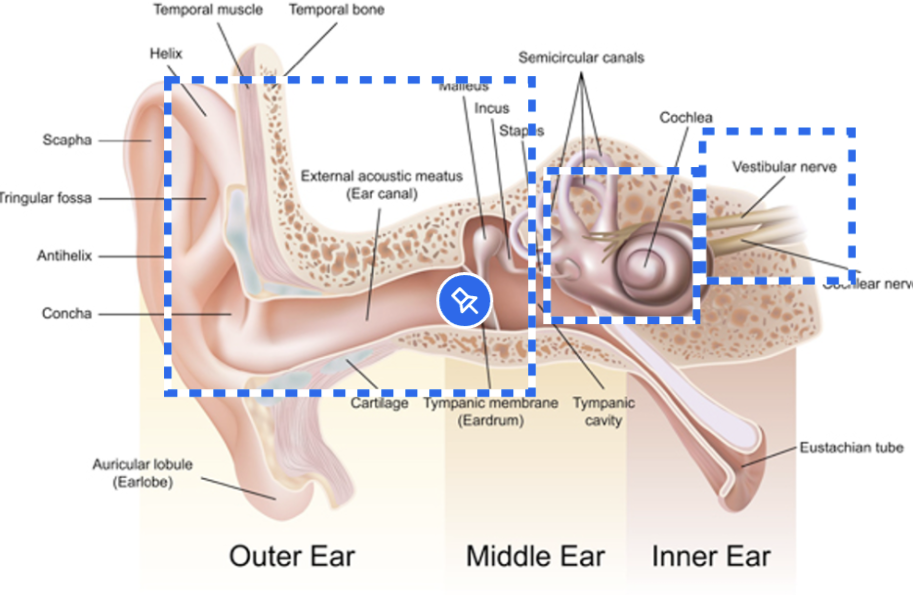
Identify the part(s) of the auditory system assessed by air conduction testing.
Entire auditory system (outer, middle, inner ear)
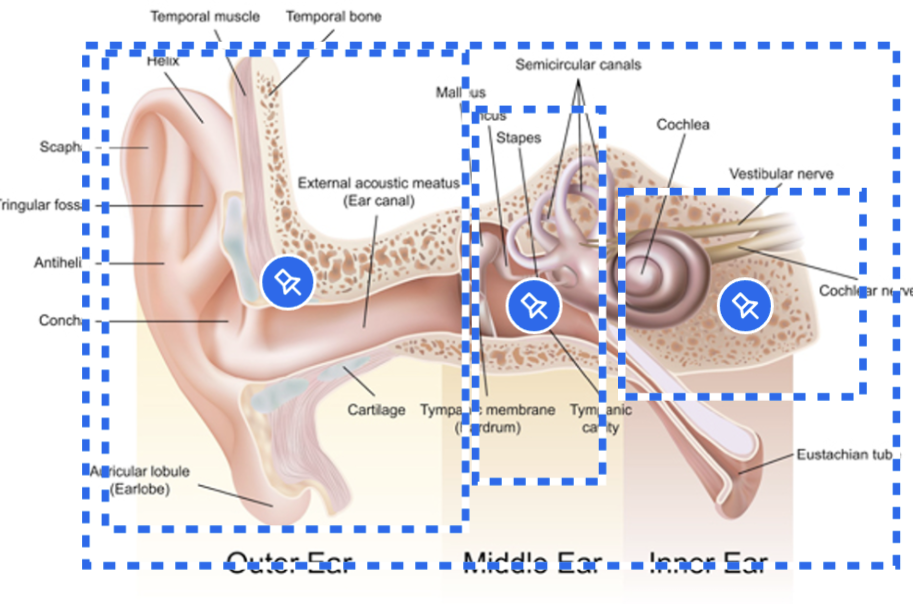
Identify the part(s) of the auditory system assessed by bone conduction testing
inner ear (cochlea) and the auditory nerve
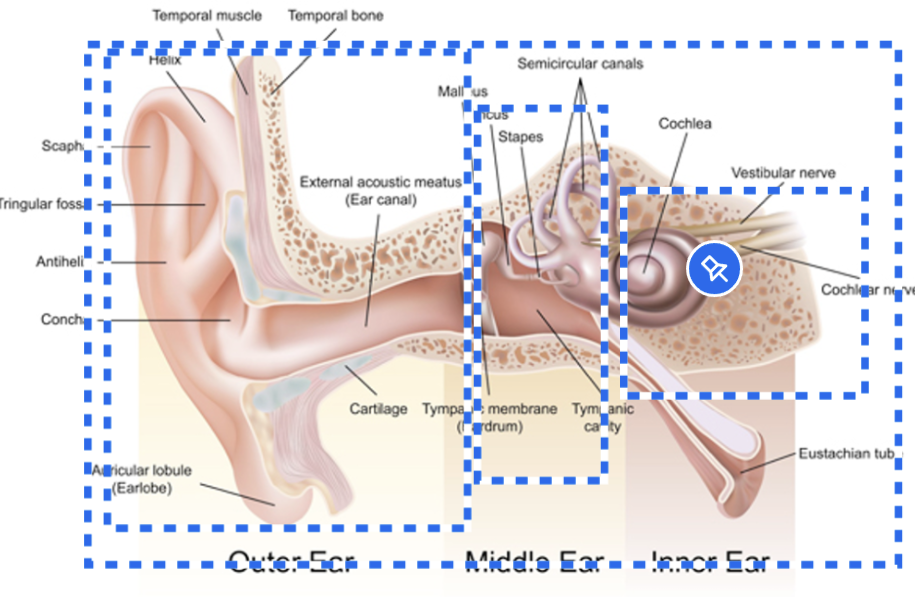
When used by itself, air conduction testing cannot tell you where the hearing problem is in the auditory system, so it cannot tell you what kind of hearing loss the person has.
True
Tympanometry will identify the severity of hearing loss.
False
We characterize hearing loss by
Type, severity (degree), and configuration
On the audiogram, which term refers to loudness?
Decibels
Considering the “speech banana” and the sloping loss associated with presbycusis, which phonemes pose the most difficulty during listening tasks for individuals with that type of hearing loss?
Voiceless fricatives (s, f, sh)
What are extremely low-intensity sounds that come from the cochlea as the outer hair cells process sounds?
Otoacoustic emissions
True or False: Cochlear Implants and Hearing Aids do the same thing
False
Auditory brain stem response testing assesses which of the following
Inner ear, auditory nerve, and brain stem functioning.
All of the following are diagnostic benefits of using evoked otoacoustic emissions (EOAEs) EXCEPT
They are easy to assess because they do not rely on any incoming auditory stimulation.
True or False: People who have a conductive hearing loss due to otitis media need hearing aids.
False
Reading has a strong phonological basis. Theories of reading acquisition and reading impairment vary on the specific details, but ALL specify an important role for the phonological form of the word. Which theory also includes roles for background knowledge, vocabulary, verbal reasoning, literary knowledge, decoding, and sight knowledge?
The Reading Rope
Auditory discrimination of small acoustic differences
Is equally as important for learning language in typical and language-learning disabled children.
True or False: Some children are able to perceive the sounds they misarticulate without a problem
True
True or False: Children with a history of otitis media with effusion (OME) perform similarly to children without OME in phonetic perception
True