stefan bon polymers
 Call Kai
 Learn
Learn Practice Test
 Spaced Repetition
 Match
Match Flashcards
 Knowt Play
1/107

There's no tags or description
Looks like no tags are added yet.
Name | Mastery | Learn | Test | Matching | Spaced | Call with Kai | Chat |
|---|
No analytics yet
Send a link to your students to track their progress
108 Terms
whats the ipuac defintion of a gel
a non fluid colloidal network or polymer network that is expanded throughout its whole volumeby a fluid
how to make a gel
a) Connected particles (percolating spheres)
Small colloidal particles touch and join together.
Eventually they form one giant connected network throughout the sample.
Example: silica gels.
(b) Plate-like particles
Thin plate-shaped particles (e.g. clay) connect into a 3D network.
Common in clay suspensions.
(c) Physical polymer gel
Polymer chains dissolved in liquid form temporary junctions.
Often occurs when cooling allows chains to crystallise or associate.
Crosslinks are physical, so heating can often reverse the gel.
(d) Chemically crosslinked polymer gel
Polymer chains are permanently joined by covalent bonds.
Creates a permanent elastic network.
Example: many hydrogels and vulcanised rubber.
How does agarose form a gel, and why is the process reversible?
Agarose is a water-soluble polysaccharide (polymer) that forms a physical gel through hydrogen bonding, not permanent covalent crosslinks.
🌡 Step 1 – Heat → Solution
When agarose is heated, thermal energy breaks many of the hydrogen bonds between polymer chains.
The chains separate and become random coils.
They dissolve throughout the water.
The mixture behaves like a liquid (solution).
Key point: The polymer itself does not break—only the weak intermolecular interactions between chains.
❄ Step 2 – Cool → Helix formation (Gel I)
As the solution cools:
The polymer chains begin to reform hydrogen bonds.
Individual chains fold into ordered helical structures.
These helices act as the first physical junction points.
This is the beginning of gel formation.
🕸 Step 3 – More cooling → Helix bundles (Gel II)
With further cooling:
Multiple helices associate together into helix bundles.
These bundles connect throughout the entire sample.
A continuous 3D percolated network is formed.
Water becomes trapped inside this network.
At this point the material behaves like a solid gel, even though it is still mostly wate
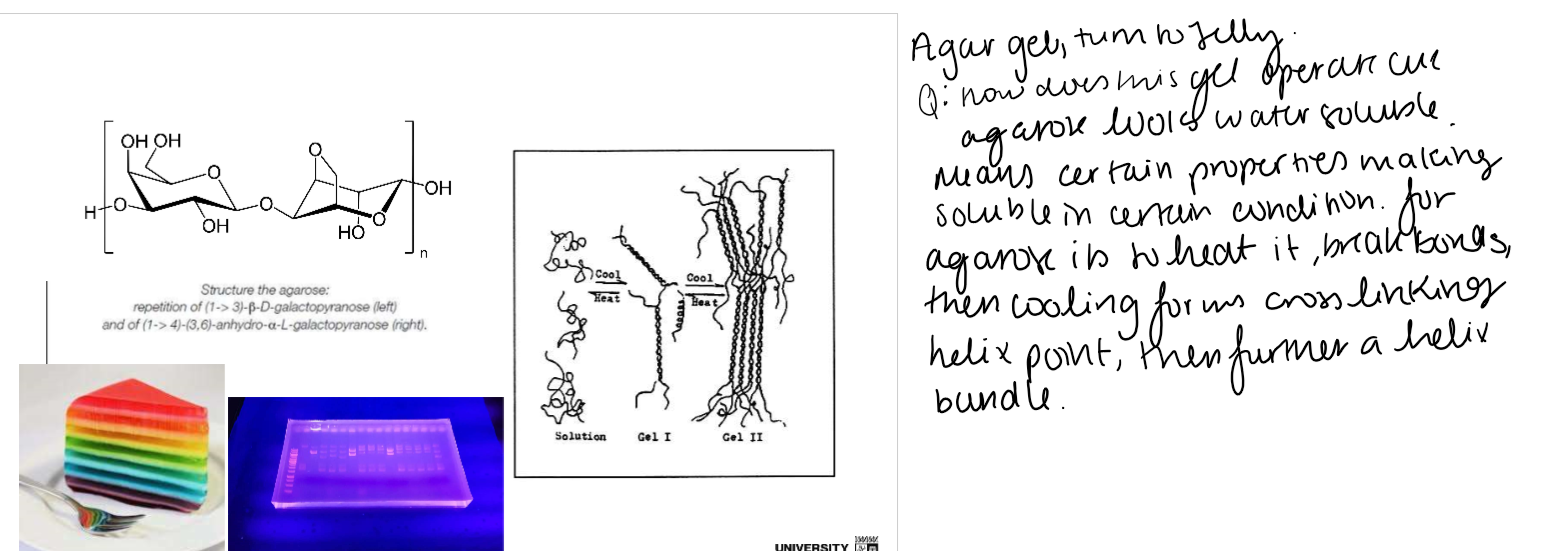
Why is agarose gelation reversible?
The crosslinks are hydrogen bonds (physical crosslinks), which are weak enough to be broken by heating.
Therefore:
Heat → hydrogen bonds break → gel melts into a solution.
Cool → hydrogen bonds reform → helices and bundles reform → gel returns.
This is called thermoreversible gelation.
What does the agarose modulus vs temperature graph show, and why do gelation and melting occur at different temperatures?
his graph measures the complex modulus (G*), which tells you how stiff or solid-like the material is.
High complex modulus → Strong gel (solid-like).
Low complex modulus → Polymer solution (liquid-like).
Heating the gel (red curve)
Start with a gel at room temperature.
As temperature increases:
The gel stays stiff for a long time because the helix bundles are still intact.
Around 60–70°C, the helices begin to unwind.
Hydrogen bonds break.
The 3D network collapses.
The modulus rapidly falls.
By ~90°C, the material is a polymer solution.
Heating
Gel → Helices unwind → Polymer solution
COoling the solution (black curve)
Start with the hot polymer solution.
As temperature decreases:
The polymer chains first lose kinetic energy.
They must find each other and reform hydrogen bonds.
Individual helices form.
Helices then bundle together.
Only after enough bundles connect into one continuous network does the gel reform.
This happens much later, around 35°C.
Cooling:
Solution → Helices form → Helix bundles → Continuous network → Gel
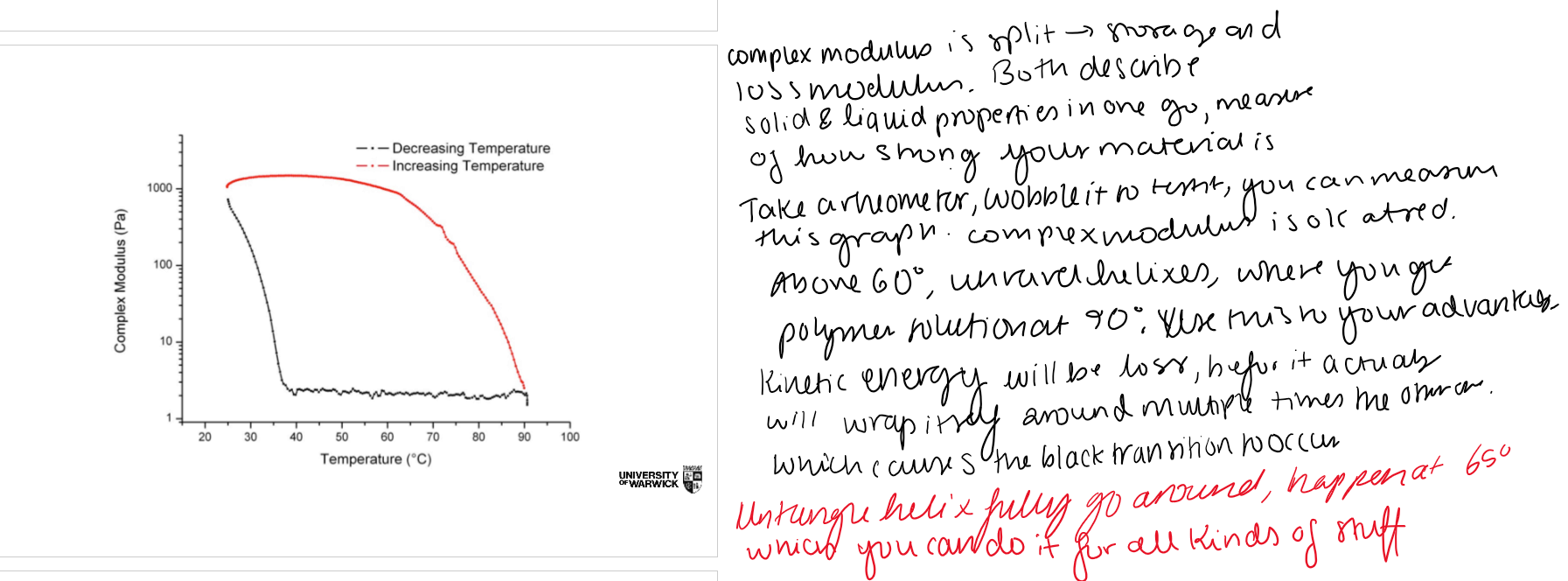
Why are the two curves different?
This is called thermal hysteresis.
The gel melts at a much higher temperature than it forms because:
Breaking an existing helix bundle is relatively straightforward once enough thermal energy is supplied.
Building a new network is slower and requires many polymer chains to correctly align, form helices, and then connect into a continuous 3D network.
Why is poly(NIPAM) a temperature-responsive gel, and what role does crosslinking play in its behaviour?
Poly(N-isopropylacrylamide) (poly(NIPAM)) is a thermoresponsive polymer, meaning its interaction with water changes dramatically with temperature.
🌡 At low temperature (below ~32°C)
The polymer chains form favourable interactions (hydrogen bonds) with water.
Water molecules surround the polymer.
The microgel swells by absorbing lots of water.
The particles appear large and soft.
Think: Polymer likes water → it expands.
At high temperature (above ~32°C)
As temperature increases:
Hydrogen bonding between the polymer and water becomes less favourable.
The polymer chains prefer interacting with each other rather than water.
Water is expelled from the network.
The microgel shrinks (collapses).
This is known as the Lower Critical Solution Temperature (LCST) behaviour.
Think: Polymer dislikes water → it squeezes the water out.
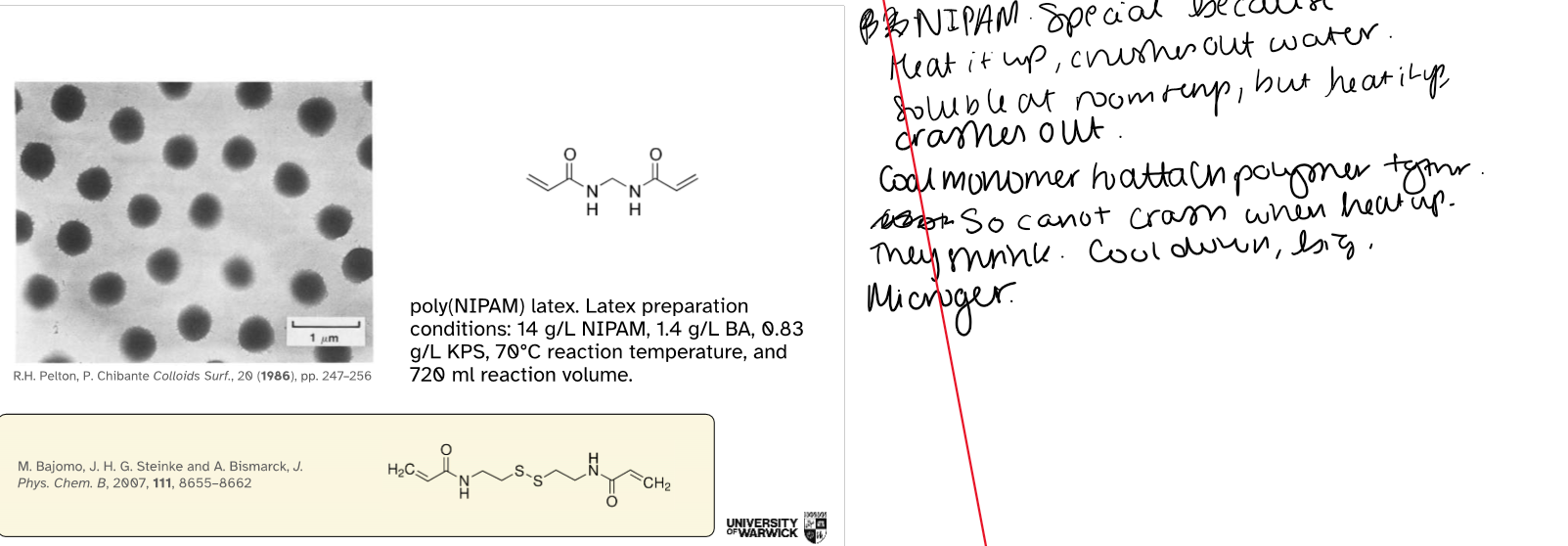
How does adding supramolecular interactions allow poly(NIPAM) microgels to reversibly assemble and disassemble with temperature?
This slide shows how poly(NIPAM) microgels can be modified so they stick together reversibly, using non-covalent supramolecular interactions instead of permanent covalent bonds.
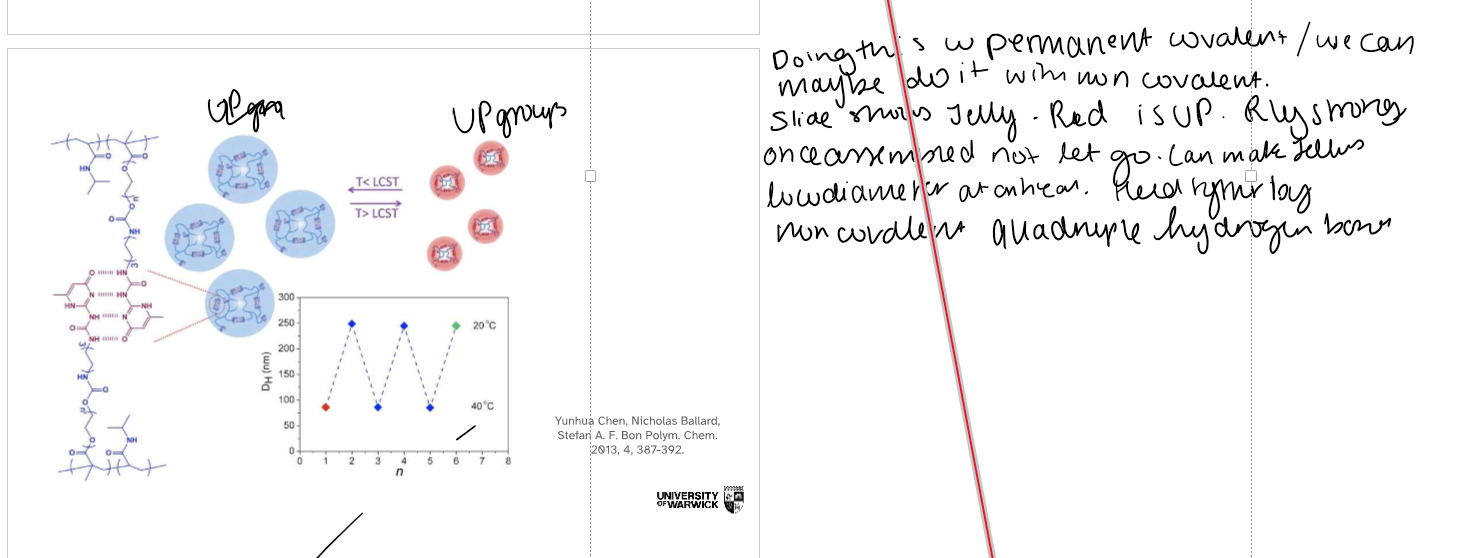
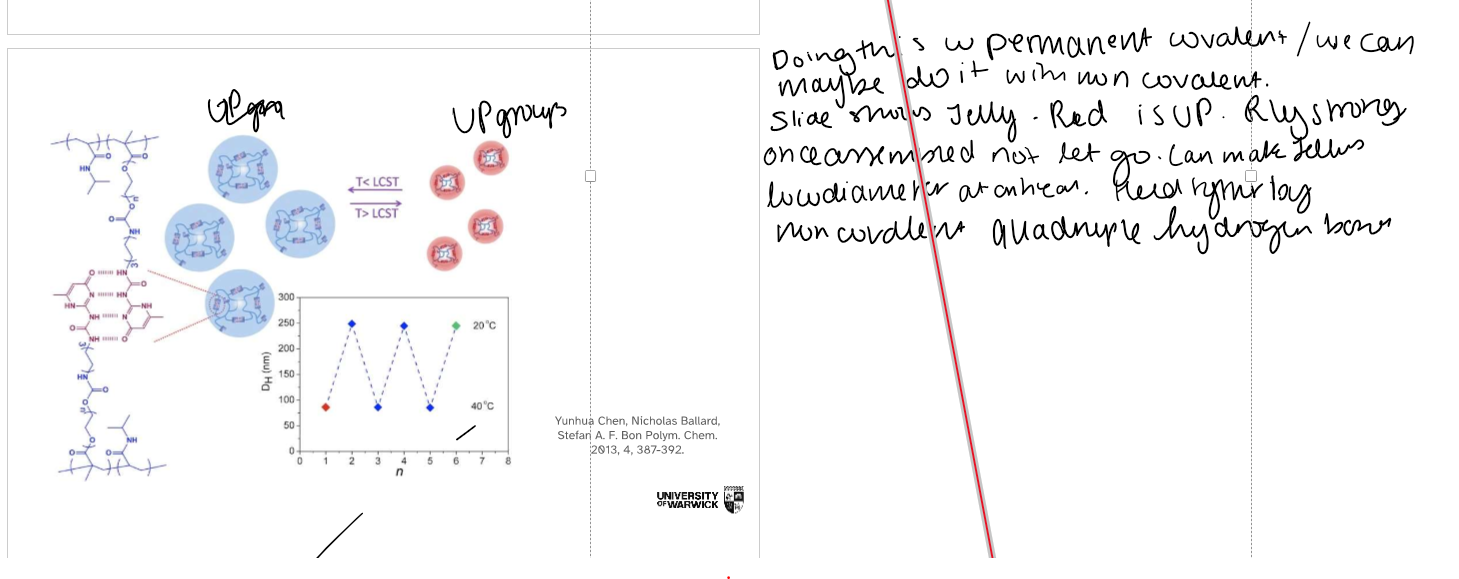
whats happening here
Below the LCST (Low temperature)
Below the LCST (~32°C):
Poly(NIPAM) microgels are swollen because they contain lots of water.
The particles are large.
The supramolecular groups (UPy groups) on their surfaces are too far apart to interact strongly.
The particles remain separate.
Result: Large, swollen, individual microgels.
Step 2 – Above the LCST (High temperature)
When heated above the LCST:
Each microgel shrinks as it expels water.
The UPy (ureidopyrimidinone) groups become concentrated on the smaller particle surface.
UPy groups on neighbouring particles form strong quadruple hydrogen bonds.
These hydrogen bonds act as temporary crosslinks, connecting different microgels together.
Result: The microgels self-assemble into a larger network or gel.
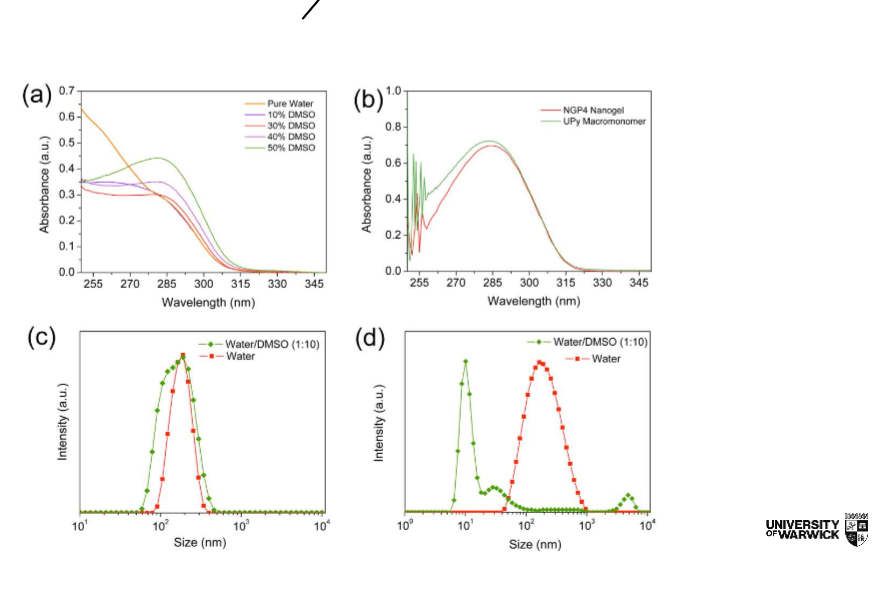
what technique is used here to prove about UP groups and whats it showing
UV vis,
a) when diemierising, the maximum shifts its wavelength, low wave theres suddenyl a peak and if you add hydrogen bond disrupts the diemerisation group dissapear (dms)
b)mixing 2 hydrogel non covalent/covalent. covalent is red, dmso mixture cannot fall apart cuz of covalency
d) dmso falls apart
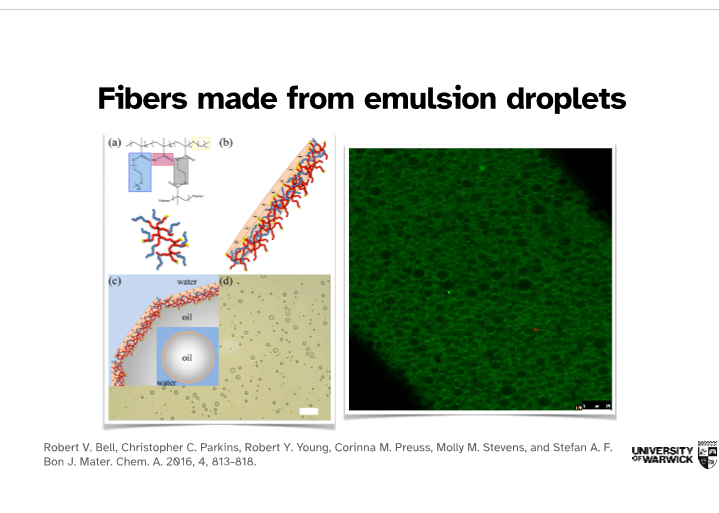
How are fibres made from emulsion droplets, and what role do supramolecular interactions play in stabilising the emulsion and forming the fibres?
his slide demonstrates how supramolecular polymers can assemble at the interface between oil and water, stabilising tiny oil droplets and allowing them to be pulled into long fibres.
🛢 Step 1 – Form an emulsion
An emulsion is simply tiny droplets of one liquid dispersed in another.
Here:
Oil droplets are dispersed in water.
Normally, these droplets would quickly merge together because oil and water are immiscible.
🧩 Step 2 – Supramolecular polymers assemble at the interface
The polymer is specially designed so that:
One part prefers the oil phase.
One part prefers the water phase.
This causes the molecules to sit at the oil–water interface (the droplet surface).
At the interface, neighbouring molecules form strong hydrogen-bonded complexes (1:1 complexes below the pKa).
These non-covalent interactions cause the molecules to self-assemble into a fibrous supramolecular network around each droplet.
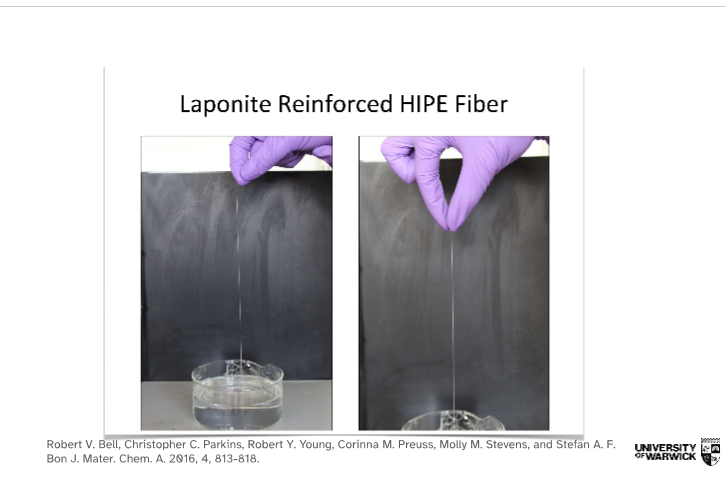
Why is Laponite added to HIPE fibres, and what effect does it have on the material?
HIPE (High Internal Phase Emulsion) fibres are initially soft gel fibres, so they can be fragile. To strengthen them, Laponite (a synthetic clay nanoparticle) is added.
Laponite acts as a nanoscopic reinforcing filler, similar to steel bars in reinforced concrete.
As a result:
It increases the mechanical strength of the fibre.
It increases stiffness.
It allows the fibre to be picked up, stretched and handled without breaking, as shown in the photographs.
The polymer still forms the gel network—the Laponite simply reinforces it by helping distribute stress throughout the material.
🎯 Exam takeaway
Laponite is added to reinforce soft HIPE gel fibres, making them mechanically stronger while maintaining their lightweight gel structure.
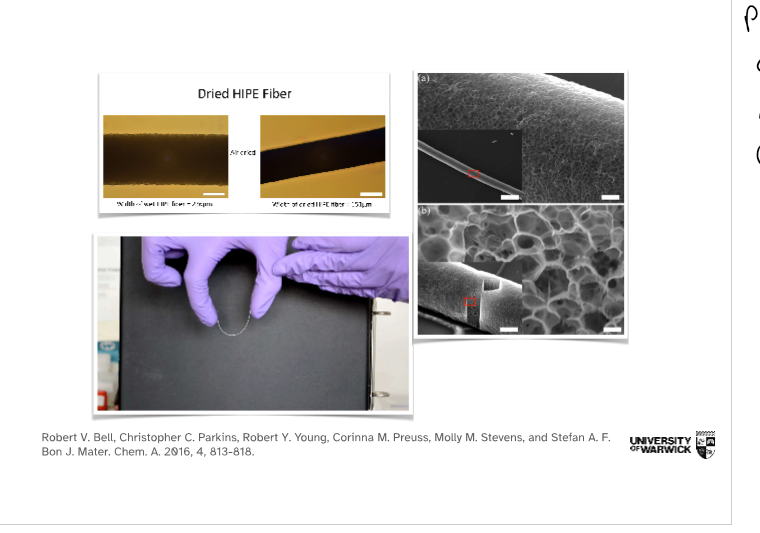
What happens when a HIPE fibre is dried, and why does it become highly porous?
A:
A HIPE contains a very high internal volume of oil droplets (around 98% oil).
When the fibre is dried:
The oil evaporates or is removed.
Every oil droplet leaves behind an empty pore.
The polymer network remains intact.
The result is a highly porous, ultralight fibre.
The SEM images show this porous "foam-like" internal structure.
Because so much of the original material was oil, removing it produces:
very low density,
large surface area,
flexibility (the fibre can bend slightly),
lightweight porous materials.
🎯 Exam takeaway
Drying removes the internal oil phase, leaving behind a porous polymer network whose pores are replicas of the original emulsion droplets.
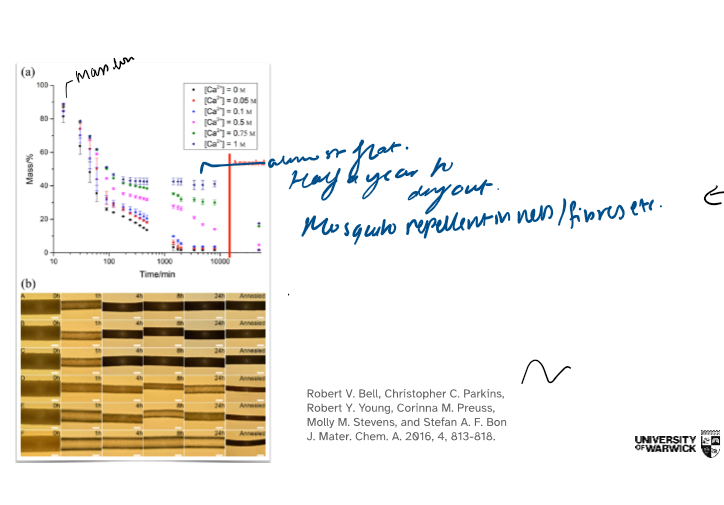
Why are porous HIPE fibres useful, and what applications do they have?
A:
Applications include:
🛢 Oil absorption (pores soak up oils).
💊 Controlled release of drugs, fragrances or mosquito repellents.
🧫 Artificial cell scaffolds/tissue engineering, where cells can grow within the porous structure.
⚗ Catalyst supports.
🚰 Filtration and separation materials.
can i programme a gel to fall apart when i want it to?
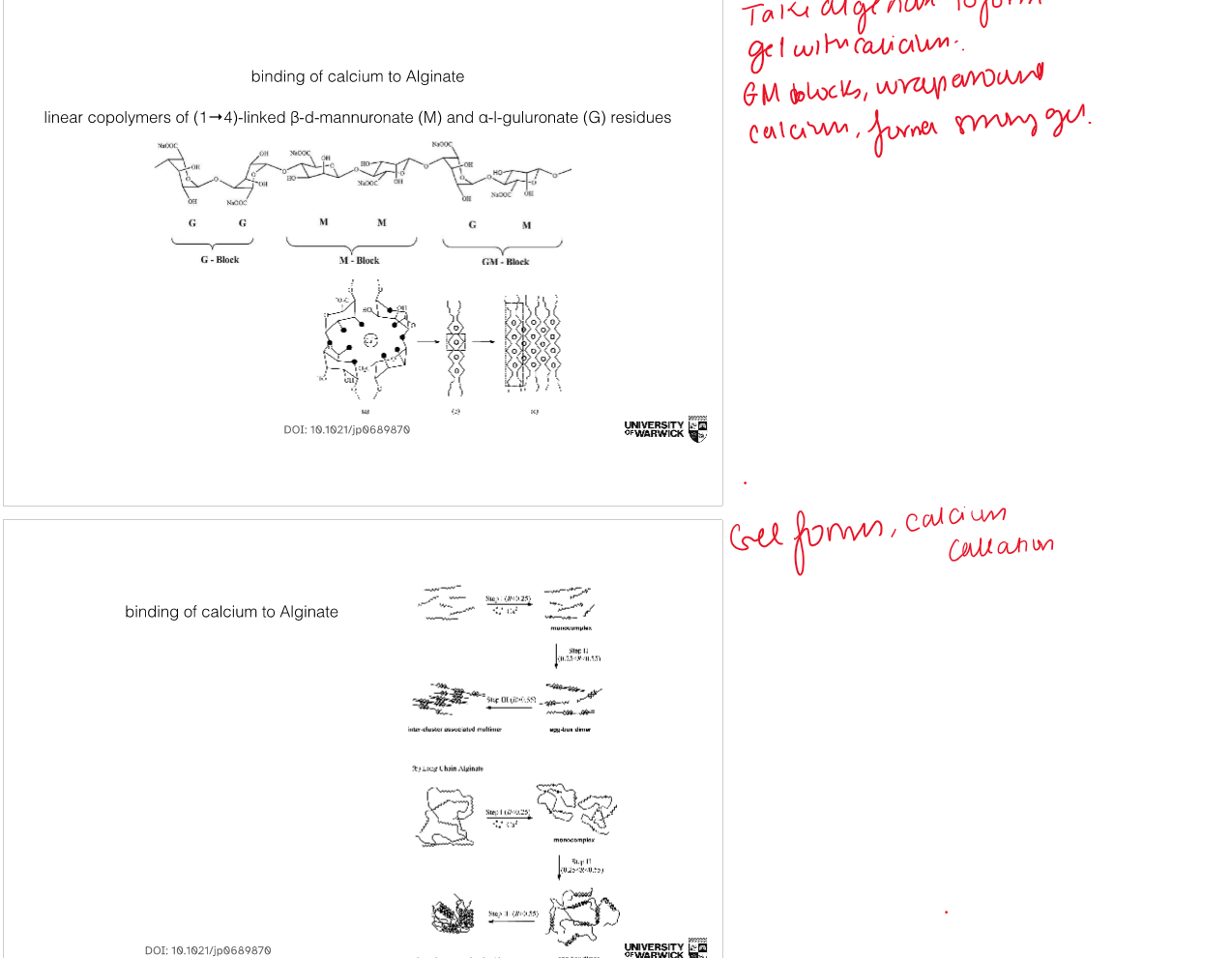
Why does adding calcium ions (Ca²⁺) cause alginate to form a gel?
Alginate is a natural polysaccharide made of two sugar units:
M blocks = β-D-mannuronate
G blocks = α-L-guluronate
These occur along the polymer chain as:
M-blocks
G-blocks
Mixed GM-blocks
⭐ The key point
The G-blocks have the correct shape to bind Ca²⁺ ions.
When calcium is added:
Ca²⁺ binds to negatively charged carboxylate (COO⁻) groups on neighbouring G-blocks.
Calcium acts as a bridge between two polymer chains.
Many calcium bridges form.
A continuous 3D crosslinked network develops.
Water becomes trapped inside this network
This is called ionic crosslinking because the chains are connected by calcium ions, not covalent bonds.
algon coordinate strong w calcium but only in high Ph
whats the definition of glass
material showing solid like response, but lacking long range order (amorphous)
whats the difference between a polymer glass and a polymer melt
A polymer glass and a polymer melt look almost identical at the molecular level. The only difference is whether the chains are able to move. but sometimes the chains will be frozen in place hence a polymer glass, the chains move very slowly that its pretty much a solid
does water have a Tg
the conditions for tg is disorder. in the case of water,liquid doenst stay in disorder structure , but every liquid has a tg, but liquids with symettry also have a melting point
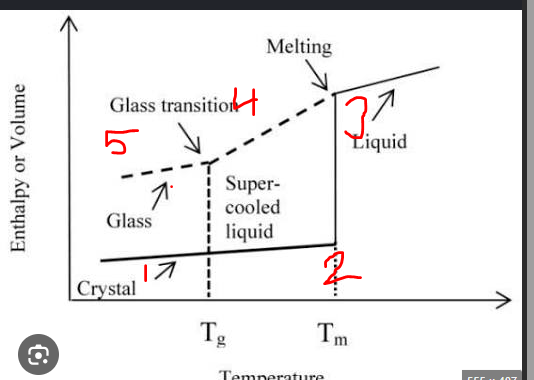
whats happening in each step of this picture
1) crystalline lattice has some thermal energy bc solid it has vibrational mobility
2)when hit Tm, you unlocked translational movement, spacing between each molecule is less. so goes straight up as a liquid.
3) liquid is now cooling , youd expect crystal, but doesnt happen because you need to nuceleate which is difficult so you end up with 2nd phase interfacical tension
4)you have to go below tm
5)now you have enough kinetic energy left to orientate the molecule, than can form crystal. If you can’t do that, you jam, kinetically freeze, and become a solid. now im glass. Tg is less than tm. molar vol greater of a crystal because theres no order at tg
whats the verdict of the tm tg graph
shows that every liquid can cool down, become a solid by definition has tg
but for polymers instead of liquid with the tg tm graph, what differs
polymers are diff lengths but can potentially crystallise. polystyrene by radical polymer cannot bc going from sp2 to sp3 and no control of how phenyl group orientate so can go front or back making a atactic, and that cant polymerise. but syndiotactic can, even if diff lengths
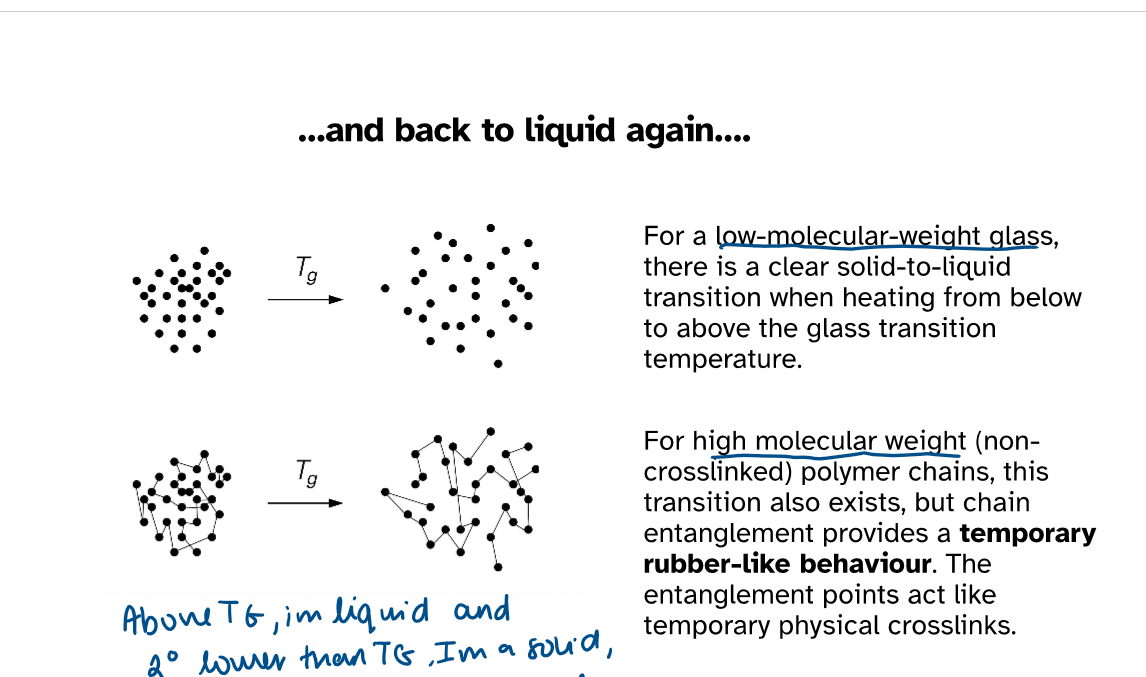
whats the difference between melting a low molecular wieght glass and high mw polymer chain
for lm weight glass, there is a clear solid to liquid transition when heating from below to above the glass transitiontemperature.
for high mw polymer chain, the transition exists but chain entanglement provides a temporary rubber like behaviour. The entanglement points act as temporary cross links. if you pull really slowly above tg, you can get the chain out
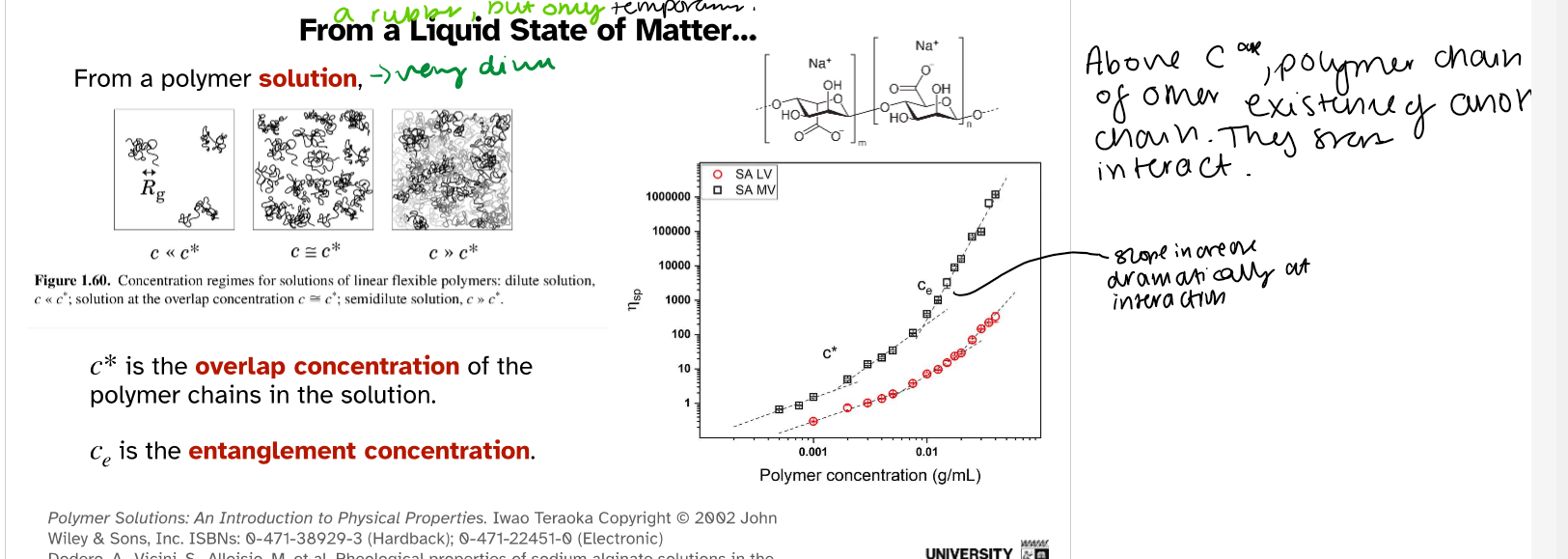
whats this showing
Up to c* → viscosity increases slowly.
After c* → chains overlap, viscosity increases faster.
After cₑ → chains entangle, viscosity increases very rapidly.
As you increase polymer concentration, the chains interact more and this completely changes the material's properties.
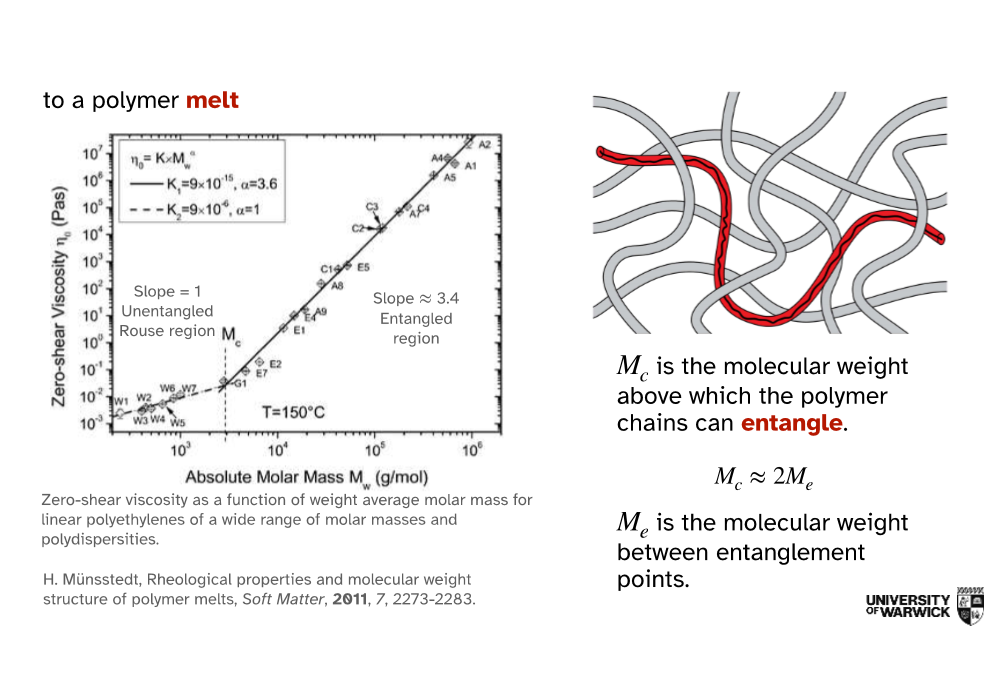
whats the graph showing or concept here
below mc, shows diff mw of polyethylene. they cant entangle cuz conc is too small, but as you increase it polymer chains can start to hook, temporarily like rubber
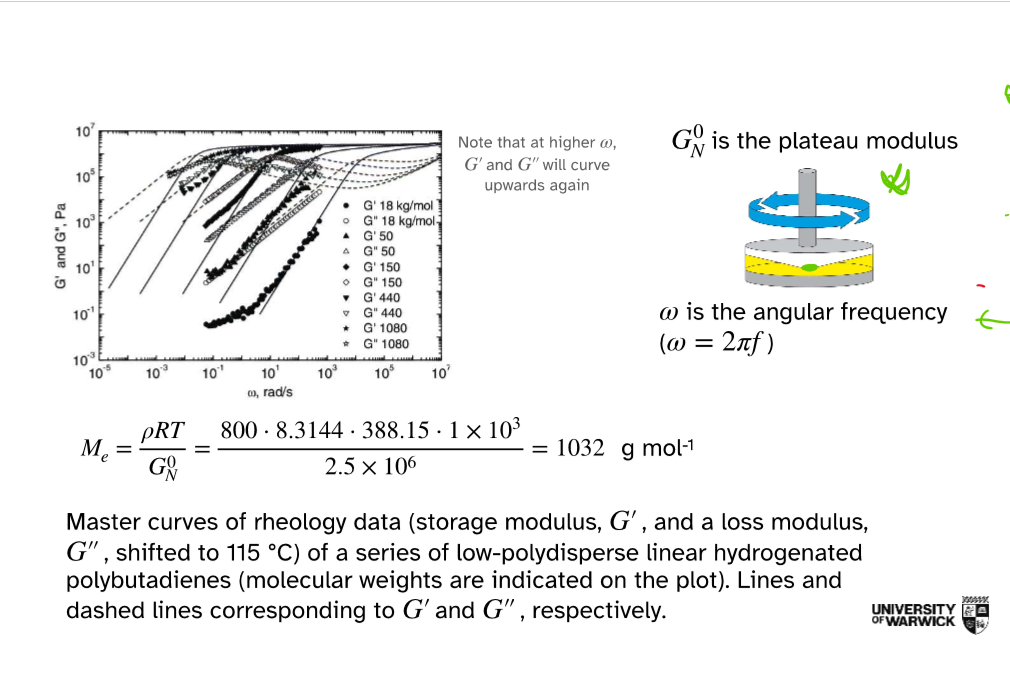
Why is oscillatory rheology used for polymers?
It measures whether a polymer behaves more like an elastic solid (high G') or a viscous liquid (high G''), allowing the effects of chain entanglements to be studied.
What does the rubbery plateau represent?
A region where polymer chain entanglements act as temporary physical crosslinks, giving the material rubber-like elastic behaviour.
What does the plateau modulus (Gₙ⁰) tell us?
It measures the stiffness of the rubbery plateau and is used to calculate the entanglement molecular weight (Me). A higher Gₙ⁰ indicates more chain entanglements and stronger rubber-like behaviour.
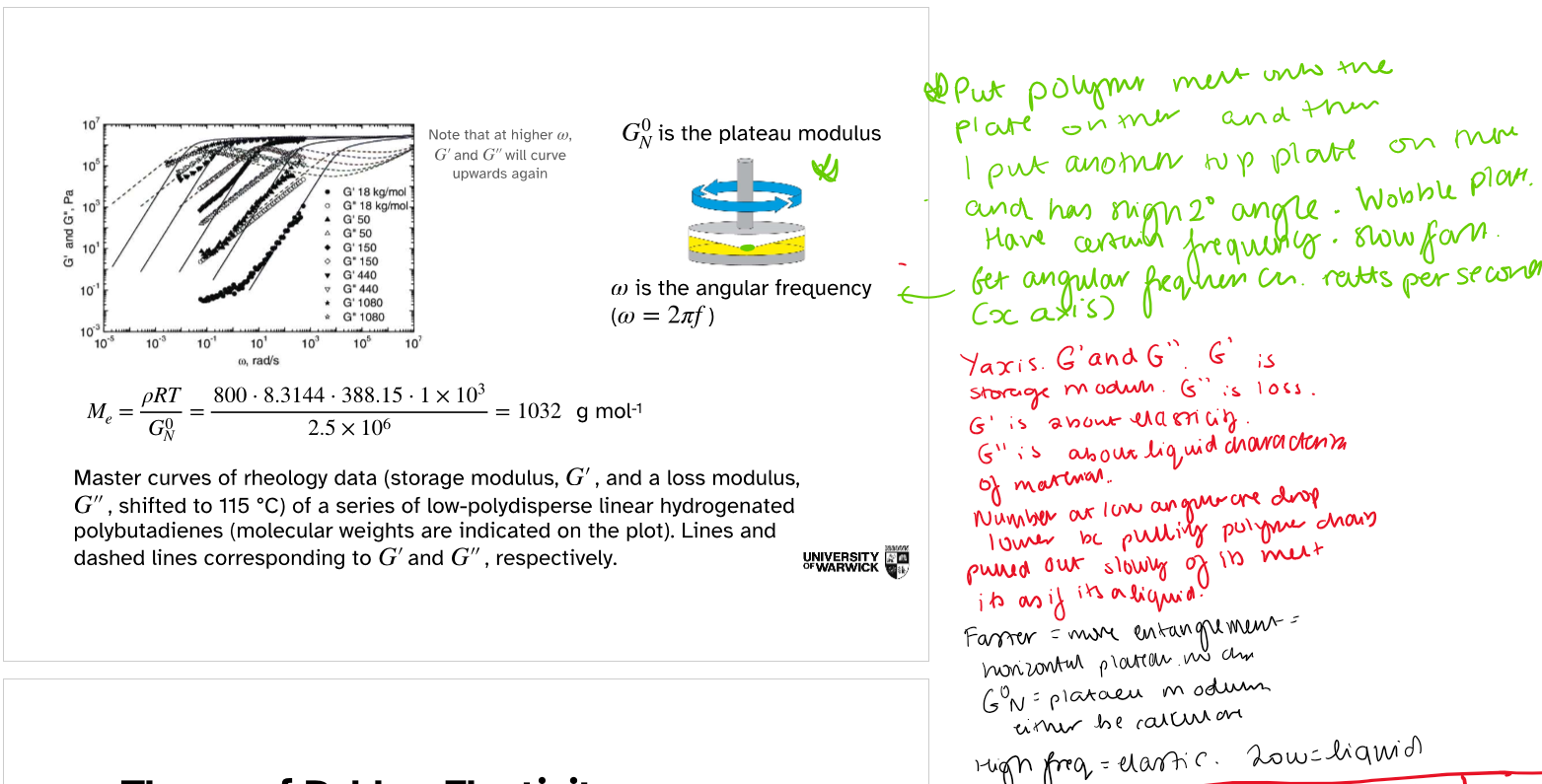
The story your lecturer is building
Long chains become entangled.
Entanglements make polymers rubbery.
We measure this by twisting the polymer.
G' tells us how elastic it is.
G'' tells us how liquid-like it is.
The plateau is evidence that entanglements are holding the material together.
From the plateau modulus Gₙ⁰, we can calculate Me, which tells us how many entanglements the polymer has.
whats the equations purpose
Me i
t's the average amount of polymer chain between two entanglements.
small me means lots of chains so more entanglements etc, its to say If I measure the plateau modulus, I can calculate the entanglement molecular weight."
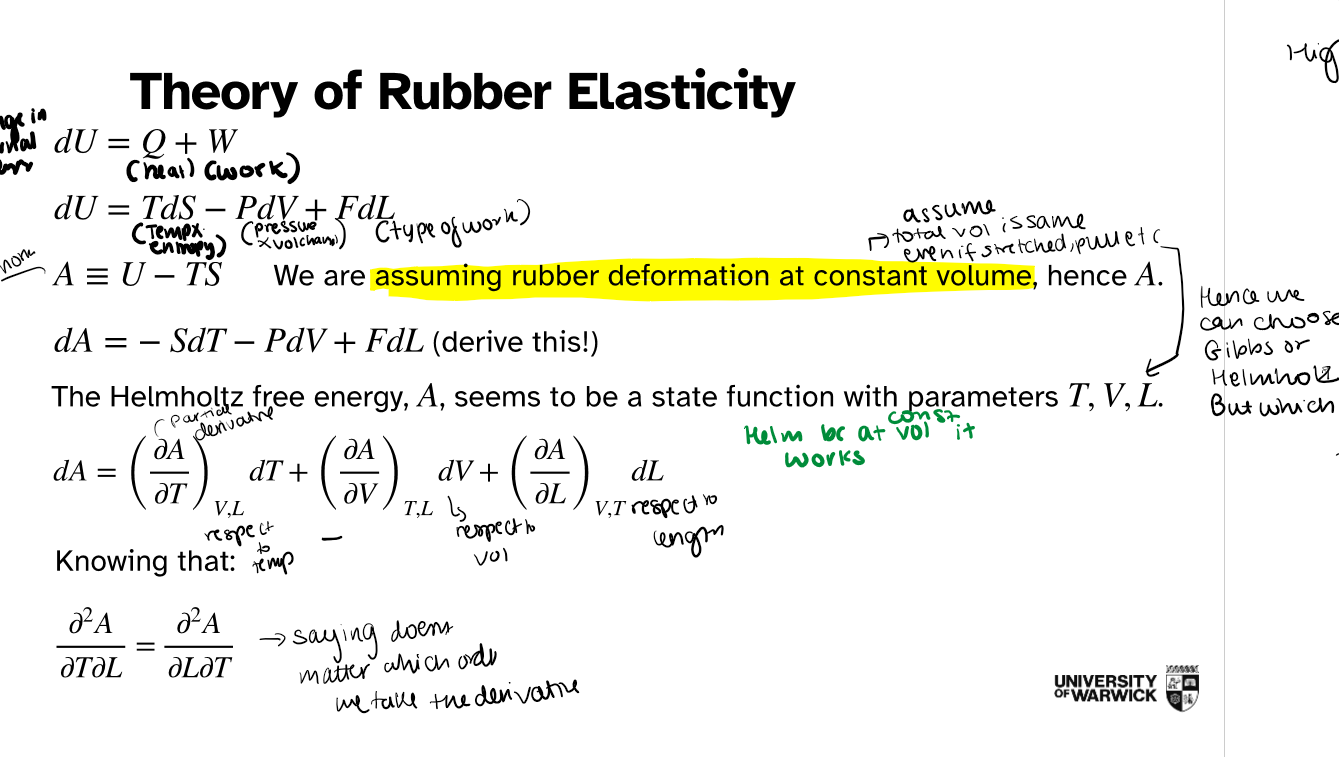
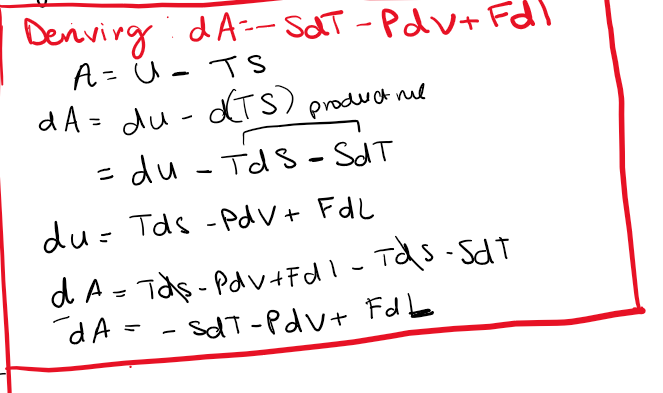
derive the part that says derive
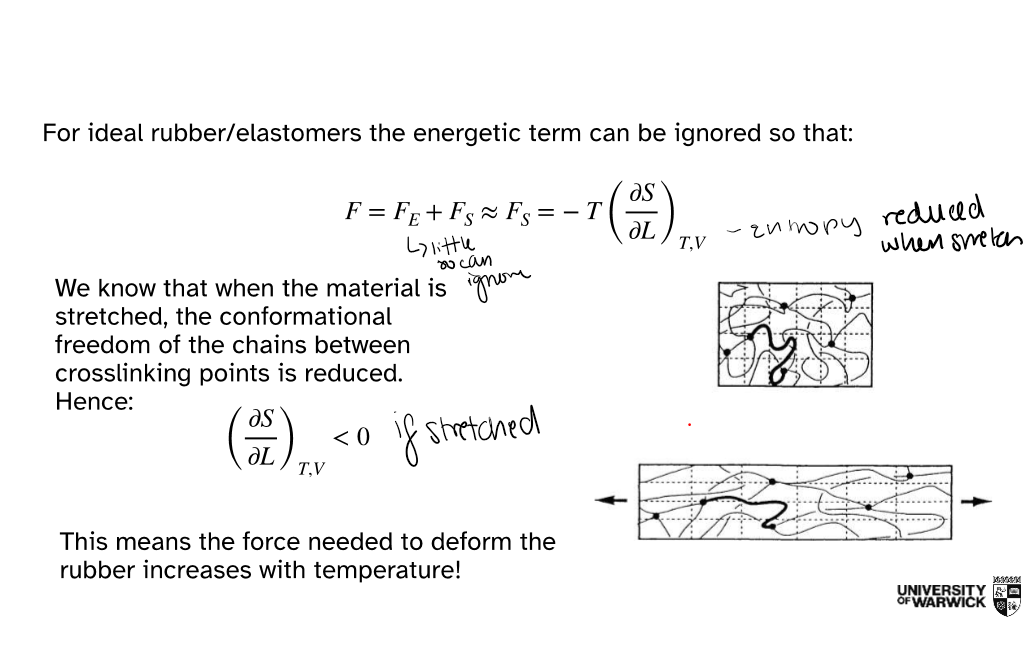
What is the main idea of this entropy and energetic force
Q: What is the main idea of this slide?
A:
The force needed to stretch a polymer network has two contributions:
Energetic force (FE): due to changes in internal energy (bond stretching, bond angles, intermolecular interactions).
Entropic force (FS): due to changes in entropy (polymer chains becoming more ordered when stretched).
Overall,
F=FE+FS
👉 This is the key takeaway from the entire slide.
Why does stretching a rubber create an entropic force?
When a polymer is relaxed, its chains are randomly coiled, giving high entropy.
Stretching forces the chains to become straighter and more aligned.
Entropy decreases.
The polymer naturally wants to return to its random coiled state.
This creates a restoring force called the entropic force (FS).
Remember: Rubber wants to maximise entropy.
What does the Maxwell relation tell
Meaning:
If stretching changes entropy, then changing temperature must also change the force.
It connects a quantity that is hard to measure (entropy) with one that is easy to measure (force).
What do the energetic and entropic terms physically represent?
Energetic contribution (FE)
Bond stretching
Bond angle changes
Internal energy changes
Usually small in rubber.
Entropic contribution (FS)
Polymer chains lose randomness when stretched.
Dominant contribution in elastomers.
👉 Rubber elasticity is mainly entropy-driven, not energy-driven.
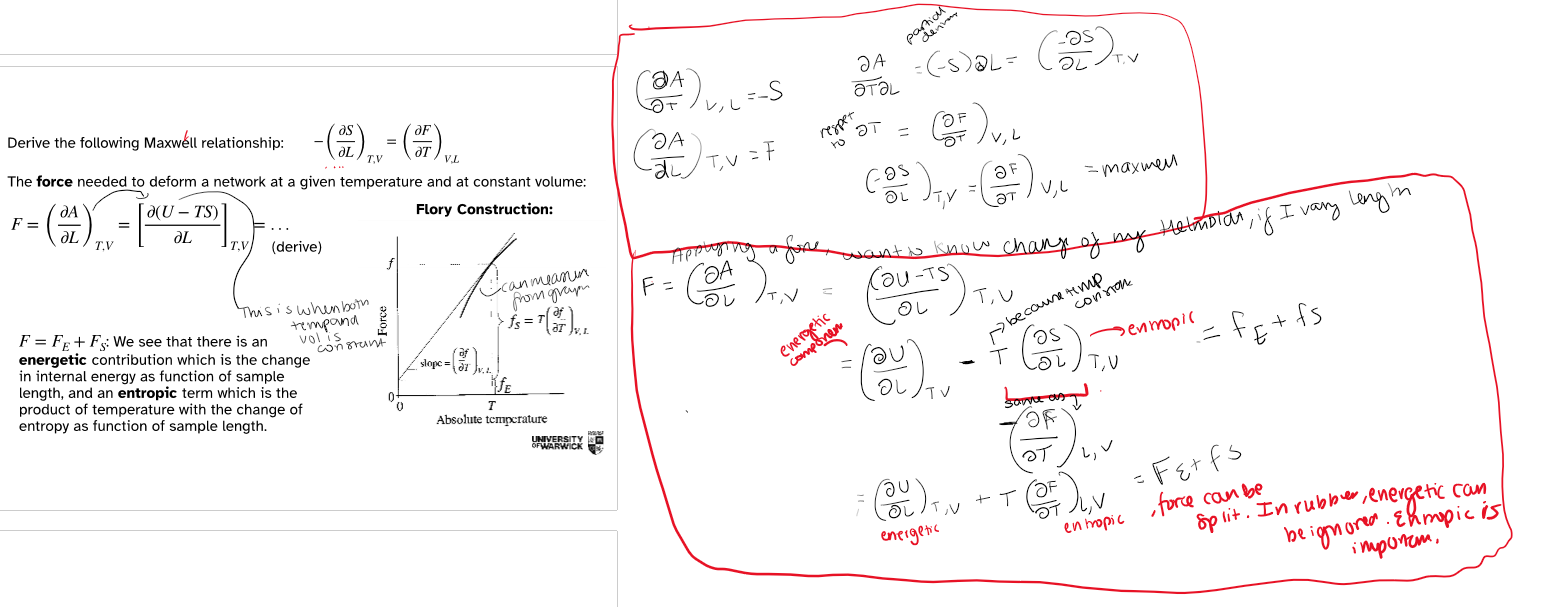
What does the Flory construction graph show?
The graph separates the total force into two parts.
y-intercept = energetic force (FE)
Slope = entropic force (FS)
As temperature increases,
entropic force increases
total force increases
The graph allows FE and FS to be measured separately.
Which force dominates in rubber elasticity?
For most elastomers,
FS≫FE
The energetic contribution can often be neglected.
Rubber behaves elastically mainly because stretching reduces entropy, so the chains naturally recoil to regain their random configuration.
when neglecting energetic force what does the new become
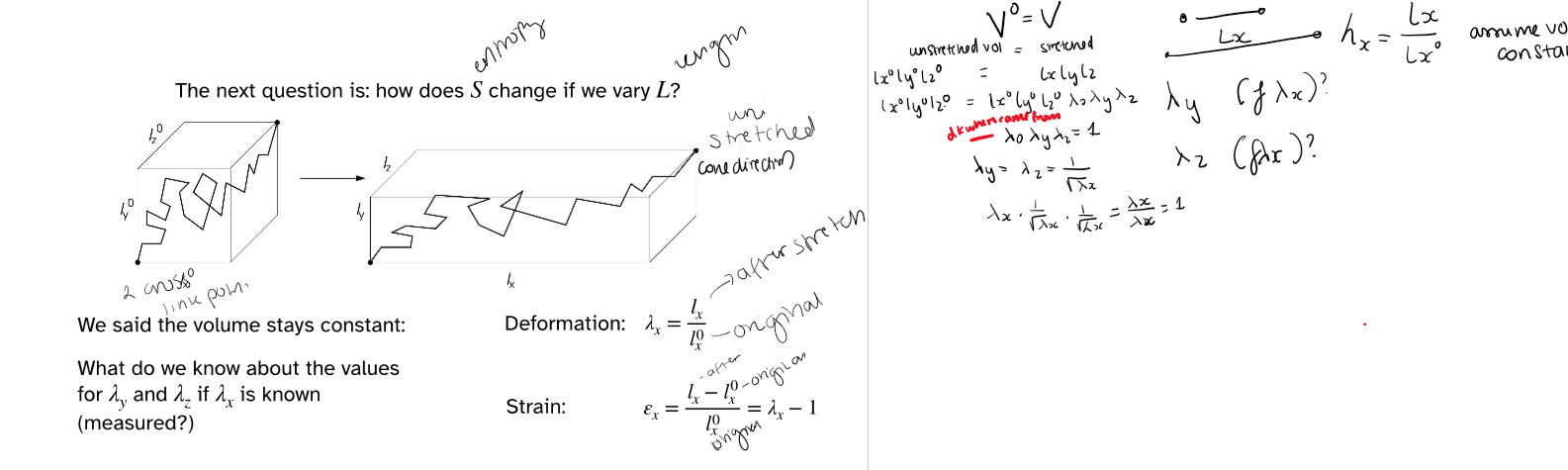
how the entropy changes when a polymer network is stretched
Stretch polymer → entropy decreases → free energy changes → restoring force appears.
What is the stretch ratio (λ)?
The stretch ratio tells us how much longer the sample has become.
λx=lx/lx0
Why do λy and λz decrease when λx increases?
Rubber is assumed to have constant volume.
If it gets longer in the x-direction, it must become thinner in the y- and z-directions.
Because:
λxλyλz=1
For uniaxial stretching:
λy=λz=1/ sqr root of λx
👉 Stretch longer → gets thinner
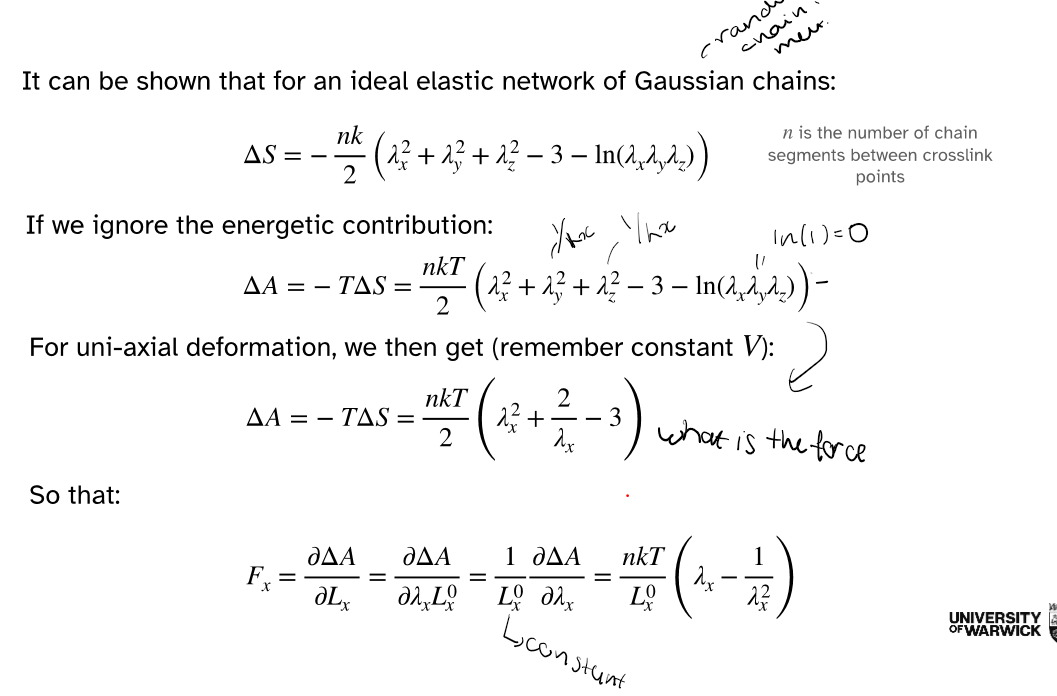
What happens to the polymer chains when rubber is stretched?
Before stretching:
Random coils
High entropy
After stretching:
Chains become straighter
Less random
Lower entropy
This decrease in entropy creates the restoring force.
What is the force equation of ideal rubber
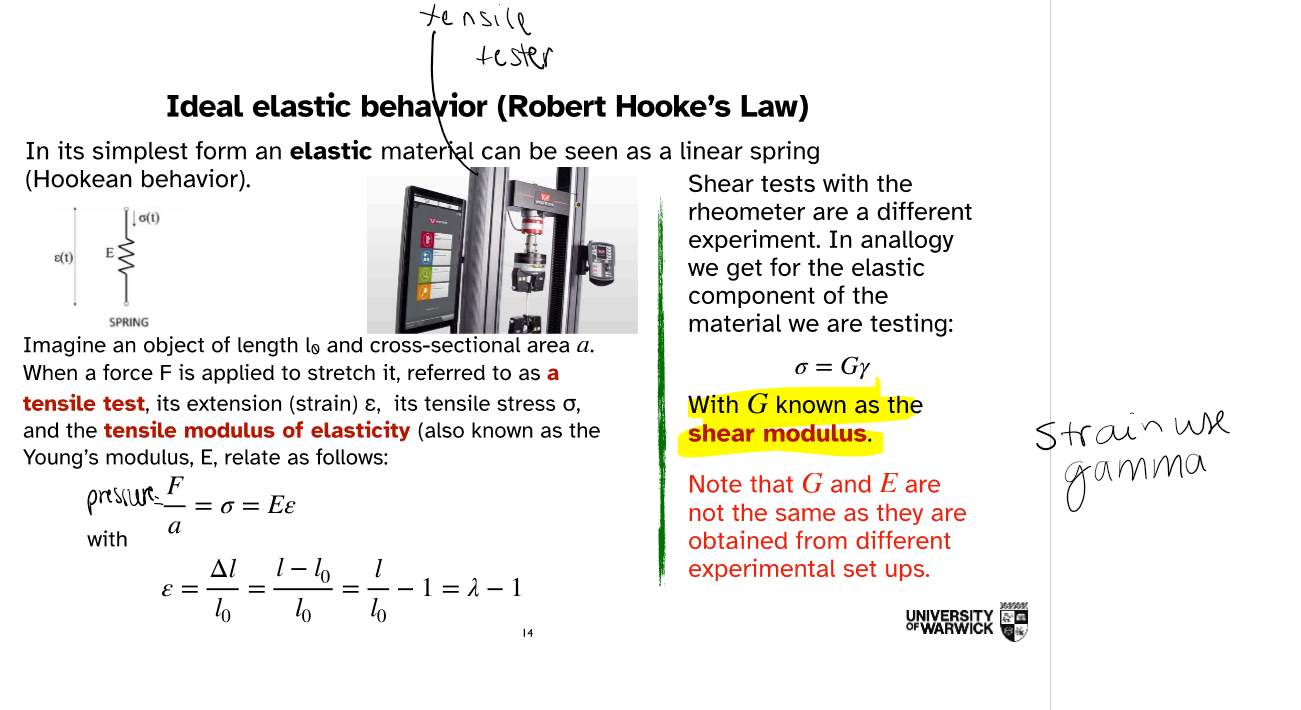
To introduce Hooke's Law, which describes ideal elastic behaviour, and show that polymers can be characterised using either:
Tensile testing (stretching)
Shear testing (twisting)
Both measure elasticity but use different types of deformation.
What is Hooke's Law in a tensile test?
For an ideal elastic material:
σ=Eε
where:
σ = tensile stress (force per unit area)
ε = tensile strain (how much it stretches)
E = Young's modulus (stiffness)
👉 Bigger E = stiffer material.
What are stress and strain?
Stress (σ)
Force applied per unit area.
σ=F/A
Strain (ε)
How much the material stretches compared to its original length.
ε=Δl/l0=λ−1
Think:
"How much longer did it become?"
What is the equivalent Hooke's Law for shear deformation?
For shear (twisting):
σ=Gγ
where:
G = shear modulus
γ = shear strain
This is measured using a rheometer, not a tensile tester.
What is the difference between Young's modulus (E) and shear modulus (G)?
Young's modulus (E) | Shear modulus (G) |
|---|---|
Measured by stretching (tensile test) | Measured by twisting (shear/rheometer test) |
Uses tensile strain (ε) | Uses shear strain (γ) |
Measures resistance to stretching | Measures resistance to shearing |
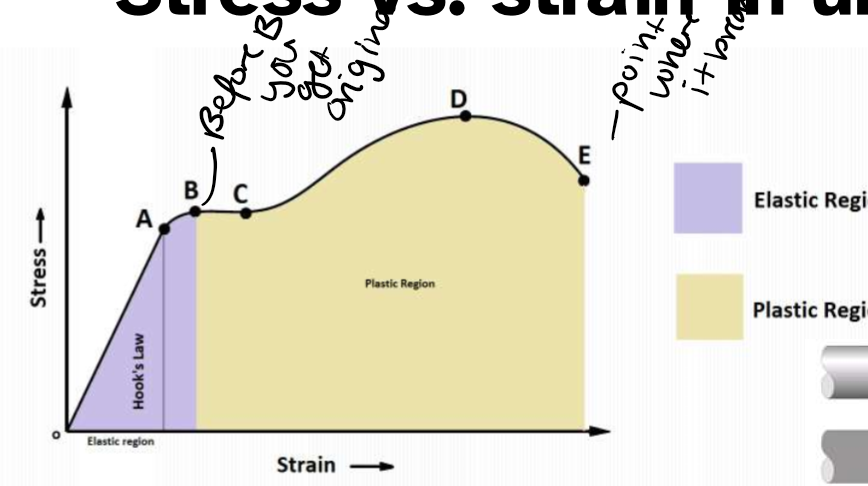
whats happening in each letter
0-A: ideal elastic behaviour
A-B: non linear elastic behaviour
B-C: non elastic deformation starts :ductility
c-d : strain hardening up to break stress point
D-E: necking up to the fracture failure point E
Difference between strength, toughness and hardness in terms of the graph
strength: ability of a material to withstand applied load. Yield strength (B: No plastic deformatio), tensile strength D , fracture E
Toughness: ability of a material to absorb energy without fracture, area under curve,
Hardness: ability of a material to resist plastic deformation (ductility)
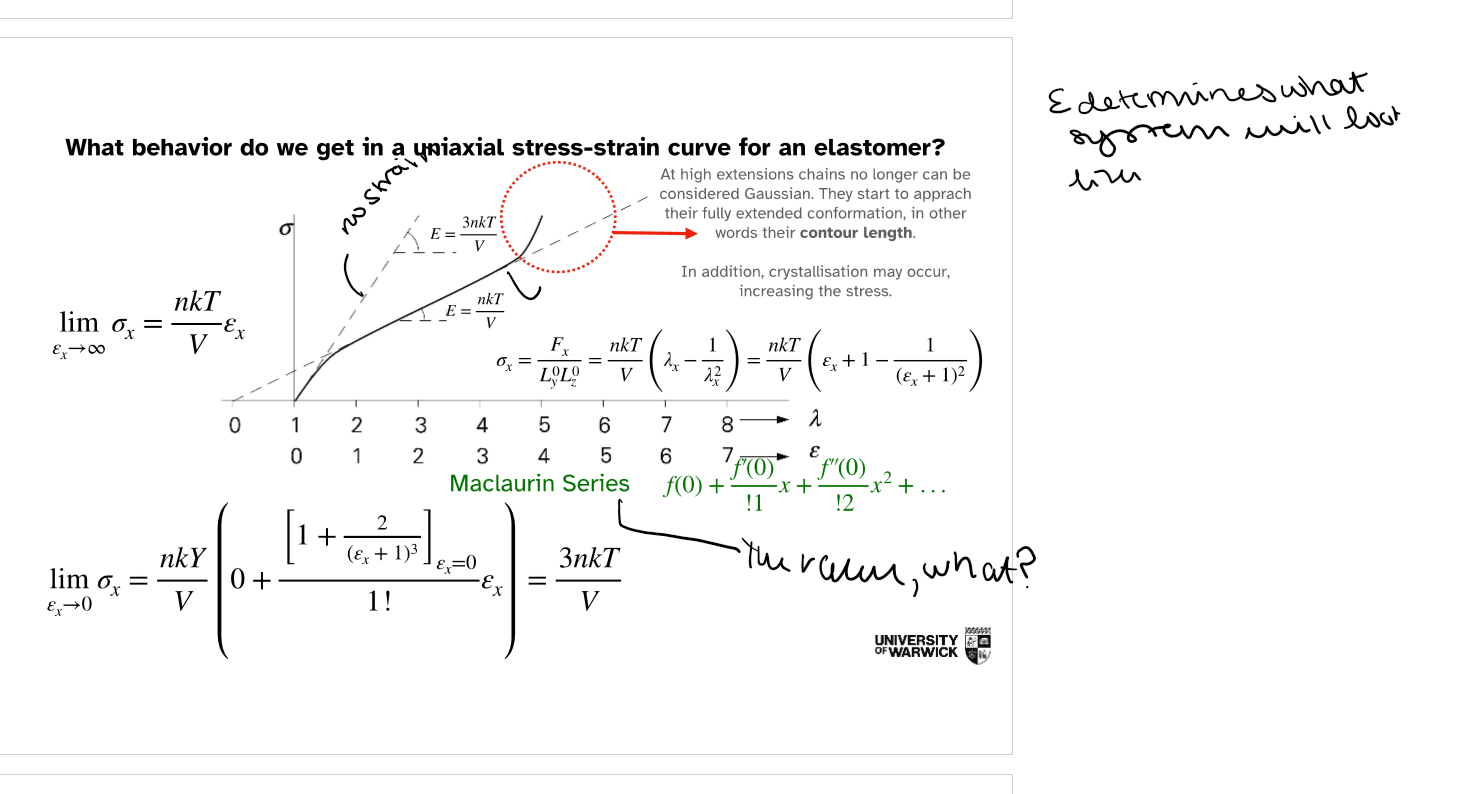
What is the main purpose of this slide?
To explain how an elastomer responds when it is stretched and why the stress-strain curve changes shape at different amounts of strain.
Why is the stress-strain curve initially linear?
At small strains, polymer chains are still mostly randomly coiled.
Only a small amount of stretching occurs, so the elastomer behaves like an ideal spring and follows Hooke's law.
Why does the stress continue to increase at moderate strain?
As the rubber is stretched:
Polymer chains become more aligned.
Entropy decreases.
The chains resist further stretching.
The restoring force is mainly entropic.
This is the normal rubber-elastic region.
Why does the stress increase sharply at very high strain?
At very large extensions:
Polymer chains are almost fully stretched.
They approach their contour length (maximum possible length).
They can no longer behave as Gaussian coils.
Much larger forces are needed for additional stretching, so the stress rises rapidly.
Some polymers may also undergo strain-induced crystallisation, increasing the stress even further
What is the contour length of a polymer chain?
The contour length is the maximum possible length of a polymer chain when every bond is fully extended.
Once a chain approaches its contour length, it cannot straighten much further.
Describe the three regions of an elastomer stress-strain curve.
Region | What's happening? |
|---|---|
Small strain | Nearly linear (Hookean), random coils begin to stretch. |
Moderate strain | Chains align, entropy decreases, rubber elasticity dominates. |
Large strain | Chains approach contour length, stress rises rapidly, crystallisation may occur. |
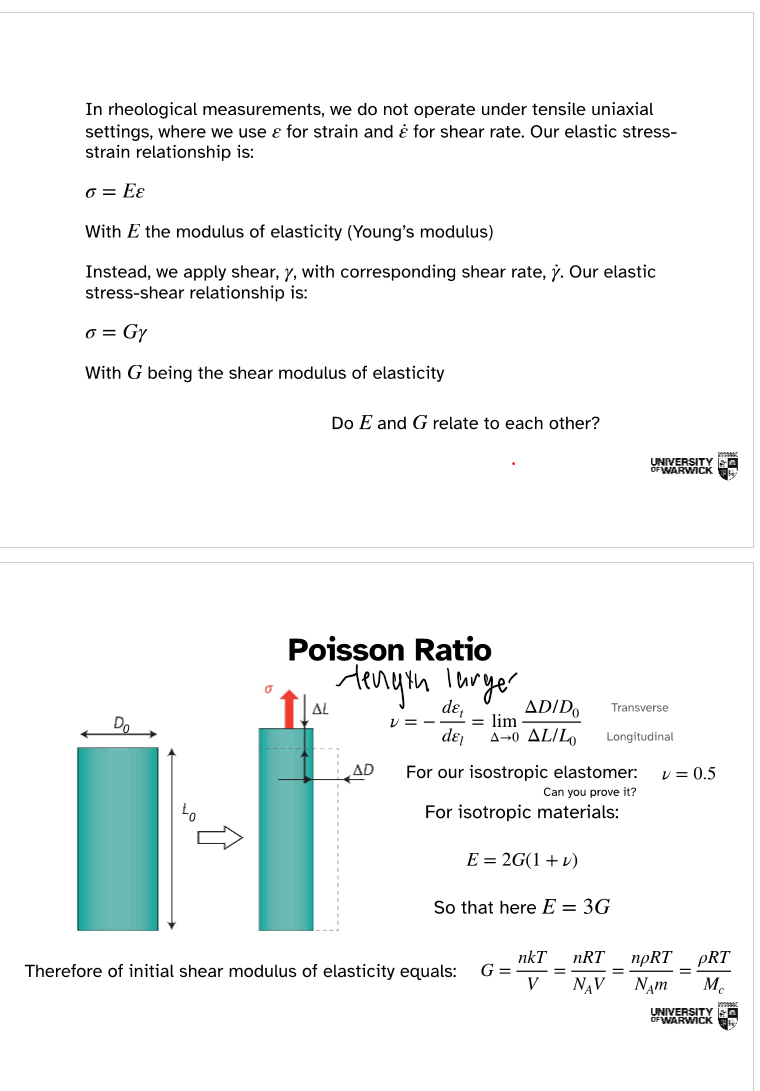
What is the main purpose of these slides?
To show that:
Tensile tests measure Young's modulus (E).
Rheometers measure shear modulus (G).
For isotropic elastomers, E and G are directly related, so information from one test can be converted to the other.
What is the difference between tensile and shear deformation?
Q: What is the difference between tensile and shear deformation?
A:
Tensile test
Pull the sample.
Measures stretching.
Uses:
σ=Eε
Shear test
Twist or slide the sample.
Measures shearing.
Uses:
σ=Gγ
👉 Same idea (stress vs deformation), just different types of deformation
What is Poisson's ratio (ν)?
A:
Poisson's ratio measures how much thinner a material becomes when stretched.
For example:
Stretch a rubber band:
⬆ Length increases
⬅➡ Width decreases
Poisson's ratio compares these two changes.
Why is the Poisson ratio of rubber approximately 0.5?
Rubber is assumed to be incompressible.
This means:
Its volume stays constant.
When stretched longer, it becomes proportionally thinner.
Therefore,
ν=0.5
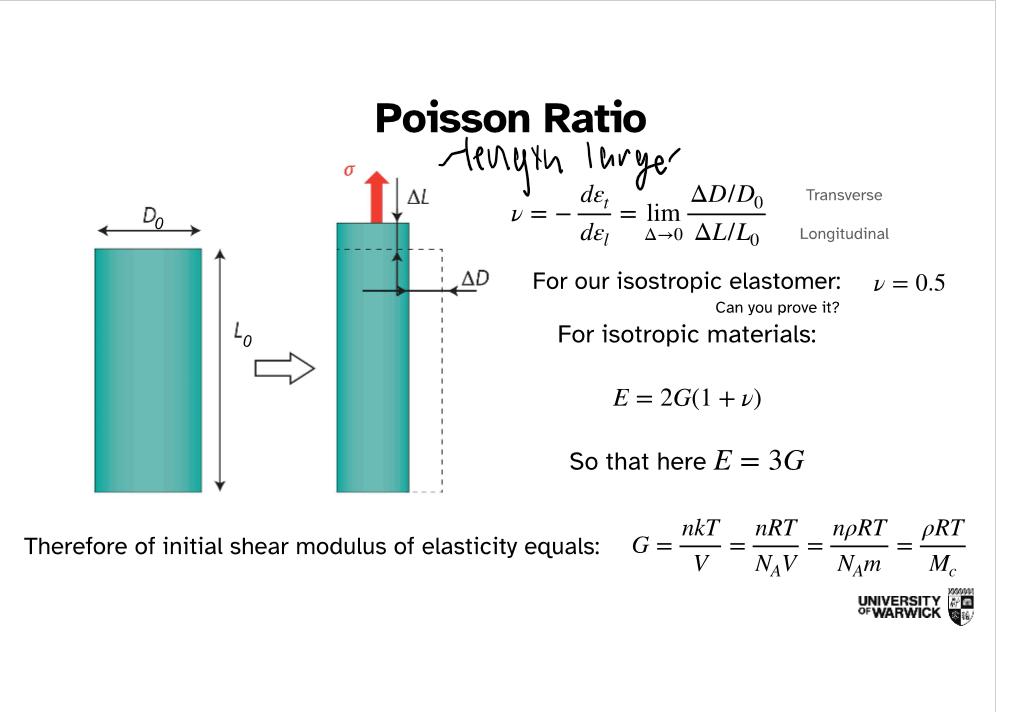
How are Young's modulus and shear modulus related?
A:
For isotropic materials:
E=2G(1+ν)
Since rubber has
ν=0.5
then
E=3G
Why is the equation G=ρRT/Mc
t links a measurable mechanical property (shear modulus) to the polymer network structure.
Specifically:
Higher G → stiffer rubber.
Smaller Mc (shorter chains between crosslinks) → more crosslinks → stiffer rubber.
👉 This equation lets us estimate the crosslink density of a polymer from mechanical testing.
Why does a chemically crosslinked elastomer remain rubbery when heated?
The permanent covalent crosslinks stop the polymer chains from sliding past one another.
Even above Tg:
chains can move locally,
but cannot flow.
Therefore the material remains an elastic rubber instead of becoming a liquid.
What happens to a polymer that is NOT chemically crosslinked when heated?
A:
A:
Initially, it behaves like rubber because of chain entanglements.
However, over time:
chains disentangle,
polymer flows,
so the material undergoes a rubber-to-liquid transition.
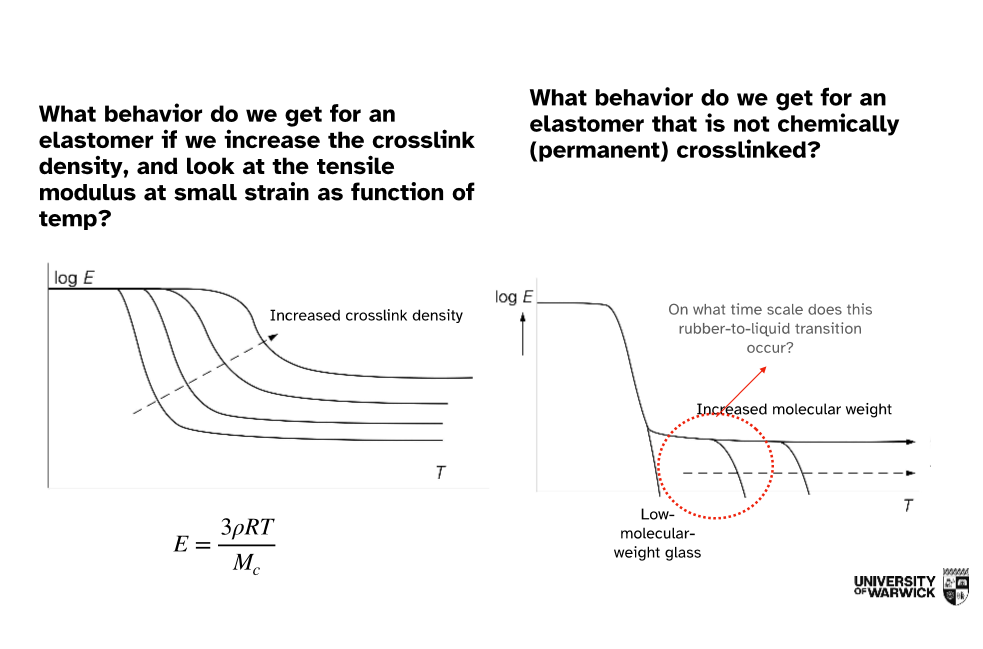
Compare chemically crosslinked and non-crosslinked elastomers.
Chemically crosslinked | Not chemically crosslinked |
|---|---|
Permanent covalent crosslinks | Temporary chain entanglements |
Cannot flow when heated | Eventually flows if given enough time |
Remains rubbery | Rubber → liquid transition |
More crosslinks = stiffer rubber | Higher molecular weight delays flow |
what is stress defined as
force per unit area and its represented by sigma.
whats shear strain
change in x over change in y, has symbol dot gamma.
newton law of vision equation
σ=ηγ*
sigma= stress
n= viscosity
y*= shear rate
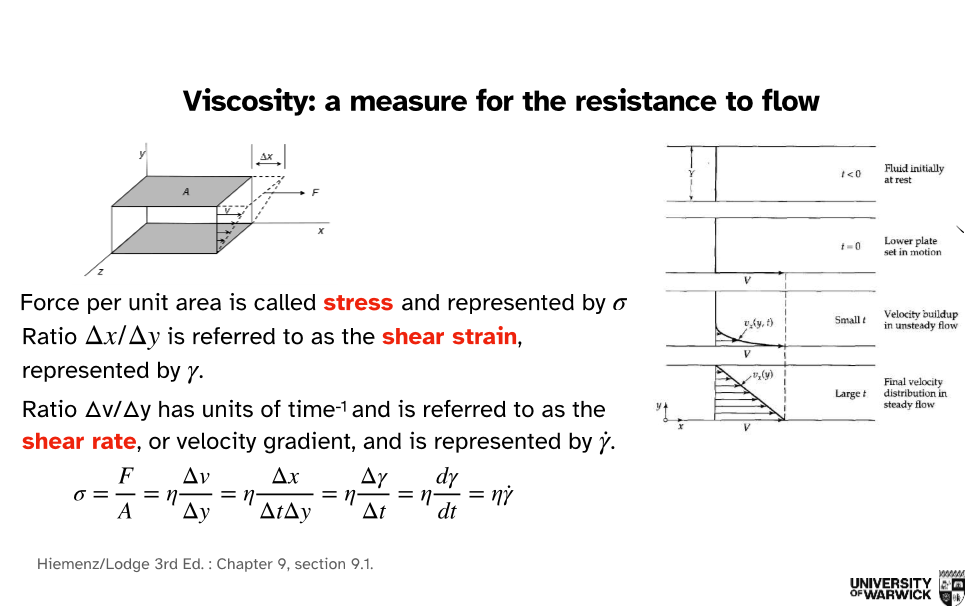
technique to measure viscosity
bottom plate is fixed. top moves. but velocity is changed through the liquid. push hard on big surface, low stress
stress equation
σ=F/A
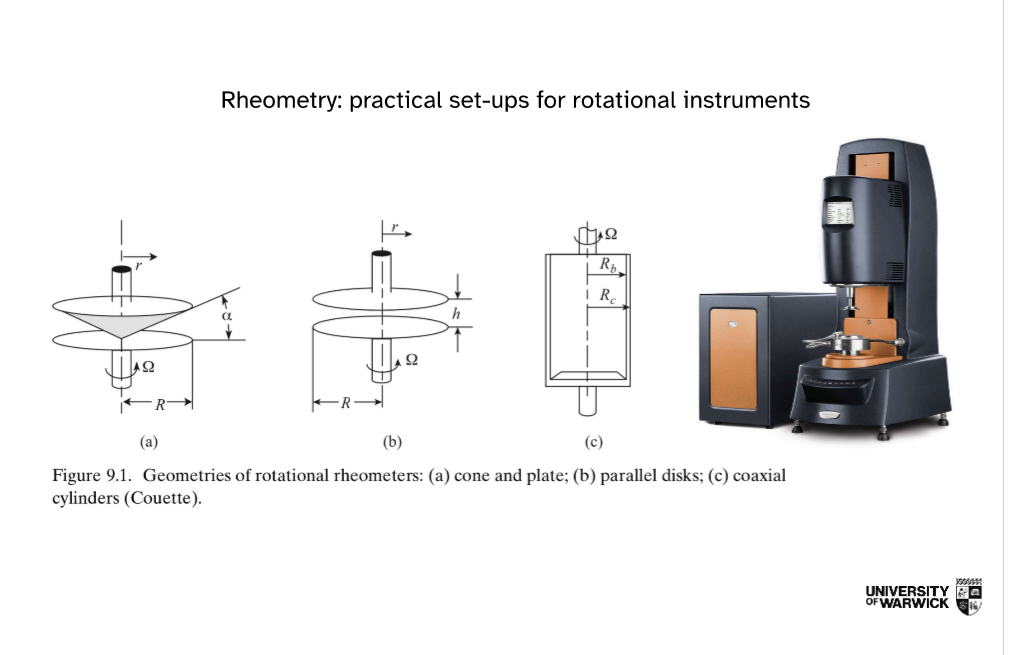
explain how a b c works
a)sample between cone and plate. 2degree angle.
adv:shear rate is uniform,
suspect to scratches
b)2 flat plates
easy for gel soft solid polymers mels
dis:shear rate is not uniform bc centre barely moves fastst at edge
c)very good for liquid/ low viscous samples
tiny gap between cylinder. behaves almost like infinite plate. needs larger sample
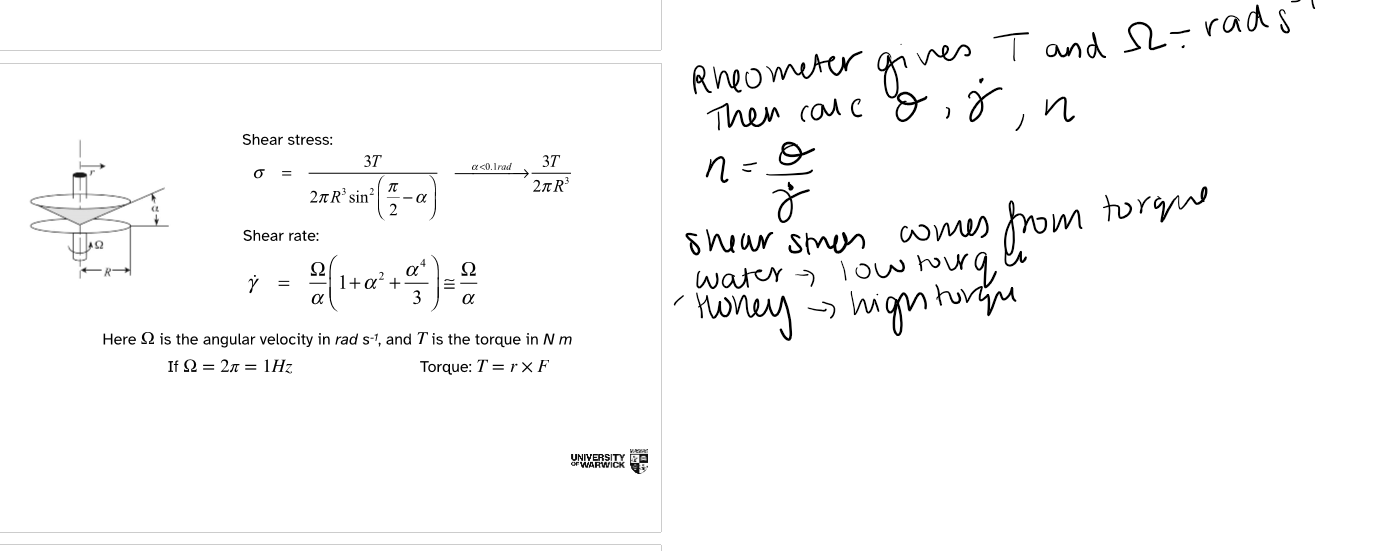
rheometer measures torque. how hard a motor works to rotate
using the cone method, what info can we get from it
shear stress, measures torque angular velocityΩ.
then use that to measure viscosity. and so on
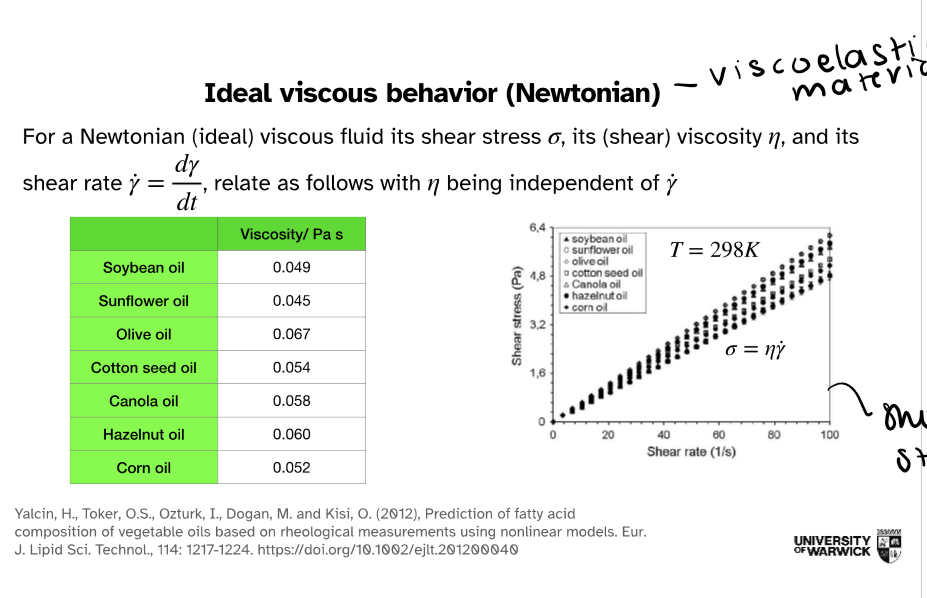
whats interpreted from this
ideal behaviours, will show a linear graph. through which we can calculate viscosity from the slope, showing ideal newtonian behaviour
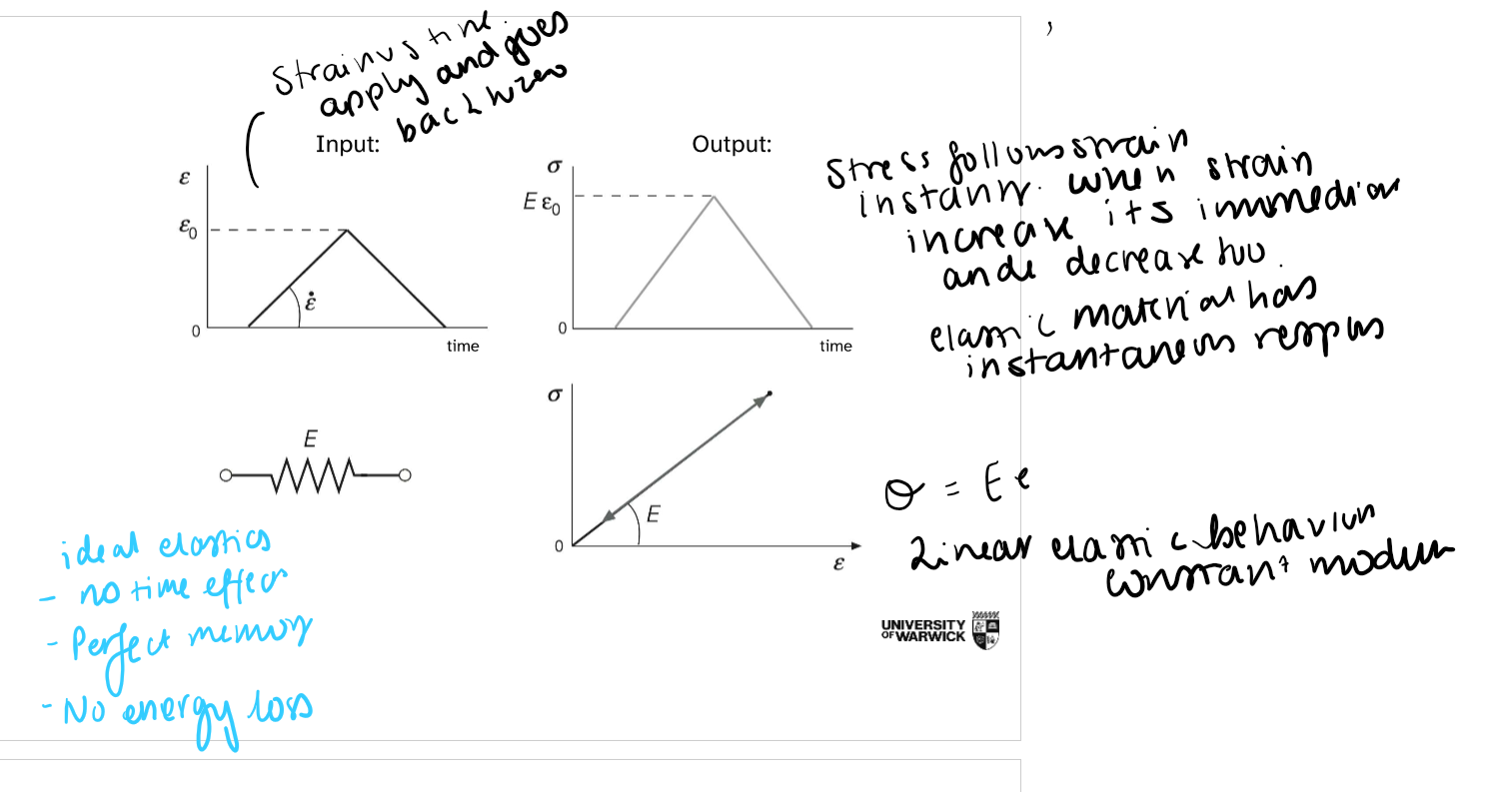
how are ideal elastic behaviours represented here
shows that it goes back to its original form
stress follows strain instantly
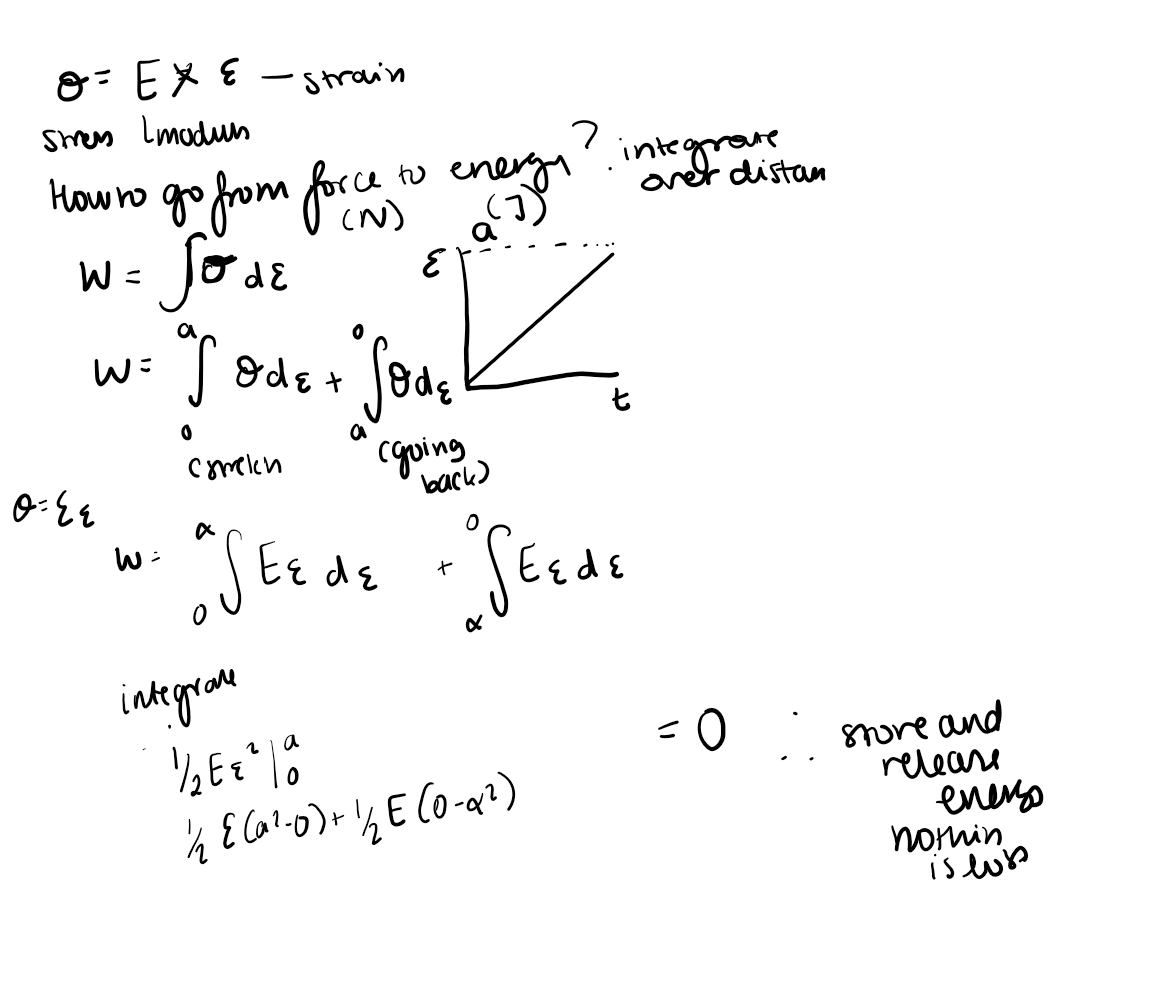
meaning that energy isnt wasted as heat, it goes back, has perfect memoery. linear elastic behaviour is constant modulus (E)
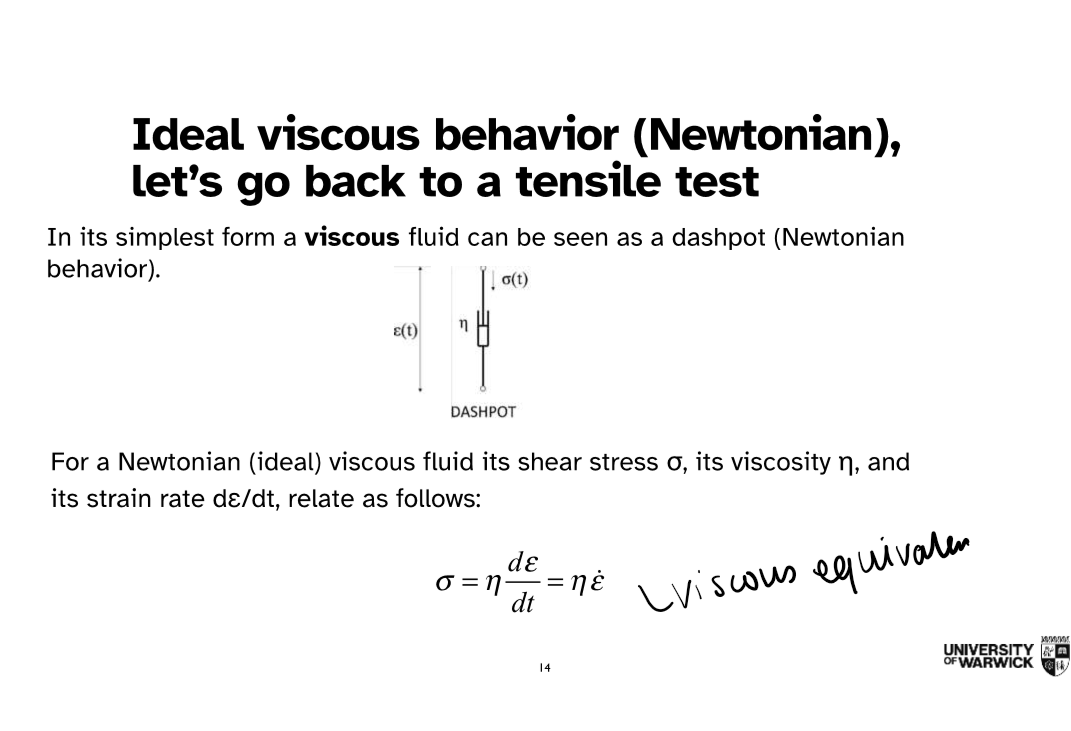
through dashpot method, what can we interpret out of it
dashpot model:
viscous fluid as dashpot
syringe with thick liquid inside piston movin thru honey.
Difference
elastic σ=Eε
stress depends on deformation
viscous: σ=ηε*
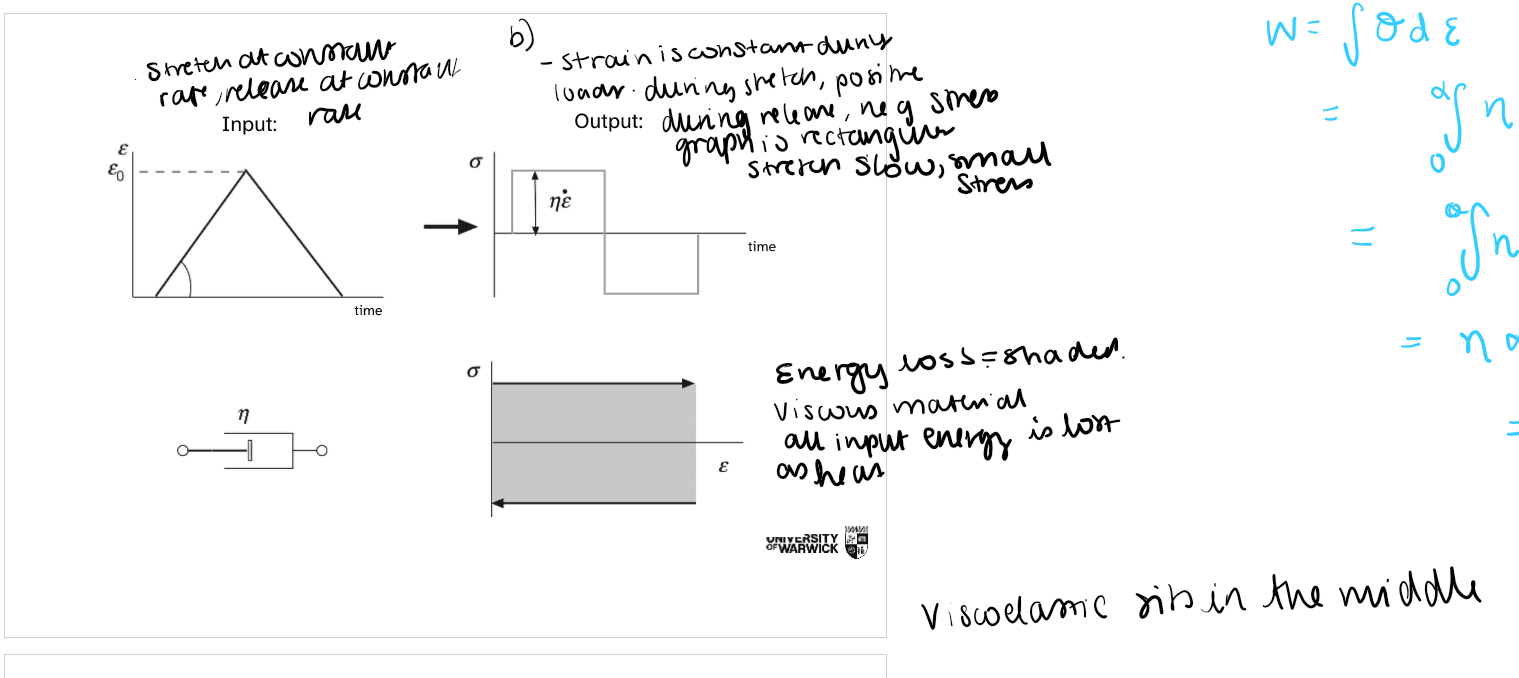
difference between newtonian fluid and ideal elastic behaviours
newtonian fluid does not have a memoery. when deformation stops, shear stress will dissappear and the fluid will not return to original configuration
all of W is dissipated
no stress normal to the direction of shear strain is present
What are the key characteristics of a Newtonian fluid?
A Newtonian fluid has a constant viscosity.
This means:
Viscosity does not change with shear rate.
Viscosity does not depend on how long it has been sheared.
Once shearing stops, the stress disappears immediately.
Examples: Water, air, glycerol (approximately).
How can you recognise a non-Newtonian fluid?
A fluid is non-Newtonian if it deviates from Newtonian behaviour.
For example:
Viscosity changes with shear rate.
Viscosity changes over time while shearing.
The material retains stress after shearing stops (elastic effects).
👉 Any deviation from constant viscosity = non-Newtonian behaviour.
What is Trouton's ratio?
For a Newtonian fluid,
Extensional viscosity=3×Shear viscosity
This constant ratio of 3 is called Trouton's ratio.
You usually only need to remember:
Newtonian fluids have a Trouton's ratio of 3.
Example of a psuedoplastic fluid
paint, printing ink
What is shear thinning (pseudoplastic) behaviour?
A shear-thinning fluid is a non-Newtonian fluid whose viscosity decreases as the shear rate increases.
Low shear rate → high viscosity
High shear rate → low viscosity
Why? As the fluid is sheared faster, polymer chains become aligned with the flow, so they slide past each other more easily.
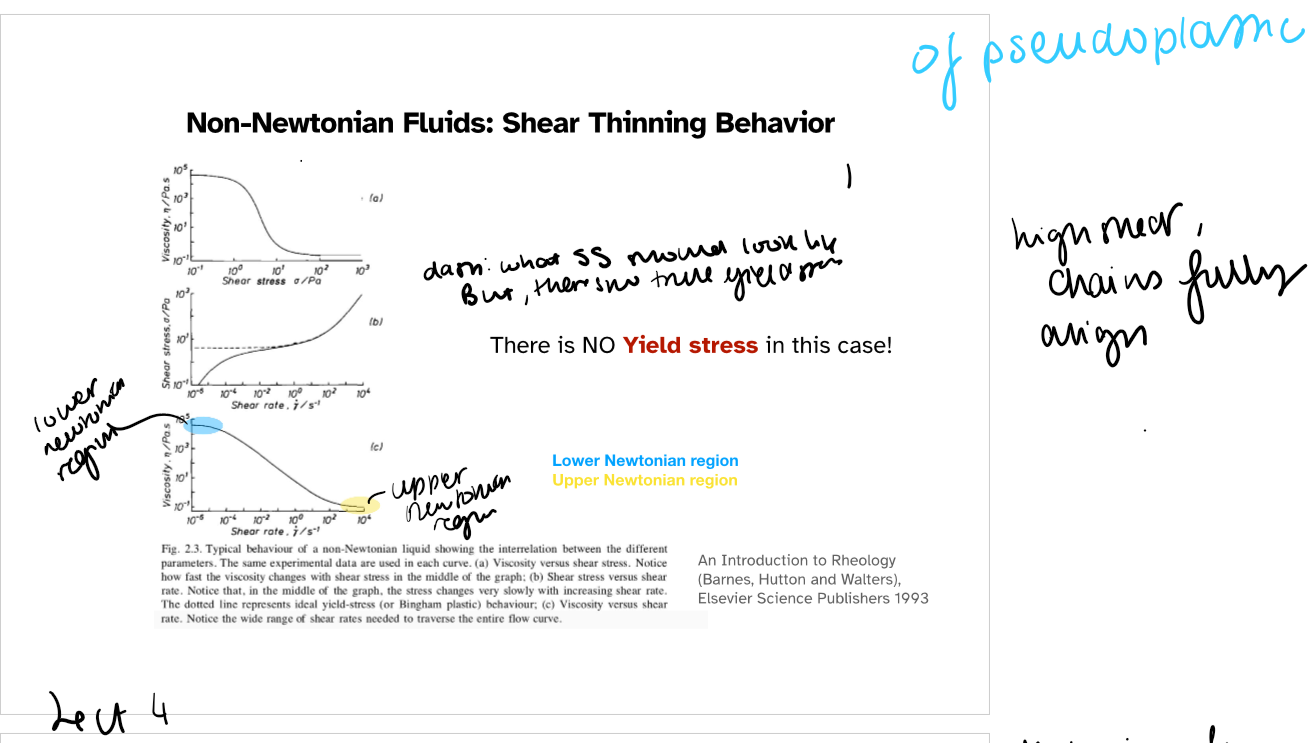
: What do the lower and upper Newtonian regions represent?
A:
Lower Newtonian region: At very low shear rates, viscosity is constant because the polymer chains are randomly coiled and not yet affected by the flow.
Upper Newtonian region: At very high shear rates, viscosity becomes constant again because the polymer chains are fully aligned, so further increases in shear rate no longer change the viscosity.
👉 Shear thinning only occurs between these two regions.
Does a shear-thinning fluid have a yield stress?
A shear-thinning fluid starts flowing as soon as any stress is applied.
This distinguishes it from a yield-stress fluid (e.g. toothpaste), which requires a minimum stress before it begins to flow.
Exam tip: Shear thinning ≠ yield stress. They are different non-Newtonian behaviours.
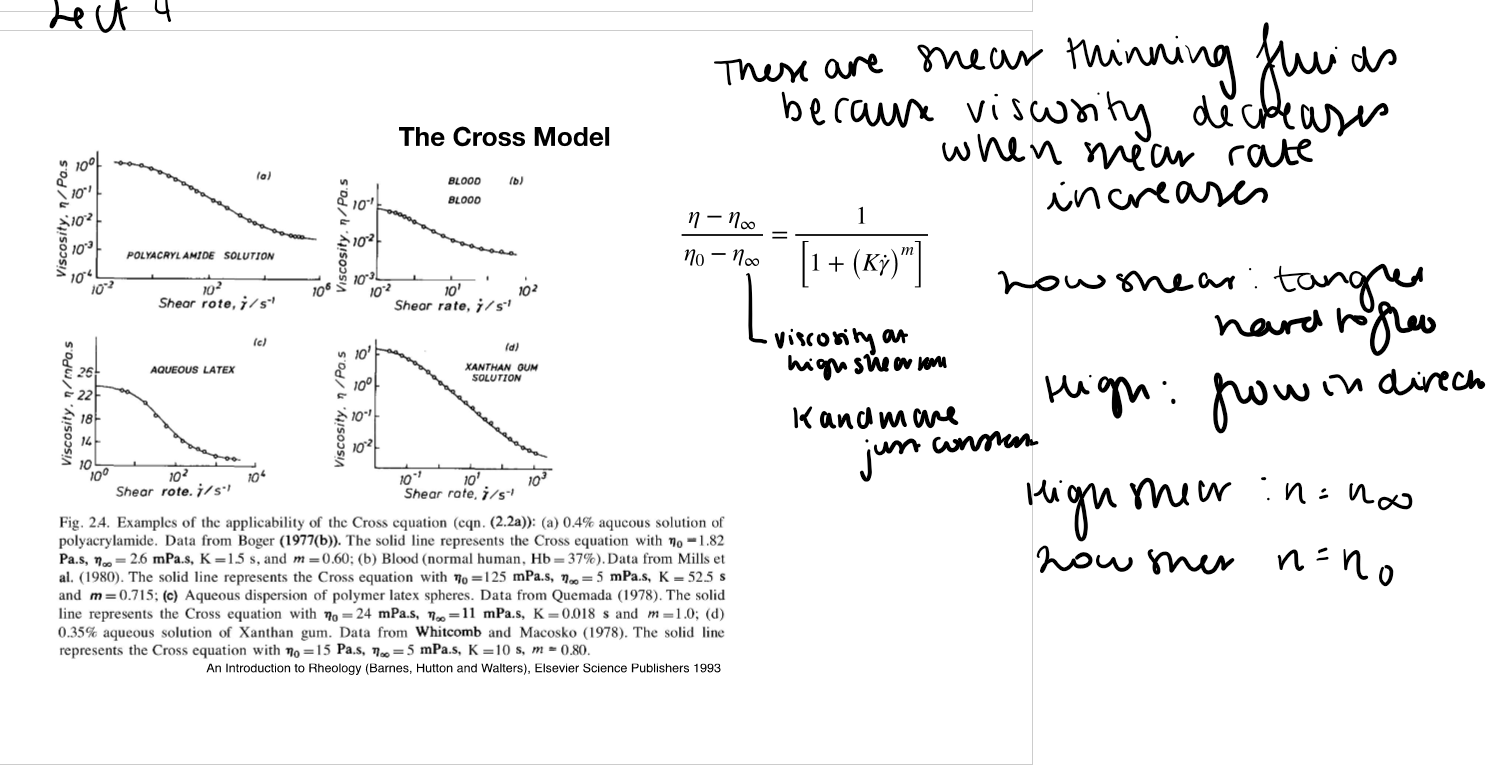
whats the cross model
The Cross model describes how the viscosity of a shear-thinning fluid changes with shear rate.
It predicts that:
Low shear rate → high viscosity (η₀)
Increasing shear rate → viscosity decreases
Very high shear rate → viscosity reaches a constant minimum (η∞)
What do η₀ and η∞ represent in the Cross model?
A:
η₀ = zero-shear viscosity (viscosity before the fluid is significantly sheared).
η∞ = infinite-shear viscosity (minimum viscosity after the polymer chains have become fully aligned).
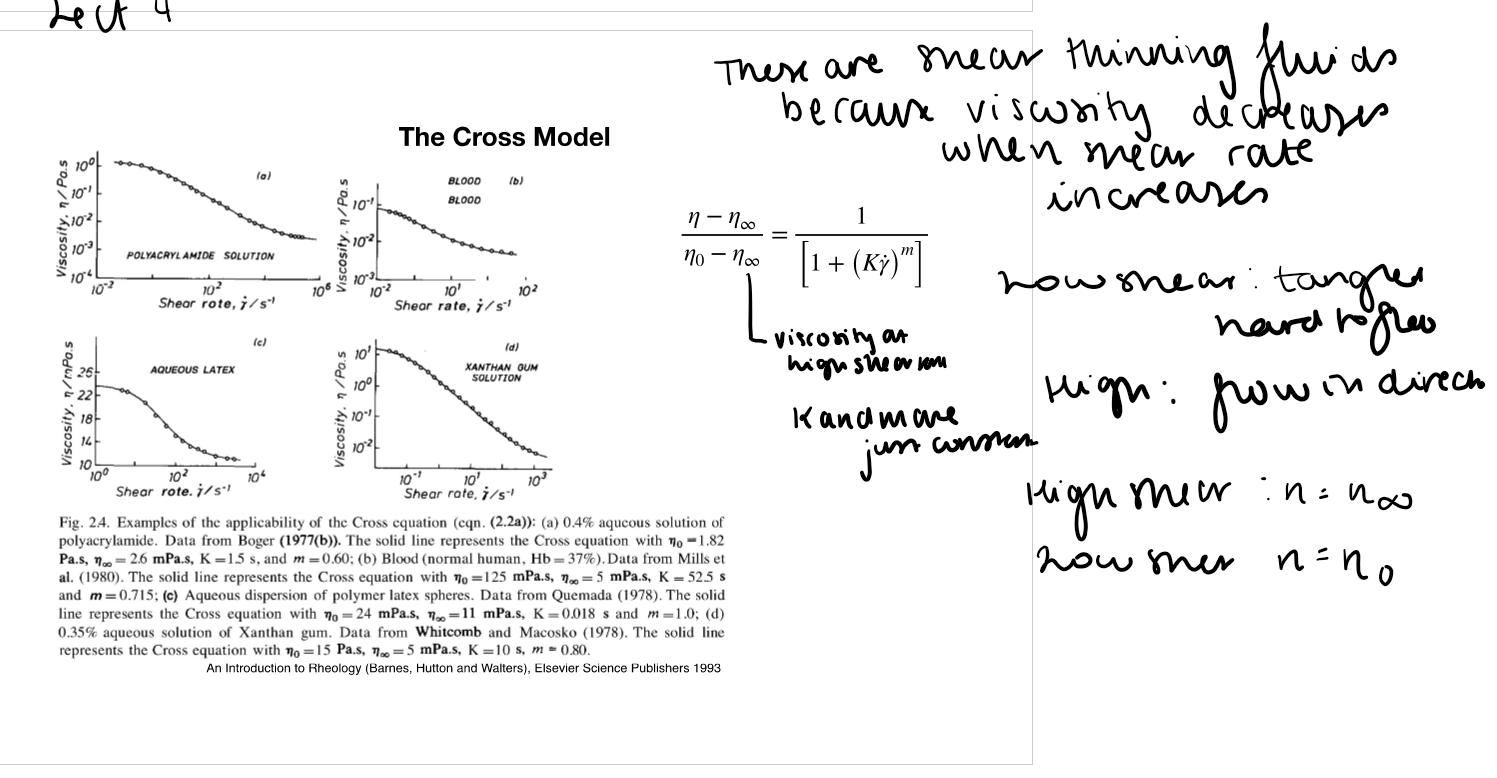
variables in cross model
η = viscosity at the current shear rate
η₀ = viscosity at zero (very low) shear rate
η∞ = viscosity at infinite (very high) shear rate
K = time constant (controls where shear thinning begins)
γ̇ = shear rate
m = controls how strongly the viscosity drops
whats thixotrophy
a gradual decrease of the viscosity under shear stress followed by gradual recovery of structure when the stress is removed.
apply stress→viscosity slows decrea
remove→ viscosity slowly rises
negative thixotrophy is when gradual increase of viscosity when followed by recovery
whats the time effect for certain materials
some materials dont depend on shear stress, it depends on the time it has been applied.
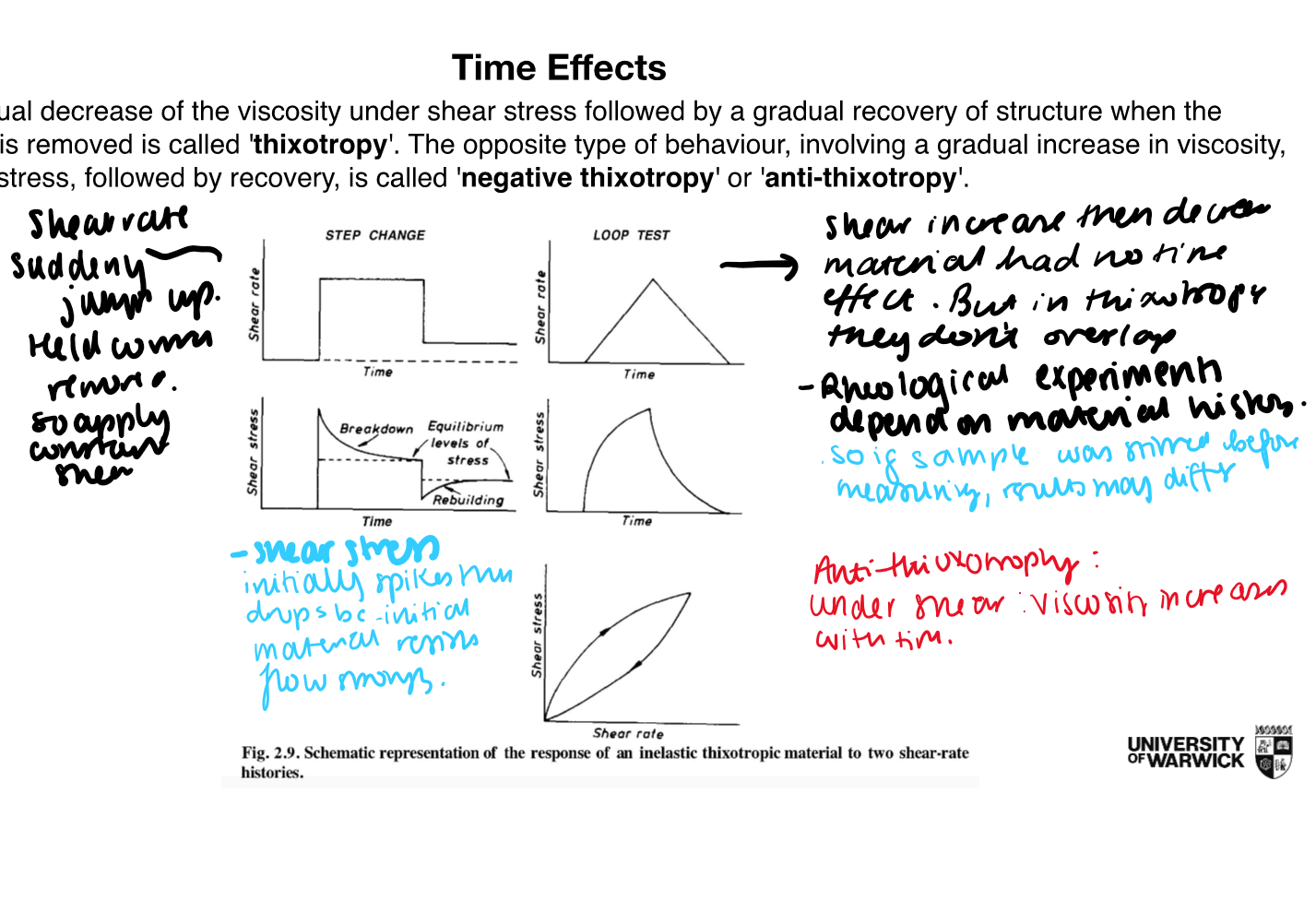
whats this showing
on your right,
in shear it increases and go back but
thixotrophy they dont overlap. so if sample was stirred befor measuring results may differ
c)under stress viscosity increases then goes back down.
so like a shake alone is thick, shake it structure breaks then leave alone goes back to its original
whats creep/retardation
when a viscoelastic material is exposed to constant stress (σ₀) its strainε will increase over time this is creep
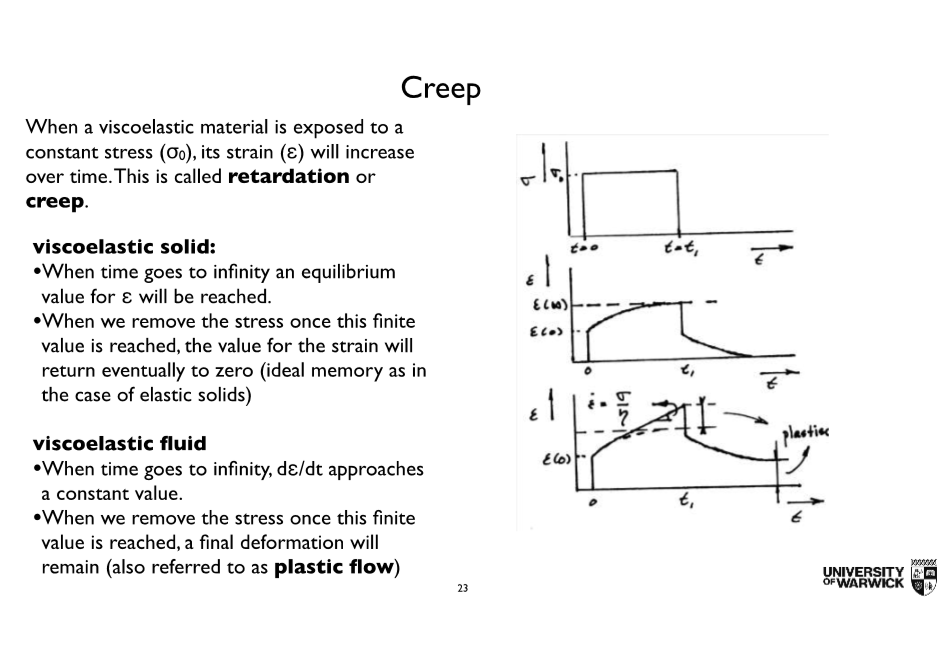
graph b and c explain how viscoelsatic solid and viscoelastic fluid differs
b)strain rises immediately
slow increase
plateus
remove stress and immediatabely drops. no permanent deformation in solid
c)immediate elastic jump
streain keeps increasing no plateau,stress is removed elastic part recovers quickly. viscous deformaton stays then permanenet deformation
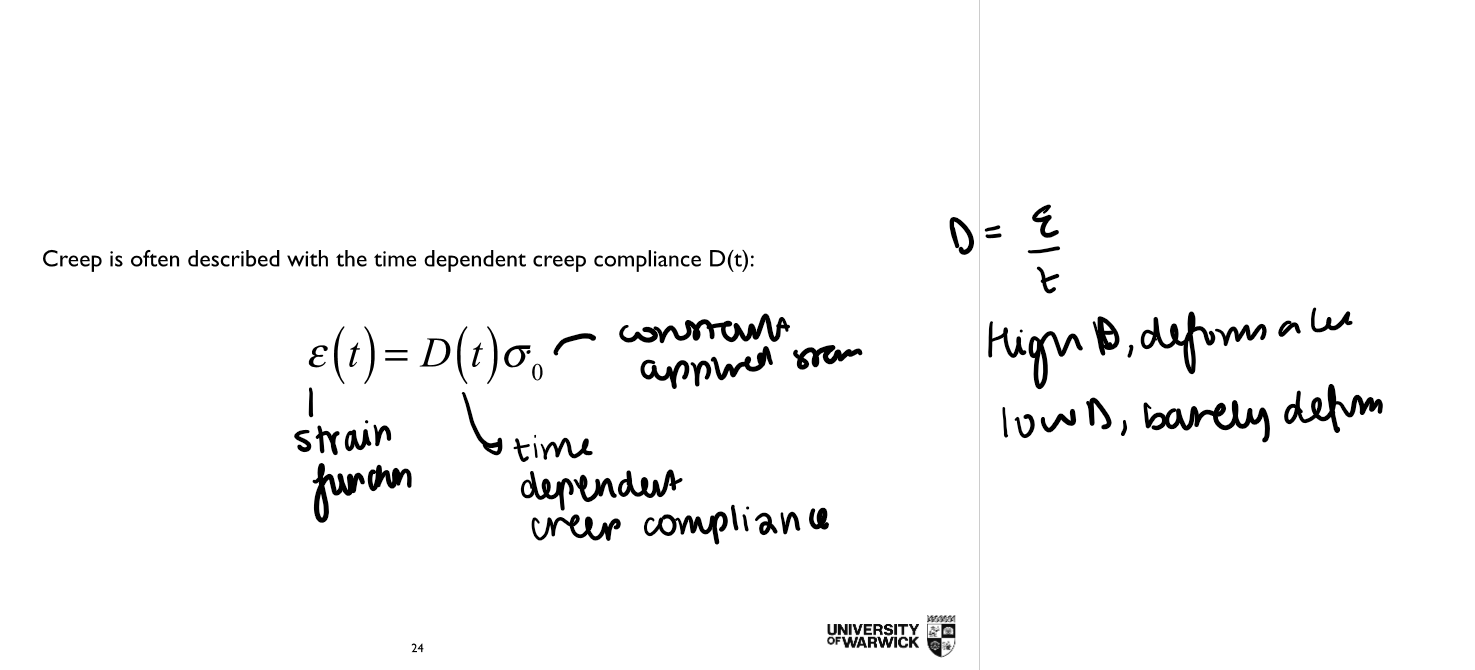
creeps is time dependant D (t) whats the euqaiton
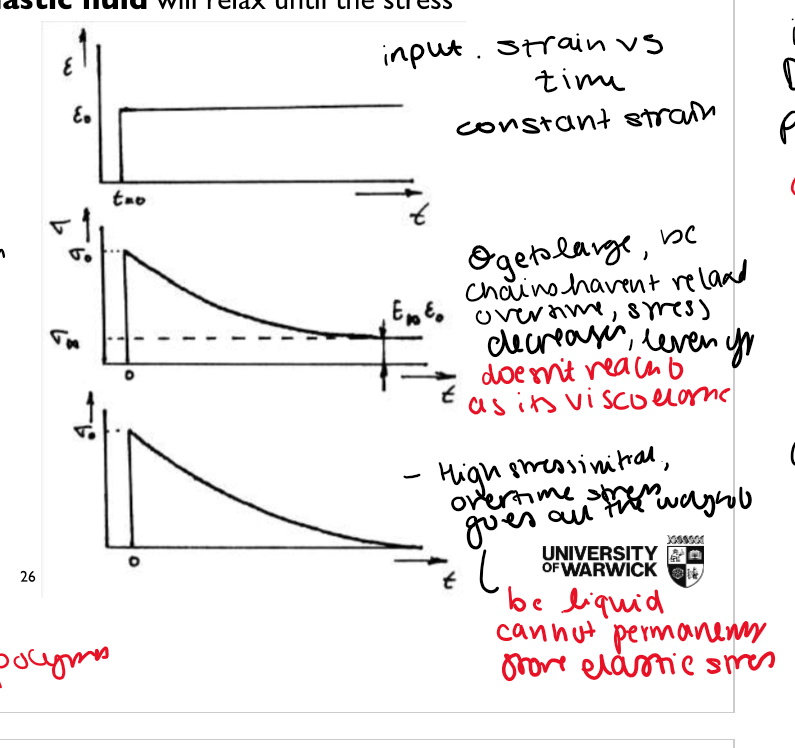
relaxation is often described with time dependant relaxationmodulus E(t). whats happening in each graph one is solid one is fluid
a) is strain vs time, constant strain.
b) σ gets large bc chains havent relaxed over time, stress decreases then elvels out, doesnt reach 0 as its viscoelastic
c)high stress initiated stress goes back to 0 bc liquid canot permanently store elastic stress
why does E not equal 1/D
this is only true in purely elastic material. not viscoelastic etc
in injecting moulding, based of that slide, whats it stating
polymer flow is quick in injection moulding. polymer melt flows quick, chain becomes stretched, then polymer cools instantly. no time to relax. so frozen like »»»» instead of - - - - - this is residual stress this is bad bc its weak points in manufacturing so manufacturs heat polymers above tg so chains can relax
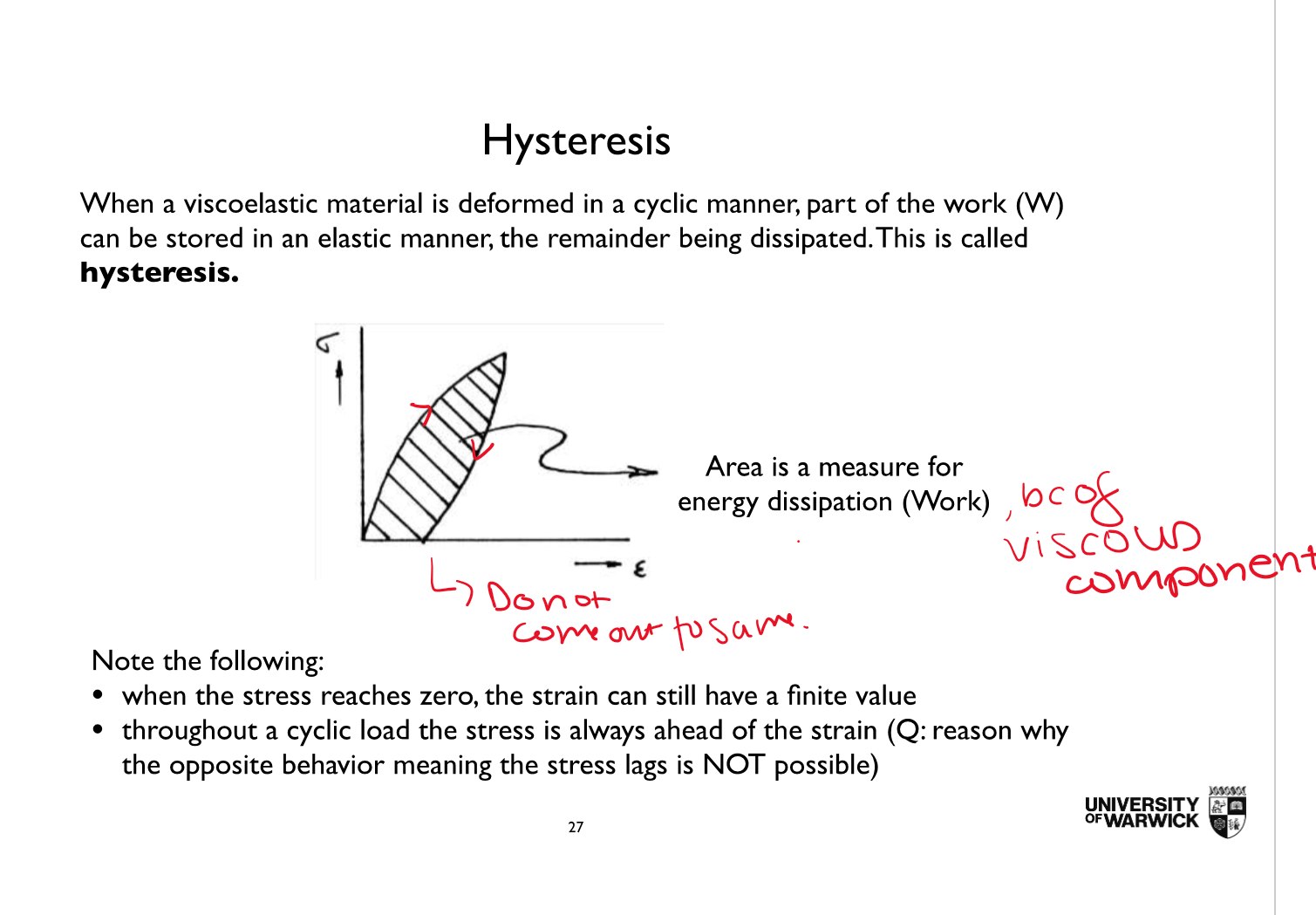
whats hysterisis
viscoelastic solids can have part work stores and then part energy dissipated. DOES NOT GO BACK to 0
when will a viscoelastic material behave linear
proportionaly: increasing the excitation gives proportional increase in response
superosition: response on combined excitation can be seen as the sum of the effects of each part
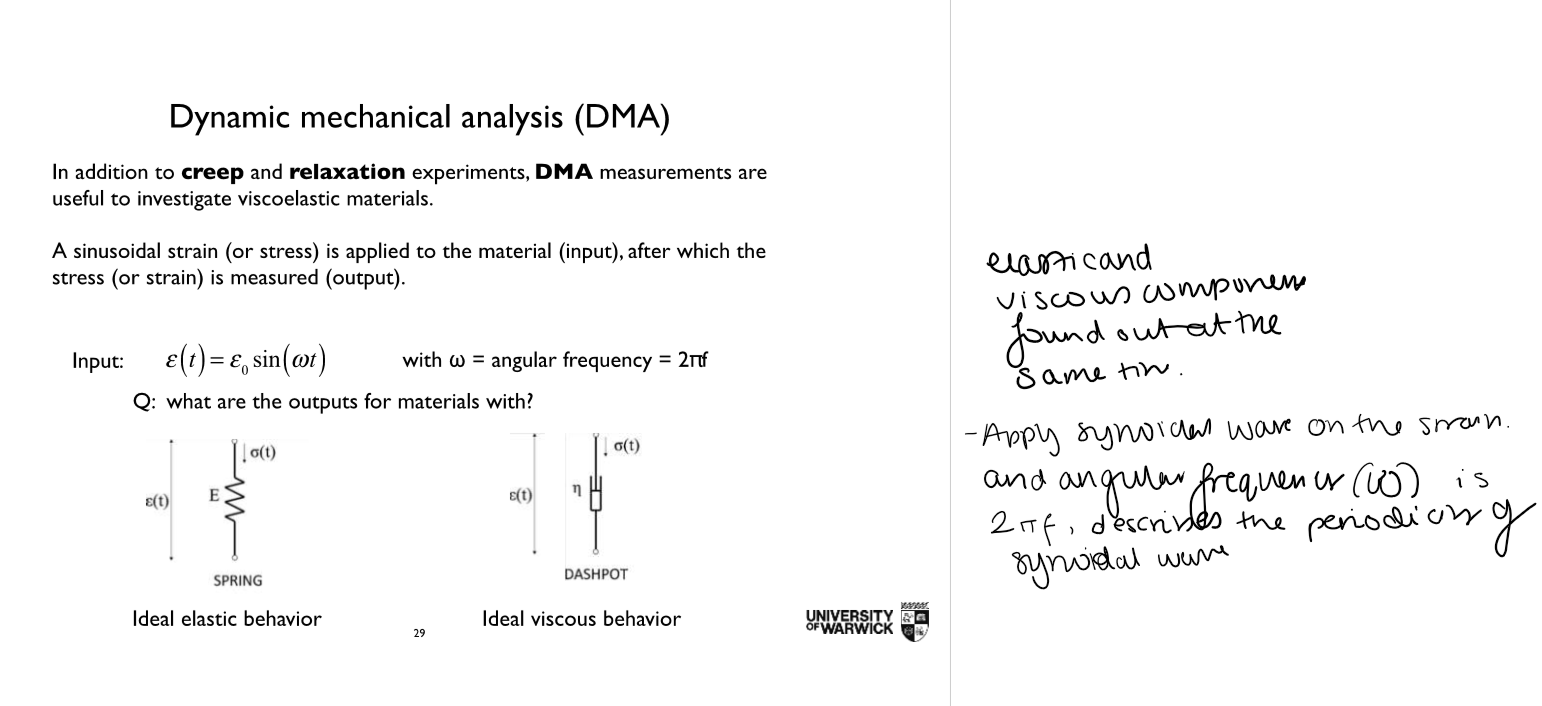
whats DMA
dynamic mechanical analysis, measure to see how useful viscoelastic materials are. a stress/strain is applied to a material after which the opposite strain or stress is measured
How do elastic, viscous and viscoelastic materials differ in oscillatory testing?
Elastic material: stress is in phase with strain.
Viscous material: stress is 90° out of phase with strain.
Viscoelastic material: stress leads strain by an intermediate phase angle (δ
What do the storage modulus (E') and loss modulus (E'') represent?
Storage modulus (E') = elastic behaviour (energy stored and recovered).
Loss modulus (E'') = viscous behaviour (energy dissipated as heat).
👉 High E' = more solid-like.
👉 High E'' = more liquid-like.
What does the phase angle (δ) tell us?
The phase angle tells us whether the material behaves more like a solid or a liquid.
δ = 0° → completely elastic.
δ = 90° → completely viscous.
Between 0° and 90° → viscoelastic.