Anatomy and Physiology Lab- Histology
 Call Kai
 Learn
Learn Practice Test
 Spaced Repetition
 Match
Match Flashcards
 Knowt Play
1/84

There's no tags or description
Looks like no tags are added yet.
Name | Mastery | Learn | Test | Matching | Spaced | Call with Kai | Chat |
|---|
No analytics yet
Send a link to your students to track their progress
85 Terms
Epithelium
Forms protective sheets that cover body surfaces, line cavities, and form glands
Epithelium Functions
Protection, absorption, filtration, and secretion
Connective
The most abundant tissue
Connective Functions
Wraps, cushions, protects, insulates, and binds other tissues together
Nervous
Highly specialized to receive stimuli and generate electrical signals across the body
Nervous Functions
Control, to send signals
Muscle
Specialized to contract
Muscle Function
To produce movement and to generate heat
Simple Squamous Function
Diffusion and Filtration
Simple Squamous Location
Kidney glomeruli, lung air sacs, capillary walls
Simple Squamous

Simple Cuboidal Function
Secretion and Absorption
Simple Cuboidal Location
Kidney tubules, small glands, ovary surface
Simple Cuboidal Appearance

Simple Columnar Function
Absorption and Secretion
Simple Columnar Location
Digestive tract (Stomach to rectum)
Simple Columnar Appearance

Stratified Squamous Function
Protects underlying tissues from abrasion
Stratified Squamous Location
Esophagus, Mouth, Vagina (non-keratinized), and skin epidermis (keratinized)
Stratified Squamous Appearance

Pseudostratified Columnar Function
Secretes and propels mucus
Pseudostratified Columnar Location
Trachea and most of Upper Respiratory Tract
Pseudo-stratified Columnar Appearance

Transitional Function
Stretches readily, permitting organ distension
Transitional Location
Urinary bladder, ureters (Cells flatten to look squamous when stretched)
Transitional Appearance

Connective Tissue Origin
Mesenchyme
Areolar Function
Wraps and cushions organs, holds tissue fluid
Areolar Location
Widely distributed under epithelia
Areolar Appearance

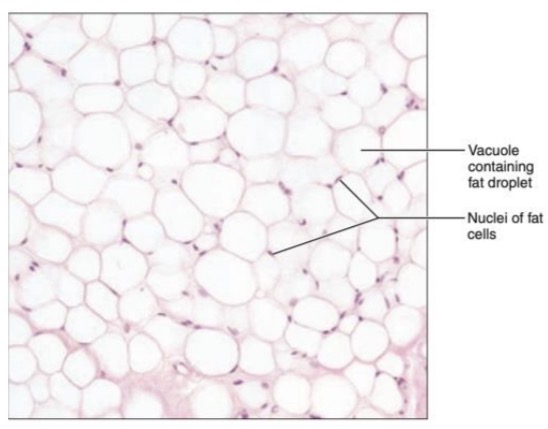
Adipose Function
Reserve fuel, insulation, organ protection
Adipose Location
Under skin, around kidneys, breasts
Adipose Appearance
Reticular Function
Forms a soft internal skeleton supporting other cells
Reticular Location
Lymphoid organs (Spleen, lymph nodes, bone marrow
Reticular Appearance

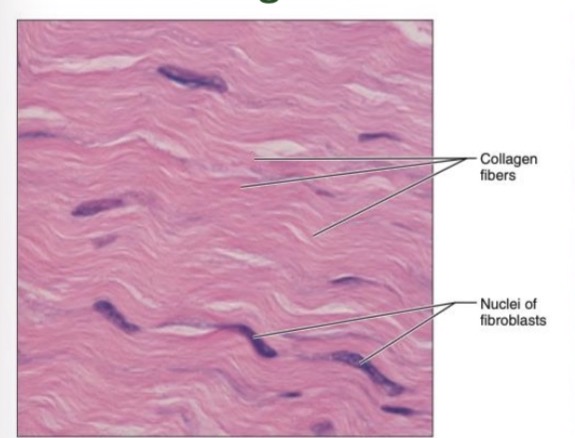
Dense Regular Function
Withstands great tensile stress pulling in one direction
Dense Regular Location
Tendons and ligaments
Dense Regular Appearance
Dense Irregular Function
Withstands tension exerted in many directions; provides structural strength
Dense Irregular Location
Dermis of skin, fibrous joint capsules
Dense Irregular Appearance

Elastic Function
Allows passive recoil of tissue after stretching
Elastic Location
Walls of large arteries (aorta), certain vertebral ligaments
Elastic Appearance

Hyaline Cartilage Function
Resilient cushion, resists compression
Hyaline Cartilage Location
Embryonic skeleton, costal (rib), cartilages, ends of long bones, trachea
Hyaline Cartilage Appearance

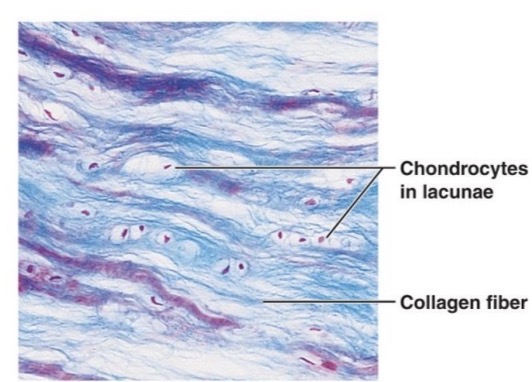
Fibrocartilage Function
Tensile strength and shock absorption
Fibrocartilage Location
Intervertebral discs, Menisci of knee, Pubic symphysis
Fibrocartilage
Bone Matrix
Hard calcified, packed with collagen. Highly vascularized
Bone Function
Supports, protects, acts as lever for muscles, stores calcium, houses marrow for hematopoiesis
Bone Appearance

Blood
The only fluid connective tissue
Blood Matrix
Completely fluid (plasma)
Blood Function
Transport of respiratory gases, nutrients, and wastes through blood vessels
Blood Appearance

Nervous Tissue Cell Populations
Neurons and Neuralgia
Neurons
Highly specialized to receive stimuli and generate electrical signals
Neuralgia
Non-excitable supporting cells that protect and insulate delicate neurons
Nervous Tissue Location
Brain, spinal cord, nerves
Nervous Tissue Appearance
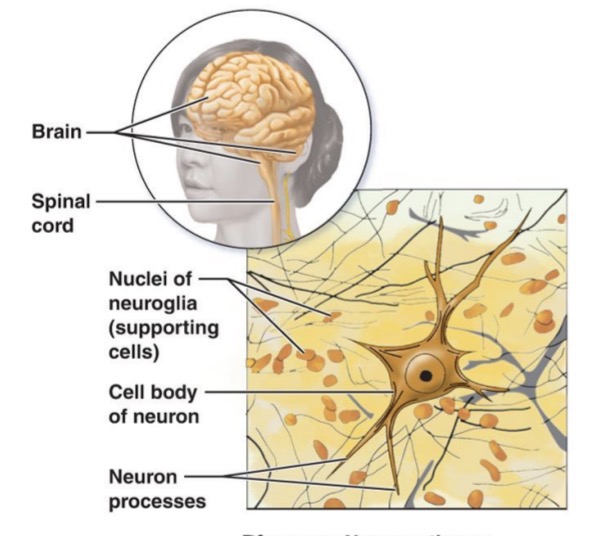
Neurons Appearance

Skeletal Muscle Structure
Long, cylindrical, multinucleate, striated
Skeletal Muscle Function
Voluntary Movement
Skeletal Muscle Location
Attached to skeleton
Skeletal Muscle Appearance

Cardiac Muscle Structure
Branching, uninucleate, striated, intercalated discs
Cardiac Muscle Function
Involuntary movement, blood propulsion
Cardiac Muscle Location
Heart Walls
Cardiac Muscle Appearance

Intercalated discs function
Allows the heart to act as a single unit
Smooth Muscle Structure
Spindle-shaped, uninucleate, no striations, arranged in sheets
Smooth Muscle Function
Involuntary movement- propulsion of substances (urine, food)
Smooth Muscle Location
Walls of hollow organs
Smooth Muscle Appearance

The Barrier Problem’s Solution
Epithelium
The Scaffolding Problem’s Solution
Connective Tissue
The Engine Problem’s Solution
Muscle
The Wiring Problem’s Solution
Nervous
The Barrier Problem
Need protection and support
The Scaffolding Problem
Need Structure and Connection
The Engine Problem
Need Force Generation
The Wiring Problem
Need Rapid Communication