essay 37 - obstructive sleep apnea. bruxism
 Call Kai
 Learn
Learn Practice Test
 Spaced Repetition
 Match
Match Flashcards
 Knowt Play
1/6

There's no tags or description
Looks like no tags are added yet.
Name | Mastery | Learn | Test | Matching | Spaced | Call with Kai | Chat |
|---|
No analytics yet
Send a link to your students to track their progress
7 Terms
what is obstructive sleep apnea

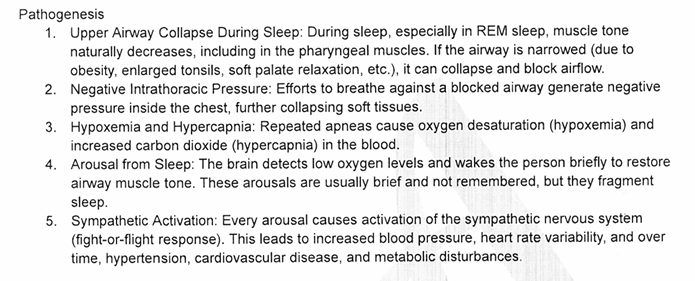
pathogenesis of sleep apnea
1) Upper airway collapse during sleep
In sleep (especially REM), muscle tone drops → pharyngeal muscles relax.
If airway is already narrow (obesity, big tonsils, soft palate), it collapses → airflow stops.
2) Negative intrathoracic pressure
Person tries to breathe against a blocked airway.
This creates strong negative pressure in the chest → pulls soft tissues inward, worsening collapse.
3) Hypoxemia + Hypercapnia
Repeated apneas → ↓ O₂ (hypoxemia) and ↑ CO₂ (hypercapnia).
Gas exchange becomes unstable.
4) Arousal from sleep
Brain senses low O₂ → triggers brief arousals to restore airway tone.
These are short, not remembered, but fragment sleep.
5) Sympathetic activation
Every arousal = fight‑or‑flight surge.
Leads to:
↑ blood pressure
↑ heart rate variability
Long‑term: hypertension, cardiovascular disease, metabolic dysfunction
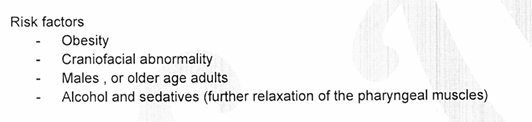
risk factors for sleep apnea
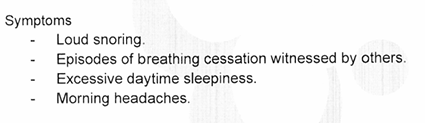
symptoms of sleep apnea
what is bruxism

pathogenesis of bruxism
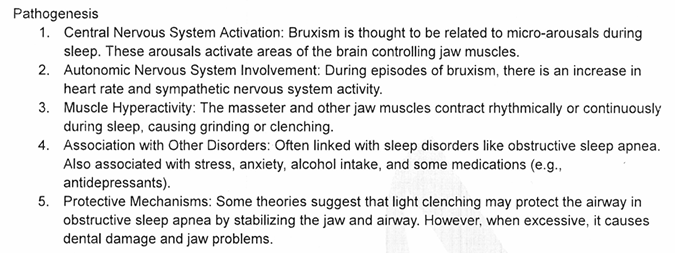
1) CNS activation
Micro‑arousals during sleep activate brain areas controlling jaw muscles → triggers grinding/clenching.
2) Autonomic nervous system involvement
Episodes show ↑ sympathetic activity and ↑ heart rate.
3) Muscle hyperactivity
Masseter + jaw muscles contract rhythmically or continuously → grinding/clenching movements.
4) Associations with other conditions
Linked with:
Sleep disorders (especially OSA)
Stress, anxiety
Alcohol
Medications (e.g., antidepressants)
5) Possible protective mechanism
Light clenching may stabilize the jaw/airway in OSA.
But excessive bruxism → dental wear + TMJ problems.
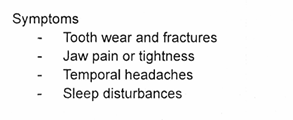
symptoms of bruxism