HTL 2.1-2.2
 Call Kai
 Learn
Learn Practice Test
 Spaced Repetition
 Match
Match Flashcards
 Knowt Play
1/27

There's no tags or description
Looks like no tags are added yet.
Name | Mastery | Learn | Test | Matching | Spaced | Call with Kai | Chat |
|---|
No analytics yet
Send a link to your students to track their progress
28 Terms
1. Define "universal solvent."
2. List 3 reagents that are universal solvents.
1. In histotechnology, a universal solvent is a reagent that may be used for both dehydration and clearing.
2. Dioxane, tetrahydrofuran, and tertiary butanol are universal solvents.
List 4 alcohols that can be used for dehydration.
The alcohols that can be used for dehydration are ethyl, isopropyl, methyl, and butyl. Reagent alcohol is commonly ethyl alcohol denatured by adding methyl alcohol.
Give a disadvantage of each of the following alcohols.
1. ethyl
2. methyl
3. isopropyl
4. butyl
1. Ethyl alcohol is heavily taxed unless one is willing to undertake the extensive recordkeeping demanded to obtain pure tax-free alcohol. It can also cause marked shrinkage and hardening if dehydration is prolonged.
2. Methyl alcohol is poisonous, and overexposure can cause blindness or possibly death.
3. Isopropyl alcohol is never completely absolute, it cannot be used in the celloidin technique, and it will not dissolve many dyes.
4. Butyl alcohol has a pronounced odor and requires prolonged periods of dehydration.
Which of the following CANNOT be used for dehydration?
a. butyl alcohol
b. acetone
c. chloroform
d. dioxane
C
Chloroform is a clearing agent and cannot be used for dehydration. The others can be used for dehydration; dioxane can also be used for clearing.
Which of the following clearing agents is the most toxic (lowest permissible exposure limit [PEL])?
a. xylene
b. benzene
c. toluene
d. chloroform
B
Benzene has a PEL of 10 ppm, toluene and chloroform each has a PEL of 50 ppm, and xylene has a PEL of 100 ppm.
An advantage of using chloroform for clearing is that it:
a. is easily disposed of
b. is not volatile
c. leaves tissue transparent
d. does not overharden uterus and muscle tissue
D
Chloroform does tend to desiccate connective tissue, but is a better clearing agent for uterus, muscle, and tendon than the aromatic hydrocarbons. It does not burn and thus presents a storage problem, it is very volatile and thus it is difficult to maintain fluid levels in open processors, and it does not leave tissue transparent as an indicator of the completeness of clearing.
List at least 3 substances that may be added to paraffin to alter the sectioning properties.
Beeswax, rubber, other waxes, and plastics may be added to paraffin to alter the sectioning properties.
List at least 1 characteristic of each of the paraffin additives.
1. Beeswax - reduces crystal size, increases stickiness and adhesion.
2. Rubber - reduces brittleness, increases stickiness making ribboning easier.
3. Other waxes – produce smooth texture and smaller crystal size.
4. Plastics – increase hardness and support.
1. Describe the effect that the melting point of the paraffin has on sectioning.
2. What melting point paraffin commonly is used for routine work?
3. Relate the temperature of the melting point to the temperature of the supply of melted paraffin.
1. As the melting point increases the paraffin becomes harder and provides better support for hard tissue. Thinner sections can be obtained but ribboning becomes more difficult. As the melting point decreases the paraffin becomes softer and provides less support for hard tissues. Thin sections are more difficult to obtain but ribboning become easier.
2. Paraffin with a melting point of 55°C to 58°C is commonly used for routine work.
3. Melted paraffin should be 2°C to 4°C above the melting point of the paraffin.
1. List 3 reagents, other than the fixative, commonly used for microwave processing.
2. Why can a clearing agent be omitted?
1. Ethyl alcohol, isopropyl alcohol, paraffin are the reagents commonly used for microwave processing.With some microwave processing methods, only isopropyl alcohol and paraffin are used.
2. The clearing agent can be omitted because the isopropyl alcohol, with a boiling point of 83.3°C, is boiled away allowing for good paraffin infiltration of the tissues.
Precipitate is noted in the processor tubing following fixation with 10% neutral buffered formalin. This could have been prevented by:
a. increasing the pH of the formalin solution
b. using Millonig formalin solution
c. changing processor solutions more frequently
d. beginning dehydration with 60% -65% alcohol
D
The precipitate is formed by the precipitation of phosphate salts by alcohol that is more concentrated than 70%. To ensure that the precipitate does not form, use alcohol that is no more concentrated that 60% -65%. Increasing the pH would not correct the problem; Millonig is a phosphate buffered formalin solution; changing the processor solutions would not prevent this problem.
List the 3 acid methods of decalcification.
The 3 acid methods of decalcification are: simple acid, ion-exchange resins, and electrolytic.
Identify a non-acid method of decalcification
Chelating agents bind calcium without the aid of acids to dissolve the calcium
Describe the basis of the 3 acid methods of decalcification.
All methods use acid and the difference is the way that calcium ions are removed from the tissue. In the simple acid method the ions are allowed to slowly migrate out of the tissue into the surrounding fluid. In the ion-exchange resin method ammonium ions of the resin are exchanged for calcium, freeing the solution of calcium ions and speeding up decalcification. In the electrolytic method, the bone is attached to the anode (positive pole) and a low level current is passed through the solution; the calcium ions are rapidly pulled away from the anode and to the cathode (negative pole).
1. List the 3 methods of determining the endpoint of decalcification.
2. Which method CANNOT be used on tissues that have been fixed with a metal containing fixative?
1. The 3 methods of determining the endpoint of decalcification are: mechanical, chemical, and radiographic.
2. The radiographic method cannot be used on tissues that have been fixed with a metal containing fixative, as the metal will render the specimen radiopaque.
Which of the following solutions are used for chemically determining the end-point of decalcification.
a. ammonium sulfate and sodium oxalate
b. sodium hydroxide and calcium oxalate
c. sodium hydroxide and calcium oxide
d. ammonium hydroxide and ammonium oxalate
D
A sample of the used decalcifying fluid is mixed with a solution containing ammonium oxalate and ammonium hydroxide. Any calcium in the decalcifying fluid will be precipitated as ammonium oxalate. The other answers are incorrect; both "b" and "c" contain calcium, so could not be used to detect the presence of calcium. The ammonium sulfate in answer "a" would not neutralize the decalcifying fluid to neutrality, so would not produce the appropriate pH for allowing precipitation of calcium oxalate.
Tissue should not be frozen directly in liquid nitrogen because:
a. freezing is too rapid
b. freezing is impeded by gas bubbles
c. tissue block is too cold to cut
d. fat will be dissolved
B
When tissue is submerged directly in liquid nitrogen, gas bubbles will form and impede freezing. Rapid freezing is desirable, and although the sections may be too cold immediately, it does not take long for the blocks to come to cryostat temperature. Fat is not dissolved by freezing.
Explain the difference in overheating the paraffin on the processor and overheating the paraffin used for embedding.
If the paraffin used on the processor is overheated it will cause the tissue to be shrunken and overhardened. If the paraffin used for embedding is overheated, it will not cause a problem with the tissue, as the tissue is in the melted paraffin for only a short time, but it will change the sectioning quality of the paraffin itself.
1. What is the chemical difference between the aromatic and aliphatic hydrocarbons?
2. Into which class of hydrocarbons does xylene fall into?
1. The aromatic hydrocarbons are those that contain one or more benzene rings (cyclic) and aliphatic hydrocarbons are those that do not contain a benzene ring.
2. Xylene is an aromatic hydrocarbon. Each of the 3 below (ortho, para, and meta) has an identical chemical formula - CH(CH3)2, but, they differ from each other physically and in certain chemical properties. Xylene is actually a nickname for dimethylbenzene.
List 4 substances that may be used for embedding and give at least 1 advantage and disadvantage of each.
1. Paraffin, water-soluble waxes, celloidin, and plastics may be used for embedding.
2. Paraffin – large numbers of blocks easily processed, serial sections are easily obtained, and storage of blocks is not difficult. Fat is lost during processing and overheating of the paraffin will damage the tissue.
3.Water soluble waxes (Carbowax) – tissue can be infiltrated directly from aqueous fixatives, and fat is maintained. Sectioning is somewhat difficult because sections dissolve on the usually flotation bath.
4. Celloidin – no heat is required so shrinkage and hardening are minimal. This is a long process, and serial sections and thin sections are difficult to obtain.

The tissue in this image most likely was:
a. cleared with cedarwood oil
b. overdehydrated
c. improperly mounted
d. incompletely cleared
B
The tissue has been overhardened by prolonged dehydration and chatter results during microtomy. Cedarwood oil hardens tissue less than any other clearing agent and tissue may remain in it indefinitely without harm. This artifact was caused before the mounting process and incomplete clearing will not cause chatter during microtomy.

What is the most likely cause of the problem seen in this image?
a. prolonged clearing
b. incomplete dehydration
c. delayed fixation
d. overoxidized hematoxylin
B
Water was still present in the tissue when it was infiltrated with paraffin. Prolonged clearing will cause overhardening of the tissue; autolysis would be the result of delayed fixation and this problem is not autolysis; overoxidized hematoxylin would stain the nuclei red-brown, but there should not be an absence of staining.

The problem seen in this image probably could have been prevented by:
a. carefully placing the tissue between dry sponges
b. pre-soaking the sponge before use
c. using a new blade for microtomy
d. using a shorted time on the flotation bath
B
This is a sponge artifact, caused by placing the tissue between two dry sponges. Either a pressure artifact, or an artifact created by trying to separate the tissue from the sponge during embedding will be seen on the stained sections. Pre-soaking the sponges in fixative before use will prevent this. This is not a microtomy error, so both "c" and "d" are incorrect.

During embedding, which of the following would most likely prevent the problem seen in this image?
a. pressing the tissue down uniformly in the mold
b. chilling the paraffin more quickly
c. using warmer forceps to handle the tissue
d. increasing the temperature of the paraffin
A
This tissue was not pressed down flat in the mold. Cutting deeper may result in cutting through part of the tissue; a good cross-section of the tissue probably cannot be obtained. Paraffin and the mold should be kept warm until the tissue can be flattened or until multiple pieces of tissue can be embedded at the same level. Although the forceps should be warm, that is not the cause of this problem. Increasing the temperature of the paraffin would not help, but might alter the sectioning quality.
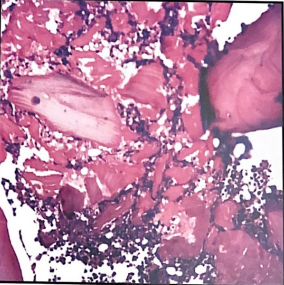
1. Identify the problem shown in this image
2. List 2 ways that it could be prevented or corrected
1. The problem shown in the image is bone dust. When sectioning bone with the saw normally used for this process, bone dust may be pressed into the surface of the bone.
2. This could be prevented by using a saw with a diamond blade, and it may be corrected by trimming the bone surfaces after decalcification but before processing.
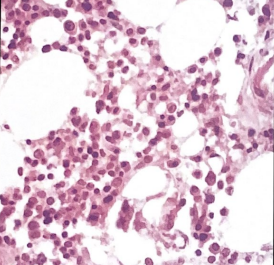
The image shown in this section most likely has been:
a. understained
b. underdecalcified
c. overdecalcified
d. poorly fixed
C
The correct answer is "c." This section has been overdecalcified, leading to a loss of nuclear detail and poor staining; increased time in the hematoxylin and/or eosin would not correct this problem.

This section of colon is embedded correctly. TRUE or FALSE.
FALSE.
GI specimens should be embedded so that all layers are shown, and only 2 layers (mucosa and submucosa) are seen in this image. The external muscle layer(s) and the adventitia/ serosa are not shown. Probably this specimen was not opened and pinned out for fixation as soon as possible, so that the section rolled during grossing and placement in the cassette.

1. What is the problem seen in this image?
2. How could this have been prevented?
1. The center of this tissue is soft and mushy. It was not infiltrated well with paraffin and it will not section.
2. This could have been prevented by ensuring complete dehydration and clearing of the tissue before the infiltration step.