Lecture 1: Peripheral Neuropathy I
 Call Kai
 Learn
Learn Practice Test
 Spaced Repetition
 Match
Match Flashcards
 Knowt Play
1/54

There's no tags or description
Looks like no tags are added yet.
Name | Mastery | Learn | Test | Matching | Spaced | Call with Kai | Chat |
|---|
No analytics yet
Send a link to your students to track their progress
55 Terms
Somatic Nervous System
The PNS is divided into autonomic and somatic NS.
The somatic NS has sensory and motor systems
It’s job is motor and sensory function
What root supplies sensory information?
Dorsal (Afferent)
*Posterior
What root supplies motor information?
-Ventral (Efferent)
*Anterior
Dermatome
-Area of the skin which is supplied by a sensory root of spinal nerve
*Follows a specific pattern while terminal branches do not
What terminal branch supplies sensory information to this area (in grey)?
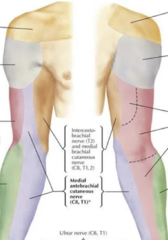
-Axillary (C5, C6)
Cutaneous nerves (peripheral nerve distribution)
-Terminal branches of peripheral nerves carry fibers from multiple spinal roots
-So they supply various territories on the body and do not line up exactly with dermatomes
What terminal branch supplies sensory information to this area (in green)?
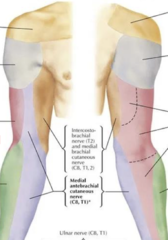
-Lateral Antebrachial
What terminal branch supplies sensory information to this area (in pink)?
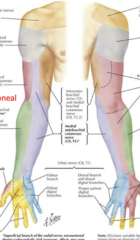
-Radial nerve
*Note the finger distribution as well
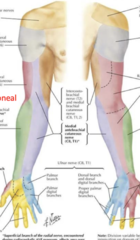
What terminal branch supplies sensory information to this area (in yellow)?
-median nerve
*note the fingers
What terminal branch supplies sensory information to this area (in blue)?
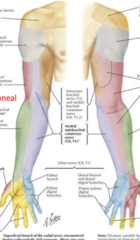
-Ulnar nerve

What terminal branch supplies sensory information to this part of the thigh (in pink)?
-Lateral cut nerve thigh


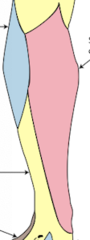
What terminal branch supplies sensory information to this part of the leg (in pink)?
-Saphenous nerve
*note distribution on back of medial calve and medial groove of inner foot
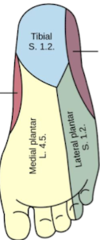
What terminal branch supplies sensory information to this part of the foot (in maroon)?
-Sural nerve
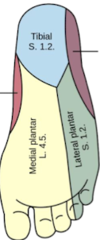
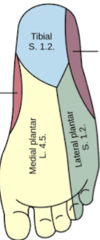
What terminal branch supplies sensory information to this part of the foot (in green)?
-on dorsal side of foot, lateral plantar
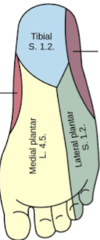
What terminal branch supplies sensory information to this part of the foot (in light yellow)?
-Medial plantar (on dorsal side of foot)

What terminal branch supplies sensory information to this part of the leg (in light blue)?
-Common peroneal nerve
-Present on lateral side (anteriorly and posteriorly)
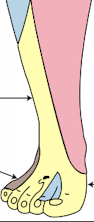
What terminal branch supplies sensory information to this part of the leg (in yellow)?
-Lower leg: superior peroneal nerve (into plamar toes)
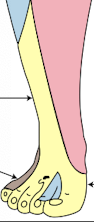
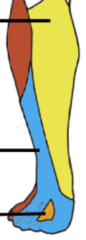
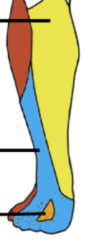
What terminal branch supplies sensory information to this part of the foot (in orange)?
-Deep peroneal nerve
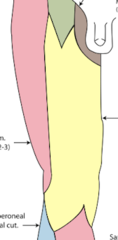
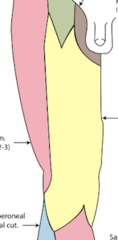
What terminal branch supplies sensory information to this part of the thigh (in yellow)?
-Anterior femoral nerve
Distribution of dermatome symptoms?
nerve pain doesn't always follow neat, predictable lines because human nerves vary greatly and injuries can trigger widespread inflammation affecting areas beyond where a specific nerve should go.
**DO NOT IGNORE SYMPTOMS, use as a guide
Types of Pain
-Nociceptive
-Nociplastic
-Neuropathic
Nociceptive Pain (nociceptors)
-Pain that comes from actual damage to non-neural tissue and is due to activation of nociceptors
Nociplastic Pain
-Pain that comes from altered nociception, without clear evidence of actual or ongoing damage
-pain is sensitized, so it is experienced without proportional peripheral input
**non-painful stimuli can result in painful response
Neuropathic Pain
-Pain caused by a lesion or disease of the somatosensory nervous system
-Can be from CNS or PNS
**Sensation of electrical shock, burning, pins and needles
ex: spinal cord lesions, diseases, stroke, tumors, TBI (injuries to tracts)
Radiculopathy
-Nerve root (or spinal nerve) is not functioning properly - meaning that the reflexes, dermatomes and myotomes/key muscles are affected
Ex: Compression, inflammation, trauma, disc herniation at the nerve root or spinal nerve
**HOWEVER THIS MAY NOT RESULT IN PAIN
Radicular Pain
-This can be categorized as a type of neuropathic pain
-This is pain coming from nerve root (or spinal nerve)
*Typically radiates along the path that spinal nerve
*Pain that comes from irritation or compression of a spinal nerve root
Peripheral Neuropathy
Is an umbrella term, it means damage or dysfunction of nerves outside the brain and spinal cord (meaning the PNS itself not CNS), often causing pain that results from the nerve injury itself (ONLY PNS)
-Umbrella term which also includes radiculopathy
Causes of Peripheral Neuropathies
-Physical Injury
-Entrapment Neuropathy
-Space Occupying Lesions
-Diabetes
-Renal/Liver Disease
-Blood/vascular
-Nutritional Imbalances
-Autoimmune
-Infections
-Medications
Space Occupying Lesions
-Tumors, cancers causing compression
Diabetes
Diabetes damages the small blood vessels that supply oxygen and nutrients to nerves, leading to nerve injury known as diabetic neuropathy.
Renal/Liver disease
-Can produce systemic toxins that affect peripheral nerves
Blood/Vascular
-Systemic (diabetes or smoking) or local (intermittent claudication)
Nutritional Imbalances
-Deficiency of B12 or excess B6
Automimmune
-Lupus, RA
Infections
-Herpes, Lyme disease, HIV
Symptoms of Peripheral Neuropathy
-Abnormal sensation
-Neuropathic pain
-Dermatomal or peripheral nerve pattern
-Feeling weak
-Changes in sympathetic responses
Abnormal sensation
-Which can be hypo/hyperesthesia, anaesthesia, paresthesia, or allyodynia
Changes in Sympathetic Responses
-Sweating, temperature regulation (heat & cold)
-Autonomic nerve
Feeling Weak (Neuropathy Symptoms)
-In muscles, painful cramps or fasciculations
Signs of Peripheral Neuropathy
-Atrophy of involved muscles
-Positive findings on neurological examination: weakness, altered sensation, change in reflex (hypo or areflexia)
- Positive special tests, clusters & nerve palpation (Wainer's cluster)
-Neurodynamic testing positive
What may be a sign that a patient is having neuropathy in terms of positioning?
-They may sit or position in a way as to which to protect the neural structure
ex: only bending on squatting on right knee and keeping left extended
Altered sensation (neuropathy sign)
-Testing of crude touch, sharp/dull, hot/cold determination with possible dermatome or peripheral nerve distribution
Loss of Function (LOF)
-Hallmark of MSK peripheral nerve injuries
-Reduced impulse conduction i.e., radiculopathy
-Hypoaesthesia or anaesthisa (partial feeling or none)
-Hyporeflexia or areflexia
-Weakness (myotomal or peripheral nerve)
Gain of Function (GOF)
-More common in entrapment neuropathies
-Abnormal excitability/reduced inhibition
-Paresthesia or hyperalgesia (feels more intense, pins & needles)
-Spontaneous pain
-Allodyna (painful stimulus to a non-painful stimulus)
-May cause cramps or fasciculations
Fasciculations
-involuntary, visible twitches of muscle fibers caused by spontaneous firing of lower motor neurons
Subjective assessment for Neuropathies
-Specific tailored questions regarding neuropathy symptoms should be explored (specific MOI, exact locations)
-History of comorbidities or other medical conditions, including red flag questions (NON-MSK could be causing neuropathic pain)
Objective Assessment for Neuropathies
-Pt's subjective history will guide the rigrousness of tests
-Irritability of NS will dictate order
*Observation & vitals
*Screen (neurological examination)
*AROM
*PROM
*strength, special tests, repeated movements
*Neurodynamics (leave till last as they are aggravating)
What do you do when peripheral neuropathy is bilateral and cannot compare to other side?
-Text other body parts
Neurodyamics (Neural Mobilization)
-Series of movements that apply mechanical force to a portion of the NS (usually terminal branches)
-Used to test the mechanosensitivity of the nerve
-No info on type of neuropathy or entrapment or location
-Negative tests do not exclude nerve dysfunction
Types of Neurodynamic Tests
-ULNT
-Slump
-LLNT
Neuropathic Grading System
-Used to determine if pain is neuropathic
-Uses medical history, symptoms, objective tests and diagnostics tests
-"possible" result can still have neuropathic pain specific treatment plans
Level 1 Neuropathic Grading System
-Medical history suggests a relevant neurological condition or disease (ex: diabetes, MOI)
-Symptom descriptors (electric shocks, pins & needles, numbness) *more than 1 will be better
-Symptom behaviour (spontaneous pain, aggravating & alleviating factor)
Level 2 Neuropathic Grading System
-neuroanatomically plausible distribution
*Dermatomal
*peripheral (going down the arm rather than isolated to one muscle)
Level 3 Neuropathic Grading System
-Clinical tests (sensory signs) in the same neuroanatomically distribution
-Sensory (touch, pin-prick, thermal)
-Motor & reflexes
**sensory is more valid than motor
Level 4 Neuropathic Grading System
-Objective diagnostic tests
-Nevre conduction testing
-MRI/CT