Communication Models (Part 2)
 Call Kai
 Learn
Learn Practice Test
 Spaced Repetition
 Match
Match Flashcards
 Knowt Play
1/20

There's no tags or description
Looks like no tags are added yet.
Name | Mastery | Learn | Test | Matching | Spaced | Call with Kai | Chat |
|---|
No analytics yet
Send a link to your students to track their progress
21 Terms
Berlo's SMCR Model
A linear communication model that explains communication through the Sender, Message, Channel, and Receiver (SMCR) and includes both verbal and nonverbal communication.
Sender (Berlo's SMCR Model)
Sends a message based on knowledge of the subject, ability to communicate, attitudes, social system, and culture.
Message (Berlo's SMCR Model)
Composed of elements arranged in a particular structure and form (e.g., musical, poetic, prose).
Content (Berlo's SMCR Model)
(Entirety of the Message) The complete information or idea being communicated.
Treatment (Berlo's SMCR Model)
The particular way the content of the message is conveyed.
Channel (Berlo's SMCR Model)
The sense used to observe the message.
Receiver (Berlo's SMCR Model)
Decodes the message based on similar personality components as the sender.
Nida's Model
A communication model that includes noise and feedback, with both the source and receptor acting as senders and receivers.
Eugene Nida
He included an element of noise in his model.
Source-S (Nida's Model)
The origin of the message.
Message-M (Nida's Model)
The information being communicated.
Receptor-R (Nida's Model)
The receiver of the message.
Encoder-En (Nida's Model)
Converts thoughts into messages.
Decoder-De (Nida's Model)
Interprets and understands the received message.
Feedback (Nida's Model)
A response message sent back by the receiver to the source.
Noise (Nida's Model)
A factor present throughout communication that interferes with the message.
Linear (Conduit) Model
A communication model that focuses on the conduit or channel.
Circular (Dialogic) Model
A communication model that gives a more active role to the receiver.
Feedback (Interaction) Model
A communication model that recognizes that all behavior of the sender sends a message, not just intentional messages.
Self-regulatory Model
A communication model that focuses on what the senders and receivers get from the environment.
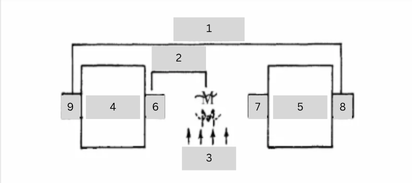
Identify the parts of Nida's Model
feedback
feedback
Noise
Sender
Reciever
Encoder
Decoder
Encoder
Decoder