NURS 340 exam 1 content (tamu)
 Call Kai
 Learn
Learn Practice Test
 Spaced Repetition
 Match
Match Flashcards
 Knowt Play
1/183

There's no tags or description
Looks like no tags are added yet.
Name | Mastery | Learn | Test | Matching | Spaced | Call with Kai | Chat |
|---|
No analytics yet
Send a link to your students to track their progress
184 Terms
physiology
normal functions of the body
pathology
structural and functional changes in cells, tissues and organs of the body. these cause or are caused by disease
why do we study pathophysiology?
So we know...
- why a disease has a clinical manifestation
- why certain medications work
- why certain side effects occur
- why complications occur
- why nursing interventions work
health
a "state of complete physical, mental, and social well-being and not merely the absence of disease and infirmity" (WHO 1948)
what are the different aspects health varies based on?
-age
-genetics
-gender
-environment
-social factors
what does it mean to always consider a patients baseline?
before they came in to us, what were they able to do?
disease
the body is no longer functioning normally
acute disease
occurs and resolves quickly (like a cold) is temporary
chronic disease
occurs over a longer time, may never resolve, but may be manageable (longterm)
insidious
gradual, le notable onset- easily overlooked
exacerbation
acute worsening
remission
signs and symptoms may lessen for a period, but disease is still present
remission in cancer
disease isn't detecible?
health and disease are on a ____
continuum
congenital
present at birth (deafness)
hereditary
transmitted across generations
genetic
caused by abnormalities in genes (down syndrome)
inflammatory
triggered by body's defenses (systemic lupus erythematosus)
degenerative
caused by deterioration (osteoarthritis)
metabolic
problem with biochemical processes
neoplastic
uncontrolled proliferation (cancer)
Clinical Manifestations
signs and symptoms or evidence of disease
signs of disease
-objective - things I can measure or witness
-measurable - BP, HR, pallor, lab values
symptoms of disease
-subjective - inside the patient, they tell us
-patient reported - pain, nausea, dizziness
prognosis
likelihood of full recovery or retaining previous functioning
mortality
death rate from a particular disease
morbidity
disease rates in a population OR suffering from a disease or medical condition
co-morbidity
presence of one of more additional disorders co-occurring with a primary disease or disorder (ex: coronary artery disease + diabetes mellitus II)
complication
a pathological process or event occurring during a disease that is not an essential part of the disease (ex: pneumonia developing in a 74 year old patient after surgery)
idiopathic
we don't know exactly what causes it
predisposing factors
risk factors
etiology
study of disease causation. disease can be caused by infectious agents, chemicals
pathogenesis
the step by step of how the disease develops (ex: the etiology is a bacteria causing a urinary tract infection. the pathogenesis is how the bacteria effects the epithelial lining of the urethra and the body's subsequent inflammatory response causing s/s of a UTI)
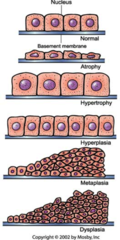
cellular adaptation
-mechanisms the body develops to prevent injury and death (ex: when we go into the mountains our body makes more RBC to help with O2)
-can be normal or abnormal, it should cease when the stimulus is removed
proliferation
cell division
differentiation
specializing in terms of types, function, and structure
atrophy
shrinking of cells

hypertrophy
enlarging of cells (lifting weights or heart muscle working harder)

hyperplasia
excess number of cells (start to watch for cancer)

metaplasia
cells not look the same way, worry about cancer- usually precancerous

dysplasia
cancerous, cells mutated completely
cell injury
-reversible up to a certain point
-caused by:
-physical (cut/car accident)
-chemical (chemical burns)
-biologic (virus)
-deficiencies (in vitamins)
-free radicals (excess O2)
hypoxia
-major cause of premature death
-an absence of enough oxygen in the blood to sustain bodily function (ex: someone with pneumonia- brain, heart, lungs need more O2)
ischemia
-major cause of premature death
-decreased blood supply to an organ (causes heart attack, no O2 or nutrients to tissues)
apoptosis
-normal/programmed cell death
necrosis
premature/abnormal death, due to injury (ex: necrotic limbs)
cells shrink down during ___
apoptosis
cells swell and burst in ___
necrosis
what happens with necrotic cells burst?
they release the by-products of death into interstitial spaces and trigger inflammation
genetics
the study of genes and their role in transmitting traits from one generation to the next
genomics
-encompasses the whole collection of an individuals genes- the genome
-the interaction of genes with one another and with environmental factors
genes
segments of DNA found on chromosomes that carry information for protein production and are responsible for the inheritance of specific traits
different functions of genes
-may say which protein to make and how to make it
-may control protein making activity by saying when to make it and how much to make
single-gene traits
-when one gene controls the expression of a specific structure, protein, or function
single gene trait examples
-A, B, O blood groups
-blood clotting factors
-color vision
-dimples
-earlobe position
-hair texture
single gene disorder examples
-cystic fibrosis
-classic hemophilia
-Huntington disease
-marfan syndrome
-sickle cell disease
-sickle cell trait
alleles
-variation of a gene at a specific location
-two alleles together control how that gene is expressed
-alleles are paired with chromosomes
-we inherit one chromosome from each parent
-the 'specific location' is referred to as the locus
dominant gene
expressed whether 2 gene alleles are identical (homozygous) or different (heterozygous)
recessive gene
expressed only when both gene alleles for the trait are identical (homozygous)
genotype
-the genetic constitution of a cell, an organ, or an individual
-a list of inherited instructions that may or may not have an observable effect on the organism
phenotype
-the physical and behavioral characteristics of an organism
-both gene and environment typically contribute
pedigree
-a diagram that shows the occurrence and appearance (phenotypes) of a particular gene or organism and its ancestors from one generation to the next (done with diseases carried on- cancer)
-most used in humans, show dogs, and racehorses
expressivity
-the degree of trait expression a person has when a dominant gene is present
-affects phenotype and can range from mild to severe
-personal issue (rather than a population issue)
-genes always expressed but at different levels
-characteristics of affected individuals differ from person to person
-EX: neurofibromatosis
penetrance
-represents the ability of a gene to express its function
-how often, within a population, a gene is expressed when present
-calculated by examining a population of people known to have the gene mutation= % of people expressing the gene (penetrant)
sex-linked inheritance
-the gene is found on the X or Y chromosome- presence or absence is linked to an organism's gender
hemophilia
a medical condition that severely reduces the ability of blood to clot, resulting in severe bleeding even from minor injuries (typically caused by hereditary lack of the coagulation factor VIII)
chromosomal disorders
-any change in the normal structure or number of chromosomes, often resulting in physical or mental abnormalities
-ex: down syndrome/trisomy 21, tuner syndrome, Klinefelter syndrome
multifactorial inheritance disorder
-associated with effects of multiple genes in combination with lifestyle and environmental factors
-ex: heart disease and diabetes
down syndrome
1. trisomy 21 (nondisjunction) accounts for 95% of cases- 50% of children born have atrial septal defect (cardiac defect), 15% of children have hypothyroidism
2. translocation accounts for ~4%
3. mosaicism accounts for ~1% - some cells are diploid, some are haploid
-all types are associated with varying levels of intellectual disability (mild to moderate), characteristic facies: slanting eyes, small chin, round face, flat nasal bridge, abnormal outer ears; hypotonia in infancy (weak muscle tone)
Klinefelter Syndrome (XXY)
-abnormal testicular development accompanied by the presence of one or more extra X chromosomes more than the normal male XY complement
-extra X results from nondisjunction during meiotic division in one of the parents`
tuner syndrome (X)
-an absence of all or part of the X chromosome
-the female is typically short in stature, but her body proportions are normal
-variations in syndrome with abnormalities
multifactorial causes to obesity
social status, gut microbiota, food abundance, technological progress, medical treatment, pollution, hormones, psychology, peer pressure, in utero environment, viruses, nutrition, exercise
multifactorial influences on the development of children's brain
1. genetic variations in genes related to neural signaling molecules (excluding: serotonin, glutamate, BDNF, COMT)
2. prenatal- poor fetal growth, substance use, maternal anxiety, maternal depression
3. intrapartum- variations in oxygenation levels
4. postnatal- low SES, parenting quality, maternal depression
5. modifications in brain structure and function -> behavioral dysfunctions and risk for mental health problems
transcription
-provides the instructions for making a protein molecule
-def: the synthesis of RNA from a DNA template
-purpose: makes RNA copies of individual genes that the cell can use in the biochemistry
-products: mRNA, tRNA, noncoding RNA (micro RNA)
-location: nucleus
-initiation: occurs when RNA polymerase protein binds to the promoter in DNA and forms a transcription initiation complex. promoter directs the exact location for the initiation of transcription
translation
-process that makes proteins
-def: the synthesis of a protein from an mRNA template
-purpose: synthesize proteins
-products: proteins
-location: cytoplasm
-initiation: occurs when ribosome subunits, initiation factors and tRNA bind the mRNA near the AUG start codon
what are the 9 body systems?
neurological, musculoskeletal, respiratory, cardiovascular, hematologic, gastrointestinal, reproductive/genitourinary, endocrine, immune
what info is crucial about each drug?
1. pharmaceutics- how does it work?
2. pharmacokinetics- how does it move?
3. pharmacodynamics- how long does it take, special characteristics?
4. expected pharmacologic and therapeutic effects- what does it do?
5. adverse drug reactions- side effects?
6. contraindications- reasons not to take?
7. precautions- what to be mindful of?
8. interactions- drug-drug, drug-food, drug-person
what does NURSE stand for in pharm?
name, usage/used for, responsibilities (as the nurse), side effects, education (to provide to patient- safety, nutrition, education)
special drug considerations
-drug-drug interactions
-drug-food interactions
-drug tolerance (ex: tolerance to pain meds)
-cumulative effect (ex: antidepressants- take for a while for best outcome)
-drug toxicity (drug building up in the body)
-populations (pregnant women, children, older adults)
-patient teaching (making sure there isn't misuse)
drug categories
-act in the same way (ex: betablockers, ending in same suffix= typically same class of drug)
-share therapeutic effects
-share adverse drug reactions, contraindications, precautions, and administration considerations
-we study the prototype drug (1st drug created)
what is in the name of a drug?
-official name -> generic name (not capitalized)
-brand/trade name -> capitalized and may vary based on the manufacturer
-ex: acetaminophen (generic) vs tylenol (brand)
-need FDA approval for being interchangeable
prescription drugs
must be obtained with a prescription
nonprescription drugs
"over the counter drugs"
how drugs work/pharmaceutics
-form of the drug can impact: dissolution, absorption rate, onset of action
-routes/form: oral, parenteral (injectable- IV or SUBQ), topical or transdermal
fastest to slowest absorption rate of oral drugs
liquid, suspension, powder, capsule, tablet, coated tablet, enteric-coated tablet
parenteral drugs
-intravenous (IV, fastest-straight to bloodstream)
-subcutaneous (SUBQ)
-intramuscularly (IM, most vaccinations)
-forms: liquid or powder that needs a liquid to reconstitute it
intravenous (IV) drugs
absorption: immediate and complete
onset: immediate
subcutaneous (SUBQ) drugs
absorption: rapid if highly water soluble and good circulatory flow. slow if poorly water soluble and/or circulatory blood flow is slow or impaired
onset: variable
topical or transdermal drugs
-apply to: skin, eyes, ears, nose, rectum, vagina, lungs
-constant amount of drug over time
-slower onset of action
-longer duration of action
pharmacokinetics
-administration/absorption: IV, SUBQ, oral, transdermal, inhalation
-distribution/metabolism: blood, gut->liver->blood
-elimination: feces, urine, sweat, exhaled air
drug half-life
the amount of time it takes for a drug to decrease by half in the body (helps base dosing of meds)
onset of action of drug
how long the drug takes to work
duration of action of drug
How long the drug remains in therapeutic range
peak level of drug
-therapeutic dose is highest
-drawn 30min-1hour after administration
trough level
drawn when the drug is at its lowest in the bloodstream right before the next dose is given
pharmacodynamics
biochemical changes that occur in the body
therapeutic effects
the intended effects of the drug (ex: benadryl- allergies)
adverse drug reactions
-unintended effects of a drug (ex: benadryl- sleep/drowsiness, dry mouth, confusion, dizziness, convulsions, hyperactivity in children)
-affect doesn't have to be negative, it is just not intended to happen
-nontherapeutic, unintended effects. predictable and unpredictable. mild to life threatening. allergic reaction (milk to severe)
agonist
drugs that enhance the action of the cells (morphine activates opioid receptors in the brain for pain)
antagonist
drugs that decrease the action of the cells (Narcan cuts off opioid receptors)