Ch 11 - Cerebral Asymmetry
 Call Kai
 Learn
Learn Practice Test
 Spaced Repetition
 Match
Match Flashcards
 Knowt Play
1/26

There's no tags or description
Looks like no tags are added yet.
Name | Mastery | Learn | Test | Matching | Spaced | Call with Kai | Chat |
|---|
No analytics yet
Send a link to your students to track their progress
27 Terms
Anatomical Asymmetries in the Brain
Laterality = the 2 hemispheres have separate functions
L hemisphere : specialized for language (contains Wernicke’s & Broca’s) + controls R body
R hemisphere : specialized for nonverbal info (logic, decisions, thinking) + controls L body
→ both hemispheres are involved in almost all behaviours
lateralization is relative, NOT absolute (always evolving & adapting)
one hemisphere just tends to take the lead in diff areas (ex. some ppl have lang area on R side instead of L)
→ actions & thoughts seem unified, despite contributions from both hemispheres
Cerebral Asymmetry
ex. Planum temporale is larger in the L hemisphere than R in majority of ppl
Planum temporale = main area involved in lang perception, processing, & planning
on the superior temporal gyrus
wernicke’s is around this area
possibly bc of of role in lang
ex. Primary auditory cortex is larger in R hemisphere
possibly bc of music
takes over the R hemisphere area where the plant temporale is smaller
→ MRI studies of brains show consistent anatomical differences b/w hemispheres (looked at over 17000 brains)


Surface Asymmetry Map
→ theres also surface/topographical asymmetry
diff areas of the brain specializing in different things allows better performance as diff things at the same time instead of the whole brain doing everything at a subpar level

Neuronal Asymmetry
→ neurons in diff parts of the lobe have diff patterns of dendritic branching
THUS, neurons are ALSO specialized b/w areas & b/w hemispheres
study : research comparing dendrites in pyramidal cells b/w Broca’s area, frontal operculum, & facial area of the motor cortex showed:
difference b/w areas & b/w hemispheres
the Brian of L-handed subjects looked diff than R-handed subjects
note: small study (only 6 subjects) → doesn’t rly show power or signify for an FMRI study with such a small n

Genetic Asymmetry
→ research has been looking at how gene expression patterns diff b/w the 2 hemispheres of the brain
findings:
some genes are expressed differently b/w the 2 hemispheres
observed as early as 5weeks post conception
likely that epigenetic modification also differ b/w the 2 hemispheres
possibly why ppl have heterochromia (2 diff coloured eyes) - mod only occurred in one hemisphere → affecting that eye
its possible that differences in gene expression lead to anatomical & neuronal asymmetries
ex. possibly gave rise to anatomical asymmetry like the motor area being larger on one side
Asymmetries in Neurological patients
→ asymmetry was initially studied in ppl w neurological diseases (ex. epilepsy)
note: epilepsy starts in one hemisphere and spreads (some involves both sides)
possible medical care included : implantation of electrodes, electrical brain stimulation & brain surgery (ex cutting corpus callosum)
observing the results of these investigations revealed lots of info abt brain function
clinical relevance : understanding differences b/w L & R hemisphere brain fxn can be important for understanding deficits
Asymmetries in Neurological patients : Brain Stimulation
→ an early treatment for epilepsy was removing the cortex where the seizures originated
goal : improve quality of life
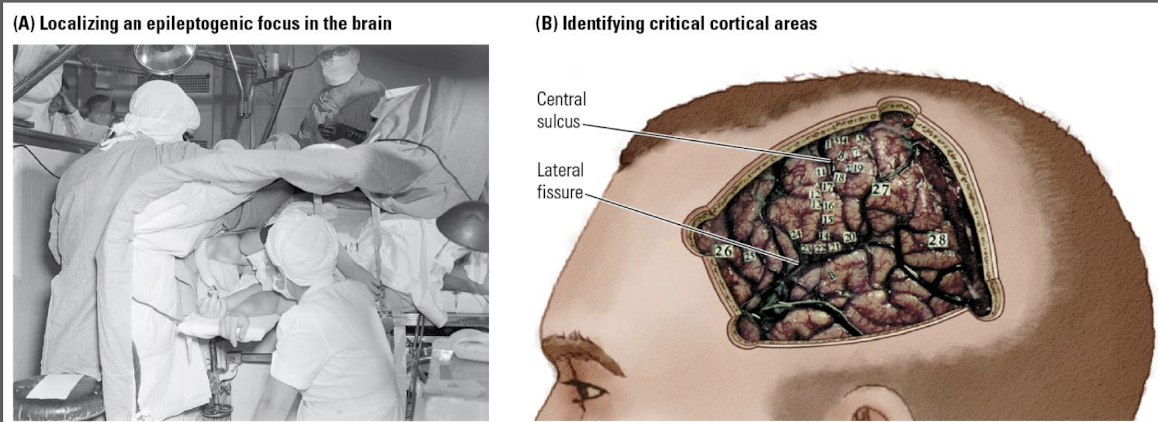
prep : map out speech & motor control areas before surgery to avoid damage to those areas
→ planning studies like the one mentioned & brain stimulation found:
some fxns (motor control & sensation) are symmetrical
thus removing one side of the cortex doesn’t rly affect it
some fxns are asymmetrical (language)
R hemisphere has increased perceptual fxns (combing info to create full perceptual picture)
stimulating L frontal or temporal lobes : facilitates speech production
stimulation can block fxns when the subject is using that brain region to perform a task
Identifying Speech & movement areas
placed electrodes (in awake pt) to stimulate/ record activity → used to identify areas of the brain and their fxn
Patients w Lateralized Lesions : Double Association
Lateralized lesions = lesions on one side of the brain
lesions can be caused by stroke, surgery or other brain injuries
Double Association = an experimental technique used to show the association of a particular fxn to a particular brain region
process: compares 2 pts with lesions in diff regions of the brain & looks at 2 diff deficits in functions (ex. reading and writing)
ex. a double dissociation b/w reading and writing means that reading & writing must be done in diff areas
shown by: when 1 pt has impaired reading but not writing, while the other pt is impaired in writing but not reading
impairment in reading (not writing) would be assoc w the brain region damaged in the 1st pt
impairment in writing (not reading) would be assoc w the brain region damaged in the 2nd pt

Commissurotomy Patients
Epilepsy = from over excitation of neurons, which can begin in once hemisphere and spread to the other via the corpus callosum
Commissurotomy = cuts the corpus callosum & anterior commissure to prevent to spread of seizure activity across hemispheres
a corpus callostomy is a type of this
initial behavioural results : good clinical outcome (reduced seizure activity) + no obvious behavioural changes
closer inspection : behavioural changes become apparent
→ this provided info abt the organization of brain fxns
Commissurotomy Patients : Effects
→ 2 hemispheres are split & can act independently - creates 2 separate experiences/views of the world
cortical connections w sensory & motor systems and their bodily receptors and effectors are Unaffected

→ experimental application : researchers can control which hemisphere visual info goes to & then observe the result
normally, : visual & auditory info is presented to both hemispheres independently
info in L visual field → R hemisphere
info in R visual field → L hemisphere
note: eye movements usually enable info directly in from of the subject to be processed by both hemispheres (takes time tho)
→ brief presentation in only the L or R visual field presents the info to a single hemisphere & bc of the commissurotomy that info cannot be shared w the other hemisphere
ex. present an image of a women in L field & name “Anne” in R field
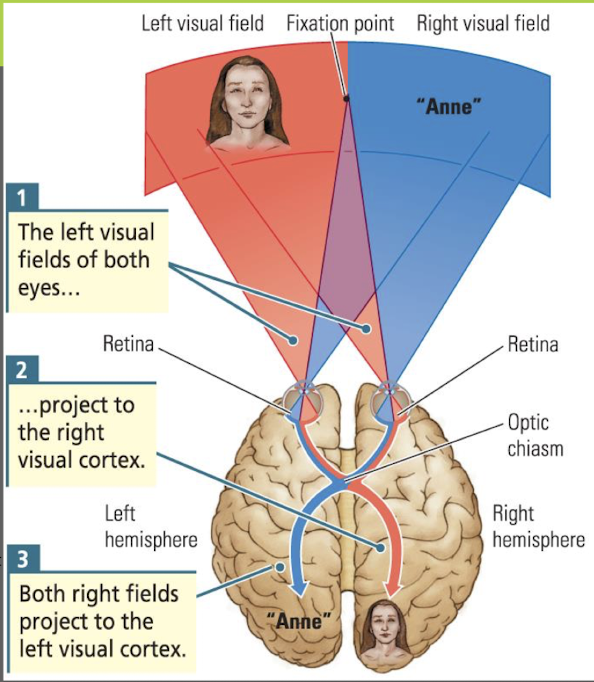
w/o split : subject combines name & the lady
w split : anne or lady w NO connection
ex. present “key” in L visual field

w/o split : L visual input is sent to R hemisphere then to L hemisphere via corpus callosum
w split : L visual input is sent to R hemisphere (isn’t sent to L hemisphere)
Split-Brain Patients
info in R visual field : presented to L hemisphere
CAN verbalize what they saw (bc sent to L hemisphere for lang)
CAN identify what they saw on R w R-hand ( L hemisphere → R body)
info in L visual field : presented to R hemisphere
CANT verbalize seeing anything (bc it doesn’t specialize in lang)
can identify what they saw on L with L-hand (R hemisphere → L body)
However, when asked to explain their hands selection the L hemisphere (verbal) interprets the choice of the L-hand & MAKES UP A REASON
sometimes they dont know that they’re making up an excuse

Split-Brain Patients : The interpreter example

see R side : L brain can assoc + verbalize why
thus, L hemisphere sees milk → sends to R-hand to select cow
see L side : R brain can assoc, but CANT verbalize why
thus, R hemisphere sees beach → send to L-land to select beachball
still makes assoc, but cant verbalize or write why bc its only sent to the R-hemisphere which ISNT for lang
Split-Brain Patients : Facial Recognition
→ not just vision is affected by split-brain
visual recognition of faces : pts choose face seen on L visual field → sent to R hemisphere
vocal naming of a face : pts choose face seen on R visual field → sent to L hemisphere where it CAN be verbalized → sent to R-hand to select
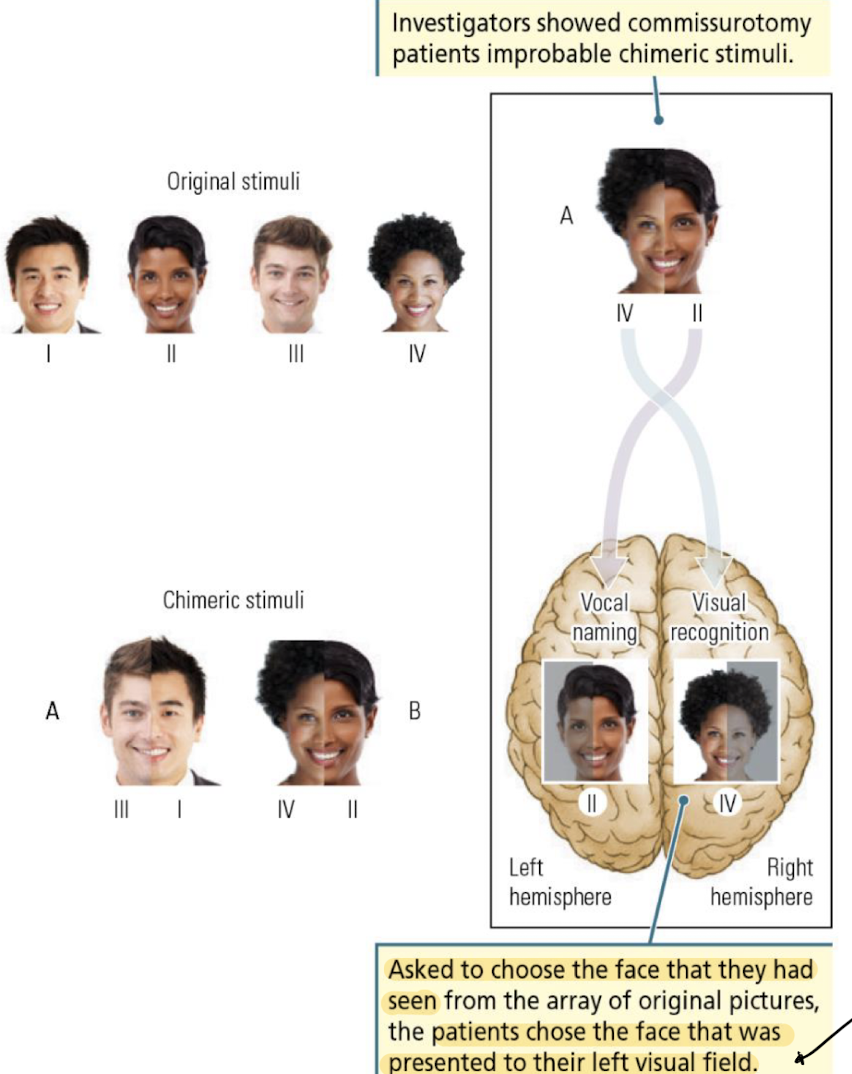
note: the switching b/w L-hemisphere to R body & vice versa occurs in the hind brain which is uncut in this procedure
Debate:
split brain pts get one consciousness in ONE of the hemispheres
or
get 2 DIFF consciousnesses ( 1 in each hemisphere)
note: see more extremes in behaviour w pts having done a full cumissurotomy
ex. arms doing opposite movements like pulling up and down they’re pants
Carotid Sodium Amobarbital Injection : WADA Test
= injecting sodium amobarbital into the carotid artery will briefly anesthetize the ipsilateral (same side) hemisphere → clinicians can check for impairments of speech & language & other cog functions
see behavioural changes within seconds of injection (wears off)
practical application: before brain surgery its important to confirm which hemisphere is the lang hemisphere for a pt
for most ppl lang is localized to the L hemisphere (both L & R-handed ppl)
→ can use this test to check which hemisphere, when anesthetized, impacts lang more
results:
98% of R-handers have lang on L hemisphere
70% of L-handers have lang on L hemisphere
30% of l-handers have lang NOT in the L hemisphere
Asymmetry in the Auditory System
→ auditory system is LESS differentiated (less segregation of info b/w fields) than the visual system
Dichotic-listening task = present diff stimuli to the L and R ears, then asks the subject to recall the info presented
lang stimuli presented to the R ear are MORE memorable
goes to L hemisphere (more lang specialized)
melodies presented to the L ear are MORE memorable
goes to R hemisphere (more hearing spec)
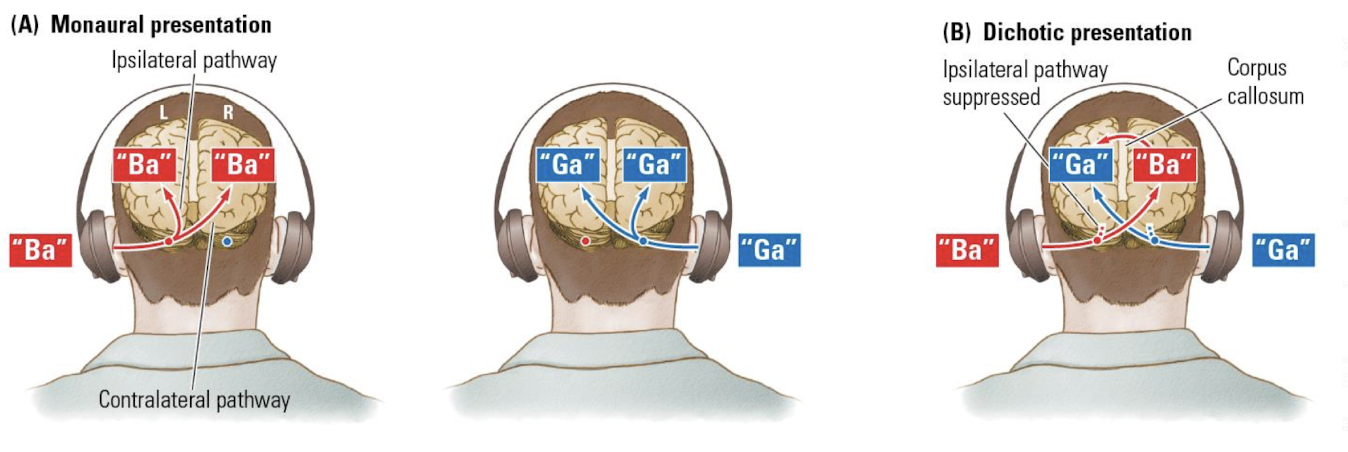
Kimura’s Dichotic Listening Model = tests how with monaural presentation to an ear the ipsilateral pathway in the brain allows the sound to be sent to both hemispheres, however w dichotic presentation (both ears) the ipsilateral pathway is suppressed and each hemisphere focuses only on the sound from the opposite ear
Monaural presentation :
sound at L ear → sent to R-hemisphere & L-hemisphere via ipsilateral pathway (thus they can verbalize what was heard)
sound at R ear → sent to L-hemisphere (can verbalize) & to R-hemisphere via ipsilateral pathway
→ even w the corpus callosum cut, both hemispheres are sent the auditory info via the ipsilateral pathway
Dichotic Presentation = present a diff sound at each ear at the same time → hemispheres focus on only the sound from the opp. ear bc the ipsilateral pathway is suppressed.
sound at L ear → sent only to R-hemis
sound at R ear → sent only to L-hemis
Asymmetry in the Somatosensory System
→ somatosensory input (touch, feel) is almost completely CROSSED :
L hand → R-hemis : recognizes patterns & shapes (ex. braille)
R hand → L-hemis : recognizes letters easier
research:
left-hand advantage to reading braille - bc of the R-hemispheres specialization in recognizing & processing patterns
right-hand advantage for recognizing letters - bc sent to L-hemisphere where lang is localized
left-hand advantage for recognizing other shapes - bc sent to R-hemisphere
THUS, recognizing braille seems to be MORE reliant on R-hemis’s pattern processing than L-hemis’s lang → thus L-hand is better for braille
Asymmetry in the Motor System
→ motor system has less clear asymmetry, however… damage to the L-hemisphere motor regions results in apraxia
Apraxia = loss of skilled fine movements
thus, those w poor fine motor skills (apraxia) may have damage to the L-hemis motor regions
note: diff sensory inputs being sent to the 2 hemispheres may influence how we interpret the roles of the L vs R hemispheres motor regions
→ results In questioning whether the differences observed are a result of the motor systems being diff on the two sides, OR if its bc the sides were reacting to diff sensory info.
→ to understand hemispheric differences in motor control we use: direct observations & interference effects
understanding hemispheric differences in motor control : direct observations
findings:
the 2 hemispheres play a complementary role in controlling movements based on native hand preference
mouth movements start on the R side of the face : controlled by L-hemisphere
stronger display of emotions on the L side of the face : bc of R-hemisphere specialization in emotions
understanding hemispheric differences in motor control : Interference tasks
findings:
different behaviours disrupt specific hands when playing the piano
note: had them play diff songs w each hand to see which was impacted
→ R-hand is disrupted by speaking : bc L-hemis is focusing on lang instead
→ L-hand is disrupted by humming : bc R-hemis is trying to identify sound
as we learn motor skills they become automatized, thus require less conscious attention → LESS impacted by interference effects
ex. a long-time pianist can easily keep playing while holding a conversation bc playing has become automatized
What do Laterality Studies tell us?
many are indirect measures of brain function
results of these are subject to interpretation
many researcher encourage skepticism when look at the field of laterality research
ex. some laterality effects, like dichotic listening, can be negated by telling the subject to focus on verbal info presented to the L ear
Role of Neuroimaging in Studying Asymmetry
→ brain-imaging studies support the asymmetries found in behavioural studies of neurological pts & intact brains
Types of neuroimgaing used:
PET
FMRI (the best)
changes in blood flow velocity in the brain
→ these tasks are less invasive than traditional tasks (Wada test), BUT brain imaging is expensive
findings:
PET & FMRI studies show a L-hemis lateralization for language
also supported by MORE blood flow in L-hemis during speaking tasks
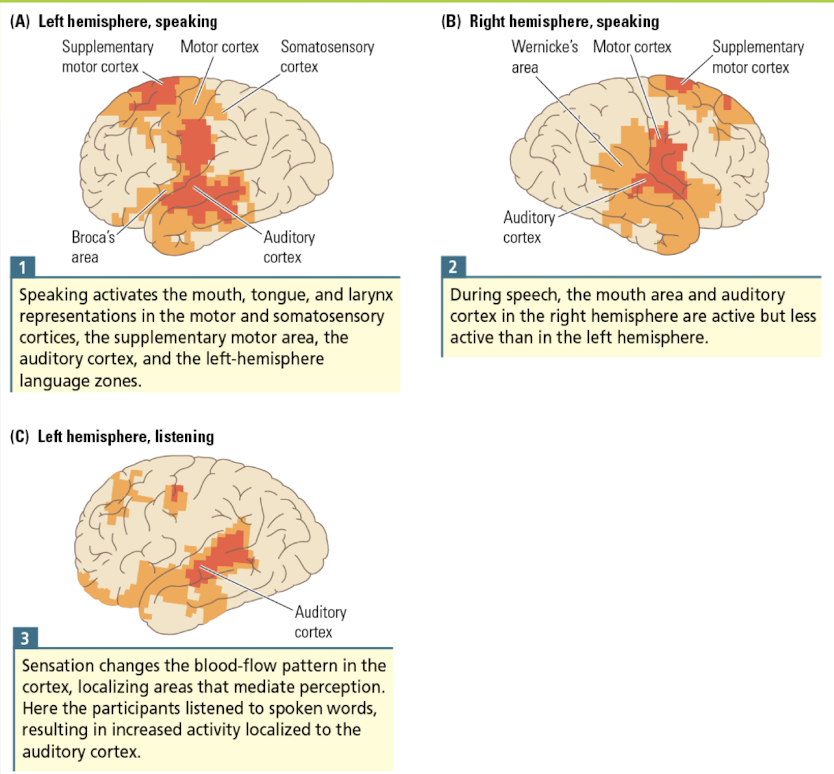
Specialization Theories of Lateralization
Specialized theories = suggest diff hemispheres have UNIQUE functions
says:
that the L-hemis is specialized for fine motor control, and that this is why speech is localized to the L-hemis bc fine motor is necessary for speech
that the L-hemis is good at rapid temporal processing which is integral to language
that the L-hemis is organized w many focal centres, while the R-hemis is more diffusely organized
→ all models are based on inference w little research to support them
Interaction Theories of Lateralization
Interaction theories = suggest that one hemisphere may be better at a task BUT they both cooperate in performing that task
→ both hemispheres are involved in a task, but one hemisphere is better
say:
the 2 hemispheres both work on diff parts of processing at the same time
both hemispheres may have the ability to perform the task, BUT one inhibits or suppresses the activity of the other
1 hemisphere receive info preferentially/ pays attention to the info preferentially and therefore performs a specific type of analysis of that info
Preferred Cognitive Mode
Cognitive Mode = individual differences will cause ppl to use one type of thought process instead of another
ex. some ppl prefer logic and math, while others prefer looking at the big picture
→ its possible that factors other than lateralization of brain fxns influence cognitive mode (using one type of thought process over another)
Cognitive Set = biases in how individuals approach problems
this can influence the results of tests of lateralization
Asymmetry in NONhuman animals
→ asymmetry is present throughout the animal kingdom
frogs & salamanders : vocalization is left lateralized
many birds : L-hemis specialization for song production (not all birds)
bees : lateralization in learning odors associated with reward & in remembering associations
chimpanzees : asymmetries in the homologues of Broca’s area & planum temporale (mimic those observed in humans)
primates : R-hemis is specialized for rapid unimanual (1-sided) movements & the L-hemis is specialized for whole-body (2-sided) movements