Processing information and making decisions
 Call Kai
 Learn
Learn Practice Test
 Spaced Repetition
 Match
Match Flashcards
 Knowt Play
1/16

There's no tags or description
Looks like no tags are added yet.
Name | Mastery | Learn | Test | Matching | Spaced | Call with Kai | Chat |
|---|
No analytics yet
Send a link to your students to track their progress
17 Terms
Objectives
The information processing approach for understanding motor performance
The stages that occur during information processing
Various factors that influence the speed of information processing
The role of anticipation in hastening the speed of responding
Memory systems and their roles in motor performance
Information-processing approach
Researchers have found it useful to think of the human being as a processor of information (like a computer)
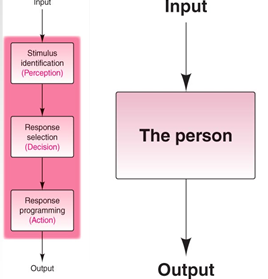
Input to information processing to response to output

Three stages of information processing
Stimulus identification
Response selection
Response programming
Reaction Time (RT)
It is an important performance measure indicating the speed and effectiveness of decision making
RT interval is a measure of the accumulated duration of the three stages of processing

Factors that influence reaction time
Number of possible stimuli
Practice
Response compatibility
Number of stimulus-response alternatives
It is a factor that influences RT
RT is the time required to detect and recognize the stimulus and select and initiate the proper response
Hick’s law: The more choices a person has, the longer it takes them to choose a response

Number of stimulus-response alternatives #2
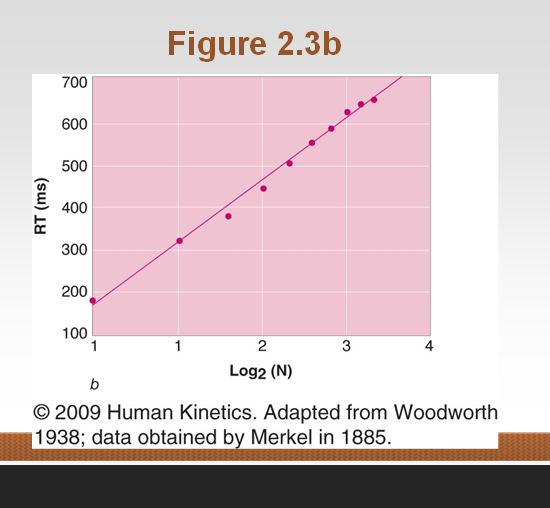
Hick’s law in-depth
There is a stable relationship between the number of stimulus-response options and choice reaction time. As the number of S-R pairs increases, choice reaction time increases in a linear fashion
Stimulus-response compatibility
It is the extent to which the stimulus and the response it evokes are connected in a natural way

Population Stereotypes
It is a type of stimulus-response compatibility
Anticipation
It is one way in which leaners cope with long RT delays
A performer can organize movements in advance
Types of Anticipation
Spatial-the ability to anticipate performance movement
Temporal-the ability to predict the time course of an event
Benefits of anticipation
A correct anticipation can result in the processing lag equivalent to RT = 0ms
One factor that affects the capability to predict effectively is the regularity of events
Strategies for preventing anticipation
Anticipation is best with randomization(keep movements unpredictable)
Anticipation is best if opponent anticipates incorrectly and pays extra movement cost
Short-Term sensory store
It is responsible for storing vast amounts of sensory information only long enough for some of it to be abstracted and further processed
Short-Term Memory
Composed of a temporary workspace where relevant information is processed
Information may be retrieved, rehearsed, processed and transferred
A small amount of information may be held, which uses 7 plus or minus 2 items or chucks(try to remember numbers)
Long-Term Memory
Characterized as having unlimited capacity and duration
Information reaches LTM through effortful processing of information in STM, which transfer it to LTM
The lost mariner