3.1.3 Transport in Plants
 Call Kai
 Learn
Learn Practice Test
 Spaced Repetition
 Match
Match Flashcards
 Knowt Play
1/23

There's no tags or description
Looks like no tags are added yet.
Name | Mastery | Learn | Test | Matching | Spaced | Call with Kai | Chat |
|---|
No analytics yet
Send a link to your students to track their progress
24 Terms
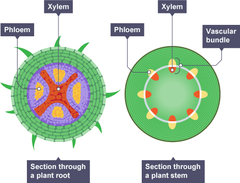
Draw a labelled diagram of a transverse section of a plant root and a plant stem. (5 marks)
and then the cambium sits in between the xylem and phloem
Define the vascular bundle in plants. (2 marks)
- The vascular bundle is made of xylem and phloem tissues, which transport water and assimilates such as sucrose.
- It is found in roots, stems, and leaves.
Describe the arrangement of vascular bundles in roots. (3 marks)
- In roots, the xylem is at the centre, forming a star shape with 3-6 spokes.
- The phloem is located between each spoke of the xylem.
- This arrangement differs from that found in stems and leaves.
Describe the arrangement of vascular bundles in stems. (3 marks)
- Stems have several vascular bundles, each containing xylem and phloem.
- Xylem is on the inner side of each bundle, closest to the stem's centre.
- Phloem is on the outer side, with cambium in between containing actively dividing cells.
Describe the arrangement of vascular bundles in leaves. (2 marks)
- Vascular bundles run through the centre of leaves as veins.
- In each bundle, xylem is towards the top of the leaf, and phloem towards the bottom.
Draw a labelled diagram of the structure of phloem tissue. (6 marks)
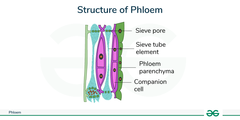
Explain the function and structure of phloem. (4 marks)
- Phloem transports assimilates like sucrose and amino acids from photosynthesis, in a process called translocation.
- It is made of sieve tube elements that are long, thin, and arranged end to end, with perforated end walls.
- Sieve tube elements are living but have no nucleus and few organelles to reduce resistance to flow.
- Companion cells next to them provide ATP for active transport of organic substances.
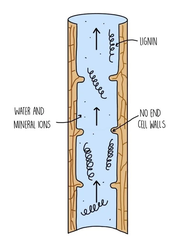
Describe the structure and function of xylem. (3 marks)
- Xylem vessels are dead, hollow cells without organelles or end walls.
- They form continuous tubes for transporting water and mineral ions.
- Their walls are strengthened with lignin for waterproofing.
Draw a labelled diagram of the structure of xylem tissue. (6 marks)
Define transpiration and describe how plants control it. (4 marks)
- Transpiration is the evaporation of water through stomata, mainly on leaves.
- Guard cells control stomatal opening by swelling when turgid, opening the pore.
- When water is scarce, guard cells become flaccid and close the stomata.
- Stomata open more when light is present.
Explain how environmental factors affect transpiration rate. (4 marks)
- Higher temperature increases kinetic energy of water molecules, speeding evaporation.
- Low humidity increases the concentration gradient, increasing water loss.
- Wind moves away humid air, speeding transpiration.
- Greater evaporation rate occurs with higher light levels.
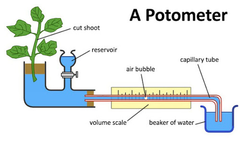
Explain how a potometer is used to measure transpiration rate. (5 marks)
1. The plant is cut underwater to avoid air entering the xylem.
2. It is sealed into the potometer with petroleum jelly to make it airtight.
3. The movement of an air bubble in the tube shows water uptake.
4. Distance moved over time is measured to calculate rate.
5. Environmental conditions like light or wind can be altered to test effects.
Draw a labelled diagram of potometer apparatus. (6 marks)
Describe how water enters a plant. (2 marks)
- Water enters root hair cells by osmosis.
- Root hair cells are adapted with thin walls and a large surface area.
Explain how water moves from roots to the xylem. (3 marks)
- Water moves via the symplast pathway through cytoplasm and plasmodesmata.
- Or via the apoplast pathway through plasmodesmata in cell walls.
- In the symplast pathway, water moves from cell to cell down a water potential gradient by osmosis.
Describe the apoplast pathway. (3 marks)
- The apoplast pathway moves water through the cell walls.
- Water molecules stick together due to cohesive forces, creating a continuous stream that travels towards the xylem.
- This pathway is faster because it has little resistance to movement.
Explain what happens when water reaches the endodermis in the apoplast pathway. (2 marks)
- Water encounters the Casparian strip, a waterproof layer of suberin.
- This forces water to cross the plasma membrane, ensuring no toxins enter.
Describe the cohesion-tension theory for water movement in the xylem. (4 marks)
1. Water moves upwards from roots to leaves against gravity due to cohesion and adhesion.
2. Cohesion between polar water molecules is caused by hydrogen bonds.
3. Evaporation from the stomata lowers water potential in the leaves which creates tension/negative pressure, pulling water up from the xylem into the leaf cells up the water potential gradient via osmosis and narrowing the xylem.
4. Diameter changes in xylem vessels can be measured in relation to transpiration rates.
Describe adhesion in water transport. (3 marks)
- Adhesion occurs when water molecules stick to other surfaces via hydrogen bonds.
- In plants, water adheres to lignin in the xylem walls, aiding capillary action.
- Narrower xylem increases this effect, helping hold the water column against gravity.
Explain the mass flow mechanism for water movement up the xylem. (4 marks)
1. Water evaporates from stomata, lowering pressure in leaves.
2. This pulls more water up the xylem to replace it, creating negative pressure.
3. Cohesion between molecules forms a continuous column, and adhesion to walls supports it.
4. Tension from the pull makes the xylem narrower.
Describe adaptations of xerophytes to reduce water loss. (5 marks)
- Xerophytes grow in environments with limited water, such as deserts.
- Marram grass rolls its leaves to trap humid air and reduce transpiration.
- Stomata are sunken in pits and surrounded by hairs to trap moisture and reduce water potential gradient.
- They have thick, waxy cuticles to reduce evaporation.
- leaves reduced to spines reduces rate of transpiration conserving water due to the reduced surface area available
- rolled leaves expose the thick waterproof waxy cuticle to the air and creates a humid space in the middle of the rolled leaf
Describe adaptations of hydrophytes for living in water. (4 marks)
- Hydrophytes, like water lilies, grow in or on water.
- They have short roots as they can extract nutrients from the surrounding water through their tissues and thin or no waxy cuticle
- they have stomata on the upper surface of the leaves allows gas exchange to occur through the air rather than through water as water contains less carbon dioxide than oxygen
- Stomata remain open to allow gas exchange.
- Large leaves with air spaces (aerenchyma) help them float and access light.
Describe the mass flow hypothesis for organic substance transport. (3 marks)
- Organic substances like sucrose move from the source (production site) to the sink (use/storage site).
- Sucrose lowers water potential at the source, drawing in water by osmosis and raising hydrostatic pressure.
- At the sink, sucrose is used or stored, raising water potential and causing water to leave, lowering pressure.
Explain the process of translocation in the phloem. (6 marks)
1. Photosynthesis produces sucrose, creating high concentration at the source.
2. H⁺ ions are pumped out of companion cells via proton pumps creating an electrochemical gradient and are actively transported from companion cells into source cells.
3. H⁺ ions diffuse back into companion cells via carrier/cotransporter proteins, co-transporting sucrose.
4. Sucrose moves through plasmodesmata into sieve tube elements, lowering water potential.
5. Water enters from xylem by osmosis, raising hydrostatic pressure at the sieve tube elements at the source
this establishes a hydrostatic pressure gradient between the source and sink
7 . At the sink, sucrose is used or stored and so unloaded from the sieve tube elements, increasing water potential, so water leaves and hydrostatic pressure drops.